

In This Article
Here’s a conversation that plays out in living rooms and dedicated home cinema dens across Britain with uncomfortable regularity: someone spends a good chunk of money on a shiny new projector, pulls up a 4K Blu-ray, and thinks — is this really 4K? The box said 4K. The spec sheet said 4K. The Amazon listing definitely said 4K. And yet, something feels slightly… off.
This is the true 4K vs upscaled 4K projector question, and it matters far more than most people realise when they’re clicking “Add to Basket.”
In plain terms: a true 4K projector reproduces all 8.3 million pixels of a 4K image — every single one — either through native 4K imaging chips (as Sony and JVC use) or through ultra-fast pixel-shifting technology that achieves equivalent resolution output (as BenQ, Optoma, and Hisense do). An upscaled 4K projector, on the other hand, uses a 1080p or lower-resolution panel, accepts a 4K input signal, and then stretches that image to fill the frame. It’s the difference between a tailor-made suit and a shop-bought one let out at the seams — both technically cover you, but the fit tells a different story on a 120-inch screen.
What this means in practice: if you’re sitting two to three metres from a large projection screen in a semi-detached in Sheffield or a converted loft in Bristol, a true 4K image delivers visibly sharper, more textured detail — particularly on close-up faces, fine architecture, and high-contrast edges. Upscaled 4K is perfectly watchable, and on screens under 100 inches at normal viewing distances, the gap narrows considerably. But on larger screens in darkened rooms? Native and pixel-shifting 4K projectors have a genuine, demonstrable edge.
This guide covers seven real projectors currently available on Amazon.co.uk — spanning every budget tier from around £800 to over £5,000 — with honest analysis of where the true 4K premium is genuinely worth paying, and where clever upscaling technology closes the gap enough to save you several hundred pounds.
Quick Comparison: True 4K vs Upscaled 4K at a Glance
| Feature | True 4K (Native SXRD/D-ILA) | True 4K (DLP XPR) | 4K Pixel-Shift (3LCD) | Upscaled 4K |
|---|---|---|---|---|
| Pixel count | 8.3–8.8 million (physical) | 8.3M (via fast-shifting) | Approx. 4K output | 2.1M native |
| Sharpness on large screens | ★★★★★ | ★★★★☆ | ★★★☆☆ | ★★☆☆☆ |
| Typical UK price range | £5,000–£15,000+ | £800–£2,500 | £900–£2,500 | £500–£1,200 |
| Best for | Dedicated cinema rooms | Home cinema + gaming | Versatile living room | Budget/casual use |
| Example models | Sony VPL-XW5000ES | Optoma UHD38x, BenQ W2720i | Epson EH-TW7100 | XGIMI Horizon S Pro |
The table above makes the hierarchy clear, but the numbers don’t tell the full story. A DLP XPR “True 4K UHD” projector like the Optoma UHD38x or BenQ W2720i punches well above its price class — the pixel-shifting happens so quickly (roughly 1/120th of a second) that your eyes genuinely cannot distinguish it from native 4K at normal seating distances. The Sony and JVC native models, however, maintain a real advantage in high-contrast scenes with very fine detail — think the pores on an actor’s skin in a dark thriller, or the individual stone work on a Gothic cathedral in a BBC period drama. Worth the extra thousands? For most British living rooms — probably not. For a dedicated, light-controlled cinema room — absolutely.
💬 Just one click — help others make better buying decisions too! 😊
✨ Don’t Miss These Exclusive Deals!
🔍 Take your home cinema to the next level with these carefully selected projectors. Click any highlighted product to check current pricing and availability on Amazon.co.uk. These picks will help you find exactly what you need — whatever your budget and room setup.
Top 7 True 4K and Upscaled 4K Projectors on Amazon.co.uk — Expert Analysis
1. Optoma UHD38x — Best True 4K for Bright Rooms and Gaming
If you’ve got a living room that stubbornly refuses to go fully dark — sunlight creeping under the blinds, lamps that the household refuses to turn off — the Optoma UHD38x is probably the most practical true 4K projector you can buy in its price bracket. Its 4,000 ANSI lumens rating is genuinely useful, not marketing puffery; in a bright British living room on an overcast November afternoon, it holds its picture where rivals fade into washed-out grey.
The UHD38x uses Texas Instruments’ 0.47″ 4K UHD DLP chip with XPR pixel-shifting, delivering full 3,840 × 2,160 resolution output. Crucially, it hits just 4.2ms input lag at 1080p in Enhanced Gaming Mode and 16ms at native 4K — figures that make it genuinely competitive for console gaming. For PS5 and Xbox Series X owners who also want cinema-quality films, this is a rare dual-purpose performer. The 240Hz refresh rate support is the cherry on top for fast-motion content.
UK buyers should note that at this brightness level, you can realistically project onto a 120-inch screen without a fully blacked-out room — meaningful when British evenings are bright until 9 p.m. in summer. Several UK reviewers have specifically praised its performance during daytime Premier League matches.
UK customers consistently highlight its setup flexibility and how little tweaking is needed out of the box.
✅ Exceptional brightness for ambient-light environments
✅ Gaming-grade response times at 4K
✅ Strong HDR10 and HLG support
❌ Fan noise can be noticeable (up to 35dB) in quiet cinema rooms
❌ Colour accuracy requires calibration for cinema purists
Price range: around £1,100–£1,400 — excellent value for what is technically a true 4K, high-brightness, gaming-capable projector.
2. BenQ W2720i — What Hi-Fi Award 2025 Winner and the UK’s Favourite Mid-Range
The BenQ W2720i is the projector that tends to make other projectors feel slightly embarrassed about themselves. It won a What Hi-Fi? Award in 2025, which in British audio-visual circles is the equivalent of getting a Michelin star — hard to earn and even harder to argue with. It’s a 4K LED projector, which means no lamp to replace every two or three thousand hours, and a claimed 30,000-hour lifespan that makes running costs essentially negligible over a decade of movie nights.
The W2720i uses DLP XPR pixel-shifting to achieve 4K UHD output from its LED light engine, delivering 2,500 ANSI lumens alongside 90% DCI-P3 colour coverage. In practice, what this means for the viewer is a picture that is phenomenally sharp, three-dimensional, and rich — reviewers consistently describe it as having an almost “tactile” quality to dark scenes and skin tones. It also supports HDR10+ and Dolby Atmos pass-through, the latter being rather useful if you’ve invested in a soundbar or AV receiver.
For a UK family in a semi-detached with a dedicated media room or a large living room that can be adequately darkened, this is possibly the sweet spot of the entire projector market right now. It’s not the cheapest option, but it represents genuine, verifiable value.
UK reviewers applaud its out-of-the-box picture accuracy and whisper-quiet operation.
✅ What Hi-Fi? Award winner — independently verified excellence
✅ No lamp replacement costs — LED source lasts 30,000 hours
✅ HDR10+, Dolby Atmos pass-through, HDMI 2.1
❌ 2,500 lumens is adequate but not outstanding in very bright rooms
❌ Throw ratio limits flexible placement in very compact flats
Price range: around £1,400–£1,700 — strong long-term value given the LED lifespan and award-winning performance.
3. Hisense C2Tuk — Triple Laser True 4K at a Surprisingly Sensible Price
The Hisense C2Tuk deserves to be better known than it is. Hisense has been quietly building a strong reputation in the UK home cinema market, and the C2Tuk — a Trichroma triple-laser DLP projector with genuine true 4K UHD output — is perhaps their most compelling argument yet for being taken seriously alongside the established Japanese brands.
The triple-laser (red, green, blue) light engine is the crucial differentiator here. Unlike single-laser-and-phosphor designs, Trichroma covers 110% of the BT.2020 colour space — a specification that sounds technical until you watch a scene with a deep blue sky or saturated autumn foliage, at which point it becomes immediately, viscerally apparent. The projector manages around 2,100 ISO lumens of accurate colour, supports HDR10 and HLG, and delivers the kind of natural, filmic colour rendering that you’d normally pay considerably more to achieve.
For British consumers, there’s an important practical note: the C2Tuk is the UK-specific model variant, supplied with a UK Type G plug and 230V compatibility. No adaptor faff, no voltage converter required. The relatively compact chassis (smaller than many traditional home cinema projectors) is a genuine asset in the typically modest spaces of British homes — it fits tidily on a shelf or media cabinet without dominating the room.
Tested across multiple UK review outlets, its colour accuracy has drawn consistent, enthusiastic praise.
✅ 110% BT.2020 Trichroma triple-laser — outstanding colour fidelity
✅ UK-specific model with correct plug and voltage
✅ Compact form factor suits smaller British rooms
❌ Native contrast isn’t as deep as Sony or JVC alternatives
❌ Less established UK service network than Epson or Sony
Price range: around £1,200–£1,500 — outstanding colour performance at a competitive price point.
4. BenQ GP520 — The Budget True 4K That Actually Delivers
The BenQ GP520 occupied an interesting gap in the market when TechRadar named it their “best budget 4K” pick after hands-on testing in 2025: a genuinely true 4K UHD projector (via DLP XPR) at a price point where most rivals are still pushing pixel-shifted 1080p and hoping you won’t notice. With 2,600 ANSI lumens and full HDR10 and HLG support, it’s a well-rounded package for someone stepping up from a 1080p projector for the first time.
The GP520’s party piece — beyond the price — is its built-in Dolby Atmos sound system, which is significantly more capable than the tiny speakers typically shoved into budget projectors. For a casual film evening without a full AV system connected, it’s surprisingly capable. The connectivity is comprehensive too: two HDMI ports (one 2.0, one 2.1), USB, and wireless streaming support.
What the spec sheet won’t tell you is that the GP520 is a forgiving projector to set up. The auto-keystone and adequate zoom range make it accessible for first-time projector buyers who don’t want to spend an evening with a spirit level and a measuring tape. For a UK household dipping its toes into proper home cinema without committing five figures, this is the sensible starting point.
UK buyers report easy setup and genuinely impressive sharpness at this price.
✅ True 4K UHD output at an accessible price
✅ Built-in Dolby Atmos — more capable than expected
✅ First-timer friendly setup
❌ 2,600 lumens limits large-screen use in bright rooms
❌ Less manual placement flexibility than pricier rivals
Price range: around £800–£1,000 — the most affordable route to genuine true 4K performance.
5. Sony VPL-XW5000ES — Four Years Running as the Reference Native 4K Standard
The Sony VPL-XW5000ES has now won a What Hi-Fi? Award for four consecutive years. Four years. In a category that moves as quickly as home cinema projection, that is an almost preposterous achievement — and a useful shortcut for anyone who simply wants to know which premium projector to buy without wading through a hundred specification sheets.
This is native 4K in the truest sense: Sony’s SXRD (Silicon X-tal Reflective Display) chip physically contains 8.3 million individual pixels, with no wobbling, no shifting, no algorithmic approximation. The result on a 150-inch screen in a properly darkened room is genuinely cinematic — the kind of image that makes you forget you’re looking at a projected picture rather than an illuminated window. Frame Adapt HDR processes tone mapping on a frame-by-frame basis; Reality Creation sharpening adds perceptible texture without introducing artificial edge enhancement. The laser light source sits at around 2,000 lumens — modest on paper, but extraordinarily accurate in measured output.
At around £5,500–£6,500 on Amazon.co.uk, the XW5000ES is not a casual purchase. But for a dedicated home cinema room — perhaps that loft conversion or basement project that finally came together — it represents the point at which projector performance stops being a compromise and starts being a genuine alternative to commercial cinema. UK reviewers consistently place it at the apex of the sub-£10,000 projector market.
✅ Physically native 4K SXRD — no pixel-shifting whatsoever
✅ Frame Adapt HDR and Reality Creation are class-leading
✅ Four consecutive What Hi-Fi? Award wins
❌ Requires a dedicated, light-controlled room to justify the premium
❌ Price puts it well beyond most casual home cinema budgets
Price range: around £5,500–£6,500 — the reference standard for serious UK home cinema buyers.
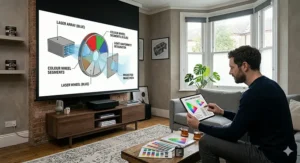
6. Epson EH-TW7100 — The Best Upscaled 4K Projector Worth Considering
Here is the honest truth about the Epson EH-TW7100: it is not a true 4K projector. Epson calls its technology “4K PRO-UHD,” which is a polished bit of marketing language for a proprietary pixel-shifting system that uses 1080p 3LCD panels and shifts each pixel diagonally to produce an approximated 4K image. And yet — and this is the important bit — for a large portion of UK buyers, it doesn’t particularly matter.
The EH-TW7100 produces a genuinely impressive image. At 3,000 ANSI lumens it is one of the brighter home cinema projectors in this price range, making it more tolerant of the ambient light reality of most British living rooms. The 3LCD technology eliminates the “rainbow effect” that some viewers (particularly those sensitive to it) notice with DLP projectors — a meaningful advantage for multi-hour film marathons. The motorised lens shift and zoom offer genuine installation flexibility, which matters enormously when you’re working around a British sitting room with a bay window, a sofa that can’t be moved, and a ceiling height that isn’t quite what you’d specify from scratch.
For a household spending evenings watching Netflix, Amazon Prime, and the occasional 4K Blu-ray on a 100–120 inch screen, the EH-TW7100 delivers a picture that most viewers will find perfectly satisfying. The sharpness gap versus true 4K is real but modest at typical viewing distances. Where it falls short is on very large screens (150 inches+) in fully darkened rooms, where the pixel-shift interpolation becomes visible on fine detail patterns.
UK buyers frequently cite its reliable performance and helpful motorised lens controls.
✅ 3,000 lumens handles ambient light well in British living rooms
✅ 3LCD — no rainbow effect, excellent colour uniformity
✅ Motorised lens — far easier to place in awkward UK room layouts
❌ Not true 4K — pixel-shift 3LCD is a genuine, if modest, step down in resolution
❌ Lamp-based — replacement bulbs are an ongoing cost (check UK availability)
Price range: around £1,200–£1,500 — a compelling proposition if brightness and placement flexibility matter more than absolute sharpness.
7. XGIMI Horizon S Pro — Smart Upscaled 4K for the Modern British Flat
The XGIMI Horizon S Pro occupies a category that didn’t really exist five years ago: the intelligent lifestyle projector. It’s smart, compact, Dolby Vision compatible, and ships with a built-in Android TV interface that means you can genuinely unbox it, place it on a coffee table, and be watching Netflix in under five minutes. For a rented flat in Manchester or a compact terrace in Cardiff where wall-mounting is not an option, that frictionlessness has real value.
Technically, the Horizon S Pro uses a 1080p native LED light engine with pixel-shifting to approximate 4K UHD output — so yes, it belongs firmly in the “upscaled 4K” category. The 1,800 ISO lumens rating is honest (ISO lumens, measured with full colour, are more meaningful than the inflated ANSI figures many rivals quote), and Dolby Vision support genuinely improves HDR performance beyond what the raw specs might suggest. The built-in 2 × 12W Harman Kardon speaker system is the best audio you’ll hear from a projector at this price — genuinely room-filling for casual viewing.
What you sacrifice versus true 4K on larger screens: fine texture on close-up detail, slight softness on high-contrast edges. On a 90–100 inch screen at normal viewing distances, most viewers won’t notice. On a 120-inch screen in a dark room, the gap to the BenQ W2720i becomes more apparent.
UK reviewers consistently praise the out-of-the-box experience and Dolby Vision performance.
✅ Dolby Vision — strong HDR on streaming content
✅ Built-in Android TV + Harman Kardon speakers — genuinely all-in-one
✅ Compact, no-fuss setup ideal for smaller UK homes
❌ 1080p native — not true 4K; sharpness gap is visible on larger screens
❌ 1,800 ISO lumens can struggle in brighter UK summer evenings
Price range: around £900–£1,100 — the best smart all-in-one option for urban UK lifestyles.
How to Choose a True 4K vs Upscaled 4K Projector in the UK: A Practical Framework
Choosing the right projector is, more than almost any other home cinema decision, a question of matching the technology to your specific room — not chasing the most impressive specification on the box.
- Assess your screen size first. Below 100 inches at a typical 3-metre viewing distance, the true 4K premium shrinks considerably. Above 120 inches in a dark room, it becomes clearly apparent. Know your screen before your shortlist.
- Measure your ambient light realistically. British living rooms are not American home cinema basements. If you watch with curtains rather than blackout blinds, prioritise projectors rated at 2,500+ ANSI lumens — specifically, the Optoma UHD38x and Epson EH-TW7100 among our seven picks.
- Factor in room geometry. UK homes are typically smaller and less geometrically convenient than their American equivalents. Motorised lens shift (the Epson EH-TW7100) and flexible zoom ratios matter more than most reviews acknowledge.
- Consider your primary use case. Gaming demands low input lag (below 16ms at 4K) — the Optoma UHD38x leads here. Cinematic film watching rewards native contrast and colour accuracy — the Sony XW5000ES and Hisense C2Tuk excel. Casual everyday viewing just needs reliability and ease of use — the XGIMI Horizon S Pro and BenQ GP520 are most appropriate.
- Think about running costs. Lamp-based projectors (including the Epson EH-TW7100) require bulb replacements every 3,000–5,000 hours, costing £80–£200 per replacement. LED and laser sources (BenQ W2720i, Sony XW5000ES, Hisense C2Tuk) eliminate this cost entirely — a meaningful factor over five to ten years of UK ownership.
- Check UK-specific compatibility. All seven projectors in this guide ship with UK Type G plugs and operate on 230V/50Hz. Some US-imported models don’t — a source of nasty surprises on Amazon.co.uk marketplace listings. Stick to products sold and fulfilled by established UK retailers.
- Budget for a proper screen. This is the piece of advice that projector reviews routinely skip. Projecting onto a painted wall in British conditions — with subtle texture variations from the damp that comes with our climate — costs you more in visible picture quality than the difference between a good and great projector. A basic fixed-frame screen (around £150–£300 on Amazon.co.uk) transforms any of these projectors. It’s the single best value upgrade available.
What to Expect: Real-World Performance of 4K Projectors in British Conditions
British conditions are unkind to projectors in ways that North American or Southern European reviews don’t fully account for, and it’s worth being direct about this.
Ambient light is your primary enemy. Even with good blinds, British summer evenings — with sunlight persisting past 9 p.m. in June and July — create projected image washing that a 2,000-lumen projector simply cannot overcome. If your room doesn’t have blackout solutions, prioritise 3,000+ lumen models. The Optoma UHD38x’s 4,000 lumens is notably more practical in these conditions than the Sony XW5000ES’s 2,000 lumens, despite the Sony’s vastly superior native image quality in a properly dark room.
Humidity and temperature cycling matter for lamp life. The damp that characterises British autumns and winters — particularly in older Victorian and Edwardian properties that dominate much of the UK’s housing stock — can accelerate lamp degradation in traditional bulb-based projectors. LED and laser sources (BenQ W2720i, Hisense C2Tuk, BenQ GP520, Sony XW5000ES) are dramatically more resilient to temperature and humidity fluctuations. If your dedicated cinema room is in a basement or a garage conversion — common in British homes — this is not an academic consideration.
Fan noise in quiet rooms. At 3 p.m. in a bright room, fan noise is irrelevant. At 10 p.m. watching a quiet dramatic scene, a 35dB projector becomes genuinely noticeable. Of our seven picks, the BenQ W2720i (whisper-quiet LED) and Sony XW5000ES (laser) are the quietest. The Optoma UHD38x at full brightness is the loudest — worth considering if you’re sensitive to background noise.
Ceiling mounting in British homes. The typical ceiling height in UK properties (around 2.4 metres, occasionally less in older homes) can create installation challenges for projectors with restricted throw ratios. The Epson EH-TW7100’s motorised lens shift is especially valuable here — it allows much greater positional flexibility than fixed-lens alternatives. Measure twice, buy once.
True 4K vs Upscaled 4K: The Honest Long-Term Cost Comparison in GBP
The upfront price is only part of the story. Over five to seven years of regular use — say, four evenings a week at two hours per session — a projector accumulates roughly 2,000–3,000 hours annually.
| Projector | Technology | Lamp Replacement? | Estimated 5-Year Extra Cost |
|---|---|---|---|
| Sony VPL-XW5000ES | Native 4K Laser | None | £0 |
| BenQ W2720i | True 4K LED | None | £0 |
| Hisense C2Tuk | True 4K Laser | None | £0 |
| BenQ GP520 | True 4K DLP | None | £0 |
| Optoma UHD38x | True 4K DLP (lamp) | Yes | £180–£400 |
| Epson EH-TW7100 | 4K Pixel-Shift Lamp | Yes | £160–£350 |
| XGIMI Horizon S Pro | Upscaled LED | None | £0 |
The Optoma UHD38x and Epson EH-TW7100 are both lamp-based, which means factoring in replacement bulb costs over a five-year ownership period. UK replacement lamps for both models are available on Amazon.co.uk, typically in the £60–£120 range each. For the Optoma UHD38x specifically, at 4,000 lumens it burns through lamps faster in full-brightness mode — dropping to eco mode extends lamp life significantly and reduces the total cost of ownership. For the LED and laser alternatives, this entire calculation disappears.
The broader insight here is that a mid-range true 4K laser projector like the BenQ W2720i, while more expensive upfront than the Epson EH-TW7100, could work out comparably priced — or even cheaper — over five years of regular use, once lamp replacement costs are factored in. Worth running the numbers before defaulting to the cheaper initial price.

Common Mistakes When Buying a 4K Projector in the UK
Mistaking “Supports 4K Input” for “True 4K Output”
This is the single most common — and most expensive — mistake in the projector market. Scores of projectors on Amazon.co.uk, particularly in the £300–£700 range, are marketed with “4K support” or “4K compatible” language that means they will accept a 4K signal from your PS5 or Blu-ray player, downscale it to 1080p or even 720p natively, and project that downscaled image. This is not 4K. It is 4K-shaped disappointment. True 4K UHD output requires either native 4K chips or properly implemented pixel-shifting technology — all seven projectors in this guide deliver this; many cheaper alternatives emphatically do not.
Buying a US Model on Amazon.co.uk Marketplace
Amazon.co.uk’s third-party marketplace includes sellers shipping US-spec projectors into the UK. These may arrive with Type A/B plugs (requiring an adaptor), 110V/60Hz power supplies (requiring a converter, or risking damage on UK mains), and — crucially — US warranties that offer zero consumer protection under the Consumer Rights Act 2015 or the Consumer Contracts Regulations. Always verify that the product is sold by a UK-authorised retailer and ships from UK warehouse stock.
Ignoring the Screen Situation
A projector paired with a bare painted wall is like a sound system plugged into a Bluetooth speaker — functional, but significantly below its potential. British walls — often covered in textured emulsion, not matte white — introduce grain, colour shifts, and hotspotting that a proper projection screen eliminates. Budget at least £150–£200 for a basic fixed-frame or pull-down screen when calculating your total outlay.
Underestimating Installation Complexity
Unlike a television, projectors require alignment, focusing, keystone correction, and often some form of cable management. In a UK rented property, ceiling mounting may not be permitted under your tenancy agreement. Consider shelf placement (using the projector’s zoom range) or a dedicated furniture mount. The XGIMI Horizon S Pro’s table-top design is specifically engineered for this scenario.
JVC 4K vs Epson 4K: A Tale of Two Very Different Philosophies
When enthusiasts argue about the best 4K projector technology, the JVC D-ILA versus Epson pixel-shift debate is one of the most illuminating — and it cuts to the heart of the true 4K vs upscaled 4K question.
JVC’s D-ILA projectors — represented at the accessible end of their range by models around the £5,000–£8,000 mark — use native 4K imaging devices with physically distinct 4,096 × 2,160 pixel arrays. The native contrast ratios they achieve (40,000:1 or higher) are simply unattainable for any DLP or LCD technology. In a dark room, watching a film with deep shadows and pinpoint highlights — a Villeneuve science fiction film, a Kubrick restoration — a JVC D-ILA image looks genuinely different from everything else. Deeper blacks. More three-dimensional image depth. A quality that home cinema enthusiasts describe, with suspicious regularity, as “cinematic.” They are correct.
Epson’s 4K PRO-UHD technology, used in the EH-TW7100, takes a deliberately different approach: maximise brightness, colour coverage, and ease of use using mature, cost-efficient 3LCD technology, and use pixel-shifting to approximate 4K resolution. The result is a projector that performs well in imperfect conditions — the kind of imperfect conditions that characterise the majority of British living rooms. What it cannot do is match the black level performance or fine-texture resolution of a native 4K LCOS design like JVC or Sony.
The honest conclusion: if you are building a dedicated cinema room with blackout and acoustic treatment — the kind of project that Which? magazine would describe as a serious investment — native 4K (JVC or Sony) is the correct choice. If you are transforming a living room or bedroom into a versatile entertainment space, the Epson or BenQ alternatives represent far more practical value. Understanding which category you actually fall into will save you considerable money and frustration.
Native Resolution vs Upscaling: Understanding the e-shift Technology in UK Projectors
The phrase “e-shift” appears regularly in Epson’s UK marketing materials and deserves a moment of honest deconstruction. Epson’s e-shift technology shifts 1080p pixels diagonally — by precisely half a pixel width — at a rate of 120 times per second. The brain interprets the rapid alternation as a higher-resolution image than either individual frame would suggest. It is clever. It is genuinely effective. It is not, however, the same thing as having 8.3 million physical pixels.
According to Wikipedia’s coverage of 4K resolution, true 4K UHD requires a display resolution of 3,840 × 2,160 pixels — approximately 8.3 million total. Epson’s implementation creates a 4K-equivalent image, and in most viewing conditions, this distinction is academic. On fine resolution test patterns and at very close viewing distances, the difference becomes measurable — and on screens above 130 inches, it becomes visible.
BenQ and Optoma’s XPR (eXpanded Pixel Resolution) technology, by contrast, uses a 0.47″ or 0.66″ DLP chip with a native resolution of 2,716 × 1,528 pixels, and shifts pixels both horizontally and vertically (four positions total) at high speed. The effective output resolution is 3,840 × 2,160 — full 4K UHD. This is why Texas Instruments and both BenQ and Optoma market these as “True 4K UHD” rather than “4K compatible” — the distinction is technically defensible, even if the underlying chip is not physically 4K native.
For practical UK purchasing decisions, the hierarchy is:
- Native 4K SXRD/D-ILA (Sony, JVC): highest theoretical and measured sharpness
- DLP XPR True 4K UHD (BenQ, Optoma, Hisense): genuine 4K UHD output, excellent sharpness
- 3LCD e-shift / pixel-shift (Epson): very good approximation, some sharpness loss on large screens
- Upscaled/1080p native (some budget projectors, XGIMI Horizon S Pro): clearly softer at large sizes
4K Projectors for Specific UK Audiences: Who Should Buy What
The London-based renter in a modern flat. You probably can’t ceiling-mount anything. Your room is modest in size and you need something that works on a coffee table and doesn’t require a professional installation. The XGIMI Horizon S Pro is designed exactly for you — smart TV built in, compact, and capable enough on screens up to 100 inches. Step up to the BenQ GP520 if you want genuine true 4K sharpness without significantly more complexity.
The suburban family in a semi-detached in the Midlands or North. You have a living room that might realistically dim to semi-dark in evenings. You want something versatile — films, sports, the kids’ gaming. The Optoma UHD38x handles every one of these use cases admirably, and its 4,000-lumen brightness means it works even when someone forgets to draw the curtains. The Epson EH-TW7100 is a worthy alternative if your household includes DLP rainbow-effect-sensitive viewers.
The home cinema enthusiast in a converted cellar or dedicated media room. You’ve done the blackout blinds. Possibly the acoustic panels. The popcorn machine is definitely on the shopping list. The BenQ W2720i gives you What Hi-Fi? Award-validated performance at a price that won’t require remortgaging. If budget runs to £5,500+, the Sony VPL-XW5000ES is the reference choice — four consecutive award wins speak for themselves.
The serious cinephile with a dedicated, properly treated room. You have already been looking at the JVC DLA-NZ500. You should be. It sits above the products in this guide, but it represents the apex of what home projection can currently achieve for under £7,000 in the UK.
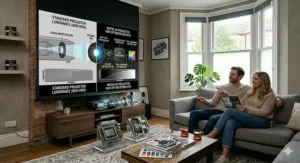
❓ Frequently Asked Questions
❓ Is upscaled 4K good enough for a typical UK living room?
❓ What is e-shift technology and is it real 4K?
❓ Are these projectors compatible with UK power (230V) and do they come with UK plugs?
❓ How does a JVC 4K projector compare to an Epson 4K projector?
❓ Is a native 4K projector worth the extra money in the UK?
Conclusion: Which 4K Projector Should You Actually Buy?
The true 4K vs upscaled 4K projector debate has a genuinely satisfying answer — which is that both technologies have their place, and the correct choice depends almost entirely on your room, your screen size, and your tolerance for spending money you might not need to spend.
For the majority of UK buyers — a living room, a 100–120 inch screen, evenings rather than dedicated cinema sessions — the BenQ W2720i is the single best recommendation in this guide. It wins independent awards, lasts thirty thousand hours without a lamp change, and produces a picture that will make every film look considerably better than you’re used to. The Optoma UHD38x is the better choice if your room is bright or gaming is a priority. The Hisense C2Tuk is the overlooked gem if colour accuracy is your primary criterion.
For the buyer who wants proper native 4K and has the room to justify it: the Sony VPL-XW5000ES has been the correct answer for four consecutive years. It’s expensive, it requires a darkened room, and it is thoroughly, measurably worth it under those conditions.
And if you simply want a capable, intelligent projector that works beautifully without fuss in a compact modern flat: the XGIMI Horizon S Pro or BenQ GP520 will serve you admirably — and save you enough to buy a very good screen to go with them.
✨ Don’t Miss These Exclusive Deals!
🔍 Click any highlighted projector above to check current pricing and availability on Amazon.co.uk. Prime members receive free next-day delivery on eligible orders — and June’s Prime Day (22–26 June 2026) is an excellent time to check for current deals on home cinema equipment.
Recommended for You 📺
- 7 Best 4K Projectors Under £1000 UK (2026)
- Best 4K Projector UK 2026: 7 Top Picks for Home Cinema
- Home Cinema Projector Setup: 7 Best Picks for UK Living Rooms in 2026
Disclaimer: This article contains affiliate links. As an Amazon Associate, I earn from qualifying purchases. If you purchase products through these links, we may earn a small commission at no additional cost to you. All products were researched on Amazon.co.uk. Prices are given as approximate ranges only and are subject to change — always check Amazon.co.uk for current pricing before purchasing.
✨ Found this helpful? Share it with your mates! 💬🤗
