
In This Article
You’ve rearranged the furniture twice. You’ve measured the wall. You’ve spent more evenings than you’d care to admit reading spec sheets at midnight with a cup of tea gone cold beside you. And you still can’t decide: home cinema projector vs TV — which one actually makes sense for your living room, your budget, and frankly, your life?
Here’s the honest answer: both can be extraordinary. But they are extraordinary in completely different ways, and choosing the wrong one for your situation is exactly the sort of decision that haunts people for three to five years, until the warranty expires and they finally do it all over again.
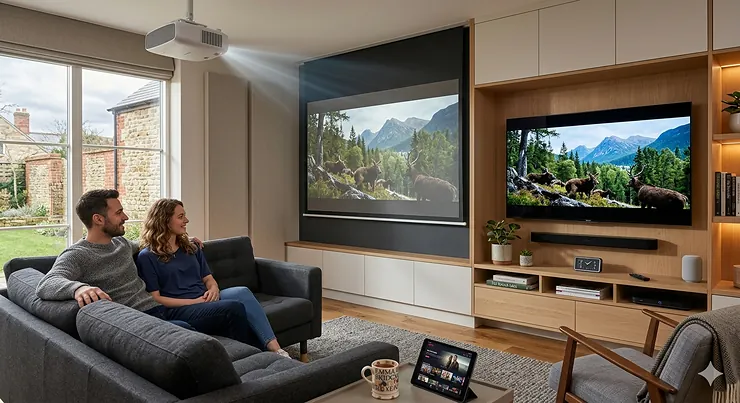
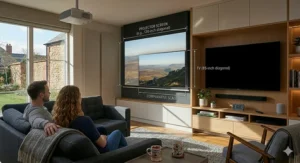
What is a home cinema projector vs TV decision, really? At its core, it comes down to this: a television delivers a self-contained, always-ready, high-brightness panel in a fixed size. A projector creates a variable-sized image by bouncing light off a surface — giving you the potential for screens that dwarf anything a TV can offer, often at a fraction of the cost per inch. A 100-inch TV vs projector comparison is perhaps the starkest illustration: a 100-inch flat panel will cost you an eyewatering amount of money and require structural reinforcement to hang it, while a decent home cinema projector can paint the same-sized image on your wall for considerably less. The maths only gets more dramatic as the screen grows.
That said, projectors ask something of you in return. They need a degree of light control. They need space — both physically in the room and in terms of throw distance. And they need a bit more setup patience than simply plugging in an HDMI cable and switching on.
In this guide, I’ve researched and selected seven projectors currently available on Amazon.co.uk that represent the best the market has to offer across every budget tier in 2026 — from competitively priced triple-laser performers to flagship cinema machines. I’ll also help you decide honestly whether a projector is right for you or whether a top-tier OLED TV is actually the smarter call.
Quick Comparison: Home Cinema Projector vs TV — At a Glance
| Feature | Home Cinema Projector | Premium OLED TV |
|---|---|---|
| Screen size potential | 80–300 inches | Typically up to 97 inches |
| Screen size per pound | Excellent | Poor at large sizes |
| Ambient light performance | Needs darker room | Excellent in bright rooms |
| Picture contrast (blacks) | Good–excellent (laser) | Best-in-class (OLED) |
| Setup complexity | Moderate | Very low |
| Lifespan of light source | 20,000–30,000 hours (laser) | 30,000+ hours (panel) |
| Best for | Dedicated cinema, movie nights | Always-on, bright rooms, gaming |
| UK living room suitability | Terraced house with blackout blinds | Open-plan, bright modern flats |
What that table is really telling you is this: if you watch films in a room you can darken, at screen sizes that make a TV feel comically small, a projector wins on value and immersion almost every time. If you’re in a south-facing open-plan flat in Leeds with floor-to-ceiling windows and no desire to fiddle with curtains every evening, a TV is probably the wiser choice — and you should accept that cheerfully rather than fighting it.
💬 Just one click — help others make better buying decisions too! 😊
✨ Don’t Miss These Exclusive Deals!
🔍 Take your home cinema to the next level with these carefully selected projectors. Click on any highlighted product name to check current pricing and availability on Amazon.co.uk. Whether you’re after a budget laser machine or a flagship 4K powerhouse, these picks cover the full range.
Top 7 Home Cinema Projectors for UK Buyers: Expert Analysis
1. Hisense 4K Laser Projector M2TUK Pro — Best Entry-Level Triple Laser
The M2TUK Pro is Hisense’s UK-specific entry into the triple-laser portable projector segment, and it’s quietly one of the most interesting propositions in the under-£1,300 bracket.
The triple-laser Trichroma light source covers an impressive 110% BT.2020 colour space — a figure that sounds abstract until you watch a forest fire sequence in a film and realise the reds are genuinely, disconcertingly vivid. It delivers 1,300 ANSI lumens of brightness, which is honest rather than spectacular. In plain terms: close your curtains, and this projector sings. Leave them open on a bright Saturday afternoon in August, and it’ll struggle — as virtually every projector at this price point does. The 4K UHD resolution runs up to a 200-inch image, supported by Dolby Vision and IMAX Enhanced certification, a set of credentials you’d normally find on machines costing twice as much.
For a UK family in a semi-detached in the Midlands with a dedicated back room or a modest spare bedroom, the M2TUK Pro is borderline revelatory. It runs on Hisense’s VIDAA OS with Netflix, YouTube, and Disney+ built in — no dongles required — and the gimbal-style mount means you can angle it at the ceiling for a surprisingly convincing bedroom cinema setup. UK customers on Amazon.co.uk have praised its picture clarity and sound quality, though a small number flagged that rainbow effects (a DLP-related phenomenon) can be distracting for sensitive viewers.
✅ Pros:
- Triple-laser colour accuracy at an entry price
- Dolby Vision and IMAX Enhanced certification
- VIDAA OS with streaming apps built in
❌ Cons:
- 1,300 lumens needs a controlled light environment
- Some users report mild rainbow effect
Price range: Around £1,099–£1,299 | Check current price on Amazon.co.uk
2. Epson EH-TW7100 — Best for Bright-Room Performance
If rainbow effects from DLP projectors give you a migraine — and you’d be surprised how many people they affect without realising it — the Epson EH-TW7100 is your answer. It’s a 3LCD projector, which means three separate panels handle red, green, and blue simultaneously. No colour wheel. No flicker artefacts. Just a smooth, natural image that’s notably easier on the eyes during long viewing sessions.
The EH-TW7100 delivers 3,000 lumens, which is substantially brighter than most rivals in this price bracket. That matters enormously in the UK context: our living rooms tend to be darker by default than American ones, but if you’ve got a south-facing lounge, standard-length curtains, and teenagers who perpetually leave doors open, 3,000 lumens is the difference between “watchable” and “actually impressive.” The 4K PRO-UHD resolution (Epson’s pixel-shifting approach to 4K) produces crisp, detailed images, and the expansive lens shift range gives you real flexibility in placement — useful if you’re working with a tricky room layout, which is rather common in Britain’s characterful but architecturally awkward housing stock.
The TW7100’s lamp-based light source (UHE lamp, rated at around 3,500 hours at full brightness) is the one concession you make at this price point. Replacement lamps are readily available through Amazon.co.uk and typically cost in the region of £100–£150 — factor that into your long-term cost of ownership. That said, UK reviewers consistently rate this projector as a workhorse that punches well above its price, particularly for sport and daytime cinema.
✅ Pros:
- 3,000 lumens handles some ambient light
- 3LCD eliminates rainbow effect entirely
- Excellent lens shift for flexible room placement
❌ Cons:
- UHE lamp needs periodic replacement
- Bulkier form factor than modern laser competitors
Price range: Around £1,199–£1,349 | Check current price on Amazon.co.uk
3. XGIMI Horizon Ultra — Best Mid-Range Dual-Light Innovation
The XGIMI Horizon Ultra arrived on the market wearing leather cladding and carrying a genuinely novel idea: a hybrid dual-light source that combines laser and LED in the same optical system. The theory is sound — lasers deliver punch and colour, LEDs smooth out the harsh spots and eye-strain edge-case that pure-laser setups can occasionally produce. In practice, the result is an image that feels unusually relaxed to watch for long periods, with 2,300 ISO lumens of output and Dolby Vision support that competes impressively with projectors well above its price.
At around the £799–£1,099 range (prices have shifted significantly since its launch), the Horizon Ultra now represents serious value on Amazon.co.uk. What Hi-Fi? has previously noted discounts that brought it to record-low prices at Amazon, making it one of the better bargains in the projector market when caught on offer. The Harman Kardon dual-speaker setup is genuinely listenable — not audiophile territory, but perfectly adequate for casual movie nights without needing to plug in a soundbar immediately. Android TV 11 handles streaming duties cleanly, with all the major UK platforms accessible.
For a Manchester flat-dweller or a couple in a Bristol terraced house who wants a sophisticated-looking piece of kit that doesn’t dominate a room, the Horizon Ultra’s design is notably more considered than the typical beige-box projector aesthetic. It’s the option you’d actually leave on the coffee table without wincing.
✅ Pros:
- Unique dual-light system reduces eye fatigue
- Dolby Vision at this price is impressive
- Stylish form factor for living room use
❌ Cons:
- Dual-light technology still maturing vs pure-laser
- 2,300 lumens isn’t class-leading brightness
Price range: Around £799–£1,099 | Check current price on Amazon.co.uk
4. BenQ W2720i — Best Overall Mid-Range Performer
The BenQ W2720i is the projector that What Hi-Fi? awarded five stars and called one of the finest projector all-rounders ever tested — and it’s hard to argue. At around £1,599–£1,999 on Amazon.co.uk, it occupies a price point that used to feel like a compromise. Now it feels like a sweet spot.
The W2720i uses a 30,000-hour LED light source paired with BenQ’s CinematicColor technology, delivering 2,500 ANSI lumens with factory-calibrated colour accuracy — 90% DCI-P3 and 98% Rec.709 coverage, with Delta E below 3 straight out of the box. What that actually means: you don’t spend your first evening squinting at a service menu trying to tune the colours correctly. It looks right immediately, which is rarer than it should be in this category. The AI Cinema Mode dynamically adjusts colour based on ambient light levels — genuinely useful in a UK living room where the light quality shifts dramatically between a grey November morning and a long June evening.
Three HDMI 2.1 ports, eARC support, Dolby Atmos pass-through, and Android TV are all present. The 17.8ms input lag at 60Hz makes it a credible gaming projector too — is a projector better than a TV for gaming? For first-person shooters, probably not. For cinematic single-player experiences on a 120-inch screen? Undeniably yes. The 6.5kg weight means ceiling mounting is feasible without specialist hardware.
UK customers have been effusive, with several describing it as a “life-changing upgrade” from mid-range TVs. The one grumble that surfaces consistently: the built-in 10W speaker is average at best. Budget for a soundbar.
✅ Pros:
- Outstanding out-of-box colour accuracy
- AI Cinema Mode adapts to UK living room lighting
- Excellent gaming credentials alongside cinema performance
❌ Cons:
- Built-in speaker disappoints
- Needs a dark or semi-dark room to truly shine
Price range: Around £1,599–£1,999 | Check current price on Amazon.co.uk
5. Hisense C2 Ultra — Best Premium Portable 4K Laser
The Hisense C2 Ultra is the projector for people who want serious performance without a fixed installation. It’s triple-laser, 3,000 ISO lumens, 4K UHD, and portable — a combination that previously existed only at price points that required a second mortgage. At around £2,299 on Amazon.co.uk, it’s still a significant investment, but it’s genuinely competitive against rivals that cost considerably more.
The C2 Ultra covers 110% BT.2020 colour space with JBL audio (two speakers handling 30W total), delivers images up to 300 inches in size, and carries both IMAX Enhanced and Dolby Vision certification. Its ISA (Intelligent Screen Adaption) system automatically detects and adjusts for obstacles, corners, and irregular surfaces — rather handy when you’re projecting onto the garden wall during a British summer evening that still has enough daylight to be optimistic about before the clouds inevitably reassert themselves.
The “designed for Xbox” certification means the C2 Ultra handles game signals with notably low latency and appropriate colour calibration for HDR gaming — a detail that will matter enormously to households where the projector doubles as a gaming screen. UK customers on Amazon have been particularly impressed with the out-of-box setup speed, with several noting a sub-10-minute time from unboxing to watching.
The caveat? It’s portable by projector standards, not by the standards of something you’d actually carry to a friend’s house regularly. At its size and price, most buyers use it as a “move it between the lounge and bedroom occasionally” option rather than a genuinely nomadic device.
✅ Pros:
- 3,000 ISO lumens handles moderately lit environments
- JBL audio is genuinely good by projector standards
- Outstanding colour gamut for the price
❌ Cons:
- Premium price demands premium use
- Form factor is portable in theory more than practice
Price range: Around £2,099–£2,299 | Check current price on Amazon.co.uk
6. Hisense PL2 — Best Ultra Short Throw for Compact UK Living Rooms
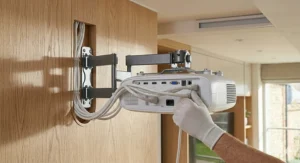
This is the projector that answers the most common British objection to projectors: “But I haven’t got the space.” The Hisense PL2 is an ultra short throw (UST) laser projector that sits just 20–30cm from your wall and projects images from 80 to 150 inches. It replaces a TV in the most direct sense — it goes where a TV would go, looks vaguely like a TV console, and delivers a far larger image than any panel you could reasonably hang on a British terraced-house wall.
The PL2 uses a triple-laser light source delivering around 2,500 ISO lumens — bright enough to be usable with curtains only partially drawn, unlike most standard-throw projectors. Its ambient light rejection (ALR) screen compatibility is significant: pair it with a proper ALR projection screen rather than a plain white wall, and performance in brighter conditions improves dramatically. What Hi-Fi? named it the best UST projector on the market, calling it a perfect balance of performance and value — high praise from a publication that has tested every serious competitor.
For a family in a compact semi-detached where a 65-inch TV feels cramped but ceiling-mounting a projector isn’t practical (listed buildings, rented properties, and nervous landlords account for a significant portion of the UK housing market), the PL2 is close to an ideal solution. It runs Hisense’s VIDAA OS with Netflix, Disney+, and YouTube built in.
The main trade-off versus traditional throw projectors at the same budget? Contrast. UST optics don’t achieve the same deep-black performance as a longer-throw laser setup. But in a living room context, during normal evening viewing, most people simply don’t notice.
✅ Pros:
- Minimal throw distance suits compact UK rooms
- No ceiling mounting required — perfect for renters
- VIDAA OS with all major UK streaming apps
❌ Cons:
- Contrast not as deep as traditional throw projectors
- Best performance requires a compatible ALR screen
Price range: Around £1,999–£2,799 | Check current price on Amazon.co.uk
7. XGIMI Horizon 20 Max — Best Flagship 4K Triple Laser
The XGIMI Horizon 20 Max is the machine for people who have decided, seriously and irrevocably, that they want the best portable 4K projector money can sensibly buy. At around £2,599 on Amazon.co.uk, it competes against the Hisense C2 Ultra and the Anker Nebula X1 — and according to TechRadar’s comprehensive review, it holds its own convincingly, particularly on raw brightness.
The Horizon 20 Max deploys triple-laser RGB technology to deliver 5,700 ISO lumens — a figure that genuinely changes what “needs a dark room” means. At that brightness level, you can maintain a watchable image with curtains open during daytime, or project outdoors on a summer evening without waiting for full darkness. The 20,000:1 contrast ratio, 300-inch maximum image size, IMAX Enhanced and Dolby Vision support, Google TV with licensed Netflix built in, and optical zoom with lens shift all combine into a specification sheet that reads like a premium cinema machine rather than a consumer projector.
The 240Hz refresh rate and 1ms input lag are not marketing confetti — they make the Horizon 20 Max one of the most capable gaming projectors currently available, full stop. For households where the same screen serves both cinema and serious gaming, this is exceptional value at the flagship tier.
Expert Reviews (UK) noted that the Horizon 20 Max competes with rivals priced similarly while delivering “excellent picture quality” — and that its hinged design, which lets you adjust projection height easily without moving the unit, is one of those ergonomic touches that sounds minor until you actually use it regularly.
✅ Pros:
- 5,700 ISO lumens works in brighter conditions
- 240Hz/1ms input lag for serious gaming
- Google TV with licensed Netflix included
❌ Cons:
- Premium price requires genuine commitment
- Larger and heavier than truly portable alternatives
Price range: Around £2,399–£2,599 | Check current price on Amazon.co.uk
Product Overview: Specifications at a Glance
| Product | Resolution | Brightness | Light Source | Price Range (GBP) | Best For |
|---|---|---|---|---|---|
| Hisense M2TUK Pro | 4K UHD | 1,300 ANSI lm | Triple laser | ~£1,099–£1,299 | Budget laser, families |
| Epson EH-TW7100 | 4K PRO-UHD | 3,000 lm | UHE lamp | ~£1,199–£1,349 | Bright rooms, 3LCD fans |
| XGIMI Horizon Ultra | 4K UHD | 2,300 ISO lm | Dual light | ~£799–£1,099 | Living room elegance |
| BenQ W2720i | 4K UHD | 2,500 ANSI lm | LED | ~£1,599–£1,999 | All-round excellence |
| Hisense C2 Ultra | 4K UHD | 3,000 ISO lm | Triple laser | ~£2,099–£2,299 | Premium portable |
| Hisense PL2 | 4K UHD | 2,500 ISO lm | Triple laser | ~£1,999–£2,799 | Compact UK rooms, UST |
| XGIMI Horizon 20 Max | 4K UHD | 5,700 ISO lm | Triple laser | ~£2,399–£2,599 | Flagship performance |
What jumps out from this table is the brightness gap between the entry-level Hisense M2TUK Pro (1,300 lumens) and the XGIMI Horizon 20 Max (5,700 lumens) — a difference of more than four times. For UK buyers, that gap matters most in autumn and winter, when you’re watching earlier in the evening and the living room light hasn’t fully dropped. If flexibility and light tolerance are priorities, the Epson EH-TW7100 and the XGIMI Horizon 20 Max represent the best value at their respective price tiers.
✨ Ready to Choose Your Cinema Setup?
🔍 Every product above is available to check on Amazon.co.uk right now — Prime members get free next-day delivery on most. Click any highlighted product name for current pricing.
Setting Up Your Home Cinema Projector in a British Home: What Nobody Tells You
Step 1: Sort Your Room First
Before you buy anything, stand in the room you’re planning to use with the lights off at the time you’d normally watch films. If it’s genuinely dark, you’re in projector territory. If light pours in from the street or a neighbour’s security light, you have two options: proper blackout curtains (widely available on Amazon.co.uk for under £60 a pair), or one of the higher-lumen projectors like the Epson EH-TW7100 or XGIMI Horizon 20 Max. The British instinct to manage without blackout blinds because surely it won’t be that bright outside is one that costs a lot of people their enjoyment of otherwise excellent projectors.
Step 2: Measure Your Throw Distance
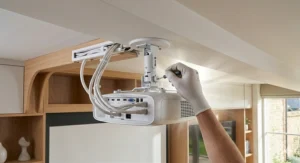
Standard-throw projectors typically need 2.5–4 metres of distance to project a 100-inch image. Measure from the wall to where you’d realistically position the projector. If you’re working with less than 2 metres, consider an ultra short throw model like the Hisense PL2. Most UK living rooms in terraced housing give you 3–4.5 metres of depth — workable, but not cavernous.
Step 3: Screen or Wall?
Projecting onto a plain white wall works surprisingly well if the wall is flat and freshly painted. A dedicated projection screen — available from around £80 on Amazon.co.uk for a fixed-frame 100-inch version — will give you noticeably better contrast and a more uniform image surface. For the Hisense PL2 and other UST projectors, an ALR (Ambient Light Rejecting) screen is strongly recommended and will transform daytime performance.
Step 4: UK Electrical Considerations
All projectors in this guide are confirmed UK-compatible — 230V, Type G plug (standard UK three-pin). No adapters required. Laser projectors draw 150–350W during operation; check your socket load if you’re running a soundbar, streaming device, and subwoofer from the same extension lead. UK electrical standards (BS 1363 plug, RCBO protection) are well-matched to modern projector power draw.
Step 5: Soundbar — Budget for It From Day One
Built-in projector speakers range from adequate to genuinely grim. Budget at least £150–£200 for a decent soundbar alongside any projector purchase. Models like the Sony HT-S400 or Yamaha YAS-109 (both available on Amazon.co.uk) transform the experience without requiring a dedicated amplifier.
Step 6: British Weather Storage Tip
If you’re storing a portable projector between uses — in a cupboard, under the stairs, or in the spare room — ensure the environment isn’t damp. British houses, particularly Victorian and Edwardian terraced properties, can harbour condensation in storage spaces. A small silica gel sachet in the bag will protect the optics from moisture over winter months.
Real UK Households, Real Decisions: Who Should Buy What
The London Flat-Dweller (Zone 2–3)
Profile: 35-year-old renter in a one-bedroom flat in Hackney. Living room is 4m × 5m. No ability to drill walls. Watches films three nights a week, occasional gaming.
The recommendation: XGIMI Horizon Ultra or Hisense PL2. The Horizon Ultra sits elegantly on a coffee table or shelf without permanent installation. The PL2 sits on a TV console like a conventional piece of AV kit. Both work with VIDAA or Android TV, so no additional streaming devices are needed. Neither requires a drill. The renter-friendly setup in both cases is the deciding factor.
The Suburban Family in the Midlands
Profile: Family of four in a four-bedroom semi-detached in Birmingham. Dedicated playroom/back room with blackout blinds. Budget around £1,500. Films, kids’ content, occasional PS5 gaming.
The recommendation: BenQ W2720i. The factory-calibrated colour means it’s immediately watchable for everything from animated films to HDR gaming. The 30,000-hour LED lifespan means no lamp replacement for the foreseeable future. The HDMI 2.1 ports handle PS5 at full resolution. The 17.8ms input lag is acceptable for most gaming. It’s the versatile family machine that does nothing badly and most things brilliantly.
The Dedicated Home Cinema Builder in Rural Scotland
Profile: Owns a cottage near Inverness. Converting the basement into a dedicated cinema room with full light control. Budget £2,000–£3,000. Serious about picture quality.
The recommendation: Hisense C2 Ultra or XGIMI Horizon 20 Max. In a dedicated, fully light-controlled room, you can push the C2 Ultra’s triple-laser colour gamut to its absolute limit and get results that would embarrass TVs at twice the price. The Horizon 20 Max adds the brightness headroom and gaming credentials if the room also doubles as an entertainment hub. Amazon.co.uk Prime delivers to most Scottish mainland postcodes; delivery to remote Highlands addresses may take an additional day.
Is a Projector Better Than a TV? The Honest Comparison
The projector vs OLED TV debate is one of those questions that sounds like it should have a simple answer. It doesn’t. But it does have a clear answer once you know your priorities.
Where Projectors Win
Screen size per pound is the headline advantage, and it’s a significant one. A 100-inch TV vs projector comparison currently sits at something like £15,000+ for a 100-inch TV panel against £1,099–£2,599 for a 100-inch projector image. The economics are so lopsided they’re almost embarrassing. According to research into human visual perception — Wikipedia’s overview of viewing angle and visual acuity is instructive here — screen size relative to viewing distance dramatically affects the sense of cinematic immersion. Projectors win this one completely.
Projector ambient light rejection has improved dramatically. Modern high-lumen laser projectors like the Epson EH-TW7100 and XGIMI Horizon 20 Max are meaningfully usable in rooms that aren’t pitch-dark, which dismantles the most common objection to projectors for UK buyers.
Where TVs Win
Projector vs OLED TV on contrast and black performance: the OLED still wins, and it’s not close. OLED panels achieve true pixel-level blackout that no projector currently matches. If you watch a lot of dark, high-contrast content — prestige drama, noir films, space documentaries — an OLED’s blacks are superior. The trade-off is that OLEDs cap at around 83–97 inches, cost significantly more at those sizes, and sit permanently in one spot.
TVs also win on eye strain for casual, daytime use. The British Journal of Ophthalmology has published research suggesting that reflected projector light and direct-emission panel light interact differently with human eyes over long periods, though the consensus is that both are safe under normal use conditions. The practical takeaway: if you watch TV casually with lights on for several hours daily, a TV is easier on the eyes. If you watch films attentively in a dimmed room, the projector experience is arguably superior.
The Hybrid Reality
Many UK households are moving towards a hybrid setup: a mid-size OLED (55–65 inches) for daytime casual viewing in the main living space, and a dedicated projector setup in a secondary room or at the push of a coffee table for proper cinema viewing. It’s not a compromise — it’s arguably the best of both worlds, and it’s more affordable in 2026 than at any point previously.
How to Choose the Right Home Cinema Projector in the UK: 6 Criteria That Actually Matter
1. Lumens — the real number to check: Marketing lumens figures can be misleading. ISO lumens (used by XGIMI and Hisense) tend to be more conservatively measured than manufacturer ANSI lumen claims. A 1,300 ISO lumen rating often outperforms a claimed 15,000 “marketing lumens” from budget no-name projectors. Stick to projectors from reputable brands that provide standardised measurements.
2. Light source technology: Lamp-based projectors (like the Epson EH-TW7100) require bulb replacement every 3,500–5,000 hours. LED and laser projectors last 20,000–30,000 hours without servicing. For a family watching 4 hours per night, a 30,000-hour laser source lasts over 20 years. Factor in replacement lamp costs (£100–£150) when comparing lamp-based options.
3. Throw ratio: Check whether a projector’s throw ratio matches your available room depth. A 1.5:1 throw ratio means 1.5 metres of distance per metre of screen width. For a 2.5-metre-wide screen (100 inches), you need 3.75 metres of throw distance. Measure your room before reading any spec sheet.
4. Smart OS quality: Android TV and Google TV (used by BenQ and XGIMI) give you access to the full Google Play Store, including all UK streaming apps. VIDAA OS (Hisense) is clean and fast, with Netflix, Disney+, YouTube and Amazon Prime pre-installed. Avoid budget projectors running obscure operating systems with limited app support.
5. Connectivity: HDMI 2.1 ports are increasingly important for 4K/120Hz gaming and future-proofing. The BenQ W2720i offers three HDMI 2.1 ports — exceptional for this price. eARC support allows a single HDMI cable to carry audio to a soundbar, simplifying cable management.
6. Warranty and UK support: All seven projectors in this guide are sold through Amazon.co.uk with UK-standard warranty terms and the Consumer Rights Act 2015 protections that apply to all online purchases in Britain. Under Consumer Contracts Regulations, you also benefit from a 14-day cooling-off period — more generous than almost anywhere else in the world.
Common Mistakes When Buying a Home Cinema Projector in the UK
Buying on lumen count alone. The most pervasive error. “20,000 lumens!” announcements on budget projectors from obscure brands are essentially fictional. Real-world brightness is measured in ISO or ANSI lumens by third-party tests. When a £150 projector claims 20,000 lumens and a £1,999 BenQ claims 2,500, the BenQ is almost certainly brighter in practice.
Ignoring the room. A projector that performs brilliantly in a darkened test room can look washed-out in your lounge if it faces a south-west window. Walk around your room at the times you actually watch content before buying.
Forgetting about sound. Projector speakers are the automotive equivalent of tyres fitted to a sports car at the factory — they’ll do the job, but nobody with taste leaves them in place for long. Budget for audio from the outset.
Buying a US-voltage projector. This matters less than it once did — virtually all major brand projectors now ship with universal power supplies — but verify before purchasing from third-party sellers. All products sold directly by Amazon.co.uk include UK-compatible power cables.
Underestimating setup time. A quality projector installation — ceiling mount, cable management, screen alignment — takes a weekend if done properly. Don’t buy on a Thursday expecting a cinema-ready room by Friday evening.
Long-Term Cost & Maintenance in the UK
The total cost of ownership calculation for projectors is more favourable than it initially appears. Consider:
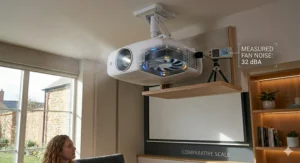
A laser projector rated at 25,000 hours, used 3 hours per day, will run for approximately 22 years without a light source replacement. There are no panels to burn in (unlike OLED TVs), no backlights to degrade unevenly, and no HDMI ports that become obsolete while the rest of the machine still works perfectly.
For lamp-based projectors like the Epson EH-TW7100, replacement lamps are available on Amazon.co.uk for £100–£150 and take around 20 minutes to swap. Over a 10-year ownership period at moderate use, you might replace the lamp twice — a total of £200–£300 in running costs, which remains excellent value.
Projection screens need occasional cleaning. A soft microfibre cloth and a can of compressed air (available from Amazon.co.uk for a few pounds) handle dust accumulation on fixed-frame screens. Portable pop-up screens should be stored in their carry cases when not in use to prevent surface scratching.
The Energy Saving Trust notes that laser projectors typically draw 200–300W during active use — similar to a large gaming PC. Running a projector for 1,000 hours per year at average UK electricity rates (approximately 24p/kWh in 2026) costs around £50–£70 per year in electricity. Comparable in most cases to a large-screen TV.
FAQ: Home Cinema Projector vs TV — Common UK Questions
❓ Is a projector better than a TV for home cinema in the UK?
❓ What is the best home cinema projector under £1,500 available in the UK?
❓ Can I use a home cinema projector in a bright UK living room?
❓ Do I need a special screen, or can I project onto a white wall?
❓ Are projectors suitable for rented UK properties where I can't drill walls?
Conclusion: So, Projector or TV?
Here’s where I’ll be straight with you: if you’re reading this article, you’re almost certainly ready for a projector. People who are truly happy with their TV don’t spend evenings researching throw ratios.
The home cinema projector vs TV question in 2026 has a clearer answer than it’s ever had: projectors have never been more capable, more affordable, or more living-room-friendly. The days of projectors being exclusively for dedicated, purpose-built rooms in the homes of enthusiasts with more space than the average British household possesses — those days are genuinely over. The XGIMI Horizon Ultra sits on your coffee table. The Hisense PL2 goes where your TV used to live. The BenQ W2720i rewards a bit of room preparation with picture quality that makes a £2,000 OLED look modest.
Whether you’re a family in the East Midlands looking to transform the back room, a London renter wanting cinema nights without a landlord’s consent form, or a serious enthusiast building something genuinely special — there’s a projector in this list for you.
The only mistake is waiting.
✨ Don’t Miss These Exclusive Deals!
🔍 Browse all seven projectors on Amazon.co.uk today. Prime members enjoy free next-day delivery to most UK addresses. Click any highlighted product to check current pricing — and enjoy your first film night at a genuinely cinematic scale.
Recommended for You
- Home Cinema Projector Setup: 7 Best Picks for UK Living Rooms in 2026
- Best Home Cinema Projector Under £500 UK: 7 Expert Picks for 2026
- Best Home Cinema Projector UK 2026: 7 Top Picks Reviewed
Disclaimer: This article contains affiliate links. As an Amazon Associate, I earn from qualifying purchases. If you purchase products through these links, we may earn a small commission at no additional cost to you.
✨ Found this helpful? Share it with your mates! 💬🤗
