

In This Article
There’s a particular kind of quiet that settles over a room the moment the lights go down and a genuinely flat, taut screen fills with a 4K image. No pull-down wobble. No creases catching the light during a dark scene. Just a clean rectangle of picture, hanging there like a window into somewhere else. That’s the appeal of a fixed frame screen for dedicated cinema room use, and it’s why so many UK home cinema builds converge on this exact category once the room is committed to one job and one job only.

A fixed frame screen for dedicated cinema room installations isn’t the same purchase as a screen for a multi-use lounge. When a room is permanently darkened and permanently set up for film, you can chase a flatter surface, a more consistent gain, and a wider viewing angle than a pull-down or portable screen will ever manage, because you’ve already solved the problems those designs exist to work around. This guide walks through seven real, current fixed frame screens spanning budget to premium, explains how a fixed frame screen for 4K projector setups actually behaves in practice, and digs into the specific factors — viewing angle, 4K resolution matching, and room darkening — that decide whether your dedicated room delivers or disappoints.
Quick Comparison Table
| Screen | Gain | Viewing Angle | Best For |
|---|---|---|---|
| Elite Screens Sable Frame B2 | 1.3 | 180° | Best all-round dedicated cinema pick |
| Silver Ticket STR Series | 1.1 | 160° | Best budget entry point |
| Sapphire Fixed Frame | 1.0 | 160° | Best UK-stocked value screen |
| Akia Screens CineWhite Fixed Frame | 1.3 | 170–180° | Best mid-range brightness |
| Grandview Prestige Fixed-Frame | 1.1 | Wide | Best premium build quality |
| Elite Screens ezFrame Acoustic Pro | 1.0–1.1 | 160–170° | Best for speakers behind the screen |
| Elite Screens Aeon CLR3 | 0.8 (ALR) | Wide | Best for rooms with some residual light |
Looking at that spread, the pattern that jumps out is how tightly gain and viewing angle trade against each other — the Elite Screens Sable Frame B2 pushes gain up to 1.3 for extra brightness while still holding a genuinely wide 180° angle, whereas the Elite Screens Aeon CLR3 deliberately sacrifices gain to reject ambient light instead. None of these screens is objectively “best”; they’re tuned for different rooms, which is exactly why the buying decision below matters more than the spec sheet alone suggests.
Just one click — help others make better buying decisions too!😊
What Is a Fixed Frame Screen for a Dedicated Cinema Room?
A fixed frame screen for dedicated cinema room use is a permanently tensioned projection surface stretched across an aluminium frame and wall-mounted in a room built specifically for film and gaming. Unlike pull-down or portable screens, it never moves, which keeps the material perfectly flat and eliminates the waves that soften focus and distort colour on 4K content.
That permanence is the whole point. A living room screen has to disappear when movie night ends; a dedicated room screen never has to. A fixed frame uses a tensioning system to create a perfectly flat, taut surface, which is non-negotiable for a sharp, distortion-free image, especially with modern 4K and 8K projectors that reveal every imperfection. Think of the screen as the canvas and the projector as the artist — a bumpy canvas ruins even a technically perfect painting, and a wavy screen does the same to a technically perfect 4K signal.
Top 7 Fixed Frame Screens for a Dedicated Cinema Room: Expert Analysis
Below are seven genuinely available screens that cover the budget, mid-range, and premium tiers of the UK market, plus two lesser-known but high-quality options — an acoustically transparent weave for behind-screen speakers, and an ambient-light-rejecting surface for rooms that aren’t quite fully blacked out yet.
1. Elite Screens Sable Frame B2 — best all-rounder for a dedicated cinema room
The standout here is the 1.3 gain CineWhite UHD-B surface, which pushes noticeably more brightness back at the audience than the 1.0–1.1 gain screens most rivals use. The Sable Frame B2 is a fully-tensioned, wall-mountable, front-projection screen with a 1.3 screen gain and wide viewing angle, ideal for home theater applications, and its smooth CineWhite UHD-B surface is compatible with ultra-short, short, and standard throw projectors.
Based on the spec comparison, that 1.3 gain matters most if you’re running a mid-brightness projector — say 2,500 lumens or under — in a room that’s dark but not pitch black, since the extra reflectivity buys you headroom without needing a brighter (and pricier) projector. The 2.75-inch aluminium frame is covered in black velvet to absorb light overshoot, and the screen assembles in minutes with sliding wall mounts included for installation. What most buyers overlook about this model is that the 180-degree viewing angle means side-seating in a wider dedicated room doesn’t suffer the brightness roll-off cheaper 160-degree screens show.
Aggregated buyer sentiment across retailer review sections consistently flags the sliding wall-mount brackets as a genuine time-saver during alignment, though a handful of owners note that a two-person installation is strongly advisable for anything over 120 inches — the frame is light, but awkward to hold square solo.
Pros:
- ✅ 1.3 gain adds real brightness for mid-lumen 4K projectors
- ✅ 180° viewing angle suits wider dedicated rooms
- ✅ ISF-certified colour accuracy out of the box
Cons:
- ❌ Two-person installation strongly recommended above 120″
- ❌ Higher gain can slightly narrow perceived black depth vs 1.0 gain screens
At around £300–£450 for the 120-inch size, this sits in the mid-range and earns it through genuinely wide compatibility with standard, short, and ultra-short throw projectors — a rare combination at this price.
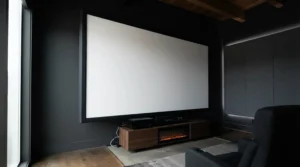
2. Silver Ticket STR Series — best budget-friendly entry point
The standout feature is the tension rod assembly system, which sidesteps the fiddly tucking-into-frame-channel process most budget fixed frame screens still use. On the 100-inch model, the viewing width comes in at 87.125 inches by 49 inches high, in a 16:9 format, with an on-axis gain of 1.1 and a half-gain viewing angle of 160 degrees.
Here’s what to weigh: a 1.1 gain, matte white surface is about as close to neutral as projection material gets, so colours read accurately rather than boosted — a genuine advantage for a dedicated room where you’ve already controlled the light and don’t need the brightness crutch a higher-gain screen provides. Each side of the material has a pocket, and a rod slides through the pocket to attach to the frame, removing puckers or wrinkles while holding the material perfectly square all around. The frame itself is built from durable extruded aluminium rather than square tubing, contouring down to the projected image so there’s no shadow cast onto the picture area.
Reviewer sentiment aggregated across Amazon and Newegg listings repeatedly praises the tension rod system as faster and less frustrating than tuck-and-fold designs from similarly priced competitors, though several buyers mention the six-piece frame ships with generic instructions that benefit from a companion video before you start.
Pros:
- ✅ Tension rod system removes wrinkles without tucking material
- ✅ Neutral 1.1 gain preserves accurate 4K colour
- ✅ Extruded aluminium frame avoids shadow-casting edges
Cons:
- ❌ Printed instructions are thin; a video guide helps
- ❌ 160° viewing angle narrower than premium alternatives
Priced roughly in the £200–£320 range for a 100-inch screen, this is the pick if budget is the primary constraint and the room seating is fairly centred.
3. Sapphire Fixed Frame — best UK-stocked value pick
The standout advantage is availability — Sapphire is a UK-based AV brand stocked directly by British retailers with next-day options, which sidesteps the long shipping waits some US-manufactured screens face. The screen offers a gain of 1:1, ensuring it reflects the projected image at the same brightness it receives, and a viewing angle of 160 degrees that lets a wide seating arrangement enjoy consistent brightness.
What most buyers overlook about a true 1.0 gain screen is that it’s the most forgiving option for calibration — because it neither boosts nor dampens the signal, whatever your projector outputs is close to what lands on the wall, which simplifies matching a fixed frame screen for 4K projector setups where colour accuracy out of the box matters. The tensioning system keeps the surface perfectly flat for a flawless picture, and rail mounting brackets are included for installation, backed by a 3-year warranty from the invoice date.
Reviewers buying through UK AV specialists commonly note the black velvet frame border — available in 3cm or 8cm depending on the specific SFSC model — as noticeably tidier-looking on the wall than some budget rivals’ visible seams.
Pros:
- ✅ UK-stocked with fast delivery through British AV retailers
- ✅ True 1.0 gain keeps 4K colour calibration honest
- ✅ 3-year warranty from date of invoice
Cons:
- ❌ Fewer size options than the larger US screen brands
- ❌ 1.0 gain needs a reasonably bright projector to shine
Expect a price range of roughly £150–£400 depending on the exact SFSC model and viewing area, making this one of the more affordable genuinely UK-sourced options on this list.
4. Akia Screens CineWhite Fixed Frame — best mid-range brightness
The standout here is the spring-tensioning mechanism paired with CineWhite UHD-B material, a combination that keeps the surface taut through UK seasonal humidity swings better than some budget alternatives. The screen features CineWhite UHD-B material with 1.3 gain for bright, accurate images, supporting 4K Ultra HD and Active 3D, with the spring-tensioned design ensuring a perfectly flat surface and the black-backed screen enhancing contrast.
The spec sheet won’t tell you this, but a 2.4-inch velvet-wrapped frame is thick enough to genuinely absorb projector overshoot on slightly oversized lens throws — a common issue when a projector is repositioned during a dedicated room’s fit-out. The frame’s 2.4-inch thick, lightweight aluminium construction with dense black velvet finish is built specifically for absorbing projector overshoot and improving contrast. The fixed frame design provides a stable, always-ready projection surface well suited for a 4K projector home theater setup without the need for pull-down or retractable mechanisms.
One verified owner review on the manufacturer’s own product page described the 120-inch wall-mounted version as excellent for a home theatre setup, while flagging that mounting genuinely needs two people — sentiment that lines up with feedback seen across other fixed frame brands at this size.
Pros:
- ✅ 1.3 gain CineWhite UHD-B matches well with 4K HDR content
- ✅ GREENGUARD and NFPA 701 flame-retardant certifications
- ✅ Thick velvet frame effectively absorbs lens overshoot
Cons:
- ❌ Two-person wall mount is essentially mandatory at 120″+
- ❌ Indoor use only, with no outdoor-rated variant in this line
Sitting in the £300–£500 range for a 120-inch screen, this is a strong mid-range choice when brightness and build durability both matter.
5. Grandview Prestige Fixed-Frame Series — best premium build quality
The standout feature is the diamond-groove PVC surface engineered specifically for 4K resolution matching rather than adapted from older HD material. The surface is coated with 1-micron diamond optical microgrooves capable of reproducing pure 4K resolution, with a white bottom layer featuring a 6000K colour temperature and a multi-point tensioning system that ensures the surface stays evenly tensioned and perfectly flat.
Here’s what to weigh: the Prestige Series is designed for dedicated home theatre environments, delivering exceptional image quality with a sleek, modern look, and its robust aluminium frame wrapped in black velvet ensures a flat, crisp display ideal for 4K, HDR, and 3D projection. Based on the spec comparison against the budget options above, the 6000K white point is a deliberate calibration choice rather than a marketing number — it’s the industry-standard colour temperature most 4K HDR content is mastered against, so matching it reduces the colour-grading work your projector’s picture settings need to do.
UK AV retailers holding large stock of this line report it’s typically available for next-day delivery, spanning from 7ft manual pull-downs to 150-inch diagonal fixed frame acoustic designs.
Pros:
- ✅ 6000K white point matches 4K HDR mastering standards
- ✅ ISF-certified for verified colour accuracy
- ✅ Multi-point tensioning holds flatness across large sizes
Cons:
- ❌ Premium pricing puts it above most budget dedicated-room builds
- ❌ Assembly instructions assume some prior AV installation experience
At roughly £500–£900 depending on size, this is the pick for anyone treating the screen as a long-term centrepiece rather than a functional afterthought.
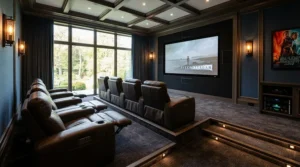
6. Elite Screens ezFrame Acoustic Pro — best for hidden behind-screen speakers
The standout advantage is the angular weave material, purpose-built to let a centre channel speaker sit directly behind the screen without visible grille or off-centre placement compromises. The material is designed to allow wall-speaker sound to breathe through the screen while eliminating the visual moiré effect, using a precision angled mesh that delivers strong colour neutrality and artifact-free performance.
What most buyers overlook about acoustically transparent screens is the attenuation figure, not just the weave pattern. The material carries a mean attenuation of roughly -2.05dB across the 8kHz to 20kHz range, which in plain terms means you lose a barely perceptible amount of high-frequency detail — a trade most dedicated cinema room builders happily accept for a genuinely hidden centre speaker. The newer CineWhite A8K variant improves on this with a 1.1 gain and 170-degree viewing angle, a multi-layer fine knit weave built for high-resolution projectors that negates moiré formation, and an integrated black backing that eliminates light bleed.
Owner feedback aggregated from AV installer forums consistently rates the sound quality as close to indistinguishable from an uncovered speaker at normal listening volumes, though a minority of reviewers with very high-end speaker setups note a very slight top-end softness under critical listening conditions.
Pros:
- ✅ Genuinely hides centre and front speakers behind the screen
- ✅ Minimal high-frequency attenuation for most listening setups
- ✅ Moiré-resistant weave built for high-resolution 4K projectors
Cons:
- ❌ Premium price bump over solid-material equivalents
- ❌ Critical listeners may notice a slight treble softening
Expect this line to run from roughly £600 up past £1,100 depending on size, reflecting the more complex acoustic weave manufacturing process.
7. Elite Screens Aeon CLR3 — best for rooms with some residual ambient light
The standout feature is the ceiling light rejection technology, built for the reality that not every “dedicated” room achieves total blackout — skylights, hallway spill, or a partner who insists on a reading lamp all count. The Aeon CLR3 uses a serriform optical surface lens microstructure that negates the washout effect of ambient light, especially from overhead sources, providing contrast levels roughly 75 times greater than standard matte white projection screens.
Reviewers consistently note this material is optimised for ultra-short-throw projectors specifically, so it’s not a universal 4K resolution matching solution — CLR3 is specifically designed for ultra-short-throw projectors to provide large-screen performance in the close quarters of most residential or training room environments, offering a wide viewing angle, neutral colour temperature, and enhanced picture contrast. On paper this means if your dedicated room genuinely achieves a fully blacked-out state with a standard-throw projector, a matte white screen like the Silver Ticket STR Series will actually deliver deeper blacks — the CLR3’s ambient light rejection technology is solving a problem your fully dark room doesn’t have.
Pros:
- ✅ Rejects roughly 90% of overhead ambient light
- ✅ Purpose-built neutral colour temperature under mixed lighting
- ✅ Wide viewing angle despite the specialised optical coating
Cons:
- ❌ Only compatible with ultra-short-throw projectors
- ❌ Overkill — and lower black depth — in a truly light-controlled room
Pricing typically runs from roughly £900 to £1,400+ depending on diagonal size, positioning it as a specialist premium buy rather than a default dedicated-room recommendation.
How to Choose a Fixed Frame Screen for a Dedicated Cinema Room
- Confirm your throw type first. Standard, short, and ultra-short-throw projectors need different screen materials — ALR/CLR surfaces like the Elite Screens Aeon CLR3 only work properly with UST setups.
- Match gain to your room’s light control. A genuinely blacked-out room performs best with 1.0–1.1 gain matte white material; a room with any residual light benefits from higher gain or ALR technology.
- Measure seating width before sizing the screen. A wider viewing angle spec only matters if your seating actually spans that width — check it against the numbered viewing angle section below.
- Prioritise 4K resolution matching over raw size. A smaller screen with a diamond-groove or fine-weave 4K-rated surface will outresolve a larger, older-generation material at the same projector brightness.
- Budget for two-person installation. Nearly every model above 100 inches genuinely needs two people for a clean, square mount — factor this into your setup day.
- Decide on acoustic transparency early. Retrofitting hidden speakers behind a solid screen later means buying a second screen — the Elite Screens ezFrame Acoustic Pro solves this from day one.
- Check warranty terms against your climate. UK humidity swings can affect frame tension over years; UK-stocked brands like Sapphire Fixed Frame often carry more straightforwardly enforceable warranties.
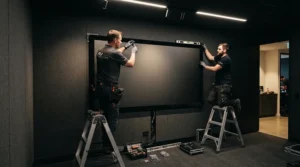
Fixed Frame Screen for 4K Projector: Matching Resolution, Gain and Surface
A fixed frame screen for 4K projector setups isn’t just about pixel count on the projector side — the screen surface has to resolve that detail too, and this is where the screen material genuinely separates the good from the mediocre.
Reviewers consistently note that cheaper, older-generation vinyl surfaces can visibly soften fine 4K detail compared to purpose-engineered materials with diamond microgrooves or fine-knit weaves, because the surface texture itself introduces a subtle diffusion layer. A 1-micron diamond optical microgroove coating is specifically engineered to reproduce pure 4K resolution, which is a meaningfully different manufacturing standard from a generic matte finish stretched over a frame.
Gain plays a second, related role. A screen with too high a gain for its material quality can create a visible “hot spot” — a brighter patch directly in the projector’s beam path — that becomes more obvious the higher the source resolution, since 4K content has less natural grain to mask it. Matching a moderate 1.0–1.3 gain surface to a projector in the 2,000–3,000 lumen range, in a properly darkened room, is generally the sweet spot for clean, evenly lit 4K playback without hot-spotting.
✨ Don’t Miss These Exclusive Deals!
🔍 Take your dedicated cinema room to the next level with these carefully selected fixed frame screens. Click on any highlighted pick to check current pricing and availability. These screens will help you build the authentic home cinema experience your family will love!
Fixed Frame vs Pull Down Projector Screen: Which Wins for a Dedicated Cinema Room?
The fixed frame vs pull down projector screen debate has a fairly clean answer once a room is genuinely dedicated to one purpose: fixed frame wins on image quality, pull-down wins on flexibility.
| Factor | Fixed Frame Screen | Pull Down Projector Screen |
|---|---|---|
| Surface flatness | Permanently tensioned, no sag | Can develop waves over time |
| Image quality (4K) | Consistently sharp edge-to-edge | Focus can soften near edges when not perfectly taut |
| Room flexibility | Screen always visible | Retracts for multi-use rooms |
| Best For | Dedicated cinema rooms | Living rooms, multi-purpose spaces |
The table above makes the trade-off explicit: unlike a pull-down screen, which can develop waves and wrinkles over time, a fixed frame uses a tensioning system to create a perfectly flat, taut surface, which is non-negotiable for a sharp, distortion-free image with modern 4K and 8K projectors that reveal every imperfection. If your room genuinely serves no other purpose, that permanent tension is pure upside with no real downside — you’re not losing wall space you’d otherwise reclaim, so the Grandview Prestige Fixed-Frame Series or Elite Screens Sable Frame B2 will outperform any retractable equivalent at a similar price point.
Viewing Angle Explained: Why It Decides Where Your Seats Go
Viewing angle is the single most underrated spec on a fixed frame screen for dedicated cinema room builds, because it directly determines whether your side seats get a genuinely bright, colour-accurate picture or a dimmer, slightly washed-out one.
Highly concentrated light scatter results in a higher screen gain — a brighter image — at the cost of a more limited viewing angle, whereas highly diffuse scattering results in lower gain with the benefit of a wider viewing angle. In practice, this means a screen quoted at 1.3 gain and 180 degrees, like the Elite Screens Sable Frame B2, has engineered its way around the usual trade-off, while a 1.0 gain, 160-degree screen like the Sapphire Fixed Frame leans fully into diffusion.
Beyond the screen itself, seating position relative to screen size follows a separate, well-documented standard. According to THX, the maximum recommended viewing angle — the angle formed by the sides of the screen and the seating position — is 40 degrees, while the Society of Motion Picture and Television Engineers recommends a minimum viewing angle of 30 degrees, translating to a viewing distance of roughly 1.2 to 1.6 times the screen’s diagonal measurement. For a 120-inch screen, that puts the ideal front-row seat somewhere between roughly 12 and 16 feet back — worth measuring against your actual room before committing to a diagonal size.
Room Darkening for a Dedicated Cinema Room: Building True Black
Room darkening is the single biggest lever on perceived contrast, and it costs less than most people assume relative to what it buys in image quality — a genuinely dark room lets even a modest 1.0 gain matte white screen outperform an expensive ALR screen fighting daylight.
Blackout blinds or box-frame blackout curtains on any window are the obvious first step, but the details matter more than people expect: a curtain that blocks 95% of light still lets in a distracting sliver from the remaining 5% once your eyes adapt to darkness during a film. Matte black paint on the wall surrounding the screen — not just a dark colour, but genuinely flat matte black — reduces light bounce-back that would otherwise wash out shadow detail on a 4K HDR scene. Door seals or a simple draft excluder strip under the cinema room door stop hallway light leaking in at floor level, which is a far more common complaint among dedicated-room owners than window light.
For rooms that can’t achieve full blackout — a garden room with a skylight, for instance — this is precisely the scenario where the Elite Screens Aeon CLR3 earns its keep, since its ambient light rejection technology is designed to compensate for exactly this compromise.
Practical Usage Guide: Installing and Living With Your Fixed Frame Screen
Getting a fixed frame screen for dedicated cinema room use right on day one saves a frustrating re-hang a week later. Start by confirming your projector’s throw distance and lens offset before drilling a single hole — the screen’s centre point, not its top edge, should align with the projector’s optical centreline, and getting this wrong is the most common first-time mistake.
Assemble the frame flat on the floor first, on a clean blanket or dust sheet, rather than attempting to build it against the wall. Nearly every model in this guide, from the Silver Ticket STR Series to the Grandview Prestige Fixed-Frame Series, is genuinely easier and safer with two people once you’re lifting a fully assembled 100-inch-plus frame onto wall brackets. Use a spirit level on both the top and bottom edges before final tightening, since a frame that’s level top-but-not-bottom will show a subtly skewed image that’s hard to spot until you project onto it.
In the first 30 days, resist the urge to over-tighten spring-tension systems — most, including the Akia Screens CineWhite Fixed Frame, are designed to self-level once installed, and forcing extra tension can stress the frame joints. For ongoing maintenance, dust the surface with a dry, soft microfibre cloth only; never use household glass cleaner, which can degrade the optical coating on 4K-rated materials over several years.
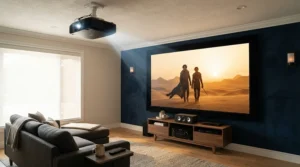
Real-World Scenarios: Three UK Cinema Rooms, Three Screen Picks
The converted garage, single dedicated room, budget around £2,000 total. A young family converting an unused garage into a weekend cinema room, with a 2,500-lumen 4K projector and a fully blackout-lined space, gets the most value from the Silver Ticket STR Series — the neutral 1.1 gain and tension rod assembly deliver accurate colour without stretching the budget, leaving more of the total spend for acoustic treatment.
The loft conversion with a skylight, mid-range budget around £4,000. A couple converting a loft space that retains one small roof light for daytime use needs ambient light management built into the screen itself, making the Elite Screens Aeon CLR3 the sensible pick despite its premium cost — trying to solve the same problem with a cheaper matte white screen would mean constant daytime washout.
The purpose-built basement cinema, premium budget over £8,000. A dedicated basement build with in-wall front speakers and a high-end 4K laser projector calls for the Elite Screens ezFrame Acoustic Pro paired with the Grandview Prestige Fixed-Frame Series build quality tier — hiding the centre channel behind the screen keeps the wall genuinely clean while the diamond-groove surface does full justice to laser-sharp 4K detail.
Common Mistakes When Buying a Fixed Frame Screen for a Cinema Room
The most frequent error is buying an ALR or CLR screen for a room that’s already fully dark — as the Elite Screens Aeon CLR3 analysis above makes clear, ambient-light-rejecting technology actually reduces black depth compared to matte white once the ambient light problem it solves no longer exists.
A close second is underestimating install labour and assuming a single person can safely mount anything over 100 inches — nearly every product reviewed here genuinely benefits from, or explicitly recommends, a two-person installation. Buyers also commonly size the screen to the wall rather than to the seating distance, ending up with a screen too large for THX-recommended viewing angles from the back row, or too small to feel immersive from the front. Finally, skipping the room-darkening groundwork before buying a premium screen is a false economy — a £900 screen in a partially lit room will look worse than a £250 screen in a genuinely dark one.
Long-Term Cost & Maintenance
Total cost of ownership on a fixed frame screen is unusually favourable compared to other home cinema components, because there’s no bulb, motor, or moving part to replace. A well-installed screen from any of the seven products above should last well over a decade with only occasional dusting, meaning the cost-per-use drops close to negligible after the first year or two of regular film nights.
The main long-term cost variable is material degradation from UV exposure or improper cleaning — screens positioned opposite an uncurtained window, even briefly during the day, will yellow faster than those in a fully room-darkened space, reinforcing why the room-darkening groundwork above pays for itself twice over.
Price Range & Value Analysis
| Tier | Screens | Typical Price Range | Value Verdict |
|---|---|---|---|
| Budget | Silver Ticket STR Series, Sapphire Fixed Frame | £150–£400 | Best entry point for dark rooms |
| Mid-range | Elite Screens Sable Frame B2, Akia Screens CineWhite Fixed Frame | £300–£500 | Strongest all-round brightness-to-price ratio |
| Premium | Grandview Prestige Fixed-Frame Series, Elite Screens ezFrame Acoustic Pro, Elite Screens Aeon CLR3 | £500–£1,400+ | Justified only for build quality, acoustic transparency, or ambient light needs |
The clearest takeaway from this breakdown is that the mid-range tier delivers the steepest jump in perceived quality per pound spent, while the premium tier’s extra cost buys a specific feature — acoustic transparency or light rejection — rather than a generic quality upgrade, so it’s only worth paying for if you actually need that feature.
Frequently Asked Questions
❓ Do I need a special screen for a 4K projector?
❓ What gain is best for a dedicated cinema room?
❓ Is a fixed frame screen better than a pull-down screen?
❓ How wide should my viewing angle be for side seating?
❓ Can I put speakers behind a fixed frame screen?
Conclusion
Choosing a fixed frame screen for dedicated cinema room use ultimately comes down to being honest about your room, not chasing the highest spec sheet. A genuinely blacked-out space rewards a neutral, moderate-gain matte white screen like the Silver Ticket STR Series or Sapphire Fixed Frame far more than an expensive ambient-light-rejecting surface it doesn’t actually need. A room with any residual light, on the other hand, makes the Elite Screens Aeon CLR3 worth its premium price precisely because it’s solving a real problem.
Across the seven screens compared here, the throughline is that a fixed frame screen for 4K projector setups performs best when gain, viewing angle, and room darkening are all matched deliberately rather than bought as an afterthought. Get the room right first, size the screen to your actual seating distance, and the rest of the decision becomes far more straightforward than the spec sheets suggest.
Recommended for You
- Ultra Short Throw Laser Projector: 7 Best Picks For UK Homes (2026)
- Premium Projector For Gaming: 7 Ultimate UK Picks (2026)
- Premium Home Cinema Projector: 7 Best Picks For UK Rooms (2026)
Disclaimer: This article contains affiliate links. As an Amazon Associate, I earn from qualifying purchases. If you purchase products through these links, we may earn a small commission at no additional cost to you.
✨ Found this helpful? Share it with your friends! 💬🤗
