
In This Article
Picture a cinema where the actor’s mouth moves in the middle of the frame and the voice arrives from a speaker sitting on the floor, two feet below her chin. Your brain forgives it. Mostly. But once you have heard dialogue that genuinely lives inside the picture, the compromise starts to itch.
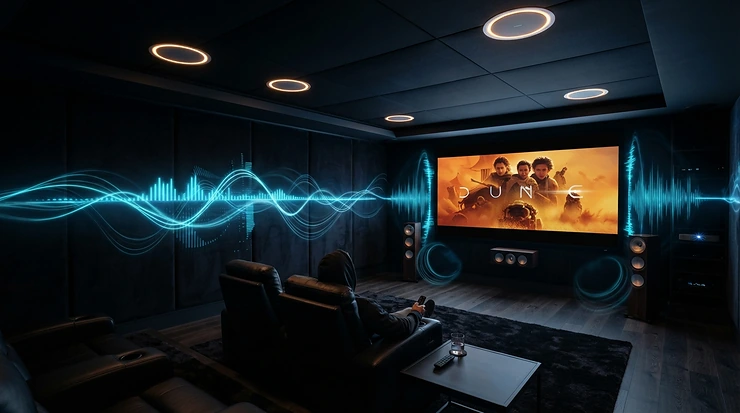
That itch is the whole reason an acoustically transparent screen for Dolby Atmos setup exists. Real commercial cinemas hide their front speakers behind a perforated screen. The trick works because the fabric lets sound through while still reflecting light back at your eyes. Bring that trick home and your left, centre and right speakers vanish behind the image, exactly where the sound mixer assumed they would be.
There is a catch, and it is worth being upfront about it. Every hole or weave gap that lets sound out also lets some projector light escape. So you are always negotiating between audio purity and picture punch. Throughout this guide I compare seven real screens, explain what their specs mean in a living room or dedicated cinema, and use published measurements and owner feedback rather than guesswork. For the technical background on how Atmos treats sound as positioned objects rather than fixed channels, Wikipedia’s Dolby Atmos entry is a solid starting point.
One practical note before we begin: some of these screens are stocked by UK dealers and marketplaces, while premium options such as the Enlightor and Stewart ranges are typically supplied through authorised installers. Check current availability on amazon.co.uk and with dealers. Prices below are indicative ranges only.
Quick Comparison Table: Seven Screens at a Glance
| Product | Type | Quoted Gain | Indicative Price | Best For |
|---|---|---|---|---|
| Silver Ticket WAB | Woven, black-backed fixed frame | 1.1 (claimed) | Mid-£300s to mid-£400s (about 100″) | Budget-conscious Atmos builders |
| Screen International Compact Home Cinema | Electric, non-tensioned | 0.7 | Roughly £700-£1,200 | Retractable screens in shared rooms |
| celexon Premium Plus SOUNDVISION SlimFrame | Woven fixed frame, velvet trim | Check spec sheet | Roughly £400-£900 by size | Neat UK-friendly fixed installs |
| Silver Ticket WVS | Finer woven fixed frame | 1.1 (claimed) | Around £450-£600 (about 100″) | Closer seating, less visible weave |
| Elite Screens Saker Tab-Tension AcousticPro UHD | Electric, tab-tensioned perforated weave | 1.0 | Roughly £900-£1,600 by size | Motorised, moiré-conscious 4K rooms |
| Screen Excellence Enlightor Neo | Ultra-fine woven, made to order | 1.0 (quoted 0.8-1.0) | Typically £1,500+, dealer-quoted | Reference sound and picture |
| Stewart Filmscreen StudioTek 130 G4 MicroPerf X² | THX-certified micro-perforated | 1.3 peak | Premium, dealer-quoted | Dark rooms needing HDR punch |
Notice how the quoted gain figures cluster around 1.0, yet independent measurements often land lower for woven fabrics. Pixel Home Theater’s measurement round-up put one popular budget woven material nearer 0.70, so treat headline gain as a starting point, not a promise. The Stewart Filmscreen StudioTek 130 G4 MicroPerf X² is the outlier for brightness, while the Screen Excellence Enlightor Neo is the outlier for smoothness and sound. If money is tight, the Silver Ticket WAB delivers the biggest sound-per-pound win here.
💬 Just one click — help others make better buying decisions too! 😊
Top 7 Acoustically Transparent Screen for Dolby Atmos Setup Picks: Expert Analysis
1. Silver Ticket WAB — the budget entry that punches above its price
The Silver Ticket WAB is the screen that made hidden speakers accessible to people without a custom-installation budget. It uses a woven acoustic fabric with a thin black speaker-cloth backing, mounted in a fixed aluminium frame. A 100-inch 16:9 version has an 87.125 × 49-inch viewing area and weighs around 30 lb, which means one person plus a helper can hang it.
Silver Ticket quotes a 1.1 gain and an 80° half-gain angle. Independent measurement is less generous: Pixel Home Theater estimated gain near 0.70 for the material, which matters if your projector is modest. On paper this means you should size the image conservatively, or budget for more lumens, rather than trusting the brochure figure. Based on the spec comparison, it is best for a controlled, dark room where sound quality is the priority.
Owners on AVS Forum describe it as a good first acoustically transparent screen, with one reporting no visible weave from about nine feet on a 110-inch image and a speaker sitting roughly three inches behind. Reviewers also note the weave is more apparent than on the fancier fabrics.
Pros:
- ✅ Excellent acoustic performance in third-party measurements
- ✅ Black backing included, cutting double imaging
- ✅ Easy fixed-frame assembly
Cons:
- ❌ Measured gain sits well below the claimed figure
- ❌ Slightly more visible texture than finer weaves
Price: typically the mid-£300s to mid-£400s for around 100 inches, so check current price. Verdict: the best value entry point for a first Atmos front stage.
2. Screen International Compact Home Cinema — a retractable UK option for shared rooms
If your cinema doubles as a living room, the Screen International Compact Home Cinema answers a question fixed frames cannot: where does the screen go when the film ends? This is an electric, non-tensioned screen using the Cinesound acoustic surface, offered by UK dealers such as Cherrywood AV in a 160 × 90 cm, 16:9 size.
Listed specs include a 0.7 gain, a 120° viewing angle and a maximum height of 200 cm. That 0.7 is the lowest quoted gain in this round-up, so the image will be softer than a 1.3 gain screen given the same projector. What it means in practice: this suits smaller rooms with a properly bright projector and controlled light, not a big-screen ambition.
The non-tensioned design also deserves an honest caution. Rolling screens can develop slight waves compared with a tab-tensioned or framed screen, and that is worth weighing if you sit close. I could not verify a meaningful body of independent owner reviews for this exact model, so I would ask the dealer for a demonstration before committing.
Pros:
- ✅ Retracts fully, freeing your wall space
- ✅ Wide 120° viewing angle for family seating
- ✅ Available through UK specialist dealers
Cons:
- ❌ Low 0.7 gain demands a bright projector
- ❌ Non-tensioned fabric may not stay perfectly flat
Price: roughly £700-£1,200 depending on size and dealer. Verdict: sensible where flexibility beats absolute picture purity.
3. celexon Premium Plus SOUNDVISION SlimFrame — velvet-framed and quietly professional
Slim frames matter more than people admit. The celexon Premium Plus SOUNDVISION SlimFrame wraps an acoustically transparent woven fabric in a narrow aluminium frame covered with black velvet, which soaks up stray light around the picture edges. A perimeter piping and mounting-rail system tensions the fabric.
The manufacturer says the woven fabric lets speakers sit invisibly behind the screen so dialogue, music and effects come from the centre of the picture. I could not find a published measured attenuation or gain figure in my research, so ask for the spec sheet before buying. Where the design earns its keep is the velvet border: it gives a cinema-style edge without a separate masking project.
On AVForums, at least one member reports buying the closely related Deluxx Cinema SlimFrame in SOUNDVISION at 110 inches, which suggests real UK owners are using this family. Detailed reviews remain thin, so I would treat it as promising rather than proven.
Pros:
- ✅ Velvet-covered slim frame reduces edge reflections
- ✅ Tensioning system keeps the fabric flat
- ✅ Sold in UK-friendly metric sizes
Cons:
- ❌ Limited independent measurements published
- ❌ Gain figure needs confirming with the seller
Price: roughly £400-£900 depending on size. Verdict: a tidy mid-range fixed install if the numbers check out.
4. Silver Ticket WVS — a finer weave for closer seating
Think of the Silver Ticket WVS as the WAB’s more refined sibling. Silver Ticket describes it as a finer weave that lets viewers sit closer without seeing the pattern, and lists it with the same 1.1 gain and 80° half-gain angle. Comparison data show the two share frame construction, so the real difference is the fabric.
What that means at home: if your seats are within about ten feet of a 100-inch image, the finer weave lowers the risk of the fabric texture reaching your eyes. A Home Theater Forum reviewer said the WVS shows ever-so-slightly less texture than the cheaper WAB, and described the material as succeeding at being a mirror for the picture and a window for the sound. That is a reviewer’s judgement, not a lab test.
Neither material has a manufacturer-recorded attenuation figure in comparison databases, so I cannot rank them for sound with certainty. Buy it if texture bothers you, otherwise the WAB does the acoustic job for less.
Pros:
- ✅ Finer weave suits closer seating positions
- ✅ Same easy fixed-frame assembly as the WAB
- ✅ Positive reviewer verdict on texture
Cons:
- ❌ Costs noticeably more than the WAB
- ❌ No published attenuation ranking against the WAB
Price: around £450-£600 for about 100 inches. Verdict: worth the premium only if you sit close.
5. Elite Screens Saker Tab-Tension AcousticPro UHD — motorised and built around moiré control
Moiré is the shimmering interference pattern that appears when a projector’s pixel grid clashes with a screen’s hole pattern. The Elite Screens Saker Tab-Tension AcousticPro UHD is engineered against it. It is a motorised, tab-tensioned screen using a perforated weave with a 1.0 gain and a stated 160° viewing angle.
Elite says the black masking borders are made from the same acoustic material, so the whole surface passes sound. That is a useful detail for anyone worried about a lonely stripe of opaque border blocking a speaker. The material has no black backing, meaning you should keep the wall behind the screen dark and non-reflective. A gain of 1.0 is a sensible middle ground for a controlled cinema room.
Elite’s own testimonials page includes an owner who moved from the older AcousticPro 1080P2 material to this one and reported that moiré vanished with a 4K projector. Note that this comes from the manufacturer’s site, so it is curated. An Adorama buyer gave the related 120-inch model four stars and praised the acoustic transparency for the price, though they had to modify the electronics slightly.
Pros:
- ✅ Tab-tension helps keep the surface flat
- ✅ Acoustic borders let sound pass everywhere
- ✅ Motorised drop with remote and trigger
Cons:
- ❌ No black backing included
- ❌ Some electronics niggles reported by a buyer
Price: roughly £900-£1,600 depending on size. Verdict: the sensible motorised choice for 4K.
6. Screen Excellence Enlightor Neo — the reference woven fabric
The Screen Excellence Enlightor Neo is a British-rooted name in this niche: Screen Excellence was founded in England in 2005, and the company also runs a joint venture with Seymour AV for North America. Its flagship woven surface is described as ultra-fine, with a weave so subtle it is hard to spot even from inches away.
Screen Excellence claims less than 1 dB loss across the audio range. Gain figures vary by source: a press release states 1.0, while coverage from CEDIA 2017 quoted 0.8. That discrepancy is exactly why I would ask a dealer for a demo. Because it passes plenty of light, a reviewer of the older Enlightor 4K measured about a third of projector light passing through without backing, so a black backing or dark wall is important.
Owners on AVS Forum are ordering the Neo for exactly this reason: they want hidden speakers without visible texture. The Pixel Home Theater roundup also singled out the family as acoustically excellent, though it noted the Bright variant measured only about 0.85 gain.
Pros:
- ✅ Among the most acoustically transparent fabrics measured
- ✅ Extremely fine weave, no minimum seating distance
- ✅ More stretch, suiting motorised installs
Cons:
- ❌ Premium cost and made-to-order lead times
- ❌ Some light passes through without backing
Price: typically £1,500 and up via dealers, so ask for a quote. Verdict: the no-compromise pick if the budget allows.
7. Stewart Filmscreen StudioTek 130 G4 MicroPerf X² — brightness for dark-room HDR
Where woven fabrics lose gain, the Stewart Filmscreen StudioTek 130 G4 MicroPerf X² fights back. It combines a THX-certified 1.3 peak-gain surface with more than 30,000 diamond-shaped, 0.5 mm perforations per square foot, designed to eliminate moiré. One forum poster puts the net gain after perforation at about 1.17.
That is a genuinely different trade. Instead of a woven weave that reads slightly soft, you get a solid-looking surface with tiny holes, so contrast and brightness suit HDR in a dark cinema. What it means in practice: it demands proper viewing distance, because micro-perforation is not designed for seats right against the screen, and the speaker should sit at the recommended gap.
Projector Reviews used a 165-inch Balón Edge with this material and saw no moiré. AVS Forum reviewers rated the G4 highly, and one noted no hot-spotting. Some forum owners note acoustic drops at the top end, roughly 7 dB at 16 kHz in one measurement they cite, which EQ can handle.
Pros:
- ✅ High gain preserves punchy HDR images
- ✅ THX Ultra certified perforation pattern
- ✅ Diamond pattern designed to defeat moiré
Cons:
- ❌ Some high-frequency loss needing EQ
- ❌ Premium price and dealer-only supply
Price: premium, dealer-quoted. Verdict: right for dark, high-end rooms.
What Is an Acoustically Transparent Screen for Dolby Atmos Setup?
An acoustically transparent screen is a projection surface, either woven or micro-perforated, that lets sound pass through with minimal loss so your left, centre and right speakers can sit hidden behind the picture. In a Dolby Atmos setup, it keeps dialogue and on-screen effects anchored to the image.
Stewart Filmscreen explains that these screens fall into two families, woven and perforated. Both work by leaving tiny gaps for sound to escape. The gaps must be big enough for audio, yet small enough that projector light does not spill onto the wall behind. Get that balance wrong and you either muffle the speakers or fill the room with stray light.
Why does Atmos raise the stakes? Dolby’s system stores sounds as positioned objects, decoded and rendered in real time according to where your speakers actually sit. That makes the front stage more important: when a sound object crosses the screen, a speaker at the right height and position can make it track the image. It also means an acoustically transparent screen for Dolby Atmos setup is less a luxury than a way to let the front stage do what the mix intends.
How to Choose an Acoustically Transparent Screen for Dolby Atmos Setup
Follow these steps, in this order, and most mistakes disappear. Stewart Filmscreen’s article on acoustically transparent screens is a helpful primer on the woven versus perforated choice.
- Measure your seating distance first. Close seats reveal weave or perforations, so finer materials such as the Silver Ticket WVS or Enlightor Neo become more attractive.
- Match gain to your projector. Measured gain often trails the claim, so a modest projector needs a brighter surface or a smaller image.
- Choose woven or micro-perforated. Woven fabrics generally pass sound most freely, while micro-perf surfaces such as the StudioTek 130 G4 favour brightness and distance.
- Plan the speaker gap. Sit speakers a few inches behind the fabric. Pixel Home Theater tested materials at 4 and 12 inches, and distance mattered.
- Decide fixed or retractable. Fixed frames stay flatter, while electric screens like the Saker AcousticPro UHD trade a little flatness for flexibility.
- Control the wall behind. Use black backing or a dark, non-reflective surface to prevent a second, ghostly image.
- Check moiré risk. Ask a dealer whether your projector’s resolution and the fabric play nicely.
Acoustically Transparent Screen vs Standard Screen: What Actually Changes
The comparison between an acoustically transparent screen and a standard one is really a comparison between two philosophies. A standard vinyl screen assumes speakers live beside or below the picture. An acoustically transparent design assumes they live behind it, as they do in a commercial cinema.
| Factor | Acoustically Transparent | Standard Solid Screen |
|---|---|---|
| Front speaker position | Behind the image, centred | Beside or below the image |
| Brightness | Some light lost through the surface | Reflects more light |
| Fine detail | Slight texture or softness possible | Smooth, sharpest surface |
| Cost | Higher for the same size | Usually cheaper |
| Install effort | Needs speaker gap and dark backing | Simple |
| Best For | Hidden fronts, e.g. Silver Ticket WAB or Enlightor Neo | Bright rooms, side-placed speakers |
Read those rows together and the trade becomes clearer. AVS Forum contributors often argue that a solid screen will beat an acoustically transparent one on pure picture, yet the sound gain from better speaker placement tends to be the larger improvement. For most Atmos builders that arithmetic favours transparency, unless a bright room or a tight budget dominates.
The Image Quality Trade-Off: What You Really Give Up
The image quality trade-off is not a myth, but it is smaller than the horror stories suggest. Pixel Home Theater measured 31 materials for sound loss, estimated gain and visible texture, and concluded that woven screens on average have lower rated gain than conventional materials. In other words, the picture cost is real and quantifiable. Their full write-up, 31 Acoustically Transparent Screen Materials Reviewed and Measured, is the best independent reference I found.
Here is what you lose. First, brightness: some light passes through, so a comparable image looks dimmer, and you may need a brighter projector to compensate. Second, contrast: light that passes through can bounce off speakers or walls and wash back, which is why black backing matters. Third, texture: at close range you may see the weave or perforations.
Now for what you keep. A well-chosen fabric, viewed from sensible distance, is very hard to fault. The owner reports I found generally describe the picture penalty as slight against the audio upgrade. The honest answer: choose the finest fabric your budget allows, size the image sensibly, and treat the image quality trade-off as a design constraint rather than a defect.
Object-Based Audio and Your Front Speaker Array
Object-based audio treats each sound as an object with coordinates rather than a signal locked to a channel. Wikipedia notes that Atmos can store up to 128 audio tracks, with a channel-based bed for ambience and the rest available for objects, and that each theatre renders them in real time based on known speaker locations.
For your front speaker array, this changes the job. The centre speaker still carries most dialogue, but left and right speakers now help place moving objects across the screen. If all three are hidden behind an acoustically transparent screen and matched, panning sounds more seamless because there is no timbre jump between the centre and the sides. AVS Forum discussion often points to the ability to use identical front speakers as one of the strongest arguments for going acoustically transparent.
Also remember that the screen only solves the fronts. Height channels still need overhead placement. Yamaha’s guidance recommends at least two and ideally four overhead speakers for a 7.1.4 layout. So a full Atmos system marries the screen with ceiling speakers, and the screen supports rather than replaces them.
Practical Setup Guide: Your First 30 Days
This section is the transformation your screen listing never gives you.
Week one: build and position. Hang the frame, then place each front speaker a few inches behind the fabric, aimed at the listening position. Keep the gap consistent across all three.
Week two: darken behind. Add black backing or paint the wall matte black. A reviewer of the Enlightor 4K measured about a third of projector light passing through without backing, so this is not cosmetic.
Week three: calibrate sound. Run your receiver’s room correction with the screen in place. One AVS Forum owner reported that speakers behind thicker fabric needed more EQ, so expect some correction, especially with micro-perforated materials.
Week four: tune the picture. Adjust focus slightly and check for moiré. Elite’s own customer feedback describes focus tweaks softening the picture on an older material, so test with real content.
Ongoing: dust the surface gently, and never press on the fabric. Re-run calibration if you move a speaker.

Real-World Scenarios: Matching Screens to Real Rooms
Scenario one, the spare-room starter. A couple converts a box room, sits about ten feet from a 100-inch image, and has around £2,500 for everything. The Silver Ticket WAB keeps screen spend low, leaving budget for a decent projector and ceiling speakers. Hang black cloth behind it and accept a slightly visible weave.
Scenario two, the family living room. A projector shares space with a sofa and a toddler. The Screen International Compact Home Cinema retracts out of sight, and the 120° viewing angle helps wide seating. Expect a softer image at 0.7 gain, so keep lighting controlled.
Scenario three, the dark-room enthusiast. Blackout curtains, an HDR projector and a 130-inch image. The StudioTek 130 G4 brings gain, while the Enlightor Neo offers smoother texture if seats are closer. Decide by seating distance and how much brightness the projector can spare.
Each choice follows the same logic: budget, distance, light and lifestyle, in that order.
Problem → Solution Guide for Hidden Front Speakers
Problem: a faint second image on the wall. Light passes through and reflects behind. Fix it with black acoustic backing, or painting the wall matte black. The Silver Ticket WAB ships with backing; the Saker AcousticPro UHD does not.
Problem: shimmering patterns. That is moiré. Adjust focus slightly, move the projector zoom, or choose a moiré-conscious material like AcousticPro UHD or the StudioTek 130 G4.
Problem: muffled treble. Reduce the gap or use a more transparent weave, then EQ. Micro-perf measured worst at 16 kHz in one cited test.
Problem: dim highlights. Choose a higher gain, shrink the image, or upgrade the projector.
Problem: confusion over Atmos basics. What Hi-Fi’s guide to Dolby Atmos explains object-based audio in plain British English.
Features That Actually Matter (And Those That Don’t)
Matter: measured acoustic loss, not just claims. Screen Excellence quotes under 1 dB for its Enlightor Neo, while some micro-perf tests cited by owners show more high-frequency loss. Matter: flatness. Tab-tension on the Saker AcousticPro UHD helps keep waves away. Matter: black borders that pass sound too, as Elite notes for its masking.
Don’t matter as much: the headline gain number. It is a mixture of marketing and measurement conditions, and third parties often find lower. Don’t matter: exotic viewing-angle figures unless your seating is genuinely wide. Don’t matter: brand mystique if the fabric is wrong for your seating distance.
What the spec sheet will not tell you is how the fabric behaves with your projector. Ask for samples, hold them against the real wall, and look at them with your actual lighting.
Common Mistakes When Buying an Acoustically Transparent Screen
Buying on gain alone is the classic error. Another is ignoring seating distance, so texture ruins the picture. A third is skipping black backing, then blaming the projector for washed-out blacks.
Some people forget that TVs and LED walls are not acoustically transparent, and that is exactly why projection remains the natural partner for hidden speakers. Others fit the screen but not the speakers: a perfect screen does nothing if the speakers sit six inches too far back.
Finally, do not assume every listing is available on amazon.co.uk. Premium ranges are frequently dealer-supplied, so confirm supply and returns before you commit.
Price Range and Value Analysis
| Tier | Products | Indicative Price | Best For |
|---|---|---|---|
| Budget | Silver Ticket WAB, celexon SlimFrame | Roughly £350-£900 | First hidden-speaker builds |
| Mid-range | Silver Ticket WVS, Screen International Compact Home Cinema, Saker AcousticPro UHD | Roughly £450-£1,600 | Closer seating or motorised needs |
| Premium | Enlightor Neo, StudioTek 130 G4 | £1,500 and up | Reference picture and sound |
The screen is rarely the largest cost in an Atmos room, yet it decides whether the whole front stage disappears. Over years, a flat, well-tensioned surface saves you from re-buying, and better fabrics tend to hold their value in your listening experience rather than in resale. If you must choose where to splurge, favour the fabric over the frame: you can hang a plain frame, but you cannot fix a weave that bothers you.
FAQ
❓ How far behind an acoustically transparent screen should speakers sit?
❓ Do I need black backing behind the fabric?
❓ Will an acoustically transparent screen work with a 4K projector without moiré?
❓ Should I run room correction after installing speakers behind the screen?
❓ Can any Atmos speaker sit behind the screen?
Conclusion
Choosing an acoustically transparent screen for Dolby Atmos setup is ultimately a decision about where you want the sound to live. Hide the front speakers behind a good surface and voices stick to faces, effects glide across the frame, and the room simply stops feeling like a room with speakers in it.
The trade-off is honest and manageable. You give up some brightness and a little sharpness, and you gain matched hidden fronts, a bigger image and a more cinematic stage. For most UK builders, the Silver Ticket WAB is the value gateway, the Silver Ticket WVS and celexon SlimFrame refine it, the Saker AcousticPro UHD adds motorisation, and the Enlightor Neo and StudioTek 130 G4 chase the reference standard. Check gain against measured data, respect your seating distance, and keep the wall behind dark.
Recommended for You
- Acoustically Transparent Projector Screen: 7 Best UK Picks (2026)
- Fixed Frame Projector Screen: 7 Best Picks For UK Homes (2026)
- Fixed Frame Screen For A Dedicated Cinema Room: 7 Top UK Picks (2026)
Disclaimer: This article contains affiliate links. As an Amazon Associate, I earn from qualifying purchases. If you purchase products through these links, we may earn a small commission at no additional cost to you.
✨ Found this helpful? Share it with your friends! 💬🤗
