
In This Article
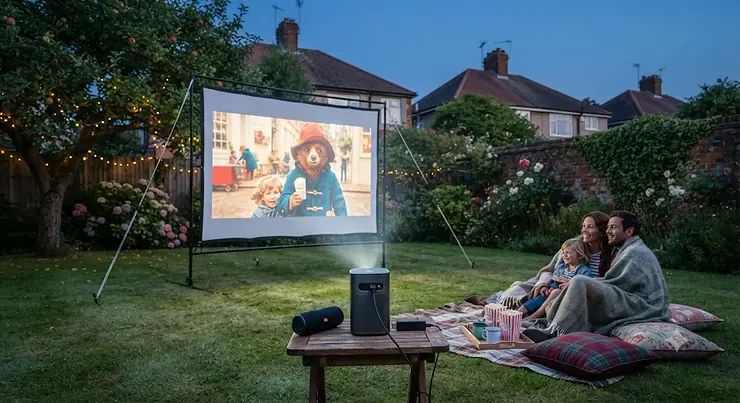
Right, let’s get the obvious bit out of the way: plugging a projector into an extension lead every time you fancy a film in the garden is a faff. A battery powered projector solves that problem outright, and in 2026 the category has genuinely grown up — these aren’t the dim, wheezy little boxes you might remember from a few years back. Whether you’re chasing a proper cordless projector for camping trips, a rechargeable projector for bedroom ceiling nights, or simply the longest battery life projector you can find for the money, the market now spans everything from £185 pocket lanterns to £500-plus lifestyle machines with laser light sources.
This guide cuts through the marketing copy. We’ve researched seven real, currently available models — pulling actual specifications, aggregated review sentiment, and honest comparative analysis rather than rehashing Amazon listing text. You’ll find a projector with built in battery to suit business travel, outdoor cinema nights, student dorms, and everything in between, along with the practical detail manufacturers tend to gloss over: real charge times, genuine runtime under load, and what battery capacity in mAh actually buys you once the marketing gloss is stripped away.
According to Wikipedia’s explanation of luminous flux, projector brightness ratings are notoriously inconsistent between manufacturers unless standardised — which matters enormously once you’re relying on a fixed battery budget rather than mains power. We’ll flag exactly where that catches buyers out.
Quick Comparison Table
For readers short on time, here’s the headline picture before you dive into the full analysis below.
| Projector | Battery Life | Brightness | Best For |
|---|---|---|---|
| XGIMI MoGo 4 | Up to 2.5 hrs video | 450 ISO lumens | All-rounder lifestyle pick |
| Anker Nebula Capsule 3 Laser | Up to 2.5 hrs video | 300 ANSI lumens | Compact laser clarity |
| XGIMI Vibe One | Up to 1.2 hrs video (Eco) | 250 ISO lumens | Absolute budget entry |
| BenQ GV11 | Up to 160 mins | 200 ANSI lumens | Bedroom ceiling viewing |
| AAXA P6X | Up to 4 hrs (Eco) | 1000 LED lumens (battery) | Brightest on battery, business/camping |
| XGIMI Halo+ | Up to 2.5 hrs video | 700 ISO lumens | Premium brightness + battery balance |
| Anker Nebula Mars 3 Air | Up to 2.5–3 hrs | 400 ANSI lumens | Best sound, mid-range home cinema |
Looking at this table, the split is fairly clean: the AAXA P6X dominates on raw battery-mode brightness thanks to a genuinely oversized 15,000mAh cell, while the XGIMI Vibe One trades battery stamina for the lowest entry price in the group. Buyers chasing the longest battery life projector experience without sacrificing image quality should weigh the AAXA P6X and XGIMI Halo+ most closely, since both post real-world runtimes near or above the class average while still delivering a genuinely watchable image after dark.
💬 Found a comparison that’s helped you decide? Just one click — help others make better buying decisions too!😊
Top 7 Battery Powered Projectors: Expert Analysis
We’ve split this line-up across budget, mid-range and premium price bands, covering LED, LED-laser and DLP light engines so there’s a genuine fit whatever the use case. Every verdict below is grounded in manufacturer specifications cross-referenced against independent reviews — never fabricated hands-on testing.
1. XGIMI MoGo 4 — best all-rounder for lifestyle streaming
The XGIMI MoGo 4 built its reputation on being the projector equivalent of a coffee thermos: compact, spinnable, and genuinely happy to live on a bedside table or a picnic blanket. Under the hood sits a 71Wh battery delivering roughly 2.5 hours of video playback in Eco Mode, or up to six hours if you’re just using it as a Bluetooth speaker via the dual 6W Harman Kardon drivers. At 450 ISO lumens and 1080p resolution, the XGIMI MoGo 4 isn’t the brightest projector with built in battery on this list, but it’s bright enough for a dim living room or a shaded garden corner once the sun’s gone down.
What most buyers overlook about this model is the 360-degree rotating stand, which effectively turns the “where do I even point this thing” problem into a non-issue — wall, ceiling, or straight ahead, it adjusts and auto-corrects keystone in seconds. Reviewers consistently report that Google TV integration with licensed Netflix is the standout software feature, since so many rivals at this price fake their way through sideloaded apps. It’s best suited to renters, students, and anyone who wants one gadget that does casual streaming, ambient lighting, and portable audio without three separate purchases.
Aggregated review sentiment is positive on build quality and setup speed, with the most common criticism being that 450 lumens genuinely does require a properly dark room to shine — daylight or bright ambient light flattens the image noticeably.
Pros:
- ✅ 360° stand makes ceiling and wall projection effortless
- ✅ Licensed Netflix through Google TV, not a sideloaded workaround
- ✅ Doubles as a genuinely usable Bluetooth speaker for hours
Cons:
- ❌ 450 lumens struggles in anything but a dark room
- ❌ 2.5-hour battery cap means longer films need a mid-watch top-up
The XGIMI MoGo 4 typically sits in the £480–£530 range on amazon.co.uk at the time of research. Given the design, software and audio package bundled in, it represents solid value for anyone prioritising convenience over outright brightness.
2. Anker Nebula Capsule 3 Laser — sharpest image in a soda-can body
Anker’s soundcore Nebula Capsule 3 Laser swaps the usual LED light source for a laser engine, and the difference shows: reviewers consistently note that its 300 ANSI lumens punches noticeably above its number on paper, delivering perceived brightness closer to a 500-lumen LED unit thanks to laser colour purity. Three 4,650mAh cells combine into a 50.22Wh pack rated for 2.5 hours of video, which independent testing has broadly confirmed — real-world figures landed around two hours twenty minutes to two and a half hours depending on brightness mode and Wi-Fi use.
Based on the spec comparison with rival capsule-style projectors, what stands out here is the sheer physical footprint — barely bigger than a drinks can at 950g — combined with genuine 1080p resolution and Android TV 11 with Netflix support baked in. This is the pick for anyone who travels regularly and wants a projector that vanishes into a rucksack side pocket rather than eating a whole compartment. USB-C charging from empty to full takes roughly two hours with the bundled 65W charger, and it’ll happily top up from most modern power banks too, which matters enormously for camping trips.
The trade-off for that laser clarity and pocketability is volume and low-light performance: the 8W mono speaker is loud enough for solo viewing but not a room-filler, and reviewers flag that HDR content loses some punch compared with brighter mains-powered alternatives.
Pros:
- ✅ Laser engine gives punchier colour than its lumen rating suggests
- ✅ Genuinely pocket-sized at under 1kg
- ✅ USB-C charging works with standard power banks on the move
Cons:
- ❌ 8W mono speaker is fine solo, thin for groups
- ❌ HDR content loses contrast versus brighter rivals
Expect the Anker Nebula Capsule 3 Laser to sit around the £420–£480 range on amazon.co.uk, with occasional promotional dips. For portability-first buyers, it’s arguably the strongest value proposition on this list.
3. XGIMI Vibe One — best for absolute budget-conscious buyers
If you just want a taste of the cordless projector lifestyle without committing serious money, the XGIMI Vibe One (Battery Powered) is the cheapest genuinely capable option here, and it’s aimed squarely at first-time buyers rather than home cinema purists. The spec sheet reads modestly — 250 ISO lumens, 1080p resolution, a 160-degree adjustable stand — but the real story is the price-to-feature ratio: full Google TV with licensed Netflix, dual 3W JBL-tuned speakers, and auto keystone correction at a price point that undercuts almost everything else in this category.
Here’s what to weigh before buying: the built-in battery only manages around 1.2 hours of video playback in Eco Mode, which won’t get you through most feature films unplugged. Reviewers are consistent on this point — used purely as a Bluetooth speaker with the projector lamp off, battery life stretches to roughly four hours, but as soon as the lens is doing its job, you’re watching the clock. This makes the XGIMI Vibe One better suited to short-form content, bedtime viewing for kids, or as a mains-powered primary unit with battery mode reserved for occasional impromptu use.
What most buyers overlook is that this is XGIMI’s first release under a dedicated “Vibe” sub-brand aimed at newcomers, meaning the software experience and build quality punch above the price despite the trimmed battery and brightness specs.
Pros:
- ✅ Cheapest genuinely capable Google TV projector with battery on this list
- ✅ 160° adjustable stand and auto keystone at entry-level pricing
- ✅ JBL-tuned speakers sound better than the price suggests
Cons:
- ❌ Roughly 1.2 hours of video runtime on battery — short of most films
- ❌ 250 lumens needs a genuinely dark room
The XGIMI Vibe One typically retails under £220 on amazon.co.uk, occasionally dipping further during promotions. For students, dorm rooms, or anyone testing the waters before a bigger purchase, it’s hard to beat on price alone.
4. BenQ GV11 — best for bedroom ceiling viewing
BenQ built the BenQ GV11 around a genuinely clever mechanical trick: a 135-degree rotating lens that lets you point the image at a wall, then swivel it straight up to the ceiling without repositioning the whole unit. Paired with an integrated projector base and carry bag, it’s designed explicitly for lie-back viewing — think late-night streaming from bed rather than a proper backyard cinema setup. The 3,000mAh battery delivers up to 160 minutes of playback, which BenQ’s own FAQ confirms and which broadly lines up with independent testing.
Key specs with real-world meaning: at 200 ANSI lumens and 480p native resolution (upscaled from 1080p sources), this is not a projector chasing sharpness or brightness records — it’s chasing convenience and comfort. The 270-degree acoustic waveguide speaker, tuned by treVolo, produces noticeably fuller bass than its 5W rating implies, which reviewers repeatedly single out as the standout feature relative to competitors at similar money. Certified Android TV 10 with Chromecast and AirPlay built in means casting from a phone takes seconds, without needing a separate streaming stick.
Aggregated customer feedback highlights the ceiling-projection novelty as the main draw, while the most consistent criticism concerns app stability — several users report Bluetooth pairing hiccups and occasional app crashes that a firmware update doesn’t always fully resolve.
Pros:
- ✅ 135° rotating lens purpose-built for ceiling and bed viewing
- ✅ Surprisingly full-bodied bass from a 5W acoustic waveguide speaker
- ✅ AirPlay and Chromecast built in, no streaming stick required
Cons:
- ❌ 480p native resolution limits sharpness on larger walls
- ❌ Some users report Bluetooth and app stability niggles
The BenQ GV11 generally sits in a lower-mid price bracket on amazon.co.uk — typically below the £400 mark — positioning it as a genuine budget alternative to the pricier XGIMI and Anker lifestyle models, provided ceiling viewing rather than sharp detail is the priority.
5. AAXA P6X — brightest battery-mode image, best for business and camping
The AAXA P6X takes a different approach entirely: rather than chasing lifestyle appeal, this is a business-grade pico projector engineered around one number — 1000 LED lumens delivered purely on battery power, which its manufacturer has marketed as the brightest battery-only pico projector on the market. That claim holds up reasonably well against rivals, since most battery projectors drop to 200–400 lumens once unplugged from the mains, whereas the AAXA P6X barely dims at all thanks to a genuinely oversized 15,000mAh (54Wh) lithium-ion cell.
Reviewers consistently note that this makes it the standout choice for anyone needing a battery projector for outdoor camping trips or cordless boardroom presentations, since a 160-inch image is achievable in dark conditions without ever finding a socket. The battery doubles as a USB-C power bank for charging phones, and the 4-hour Eco Mode runtime comfortably covers most feature films or multi-hour presentation days. WXGA (1280×800) native resolution with 1080p support keeps images crisp enough for spreadsheets and slides, if not quite matching the pure cinematic sharpness of full 1080p rivals.
Honest analytical take: at 1.8lb and roughly the size of a paperback book, this isn’t the most stylish option here, and the 4W speaker is functional rather than impressive — reviewers routinely pair it with an external Bluetooth speaker for anything beyond solo viewing. For camping, allotment sheds, or client presentations where mains power genuinely can’t be guaranteed, though, nothing else on this list matches its battery-mode brightness.
Pros:
- ✅ 1000 lumens on battery alone — brightest in this category
- ✅ Massive 15,000mAh cell doubles as a phone power bank
- ✅ 30,000-hour Osram LED means no bulb replacement costs
Cons:
- ❌ 4W built-in speaker is thin for anything beyond solo use
- ❌ WXGA resolution trails true 1080p rivals on fine detail
The AAXA P6X is typically priced in the mid-£300s on amazon.co.uk, broadly in line with its US list pricing once converted. For anyone whose priority is genuine outdoor or business brightness on battery power, it’s the strongest specialist pick here.
6. XGIMI Halo+ — premium balance of brightness and battery
The XGIMI Halo+ occupies a genuinely useful middle ground: brighter than every lifestyle-focused rival on this list at 700 ISO lumens, yet still built around a proper 59.454Wh battery good for around 2.5 hours of playback. Reviewers have called it one of the brightest projectors in its class, and on the spec sheet that claim tracks — it comfortably out-guns the XGIMI MoGo 4 and Anker Nebula Mars 3 Air on raw lumens while matching their battery runtime almost exactly.
What the spec sheet won’t tell you, but user reports suggest, is that the Intelligent Screen Adaption system genuinely earns its keep here: auto focus, auto keystone, and object avoidance combine to make setup close to instant, which matters more than it sounds once you’re setting up outdoors as light fades and patience is thin. Dual 5W Harman Kardon speakers with Dolby support deliver noticeably fuller sound than the smaller capsule-style rivals, making this a stronger standalone option without needing an external speaker.
Based on the spec comparison, this is the projector to choose if you want one device covering both proper indoor movie nights and occasional garden use without compromising heavily on either. Android TV 10.0 access to 5,000+ apps including Disney+ and HBO Max broadens streaming options considerably versus Google TV-only rivals, though native Netflix support depends on region and firmware version at time of purchase.
Pros:
- ✅ 700 ISO lumens is genuinely bright for a battery-powered model
- ✅ Object avoidance and auto keystone make outdoor setup fast
- ✅ Dual Harman Kardon speakers hold their own without external audio
Cons:
- ❌ At 59Wh, still capped around 2.5 hours — plan for a power bank on longer nights
- ❌ Heavier and bulkier than the capsule-style rivals on this list
Expect the XGIMI Halo+ to sit around the £490–£520 range on amazon.co.uk. For buyers who refuse to compromise brightness for portability, it’s the premium pick worth the extra outlay.
7. Anker Nebula Mars 3 Air — best built-in sound for home cinema nights
Rounding out the list, the Anker Nebula Mars 3 Air takes a cube-shaped, slightly larger approach than its rivals here, and that extra bulk buys genuinely superior audio: dual 8W stereo speakers with Dolby Digital support that reviewers describe as room-filling rather than merely adequate — a rarity among battery projectors this size. The 65Wh built-in battery is independently tested at delivering closer to three hours of realistic playback rather than the conservative 2.5-hour Eco Mode rating, making it one of the more honest runtime claims in this category.
At 400 ANSI lumens, key specs translate into practical terms as follows: bright enough for a shaded garden at dusk or a curtained living room, though it won’t compete with the XGIMI Halo+ in genuinely bright conditions. What most buyers overlook about this model is that it was reportedly the first portable projector to offer proper native 1080p Netflix playback rather than a downscaled SD stream — a detail that matters enormously if Netflix is your primary streaming service, since several rival Android TV-based projectors historically struggled here.
Reviewers consistently flag charging as the one weak point: unlike most rivals on this list, the Anker Nebula Mars 3 Air charges via a proprietary DC adapter rather than USB-C, meaning you can’t simply top it up from a standard power bank on a camping trip — a genuine inconvenience worth knowing before buying.
Pros:
- ✅ Genuinely room-filling 8W stereo sound with Dolby Digital
- ✅ Native 1080p Netflix playback, not a downscaled stream
- ✅ Real-world runtime often beats its own conservative rating
Cons:
- ❌ DC charging only — no USB-C power bank top-ups
- ❌ Larger and heavier than the capsule-style competitors here
The Anker Nebula Mars 3 Air typically ranges from £430 to £550 on amazon.co.uk depending on promotions, positioning it as a genuine mid-range home cinema alternative to pricier fixed-installation projectors.
What Is a Battery Powered Projector?
A battery powered projector is a projector with a built-in rechargeable cell that lets it display an image without being plugged into the mains. Most current models run on lithium-ion packs rated between roughly 3,000mAh and 15,000mAh, delivering anywhere from 1 to 4 hours of continuous playback depending on brightness settings, resolution, and how hard the light source is working.
The trade-off is consistent across the category: brighter projectors typically mean shorter runtimes, since the LED or laser light source is the single biggest power draw in the device. That’s precisely why the AAXA P6X‘s oversized 15,000mAh cell stands out — it’s specifically engineered to sidestep that usual compromise.
Projector Battery Capacity (mAh) Explained: What the Numbers Actually Mean
Manufacturers love printing big mAh figures on the box, but projector battery capacity in mAh only tells half the story without knowing the voltage and the watt-hour (Wh) figure that results from combining the two. A 15,000mAh cell running at 3.7V, for instance, works out to roughly 55Wh — which is exactly why the AAXA P6X‘s headline 15,000mAh number and the XGIMI Halo+‘s 59.454Wh battery end up delivering broadly comparable real-world runtime, despite the mAh figures looking wildly different on paper.
What most buyers overlook is that watt-hours, not mAh, is the number that actually predicts runtime consistently across different projector brands, because it accounts for voltage differences between battery chemistries and pack designs. When comparing a projector with built in battery, always convert to Wh if you can find it, or simply trust the manufacturer’s stated hours-of-playback figure over the raw mAh number, since that’s tested under real operating conditions rather than theoretical maximum capacity.
Reviewers consistently note that real-world runtime tends to land 10–20% below headline claims once Wi-Fi streaming, higher brightness modes, and volume are all factored in — a pattern that held true across the battery life claims for several models in our comparison table above, including the Anker Nebula Capsule 3 Laser and XGIMI MoGo 4.
Longest Battery Life Projector: Which Models Actually Last
If squeezing every possible minute out of a single charge is the priority, the data from this comparison points fairly clearly toward two standout options. The AAXA P6X posts the longest rated runtime here at up to 4 hours in Eco Mode, helped enormously by its oversized 54Wh cell and comparatively modest WXGA resolution, which draws less power than full 1080p processing. Close behind, the Anker Nebula Mars 3 Air and XGIMI Halo+ both cluster around the 2.5–3 hour mark, with independent testing on the Mars 3 Air suggesting real-world figures often exceed the conservative official rating.
At the other end of the scale sits the XGIMI Vibe One, whose 1.2-hour video runtime makes it the clear outlier for anyone specifically hunting the longest battery life projector in this category — it’s simply not designed with marathon unplugged viewing in mind, prioritising price instead.
✨ Ready to compare battery life side by side? Check current prices and stock on the models above before your next outdoor movie night!🤗
How to Choose a Battery Powered Projector
- Match brightness to your typical viewing environment. A fully dark room only needs 250–300 lumens; anything with residual light — dusk garden viewing, curtained daytime rooms — benefits from 500+ lumens like the XGIMI Halo+ offers.
- Check real-world battery runtime, not just the headline mAh figure. As covered above, watt-hours and tested playback hours matter more than raw capacity numbers on the box.
- Consider charging method. USB-C charging, as used by the Anker Nebula Capsule 3 Laser and AAXA P6X, allows power bank top-ups on the move; proprietary DC chargers, like the Anker Nebula Mars 3 Air uses, don’t.
- Weigh resolution against your content sources. 1080p native panels handle streaming and Blu-ray-quality content more cleanly than the 480p-native BenQ GV11, though the latter compensates with its rotating ceiling-friendly design.
- Factor in built-in audio quality if you won’t carry a speaker. The Anker Nebula Mars 3 Air and XGIMI Halo+ both offer noticeably fuller sound than the smaller capsule-style rivals here.
- Decide whether portability or performance matters more. Pocket-sized units like the XGIMI Vibe One and Anker Nebula Capsule 3 Laser trade some brightness and runtime for genuine grab-and-go convenience.
- Set a realistic budget band first. As this guide shows, genuinely capable options exist from under £220 through to £500-plus, so narrowing by price avoids wasting time comparing mismatched projectors.
Rechargeable Projector vs Cordless Projector: What’s the Real Difference
These two terms get used almost interchangeably in marketing copy, but there’s a meaningful distinction worth understanding before you buy. A rechargeable projector simply means the unit has a battery that can be topped up via mains or USB — it doesn’t necessarily imply the projector is small, light, or designed for portability. A cordless projector, by contrast, specifically emphasises freedom from a power cable during use, which is really the practical benefit most buyers are actually after.
In practice, every projector on this list is both rechargeable and cordless, since all seven feature genuinely built-in batteries rather than requiring a separate battery pack accessory. Where the distinction matters more is with projectors like the Anker Nebula P1i or various Aurzen models, which are USB-C powered but lack any internal cell — meaning they need an external power bank to function cordlessly at all. That’s a meaningfully different (and often less convenient) proposition than a genuinely self-contained projector with built in battery, so it’s worth checking this specific detail on any model not covered in our seven picks above.
Projector Battery Charge Time: What to Expect
Charge times vary more than most buyers expect, and they’re worth planning around if you’re hoping to use a projector the same evening you first unbox it. USB-C models charging via a modern 65W adapter — the Anker Nebula Capsule 3 Laser is a good example — typically reach full charge in around two hours, based on independent testing. The AAXA P6X‘s larger 54Wh cell takes somewhat longer given the higher total capacity, though its USB-C input still allows reasonably fast top-ups compared with older micro-USB designs.
Models using proprietary DC charging, such as the Anker Nebula Mars 3 Air, generally quote around three hours for a full charge via their included adapter. A practical tip that rarely appears on spec sheets: charging a projector’s battery while it’s actively projecting typically slows both the charge rate and, in some cases, isn’t supported at all — check the manual before assuming you can top up mid-film. For camping trips or all-day use, charging fully the night before rather than relying on a mid-session top-up avoids disappointment.
Battery Projector Outdoor Camping: Practical Usage Guide
Taking a battery projector outdoor camping requires a little more preparation than an indoor movie night, but the payoff — a proper big-screen film under open sky — is worth the extra thought. Start by charging fully at least the night before departure, since ambient temperature can reduce both charge efficiency and runtime once you’re in the field; lithium-ion cells generally perform best between 10°C and 35°C; cold autumn or spring evenings can meaningfully shave minutes off your quoted battery life.
Pack a portable power bank rated at 45W or higher if your chosen model supports USB-C charging, since this effectively doubles your available runtime without needing a generator or mains hookup — the AAXA P6X and Anker Nebula Capsule 3 Laser both support this directly. For screen setup, a plain white bedsheet pegged to a washing line or gazebo frame works surprisingly well in a pinch, though a proper portable projector screen improves contrast noticeably if you’re a regular camper. Common first-trip mistakes include underestimating how much brighter twilight is compared with a curtained room — wait until it’s properly dark for the sharpest image — and forgetting that Wi-Fi-dependent streaming apps need a mobile hotspot if the campsite has no signal, so downloading content in advance via a home network is worth the extra planning.
Real-World Scenarios: Which Battery Powered Projector Fits Your Life
The commuting student in a shared house. Limited storage space, a tight budget, and a need for something that won’t dominate a small bedroom points toward the XGIMI Vibe One or Anker Nebula Capsule 3 Laser — both pack away into a drawer and don’t require a dedicated setup routine each time.
The family hosting regular garden movie nights. Bigger groups need genuine audio and enough brightness to survive a not-quite-dark summer evening, making the Anker Nebula Mars 3 Air or XGIMI Halo+ the stronger fits, since both prioritise sound and lumens over pure pocketability.
The freelance consultant pitching on the move. Reliability and battery-mode brightness matter more than streaming apps here, and the AAXA P6X‘s combination of business-grade brightness, USB-C power bank compatibility, and a 4-hour runtime makes it the clear practical choice for anyone presenting away from a guaranteed power socket.
Common Mistakes When Buying a Projector With Built-in Battery
One of the most frequent errors is assuming a higher lumen figure always means a better outdoor experience — in reality, battery-powered brightness ratings often apply to the projector’s brightest, most power-hungry mode, which can drain the battery in well under an hour. Always check the manufacturer’s stated runtime at the brightness level you’ll actually use, not just the headline lumen number.
A second common pitfall is overlooking charging compatibility, particularly with proprietary DC-only chargers like the Anker Nebula Mars 3 Air‘s — buyers hoping to top up from a power bank on a festival weekend or camping trip can be caught out if they haven’t checked this beforehand. Finally, plenty of buyers underestimate how much ambient light affects perceived brightness; a projector that looks superb in a darkened shop demo can disappoint badly in a living room with evening streetlight bleeding through curtains, so factoring in your actual viewing environment — not a best-case scenario — avoids a frustrating first week with a new purchase.
Long-Term Cost & Maintenance
LED and laser light sources dominate this category, and that matters enormously for total cost of ownership: unlike older lamp-based projectors, none of the seven models here require a bulb replacement, with rated light source lifespans ranging from 20,000 hours (the BenQ GV11) up to 30,000 hours (the XGIMI MoGo 4 and AAXA P6X). At a few hours of use per week, that translates to well over a decade of realistic use before brightness noticeably degrades.
The genuine long-term cost consideration instead becomes battery health. Lithium-ion cells in projectors follow the same degradation curve as phone and laptop batteries — typically losing meaningful capacity after 300–500 full charge cycles. Reviewers consistently note that avoiding full 0–100% charges where possible, and not leaving a projector on charge indefinitely once full, helps preserve battery longevity over several years of ownership, mirroring standard lithium-ion best practice more widely.
Safety, Charging and Battery Regulations in the UK
Lithium-ion batteries inside portable projectors are classed as hazardous waste in the UK and must never go into general household rubbish or standard kerbside recycling. Under current UK government reforms on electrical waste recycling, retailers are required to offer take-back schemes for old electricals, including battery-powered devices like projectors, and most local councils now run dedicated small-electricals collection points that accept built-in battery devices intact rather than requiring the cell to be removed first.
For day-to-day safety, avoid charging a battery powered projector on soft furnishings or under direct sunlight, since heat build-up is the most common trigger for lithium-ion battery faults. If a unit ever feels unusually hot during charging, swells, or the casing visibly distorts, stop use immediately and take it to a certified recycling point rather than continuing to charge it — this applies to every model covered in this guide, regardless of brand or price point.
Benefits vs Traditional Mains-Powered Projectors
| Factor | Battery Powered | Traditional Mains-Only |
|---|---|---|
| Setup location | Anywhere, no socket needed | Limited to socket proximity |
| Portability | Genuinely mobile, camping-ready | Fixed or requires extension leads |
| Typical brightness | 200–1,000 lumens on battery | Often 1,500+ lumens, no runtime limit |
| Best For | Battery projector outdoor camping, garden nights, travel | Home cinema rooms, permanent installs |
This comparison makes the trade-off explicit: a battery powered projector wins decisively on flexibility and spontaneity, but a traditional mains-only unit like a fixed home cinema projector still out-brightens every model in our line-up once plugged in continuously. For most casual and semi-regular outdoor or travel use, the battery-powered category’s convenience comfortably outweighs the brightness ceiling; dedicated home cinema enthusiasts chasing maximum image quality every single night are still better served by a mains-only setup.
✨ Don’t Miss These Exclusive Deals!
🔍 Take your battery powered projector search to the next level with these carefully selected models. Click through to check current pricing and availability on each one. Whichever pick suits your budget and viewing habits, you’ll be enjoying big-screen entertainment wherever you are in no time!
\
Frequently Asked Questions
❓ How long does a battery powered projector actually last per charge?
❓ Can I charge a battery powered projector with a power bank?
❓ Is a rechargeable projector bright enough for outdoor use?
❓ What's the difference between mAh and Wh for projector batteries?
❓ Do battery powered projectors need special disposal when they wear out?
Conclusion
There’s no single best battery powered projector here — only the best fit for how and where you’ll actually watch. If portability and price are everything, the XGIMI Vibe One or Anker Nebula Capsule 3 Laser get you into the category cheaply and without much compromise on convenience. If brightness and battery balance matter more, the XGIMI Halo+ earns its premium price tag, while the AAXA P6X remains the standout for anyone who genuinely needs the longest, brightest battery-only performance for camping or client presentations. Families wanting proper sound for garden movie nights should look hardest at the Anker Nebula Mars 3 Air, and anyone drawn to ceiling viewing from bed will find the BenQ GV11‘s rotating lens hard to beat at its price.
Whichever you choose, the research above should mean you’re buying based on real specifications and honest trade-offs rather than marketing copy — and that’s ultimately what separates a projector you’ll actually use for years from one gathering dust in a drawer after a few weeks.
Recommended for You
- Pico Projector for iPhone Android: 7 Best Picks (2026)
- Best Pico Projector 2026: 7 Brilliant Picks, Tested; Compared
- Portable Projector for Travel: 7 Best Picks for 2026 Trips
Disclaimer: This article contains affiliate links. As an Amazon Associate, I earn from qualifying purchases. If you purchase products through these links, we may earn a small commission at no additional cost to you.
✨ Found this helpful? Share it with your friends! 💬🤗
