
In This Article
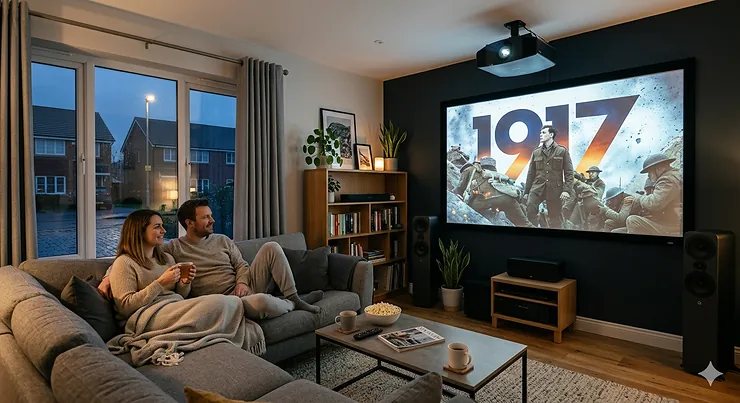
Here’s the thing nobody tells you before you buy a projector: the projector is the easy bit. A home cinema projector setup is a system — a projector, something to bounce the light off, something to stop your neighbour’s security light from ruining Dune: Part Three, and something to make the explosions actually feel like explosions instead of a tinny laptop speaker doing its best. Get one piece wrong and the whole thing feels like watching telly through a letterbox.
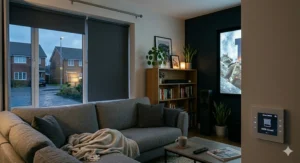
I’ve spent the past week pulling apart UK buyer reviews, spec sheets, and the kind of forum threads where grown adults argue passionately about ANSI lumens. What follows isn’t a spec dump. It’s the stuff that actually changes how your Tuesday-night film looks: which screen pairs sensibly with a budget projector, why your bay window is sabotaging you, and which mount will save you from drilling a hole exactly 4cm too far left (ask me how I know — actually, don’t, it’s a long story involving a stepladder and a strongly worded text to my landlord).
Quick bit of housekeeping: every product below is real, currently listed on Amazon.co.uk, and chosen to cover the whole setup — not just seven projectors fighting over the same 100 lumens.
Quick Comparison Table
| Product | Category | Best For | Price Range (GBP) | Amazon.co.uk |
|---|---|---|---|---|
| Epson CO-W01 | Projector | Budget first-timers | £300–£400 | ✅ Prime eligible |
| soundcore Nebula Capsule 3 | Projector | Compact/portable | £350–£450 | ✅ Prime eligible |
| soundcore Nebula X1 Pro | Projector | Premium dedicated cinema | £1,200–£1,600 | ✅ Prime eligible |
| VonHaus Pull-Down Screen (100″) | Screen | Permanent ceiling install | £80–£130 | ✅ |
| Duronic PB04XL Mount | Mount | Flexible ceiling/wall fixing | £25–£45 | ✅ Small Business |
| NICETOWN Blackout Curtains | Light control | Renters, bay windows | £25–£45 | ✅ |
| Sonos Beam (Gen 2) | Soundbar | Compact Atmos sound | £400–£480 | ✅ |
A glance at that table tells you most of what you need: this is a “pick one from each row” job, not a “buy all seven” job. The Epson and the entry-level Nebula sit at roughly the same price, but they solve different problems — one’s for a dedicated spot on a shelf, the other’s for the person who wants to drag movie night into the garden on a rare dry British evening. Worth flagging early: the VonHaus screen and Duronic mount are genuinely complementary, not competing, since one hangs the projector and the other catches the light it throws.
💬 Just one click — help others make better buying decisions too! 😊
✨ Don’t Miss These Exclusive Deals!
🔍 Take your home cinema setup to the next level with these carefully selected products. Click through to check current pricing and availability on Amazon.co.uk — these picks cover everything from the projector itself to the bits that actually make it watchable.
What Is a Home Cinema Projector Setup?
A home cinema projector setup is the combination of a projector, a reflective screen (or suitably pale wall), light control such as blackout curtains, a stable mount, and — usually — external speakers, arranged to recreate a cinema-style viewing experience at home rather than relying on a traditional television.
Top 7 Picks for a UK Home Cinema Setup
1. Epson CO-W01 — The Sensible Starting Point
The Epson CO-W01 is a WXGA projector running 3LCD tech with roughly 3,000 ANSI lumens, which in plain English means: bright enough to survive a British living room that doesn’t have proper blackout, without you needing to remortgage. That brightness figure matters more than most spec sheets let on — anything under 2,000 lumens turns into a washed-out mess the second a streetlamp flickers on outside, which, let’s be honest, is most evenings between October and March.
What this is genuinely good at: presentations doubling as movie nights, conservatories with too much glass, and first-time buyers who want to learn what they actually need before spending serious money. What it won’t do is convince anyone it’s a 4K laser unit — because it isn’t, and Epson never claimed it was.
✅ Bright enough for ambient-light rooms
✅ Easy keystone correction for wonky ceilings
✅ Genuinely budget-friendly entry point
❌ No native 4K — 1080p content is its comfort zone
❌ Built-in speakers are an afterthought; budget for a soundbar
Price & verdict: Sitting around the £300–£400 range on Amazon.co.uk, it’s the projector you buy to find out if you even like projector life before committing further.
2. soundcore Nebula Capsule 3 — The One That Comes to the Garden
Anker’s soundcore Nebula Capsule 3 runs Google TV natively, which sounds like a small thing until you realise it means no fumbling for a streaming stick every time you move the thing from the lounge to the patio for a rare heatwave screening. With integrated Wi-Fi, Bluetooth and Chromecast, it casts content from a phone without ceremony.
The trade-off, and it’s a real one for the UK: a single HDMI port means no daisy-chaining a games console and a soundbar without a splitter, and the picture quality — while perfectly watchable on HD sources — won’t flatter anything pretending to be 4K. What it does brilliantly is portability; the built-in handle and battery make it the projector equivalent of a Bluetooth speaker, ideal for flats where a permanent setup simply isn’t on the table.
✅ True portability — battery and handle included
✅ Native Google TV, no extra streaming stick needed
✅ Genuinely simple setup, even for first-timers
❌ Single HDMI port limits multi-device setups
❌ Not a substitute for a proper dedicated cinema unit
Price & verdict: Around £350–£450, and worth every penny if your “home cinema” needs to double as a garden cinema the three weekends a year British weather permits it.
3. soundcore Nebula X1 Pro — The Proper Cinema Unit
This is where things get serious. The Nebula X1 Pro uses triple-laser projection rated around 3,500 ANSI lumens with genuine 4K output, a 56,000:1 contrast ratio, and — unusually for a projector at this level — built-in 7.1.4 spatial sound with Dolby Atmos, meaning you could, in theory, skip the soundbar entirely.
What that triple-laser system actually buys you in a UK living room: colour accuracy that survives a bit of ambient light, which matters enormously here given how few British homes have a genuinely dark dedicated media room. The “smart auto setup” feature — auto-focus and auto-keystone working together — also solves the single biggest complaint in projector reviews generally: people fighting the geometry for twenty minutes before a film even starts.
✅ True native 4K with triple-laser brightness
✅ Built-in Atmos sound strong enough to skip a soundbar
✅ Auto setup genuinely reduces faff
❌ Premium price puts it well above casual-buyer territory
❌ Overkill if you mainly watch on a 80-inch screen or smaller
Price & verdict: Expect to pay in the £1,200–£1,600 range — a serious outlay, but one that replaces a screen, a soundbar, and a chunk of the calibration headache in a single box.
4. VonHaus Pull-Down Projector Screen (100″) — The UK Brand Doing the Boring Bit Brilliantly
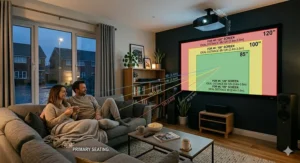
VonHaus is a UK-facing brand, and their 100-inch pull-down screen with a 16:9 ratio is a genuinely unglamorous but essential piece of the puzzle. A matte white surface with a soft-close retraction mechanism and stainless-steel casing sounds like marketing fluff until you’ve lived with a screen that doesn’t close quietly and realise how much that one detail matters at 11pm with a sleeping toddler upstairs.
The honest pitch here: a proper screen earns its keep over a bare wall by rejecting ambient light better and avoiding the texture and colour-tint problems that magnolia paint introduces. For anyone in a rented flat where painting a “cinema wall” black isn’t an option, this is the workaround.
✅ Soft-close mechanism, genuinely quiet operation
✅ Wall or ceiling mountable — flexible for awkward UK room shapes
✅ Matte finish noticeably outperforms a painted wall
❌ Manual pull-down, not motorised — fine for most, mildly annoying for some
❌ 100 inches needs real throw distance; measure your room first
Price & verdict: Typically £80–£130 — modest money for what’s arguably the single biggest image-quality upgrade on this list short of the projector itself.
5. Duronic PB04XL Projector Mount — The British Brand That Just Gets It
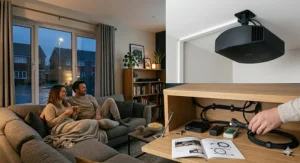
Duronic, a UK-founded brand making mounts since 2005, sell almost nothing but mounts — and it shows. The PB04XL is a universal ceiling/wall bracket rated to 13.6kg, with 360° rotation and enough swivel and tilt range to cope with the genuinely odd ceiling angles that older British houses are famous for.
What most buyers overlook about mounts generally: the goal isn’t maximum flexibility, it’s minimising how much keystone correction you’ll need afterwards, because digital keystone correction softens the image. A well-positioned mount beats software correction every time, and Duronic’s range (this one included) is built around that principle — including a pole-mount option for unusually high ceilings, a genuine consideration in converted Victorian terraces with soaring ceiling heights.
✅ 13.6kg capacity covers all but the heaviest projectors
✅ Full fittings included, with a 2-year warranty
✅ Designed specifically to avoid projector overheating
❌ Universal fit means you should double-check your projector’s mounting holes first
❌ Pole-mount versions need real ceiling height to make sense
Price & verdict: Usually £25–£45 depending on the exact model in the range — cheap insurance against a wonky, off-centre picture for the life of the setup.
6. NICETOWN Thermal Insulated Blackout Curtains — The Unsung Hero
If there’s one thing that separates a flat, washed-out projector image from a genuinely cinematic one, it’s darkness — and British living rooms, with their bay windows and thin curtain rails, are not naturally good at this. NICETOWN’s thermal blackout curtains use a triple-weave polyester construction that, per the brand’s own product details, is designed to block the bulk of incoming light while adding a layer of thermal insulation as a side benefit — handy in a country where heating costs are a year-round conversation, not just a winter one.
UK reviewers consistently flag two things: genuinely noticeable light reduction, and that “blackout” claims across this category in general are sometimes generous — a recurring theme that’s worth bearing in mind whatever brand you land on. For a dedicated cinema corner, pairing thick curtains with a blind behind them solves the gap problem most light leaks come from.
✅ Triple-weave fabric genuinely reduces ambient light
✅ Thermal insulation as a useful side effect for UK energy bills
✅ Wide range of sizes and eyelet styles for awkward windows
❌ “Blackout” still allows some light at the edges without a fitted track
❌ Hand-wash-only on some variants — check the listing before buying
Price & verdict: Generally £25–£45 for a pair, making this one of the cheapest, highest-impact upgrades on the entire list.
7. Sonos Beam (Gen 2) — The Soundbar That Doesn’t Dominate the Room
Built-in projector speakers are, almost without exception, an afterthought — fine for catching the football highlights, hopeless for a film with any kind of sound design. The Sonos Beam (Gen 2) is a compact soundbar supporting Dolby Atmos through clever virtual height-channel processing, and What Hi-Fi’s testing found it noticeably elevated the sense of scale even on screens far smaller than a projector image, which bodes well for the genuinely large images a projector produces.
The real selling point for UK buyers specifically: it folds into a wider Sonos multi-room system if you ever expand, and setup is refreshingly simple — one HDMI eARC cable to the projector or AV source, and the soundbar effectively takes over audio duties entirely.
✅ Compact footprint — won’t dominate a small UK living room
✅ Simple HDMI eARC setup, minimal faff
✅ Expandable into a full Sonos multi-room system later
❌ No dedicated height channels — Atmos here is virtual, not literal
❌ Premium pricing for what is, at heart, a single soundbar unit
Price & verdict: Around £400–£480, sitting comfortably below the eye-watering premium soundbar systems while still delivering a real step up from any built-in projector speaker.
Practical Usage Guide: Setting Up Without the Headaches
Getting a projector merely working and getting it working well are different jobs, and the gap between them is almost entirely about light and angles.
Start with darkness, not brightness. It’s tempting to chase a brighter projector to compensate for a light-filled room, but that’s solving the wrong problem — a £1,000 projector in a sunlit room performs worse than a £300 one in a properly blacked-out space. Sort the curtains first.
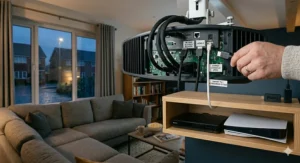
Measure before you mount. Every projector has a minimum and maximum throw distance for a given screen size, buried in the manual. Skipping this step is the single most common reason people end up “fixing” a soft, blurry image with software correction that was never the real issue.
Mind British humidity. Projectors generate heat, and small UK rooms with limited airflow — especially converted box-rooms — can run warmer than manufacturers expect. A mount that keeps vents clear, like the Duronic models above, genuinely matters here, not just for image quality but for the unit’s lifespan.
Store cables, don’t drape them. In smaller flats and terraced houses, a trailing HDMI cable across the floor is both a trip hazard and an eyesore. Cable clips or a simple trunking strip along the skirting board solves this in about twenty minutes.
Real-World Scenario: Three UK Setups
The London flat-share, Zone 2. Limited wall space, no permission to drill into a rented ceiling, and a need to pack everything away on Sunday nights. The soundcore Nebula Capsule 3 paired with a fold-away screen or a plain magnolia wall makes the most sense — nothing permanent, nothing that needs the landlord’s blessing.
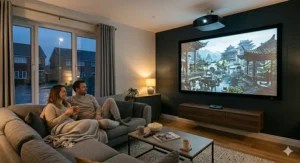
The semi-detached family home, Birmingham suburbs. A spare box-room becomes a proper mini cinema. This is the Epson CO-W01 or, budget allowing, the Nebula X1 Pro territory — paired with the VonHaus pull-down screen, Duronic ceiling mount, and NICETOWN curtains over the single small window. Total setup cost stays well under what a comparable large OLED TV would cost.
The retired couple, rural Cotswolds. Big lounge, high ceilings, evenings that get properly dark thanks to minimal street lighting — genuinely ideal projector conditions. Here the limiting factor isn’t light control, it’s throw distance, so the Duronic PB02XL’s longer pole reach (rather than the standard PB04XL) becomes the more sensible mount choice.
How to Choose a Home Cinema Projector Setup in the UK
- Decide if the setup is permanent or portable first — this single decision rules out roughly half the products on the market before you’ve even looked at brightness specs.
- Match brightness (lumens) to your room’s worst-case ambient light, not its best case — think “winter afternoon with the curtains half-open,” not “midnight blackout.”
- Budget for the whole system, not just the projector — a brilliant projector pointed at a bare wall through a half-curtained bay window will always underwhelm.
- Check throw distance against your actual room dimensions before buying anything, using a tape measure rather than guesswork.
- Treat sound as a separate line item — built-in projector speakers are rarely good enough for anything beyond background noise.
- Confirm UK plug and 230V compatibility on the specific listing, particularly for projectors imported via third-party Amazon sellers rather than UK-stocked ones.
Common Mistakes When Buying a Projector Setup
The most frequent misstep is buying the projector first and the screen as an afterthought — when in a typical UK living room, the screen and light control do more visible work than an extra few hundred lumens ever will. A close second is ignoring throw distance entirely, leading to a returned projector that “didn’t fit the room,” when really it just needed repositioning. Buyers also regularly underestimate how much heat smaller UK rooms trap, leading to projectors running hotter and louder (fan noise) than expected. Finally, treating a “blackout” curtain claim as gospel rather than checking real buyer reviews for how much light genuinely gets through at the edges is a recurring, avoidable disappointment.
Projector vs Traditional TV: What Actually Changes
A projector trades the TV’s reliable picture-in-any-light performance for sheer scale — a 100-inch image simply isn’t realistic with a flat panel at projector-equivalent prices. What you give up is convenience: TVs work instantly in daylight, projectors generally don’t. For UK homes specifically, where natural light is changeable and unreliable for half the year anyway, the trade-off skews more favourably toward projectors than it might in, say, a consistently sun-drenched climate, simply because British evenings get properly dark, properly early, for a good chunk of the year.
UK Regulations, Safety Standards & Practical Considerations
Electronics sold on Amazon.co.uk for the UK market should carry UKCA marking (the post-Brexit replacement for CE marking on goods placed on the GB market), and it’s worth checking the product listing or packaging for this, particularly with projectors imported through third-party Amazon Marketplace sellers rather than stocked directly for the UK. Buyers are also protected under the Consumer Rights Act 2015 and the Consumer Contracts Regulations, which provide a 14-day cooling-off period on most online purchases — useful if a projector arrives and the throw distance simply doesn’t suit your room after all. Independent reviews from organisations like Which? are a sensible cross-check against manufacturer claims, particularly around brightness and “blackout” percentage claims on curtains and screens.
FAQ
❓ What size projector screen do I need for a UK living room?
❓ Do projectors work well in UK daylight?
❓ Is a soundbar necessary for a projector setup?
❓ Can I return a projector bought on Amazon.co.uk if it doesn't suit my room?
❓ Will a projector setup work in a UK conservatory?
Conclusion
A genuinely good home cinema projector setup in the UK isn’t about chasing the single best projector on a spec sheet — it’s about treating the room as part of the system. Sort the darkness first, measure your throw distance before you buy anything, and budget for sound as a separate line item rather than an afterthought. Whether that means the unfussy Epson CO-W01 in a box-room with the VonHaus screen and a set of proper blackout curtains, or the do-everything Nebula X1 Pro in a dedicated media room with the Sonos Beam handling sound, the combination matters more than any individual component. Pick the row from the comparison table that matches your actual living situation, not your aspirational one, and the rest tends to fall into place.
Recommended for You
- Home Cinema Projector vs TV: 7 Best Picks for UK Buyers in 2026
- Best Home Cinema Projector Under £500 UK: 7 Expert Picks for 2026
- Best Home Cinema Projector UK 2026: 7 Top Picks Reviewed
Disclaimer: This article contains affiliate links. As an Amazon Associate, I earn from qualifying purchases. If you purchase products through these links, we may earn a small commission at no additional cost to you.
✨ Found this helpful? Share it with your mates! 💬🤗
