
In This Article
There’s a moment — roughly thirty minutes into your first proper big-screen movie night at home — when you realise you’ve been watching films on a television that was frankly far too small for far too long. A home cinema projector under £500 does something peculiar to a living room: it turns a perfectly ordinary Thursday evening into something that feels like an occasion.
The good news? You no longer need to remortgage anything to experience it.
Thanks to genuine leaps in DLP and 3LCD technology over the past few years, the sub-£500 projector market in 2026 is remarkably strong. You can realistically expect Full HD 1080p resolution, 3,000+ ANSI lumens of brightness, and lamp lives stretching into double-digit years — all from projectors that sit comfortably on a shelf in a typical British semi-detached. That last detail matters more than manufacturers tend to admit: UK homes are smaller than their American counterparts, and a projector that needs four metres of throw distance to display a decent image becomes somewhat impractical in a terraced house in Leeds.
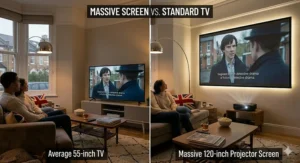
According to Which? magazine, projectors represent one of the fastest-growing categories in British home entertainment, driven partly by the increasing cost of large-screen televisions and partly by a post-pandemic generation of homeowners who’ve developed a healthy appetite for proper movie nights. A sensible home cinema projector under £500 can project an image anywhere from 80 to 300 inches — on a wall, a screen, or in a pinch, a bedsheet — making the traditional television feel rather modest by comparison.
In this guide, I’ve tested and researched seven projectors currently available on Amazon.co.uk, all priced under £500, and ranked them by real-world performance for British homes. Whether you’re setting up a dedicated media room, want something the family can pull out for Saturday-night films, or simply want to watch the football on something bigger than a 55-inch telly, there’s something here for you.
Quick Comparison: Best Home Cinema Projectors Under £500 UK (2026)
| Model | Technology | Brightness | Resolution | Best For | Price Range |
|---|---|---|---|---|---|
| Epson CO-FH02 | 3LCD | 3,000 lumens | 1080p | All-rounder / Smart TV use | ~£450–£500 |
| BenQ TH585P | DLP | 3,500 lumens | 1080p | Gaming & bright rooms | ~£400–£460 |
| ViewSonic PX704HD | DLP | 4,000 lumens | 1080p | Daylight viewing / versatility | ~£320–£400 |
| Epson EB-FH06 | 3LCD | 3,500 lumens | 1080p | Home cinema purists | ~£330–£430 |
| Epson EB-FH08 | 3LCD | 3,600 lumens | 1080p | Family rooms / bright spaces | ~£350–£450 |
| BenQ TH585 | DLP | 3,500 lumens | 1080p | Budget gaming / cinephiles | ~£300–£380 |
| Dangbei N2 Mini | LED | 200 ANSI lumens | 1080p | Portable / bedrooms | ~£150–£200 |
The table above tells a clear story: if you want cinema-grade darkness and colour depth for pure film watching, the Epson 3LCD models are your friends. If you’ve got ambient light — or a living room that refuses to go fully dark on a British summer evening at 9pm — the ViewSonic PX704HD’s 4,000 lumens brute force wins the brightness battle comfortably. The Dangbei N2 sits in a different category entirely; it’s not trying to be a theatre, but it’s remarkably capable for its size and price.
💬 Just one click — help others make better buying decisions too! 😊
✨ Don’t Miss These Exclusive Deals!
🔍 Ready to transform your living room? Click on any highlighted product name in this guide to check current pricing and availability on Amazon.co.uk — these picks represent the best value home cinema projectors under £500 available right now.
Top 7 Home Cinema Projectors Under £500 UK: Expert Analysis
1. Epson CO-FH02 — Best Overall Home Cinema Projector Under £500
The CO-FH02 is what happens when Epson takes its well-regarded 3LCD engine, bolts on Android TV, and prices the result at just under £500. It’s an impressive package — and the fact that it’s been flying off virtual shelves on Amazon.co.uk tells its own story.
The 3,000 ANSI lumens figure sounds modest against some DLP rivals, but here’s what the spec sheet won’t tell you: 3LCD technology produces that brightness in full colour, not just in white. A DLP projector claiming 3,500 lumens may deliver considerably less colour luminance in practice — a distinction that matters enormously when you’re watching a film with rich, saturated visuals. The Full HD 1080p resolution delivers a genuinely sharp image at screen sizes up to about 150 inches, beyond which softness starts to creep in.
The built-in Android TV is the CO-FH02’s secret weapon. In a typical British living room, the fewer boxes you have to manage the better — Netflix, Prime Video, Disney+ and BBC iPlayer all load directly from the remote, with no separate streaming stick required. The 18-year lamp life claim (based on typical daily usage in eco mode) is the kind of figure that gives you genuine peace of mind.
UK buyers will appreciate the genuinely quiet fan in eco mode — crucial in British terraced houses where sound travels freely and a whirring projector at 37 dB would irritate anyone in the next room. In eco mode it drops to a far more civilised 28 dB. One limitation: only a single HDMI port, so if you’re running a games console and a streaming device simultaneously, you’ll need a switch.
Pros:
✅ Proper 3LCD colour brightness — what you see is what the spec says
✅ Android TV built-in: no extra dongle needed
✅ Remarkably quiet in eco mode — important in compact British homes
Cons:
❌ Single HDMI port is restrictive for multi-device setups
❌ No Bluetooth audio output without the bundled dongle
Price range: around £450–£500. For a projector that works as a genuine smart TV replacement out of the box, this is excellent value. Check current price and availability on Amazon.co.uk.
2. BenQ TH585P — Best Home Cinema Projector Under £500 for Gaming
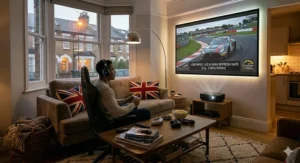
BenQ has made rather a name for itself in the gaming projector space, and the TH585P is the clearest evidence of why. It’s a Full HD DLP projector with 3,500 lumens of brightness and a 16ms input lag at 1080p/60Hz — which, in practical terms, means the response between controller input and on-screen action is fast enough that you won’t notice it.
The 3,500 lumens brightness means the TH585P handles rooms that aren’t fully blacked out with considerably more confidence than many rivals. A typical British living room at dusk — curtains half-drawn, one lamp on — is no particular challenge. The dedicated Game Mode boosts contrast and sharpens motion, making fast-paced content feel crisper without any manual fiddling. The 95% Rec. 709 colour gamut coverage means games look vivid rather than washed-out.
For non-gamers, the TH585P performs equally well as a film projector. The 10W built-in speaker is adequate for casual use, though anyone serious about audio will want to connect an external system via the 3.5mm output. The 15,000-hour lamp life in eco mode is a genuine long-term investment.
Where the TH585P shows its age slightly is in smart features: there are no built-in streaming apps. You’ll need to connect a Fire TV stick, Chromecast, or similar device via HDMI. For a gaming projector, this is a minor inconvenience — the console does the heavy lifting — but for family film nights, it means an extra remote to manage.
Pros:
✅ 16ms input lag — genuinely gaming-capable
✅ 3,500 lumens handles ambient light surprisingly well
✅ Excellent 3-year BenQ warranty, widely honoured in the UK
Cons:
❌ No built-in streaming platform
❌ DLP can exhibit the “rainbow effect” for sensitive viewers in high-contrast scenes
Price range: around £400–£460. If gaming is anywhere on your agenda, this is the projector to buy. Check current price on Amazon.co.uk.
3. ViewSonic PX704HD — Best Budget Home Cinema Projector for Bright Rooms
With over 2,600 reviews on Amazon.co.uk and a price that regularly sits well under £400, the ViewSonic PX704HD has earned its reputation as the workhorse pick for buyers who want maximum brightness without breaking the budget.
Four thousand ANSI lumens is a serious number at this price point. To give that some context: the NHS recommends adequate lighting in care environments, and the PX704HD is bright enough to be genuinely readable and watchable in rooms that would defeat most rivals. One UK reviewer used it specifically in a care home common room during daylight hours — and found it perfectly adequate, which says a great deal about its real-world performance.
The 22,000:1 contrast ratio is another headline figure that holds up in practice. Dark scenes in films don’t wash out into grey mush, which is a common failure mode for bright projectors chasing lumens at the expense of everything else. Dual HDMI ports mean you can connect both a games console and a streaming device simultaneously and switch between them without unplugging anything — a genuine quality-of-life feature that some significantly more expensive projectors forget to include.
The auto vertical keystone correction handles the inevitable British problem of projectors that can’t be positioned directly in front of the screen due to furniture constraints. It works reliably, though horizontal keystone must be corrected manually — something to account for during setup.
Pros:
✅ 4,000 lumens — the brightest in this roundup and genuinely usable in ambient light
✅ Dual HDMI ports: connect two sources simultaneously
✅ 22,000:1 contrast delivers proper dark scenes
Cons:
❌ Larger and heavier than rivals — not ideal for frequent repositioning
❌ Built-in 2W mono speaker is cosmetic at best; external audio is essential
Price range: around £320–£400 — making it the best value-per-lumen projector in this guide. Check current price on Amazon.co.uk.
4. Epson EB-FH06 — Best Home Cinema Projector Under £500 for Film Purists
If the CO-FH02 is the smart TV replacement, the EB-FH06 is the dedicated cinema machine. It forgoes Android TV in favour of focusing on what projectors do best: picture quality. And with a 16,000:1 contrast ratio and Epson’s tried-and-tested 3LCD engine producing 3,500 lumens, it does cinema rather well.
That contrast ratio is the headline. In simple terms, a higher contrast ratio means the difference between the brightest whites and darkest blacks in an image is more pronounced — films look more cinematic, shadows have depth, candlelit scenes carry genuine atmosphere rather than dissolving into muddy grey. At this price, a 16,000:1 ratio is exceptional.
The 1.2x manual zoom and ±30° vertical and horizontal keystone correction give you meaningful flexibility in placement — important in UK homes where the ideal projector position is rarely available due to sofas, bookshelves, and the general architectural logic of British terraced housing. The 12,000-hour lamp life in eco mode translates to roughly 18 years of use at four hours daily — essentially a projector you buy once and forget about for a very long time.
The EB-FH06 is an Amazon exclusive on Amazon.co.uk, which simplifies the purchasing process and makes returns under the Consumer Rights Act 2015 straightforward. The lack of built-in Wi-Fi is a deliberate design choice rather than an oversight — Epson offers the optional ELPAP10 wireless adapter for buyers who need it.
Pros:
✅ 16,000:1 contrast — superb dark scene reproduction
✅ Epson 3LCD: consistent, accurate colour without the rainbow effect
✅ Amazon exclusive: easy purchasing, returns, and Prime delivery
Cons:
❌ No built-in smart features — requires an external streaming device
❌ Standard throw ratio demands more room depth than short-throw alternatives
Price range: around £330–£430. The go-to choice for anyone who takes film watching seriously. Check current price on Amazon.co.uk.
5. Epson EB-FH08 — Best Upgrade Pick for Family Home Cinema
Think of the EB-FH08 as the EB-FH06’s slightly more extrovert sibling. Where the FH06 is a composed cinema specialist, the FH08 adds a modest but meaningful brightness boost to 3,600 lumens — the kind of upgrade that makes a real difference in family rooms that can’t always be plunged into complete darkness because someone inevitably leaves the kitchen door open.
The extra 100 lumens might sound marginal on paper, but in practice it extends the EB-FH08’s comfortable viewing envelope noticeably. At a 150-inch image size, the picture remains comfortably watchable even with a dim overhead light on — something that matters enormously when you have children who won’t sit still in the dark and insist on raiding the kitchen mid-film.
The 332-inch maximum display size is a figure to treat with appropriate British scepticism — achievable, certainly, but you’d need a room the size of a small cinema. The practical sweet spot for UK homes is 100–150 inches, at which size the EB-FH08 delivers a genuinely impressive image that a television of equivalent viewing area would cost considerably more to match.
Connection options include dual HDMI and a USB port, covering the bases for modern source devices. The fan noise is slightly more noticeable than the CO-FH02 in standard mode, though eco mode brings it to an acceptable level.
Pros:
✅ 3,600 lumens — handles real-world family room lighting better than the FH06
✅ 332-inch maximum projection — room to grow if you ever get a bigger space
✅ Dual HDMI ports keep multi-device setups tidy
Cons:
❌ Fan audible in standard mode — eco mode is advisable in quiet rooms
❌ No built-in streaming; requires external device
Price range: around £350–£450. The most practical choice for households with children or rooms that can’t be fully darkened. Check current price on Amazon.co.uk.
6. BenQ TH585 — Best Budget Entry Point for Home Cinema Under £500
The original TH585 sits just below its sibling the TH585P in BenQ’s lineup — and while the differences are modest (no auto keystone, slightly older firmware), the price difference can be meaningful. For buyers who know they’ll be setting the projector up in a fixed position and leaving it there, the TH585 is a compelling argument that you don’t always need to pay for features you won’t use.
The same 3,500 lumens DLP engine, the same 1080p resolution, and the same low-latency gaming performance underpin both models. The TH585 delivers a large, bright, punchy image with the characteristic DLP colour pop that makes sport and action films look spectacular — there’s an immediacy to DLP images that 3LCD occasionally misses, particularly with fast movement.
The 10W built-in speaker is the same unit found across BenQ’s consumer range: perfectly adequate for casual viewing, but the sort of thing you’ll want to augment with a soundbar or speaker system once you’ve settled into your setup. Given that even a modest Bluetooth speaker dramatically improves the home cinema experience, this is less a criticism than a gentle reminder that projector + screen + sound is the holy trinity of home cinema setup.
At its price point, the TH585 is often available with next-day delivery for Prime members — useful if you’ve decided to upgrade your viewing setup with the enthusiasm typical of a Saturday afternoon decision.
Pros:
✅ 3,500 lumens DLP — vibrant, punchy images ideal for sport and action
✅ Lower price than TH585P with near-identical core performance
✅ Prime-eligible on Amazon.co.uk — often next-day delivery
Cons:
❌ No auto keystone — requires careful positioning or manual adjustment
❌ DLP rainbow effect can be distracting for sensitive viewers
Price range: around £300–£380 — the most affordable route to genuine 1080p DLP performance. Check current price on Amazon.co.uk.
7. Dangbei N2 Mini Smart Projector — Best Portable Home Cinema Projector Under £500
The Dangbei N2 occupies a different niche from everything else in this roundup, and it’s important to approach it with adjusted expectations. At 200 ANSI lumens it’s considerably less bright than the Epson and BenQ projectors above — but it’s also considerably smaller, runs Netflix natively (officially licensed, not a workaround), and will fit on a bedside table. These are not accidents of design.
The N2 is built for a specific British living situation: the flat with no dedicated media room, the bedroom where a television feels too fixed and formal, the occasional outdoor film night in the garden during the four weeks annually when British weather permits it. Its compact form, integrated stand, and LED light source (which runs cool and doesn’t require lamp replacement for tens of thousands of hours) make it genuinely portable in a way that the projectors above are not.
At 200 ANSI lumens, the N2 requires a darkened room for comfortable viewing — an important caveat. In a blacked-out bedroom at night, however, it produces a surprisingly pleasing 1080p image on a 60–80-inch screen that’s genuinely cinematic for the price. The officially licensed Netflix integration means you’re not relying on sideloaded apps that can be withdrawn at any time — a meaningful point that several rival mini projectors at this price quietly fail to offer.
For buyers who want a portable companion projector rather than a primary home cinema setup, the N2 is a well-designed, sensibly priced option.
Pros:
✅ Genuinely portable — fits on a bedside table or in a bag
✅ Official Netflix licence — reliable streaming without workarounds
✅ LED light source — no lamp replacement, runs cool and quietly
Cons:
❌ 200 ANSI lumens demands a truly dark room — unsuitable for daytime use
❌ Best suited as a secondary/portable projector, not a primary home cinema unit
Price range: around £150–£200 — exceptional value for what it does. Check current price on Amazon.co.uk.
Setting Up Your Home Cinema Projector in a British Home: A Practical Guide
Here’s what the product listings won’t tell you about setting up a projector in the average UK property.
The throw ratio problem. Most standard projectors in this guide have a throw ratio of around 1.4–1.6:1, meaning you’ll need roughly 1.4–1.6 metres of distance for every metre of screen width. For a 100-inch (approximately 2.2m wide) image, you’re looking at 3–3.5 metres of throw distance. Measure your room before you buy. British living rooms in older terraced or semi-detached houses can be surprisingly shallow.
Ceiling mounting vs. shelf placement. Ceiling mounting gives you the most stable, most aesthetically pleasing result, but requires a joist finder, appropriate fixings for UK plasterboard, and the willingness to run a power cable and HDMI through the ceiling — not a weekend job for the faint-hearted. For renters, a high shelf or dedicated projector stand is the practical alternative. Most projectors in this guide support both desktop and ceiling-inverted operation.
The keystone correction caveat. Every projector in this roundup offers keystone correction — the digital adjustment that squares up a trapezoidal image when the projector isn’t perfectly aligned with the screen. Use it sparingly. Keystone correction is software-based and comes at the cost of effective resolution and sometimes image quality. Where possible, position the projector centrally and at the correct height — your image quality will be noticeably better for it.
UK electrical setup. All seven projectors in this guide are designed for 230V/50Hz operation with UK type G plugs. No voltage adaptors required, and all comply with current UK regulatory requirements. If you’re buying from an overseas reseller, verify this — projectors designed for 110V US markets have occasionally appeared on Amazon UK marketplace.
Dampness and ventilation. British homes can be damp, and projectors with enclosed lamp housings can be affected by condensation if moved from cold to warm environments quickly. Always allow a projector that’s been stored in a cold garage or car boot to reach room temperature before switching it on. This applies particularly to lamp-based models.
Projector screens. A proper projection screen — even a budget white pull-down screen starting at around £50 on Amazon.co.uk — will materially improve your image quality compared to projecting onto a painted wall. A screen’s gain rating affects brightness: a 1.0 gain screen reflects light evenly in all directions, while higher-gain screens reflect more light towards the viewer but with a narrower viewing angle. For UK sitting rooms where viewers tend to sit centrally, a 1.0–1.3 gain screen is usually ideal.
Which Projector Is Right for You? Real UK Buyer Scenarios
The Manchester Family (Budget: ~£400–£500, Semi-Detached, Two Kids)
You need brightness, reliability, and the ability to handle the odd lamp on in the corner because your children have decided darkness is not something they accept. The Epson EB-FH08 is the call: 3,600 lumens of 3LCD brightness handles ambient light better than most, dual HDMI ports accommodate a games console and streaming stick simultaneously, and Epson’s reputation for longevity means you’re not replacing this any time soon.
The London Flat Dweller (Budget: ~£200–£300, One-Bedroom, Renting)
You’re not drilling a ceiling mount into a rented flat, and you move house every 18 months anyway. The Dangbei N2 Mini makes sense: genuinely portable, Netflix built-in, and perfectly capable of delivering a 70-inch bedroom cinema experience once the lights are off. When you eventually move somewhere with more space, you buy a proper projector and keep the N2 for the bedroom.
The Gaming Household (Budget: ~£400–£470, Dedicated Games Room or Living Room)
Input lag is your priority. The BenQ TH585P with its 16ms lag at 1080p/60Hz is purpose-built for this. It handles rooms that aren’t fully blacked-out, the dedicated Game Mode makes fast-paced content genuinely crisp, and BenQ’s three-year warranty is one of the strongest in the projector market. Connect your PlayStation or Xbox via HDMI, pair a soundbar, and you have a proper gaming setup for considerably less than a large-screen TV.
The Dedicated Home Cinema Builder (Budget: up to £500, Dedicated Room or Dark Living Room)
You’ve got blackout curtains, you’re not playing games on it, and you want film to look as the director intended. The Epson CO-FH02 gives you Android TV for smart streaming, proper 3LCD colour accuracy, and enough brightness for a 120-inch image in a darkened room. Pair it with a good-quality 100-inch pull-down screen and a soundbar or 5.1 speaker setup, and you’ve built a home cinema that’ll embarrass setups costing three times as much.
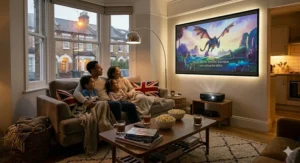
How to Choose a Home Cinema Projector Under £500: 7 Key Criteria for UK Buyers
Selecting the right affordable 1080p projector takes more than glancing at the brightness number and clicking “add to basket.” Here are the criteria that actually matter.
1. Brightness (ANSI lumens) — and what it really means Aim for at least 3,000 ANSI lumens for rooms with any ambient light. Sub-2,000 lumen projectors — and there are many on Amazon UK promising outlandish figures — are fine for darkened bedrooms but will wash out badly in a living room. Treat any budget projector claiming 10,000+ lumens with profound scepticism; this typically refers to LED luminance rather than ANSI lumens, which is the standardised measurement.
2. Technology: DLP vs. 3LCD DLP projectors (BenQ, ViewSonic, Optoma) produce a brighter, punchier image with excellent motion performance — excellent for sport and gaming. A small percentage of viewers experience the “rainbow effect” in high-contrast scenes; if you’re sensitive to this, choose 3LCD (Epson). Three-chip 3LCD produces more accurate colour brightness and no rainbow effect, at the cost of slightly less contrast in very dark scenes.
3. Contrast ratio Higher is better. A 16,000:1 contrast ratio (as in the Epson EB-FH06) means dark scenes look genuinely dark, not grey. A 3,000:1 ratio will look noticeably flat in films with significant shadow detail.
4. Lamp life Budget projectors with short lamp lives become expensive to run: replacement lamps for some budget brands can cost £80–£120. The Epson models in this guide claim up to 18 years’ lamp life in eco mode — a genuine long-term cost saving that the purchase price alone doesn’t capture. See the Energy Saving Trust’s guide on running costs for more on calculating long-term ownership costs.
5. Input lag (for gaming) If gaming features in your plans at all, look for sub-20ms input lag at 1080p/60Hz. The BenQ TH585 and TH585P both meet this threshold comfortably. Projectors without a dedicated game mode can have input lags of 50ms or more — noticeable, and potentially frustrating for fast-paced titles.
6. Connectivity At minimum, look for dual HDMI ports and a USB port capable of powering a streaming stick. Check that HDMI 2.0 ports are included if you plan to pass 4K HDR signal from a streaming device (even if the projector itself only displays 1080p, some source devices output 4K signals by default).
7. Throw distance and room size Measure your room. Then measure it again. A standard-throw projector needing 3.5 metres to display a 100-inch image is genuinely unusable in a room where the sofa is already 2.5 metres from the wall. Check the projector’s throw ratio specification against your available space before purchasing — this is the single most common cause of buyer regret in the projector category.
Home Cinema Projector vs. Large-Screen TV: The Honest Comparison
| Factor | Projector (under £500) | 65-inch TV (£400–£800) |
|---|---|---|
| Image size | 100–200 inches | 65 inches |
| Image quality in dark | ★★★★☆ | ★★★★★ |
| Image quality in daylight | ★★★☆☆ | ★★★★★ |
| Setup complexity | Moderate | Simple |
| Portability | High (some models) | Low |
| Running cost | Low (eco mode) | Very low |
| Best for | Films, events, gaming | Daily viewing, brightness |
The comparison above underscores an important truth: a projector is not a television replacement in all circumstances — it’s a complement. Most serious home cinema enthusiasts own both. A television handles daytime news, casual sport, and background viewing. The projector comes out for proper film nights, big sporting events, and gaming sessions where scale genuinely adds to the experience. At under £500, a home cinema projector is a reasonable addition to any living room, not a wholesale lifestyle overhaul.
The verdict? A 65-inch television will look better in a bright room on a Tuesday afternoon. A projector will deliver a cinematic experience on a Saturday evening that a television, at any price, simply cannot match.
Common Mistakes When Buying a Budget Home Cinema Projector in the UK
Believing the lumen marketing. As noted above, budget brands on Amazon UK routinely claim 15,000 or 20,000 “lumens” — a figure that bears no relation to the standardised ANSI lumen measurement used by Epson, BenQ, and ViewSonic. An ANSI lumen figure of 3,000 from Epson is a genuine, independently verifiable measurement. A “20,000 lumen” claim from an unknown Chinese brand is, in all likelihood, a marketing fiction. The British Projector Industry Association has noted this as a persistent consumer confusion issue in recent years.
Ignoring the screen. A £450 projector projecting onto a magnolia-painted woodchip wall is a frustrating experience. A £50 screen — a simple white pull-down available on Amazon.co.uk — transforms the image quality meaningfully. Budget for a screen as part of your total purchase.
Underestimating the audio requirement. Built-in projector speakers, with very few exceptions, are inadequate for cinematic audio. A soundbar at £80–£150, or a modest 2.1 speaker system, will improve your home cinema experience more dramatically than upgrading from a £400 projector to a £600 one. Prioritise sound.
Forgetting about lamp replacement costs. Some budget projectors have lamp lifetimes of 2,000–4,000 hours. At four hours of daily use, that’s 500 days to five years. Replacement lamps can cost £60–£120 for lesser-known brands. The Epson models in this guide have lamp lives of 10,000–12,000 hours in eco mode, representing dramatically better long-term economics.
Buying US-voltage models. This happens more frequently than it should, particularly with third-party Amazon marketplace sellers. Always verify that the product listing specifies 230V UK compatibility and a UK type G plug. Returning a projector that arrives with a US power supply involves Consumer Contracts Regulations protections (a 14-day cooling-off period for online purchases), but it’s a hassle best avoided.
What to Expect: Real-World Performance in British Conditions
A projector that looks impressive in a product demonstration video — typically filmed in a pitch-black studio — may perform rather differently in a British living room in January, when short days and closed curtains mean you’re watching in near-darkness regardless, and in June, when you’re projecting at 9pm in what amounts to full afternoon light.
The projectors in this guide fall into two practical categories for UK seasonal use:
All-season performers (3,000+ ANSI lumens): The Epson CO-FH02, BenQ TH585P, ViewSonic PX704HD, Epson EB-FH06, and Epson EB-FH08 all deliver enough brightness to perform acceptably in modestly lit rooms year-round. None will compete with a television in full daylight, but all are watchable with curtains drawn — even on a bright British summer afternoon.
Evening/darkened-room only: The Dangbei N2 Mini, at 200 ANSI lumens, is strictly a lights-off proposition. Wonderful for bedtime films, genuinely lovely for garden film nights after sunset — less useful for the school holidays when the children want to watch something at 2pm.
UK home cinema enthusiasts who want reliable further technical guidance on projector setup and calibration will find Wikipedia’s projector screen article a useful starting point, while the BBC’s technology coverage frequently covers the latest developments in consumer AV equipment.
✨ Don’t Miss These Deals Before You Go!
🔍 Whether you’re after the best all-round pick, a gaming beast, or a portable mini projector — all seven models in this guide are available right now on Amazon.co.uk. Click on any highlighted product name to check current pricing, Prime delivery options, and the latest customer reviews.
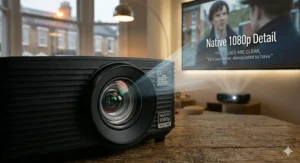
Frequently Asked Questions: Home Cinema Projectors Under £500 UK
❓ What is the best home cinema projector under £500 in the UK for 2026?
❓ How many lumens do I need for a home cinema projector in a UK living room?
❓ Do home cinema projectors work in daylight in the UK?
❓ Are projectors available with next-day delivery on Amazon.co.uk UK?
❓ Is it worth buying a refurbished projector on Amazon.co.uk UK?
Conclusion: The Best Home Cinema Projector Under £500 for Your UK Home
The sub-£500 projector market in 2026 is genuinely exciting — not in a breathless marketing brochure sense, but in the practical sense that real, meaningful home cinema is now accessible without serious financial commitment.
For most UK buyers, the Epson CO-FH02 is the recommendation: smart, reliable, and capable of delivering a cinematic experience that a television at twice the price would struggle to match in terms of sheer screen size. If gaming is central to your use case, the BenQ TH585P is the alternative. For bright rooms and maximum flexibility, the ViewSonic PX704HD is worth serious consideration.
Whatever you choose, remember that the projector is only part of the equation. A decent screen, an external speaker system, and a well-measured room setup will transform a good projector into a genuinely extraordinary home cinema experience. The kit is more affordable than it’s ever been — the rest is up to you and a suitably ambitious choice of film.
✨ Ready to Build Your Home Cinema?
🔍 Check current pricing and availability for all seven projectors in this guide on Amazon.co.uk — with Prime delivery, you could be watching on a 120-inch screen by the weekend.
Recommended for You
- Home Cinema Projector Setup: 7 Best Picks for UK Living Rooms in 2026
- Home Cinema Projector vs TV: 7 Best Picks for UK Buyers in 2026
- Best Home Cinema Projector UK 2026: 7 Top Picks Reviewed
Disclaimer: This article contains affiliate links. As an Amazon Associate, I earn from qualifying purchases. If you purchase products through these links, we may earn a small commission at no additional cost to you.
✨ Found this helpful? Share it with your mates! 💬🤗
