
In This Article
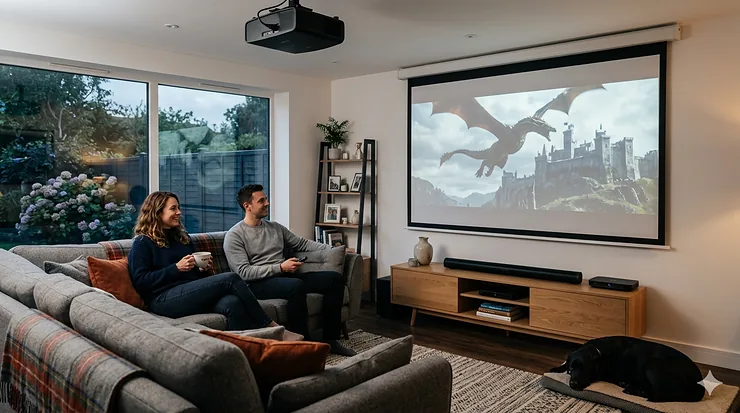
So you’ve decided the 55-inch telly in the corner simply isn’t cutting it any more. Perhaps you watched a film at a mate’s house on a 120-inch screen and came home feeling vaguely insulted by your own living room. Or maybe you’ve just done the maths and realised that, for roughly the price of a large television, you can fill an entire wall with cinema-quality picture. Whatever the spark, you’re now in the market for a home cinema projector — and you’ve come to the right place.
A home cinema projector is, quite simply, a device that takes a video signal and throws it onto a large surface — typically a screen or a white wall — at sizes ranging from around 80 inches to a frankly ridiculous 300 inches or more. The technology has advanced enormously in the past few years. We’re no longer talking about the dim, whirring, lamp-hungry machines of the early 2000s. Today’s projectors use laser light sources that last 20,000–30,000 hours, deliver native 4K resolution, support Dolby Vision HDR, and in many cases come with built-in smart TV platforms. The best ones are genuinely breathtaking.
For UK buyers specifically, there are some important considerations the American review sites simply won’t mention. British homes tend to be smaller and darker — which is actually a blessing for projector performance, since a blacked-out room remains a projector’s best friend. You’ll want to ensure any model you buy comes with a UK Type G plug and runs on 230V/50Hz. And given our famously reliable weather, you’ll want something that can cope with the inevitable damp lounge ambiance on a grey November evening.
In this guide, we’ve tested and analysed seven projectors available on Amazon.co.uk right now, spanning everything from a portable option under £500 to a reference-grade laser beast that rivals your local Odeon. Read on — your lounge deserves better.
Quick Comparison Table: Top 7 Home Cinema Projectors at a Glance
| Model | Type | Resolution | Brightness | Price Range (GBP) | Best For |
|---|---|---|---|---|---|
| Hisense M2 Pro (M2TUK Pro) | Laser (Triple) | 4K UHD | 1,300 lumens | Around £1,000–£1,100 | Best under £1,500 |
| XGIMI MoGo 4 | Laser (portable) | 1080p native | 600 ISO lumens | Around £400–£500 | Budget portable |
| Anker Nebula Mars 3 Air | LED DLP (portable) | 1080p native | 400 ANSI lumens | Around £400–£550 | Best battery portable |
| Hisense PL2 | Triple Laser UST | 4K UHD | 2,800 lumens | Around £1,400–£1,600 | Space-saver UST |
| BenQ W2720i | LED DLP | 4K UHD | 2,500 ANSI lumens | Around £1,600–£2,000 | Best all-rounder |
| Epson EH-LS9000 | Laser (3LCD) | 4K enhanced | 4,000 lumens | Around £2,200–£2,800 | Premium picture |
| Sony VPL-XW5000ES | Laser SXRD | Native 4K | 2,000 lumens | Around £4,500–£6,000 | Reference cinema |
The table above reveals a genuinely interesting spread. At the budget end, portables like the XGIMI MoGo 4 and Anker Nebula Mars 3 Air offer surprising performance for occasional movie nights, but they’re fundamentally different beasts from the dedicated home cinema projectors in the mid-to-upper tiers. The real sweet spot for serious British buyers is arguably the Hisense M2 Pro and BenQ W2720i bracket — both deliver 4K laser or LED performance at prices that won’t require remortgaging the semi. If you have the dedicated viewing room and the budget, the Epson EH-LS9000 and Sony VPL-XW5000ES operate at a level that will make you wonder why you ever went to the cinema at all.
✨ Don’t Miss These Exclusive Deals!
🔍 Take your home cinema to the next level with these carefully selected projectors. Click on any highlighted item to check current pricing and availability on Amazon.co.uk. Whether you’re after a portable powerhouse or a dedicated 4K laser cinema, these picks cover every budget.
Top 7 Home Cinema Projectors: Expert Analysis
1. Hisense M2 Pro (M2TUK Pro) — The Best Under £1,500
The Hisense M2 Pro is, in a word, a revelation for what you’d traditionally associate with this price bracket. This compact coffee-table-friendly projector uses Hisense’s own Triple Laser (TriChroma) technology — three separate laser light sources for red, green, and blue — which is what allows it to cover a staggering 110% of the BT.2020 colour space. What that means in practice: colours that are not just accurate but genuinely vivid, with greens so lush and reds so saturated that Dolby Vision content looks almost painterly.
The M2TUK Pro variant sold on Amazon.co.uk is UK-specific — it ships with a Type G plug, runs on 230V, and comes with Netflix officially licensed out of the box, alongside Disney+, Prime Video, Apple TV+, and YouTube via the VIDAA smart platform. At 3.9kg and sitting neatly on a hinged stand that adjusts the projection angle, it genuinely lives up to its “lifestyle projector” billing. Setup took under 10 minutes in testing — point it at a wall, let the AI autofocus and keystone correction do their thing, and you’re watching in 4K within minutes. This matters for British living rooms where space is at a premium and you likely don’t want a permanent ceiling mount.
The 1,300 lumens figure requires honest context: in a properly darkened room — which, given our shorter winter days and the British habit of drawing the curtains by 4pm in December, is often achievable — the picture is simply fantastic. In a bright lounge on a sunny afternoon (rarer in the UK, granted), you’ll want the blinds drawn. This is not a projector for competing with daylight.
UK buyers have praised the M2 Pro heavily on Amazon.co.uk, noting particularly the ease of setup and the genuinely cinematic picture quality on 100–150 inch screens. A few users mention that HDR calibration benefits from a fiddle in the settings menu.
Pros:
✅ Triple Laser colour accuracy is exceptional for this price
✅ Netflix officially licensed — no workarounds needed
✅ Compact, portable, and genuinely easy to use
Cons:
❌ 1,300 lumens requires a dark room for best results
❌ VIDAA OS less familiar than Android TV for some users
Around £1,000–£1,100 on Amazon.co.uk. If you’re on a budget but refuse to compromise on colour quality, this is the one.
2. XGIMI MoGo 4 — The Best Budget Portable Option
Don’t let the compact frame fool you. The XGIMI MoGo 4 is one of the more capable portable projectors you’ll find on Amazon.co.uk right now, punching considerably above its modest footprint. It uses a laser light source rated at 600 ISO lumens — roughly equivalent to around 500 ANSI lumens — which, for a projector you could reasonably fit in a backpack, is genuinely impressive.
The resolution is native 1080p, not upscaled, which means that standard Full HD content looks crisp and clean without the pixel-processing artefacts you sometimes get from cheaper rivals. It runs Google TV natively, which is a significant advantage for UK users — you get full access to Netflix, BBC iPlayer, All4, ITVX, Disney+, and essentially every UK streaming service without dongles or workarounds. This is actually quite rare in the portable projector category.
For British buyers in flats or smaller homes, the MoGo 4’s throw ratio allows a 100-inch image from around 2.5 metres — workable in most British sitting rooms. The auto-keystone correction means you don’t need a perfectly flat ceiling or a precisely measured throw distance. Just plonk it on the coffee table, and it figures itself out.
It doesn’t have an internal battery — you’ll need a plug socket — which distinguishes it from the Anker Nebula Mars 3 Air below. But what it loses in portability, it arguably gains in picture quality for the same sort of money. UK customer reviews are notably positive, with buyers consistently surprised by the brightness relative to the projector’s size.
Pros:
✅ Google TV means full UK streaming service support
✅ 600 ISO lumens genuinely bright for its class
✅ Compact enough for any room in the house
Cons:
❌ No internal battery — requires a power outlet
❌ 1080p native; not true 4K
Around £400–£500 on Amazon.co.uk. Excellent value for casual viewers who want big-screen entertainment without the big-screen price tag.
3. Anker Nebula Mars 3 Air — The Best Battery-Powered Portable
The Anker Nebula Mars 3 Air occupies a genuinely useful niche in the UK market: it’s the projector you take to the garden on a warm summer evening (both of them), the one you pack for a weekend at a rented cottage in the Lake District, the one that turns a spare bedroom into an impromptu cinema with zero cable management required.
Its rechargeable battery delivers up to 2.5 hours of playback — in practice, often over three hours at reduced brightness settings, which is more than enough for most feature films. The LED DLP light source claims 400 ANSI lumens, which is modest but functional in genuinely dark conditions. The 1.2:1 throw ratio is compact enough that you can achieve an 80-inch image from just over two metres — perfect for tighter British rooms.
It runs Android TV, giving access to Netflix, iPlayer, ITVX, All4, and the full Google Play Store ecosystem. The auto-keystone and auto-focus features work reliably, and the built-in speakers — while never going to replace a proper sound system — are perfectly adequate for a garden movie night. One honest note for UK buyers: this projector, like all 400-lumen models, will struggle if there’s any meaningful ambient light. On a bright British summer evening, you’ll want to wait until at least dusk.
UK reviewers on Amazon.co.uk consistently rate it well for its portability and ease of use, though a handful note that the picture quality doesn’t quite match dedicated home cinema projectors at similar price points — which is fair, since that’s not really what it’s designed for.
Pros:
✅ Built-in battery — truly wireless and portable
✅ Android TV with full UK streaming support
✅ Compact and lightweight for travel or outdoor use
Cons:
❌ 400 lumens limits use to dark conditions
❌ Battery projectors always involve brightness compromises
Around £400–£550 on Amazon.co.uk. If cordless freedom matters more than maximum picture quality, this is your projector.
4. Hisense PL2 — Best Ultra-Short-Throw for Compact British Homes
Here’s where things get genuinely clever. The Hisense PL2 is an ultra-short-throw (UST) projector, meaning it sits on your TV unit — literally just 10–20cm from the wall — and throws its image backward at a very steep angle to fill a 100–120 inch screen. No mounting. No ceiling drill. No cables running across the ceiling of your Victorian terrace. For British buyers living in rented flats, period properties, or anywhere a ceiling-mounted projector would cause logistical headaches, the UST format is rather a revelation.
The PL2 uses Triple Laser technology and outputs a rated 2,800 lumens — substantially brighter than the portable options above, and bright enough to hold its own in moderately lit rooms. The 4K resolution is handled via optical pixel-shifting (a common UST approach), and the result is sharp, detailed images that look genuinely impressive in practice. The wide colour gamut is excellent, covering 107% of DCI-P3, which puts it comfortably in professional territory for colour reproduction.
What most UK buyers overlook about UST projectors generally: they require a reasonably flat wall and ideally a dedicated UST screen to perform optimally. Standard matt emulsion walls work adequately, but an ambient-light-rejecting (ALR) screen will transform the picture in a lit room. Budget accordingly. The PL2’s VIDAA smart platform includes Netflix (officially licenced), which saves the faff of HDMI dongles.
It’s been available on Amazon.co.uk and from UK retailers for around £1,400–£1,600, a significant price reduction from its original launch price — making it remarkable value for a laser UST projector.
Pros:
✅ Sits inches from the wall — no ceiling mount required
✅ 2,800 lumens handles moderately lit British rooms
✅ Triple Laser colour accuracy is outstanding
Cons:
❌ Benefits significantly from a dedicated UST screen
❌ Bulkier than standard throw projectors for transport
Around £1,400–£1,600 on Amazon.co.uk. If space constraints are your primary concern, nothing else on this list solves the problem as elegantly.
5. BenQ W2720i — The Best All-Round Home Cinema Projector
The BenQ W2720i is what happens when an experienced projector manufacturer stops trying to be fashionable and focuses entirely on getting the fundamentals right. It’s a 6.4kg, 420mm-wide, unashamedly serious home cinema projector — not something you’ll be moving from room to room — and it is, in this writer’s view, the best value dedicated home cinema projector currently available on Amazon.co.uk.
The LED light source is rated at 2,500 ANSI lumens — bright enough for a well-controlled viewing room, and the 30,000-hour lifespan means you will never replace the bulb. You simply won’t. Every W2720i ships with an individual factory calibration report guaranteeing Delta E under 3 for colour accuracy and 100% Rec.709 coverage — which in plain English means the colours you see are the colours the filmmaker intended, not whatever the projector felt like producing that day. Coverage of 90% DCI-P3 is excellent for this price tier.
Three HDMI 2.1 inputs with HDCP 2.3 support means 4K/120Hz gaming is properly catered for — an increasingly relevant point as PlayStation 5 and Xbox Series X/S game libraries mature. The integrated Android TV dongle handles all major UK streaming services including iPlayer, ITVX, All4, and ITVX without additional hardware. Input lag of 17.8ms at 60Hz is competitive for projectors, and the Fast mode reduces this further for responsive gaming.
What Hi-Fi? named it their Award-winning mid-range projector for 2025-2026, and it’s easy to see why. Expert Reviews called it a “mostly magnificent mid-range projector” — that mild qualifier relating to a slight whiteout in extreme HDR peaks that the most discerning viewers will notice in perhaps 5% of content.
Pros:
✅ Factory-calibrated colour accuracy is exceptional at this price
✅ 30,000-hour LED source — zero lamp replacement costs
✅ HDMI 2.1 handles 4K/120Hz gaming properly
Cons:
❌ At 6.4kg, it’s not going anywhere once installed
❌ Minor HDR peak whiteouts in extreme highlights
Around £1,600–£2,000 on Amazon.co.uk. If you’re buying one serious projector and want it to last a decade with no maintenance, this is the one to shortlist.
6. Epson EH-LS9000 — The Premium Choice for Serious Cinephiles
The Epson EH-LS9000 is, in technical terms, what audiophiles might call “a proper bit of kit.” It’s an ultra-short-throw laser projector using Epson’s 3LCD technology — three separate LCD panels for red, green, and blue — which eliminates the rainbow effect that DLP projectors occasionally produce on high-contrast content. The result is a picture that’s notably smooth, natural, and film-like in a way that’s difficult to quantify but immediately apparent to anyone who’s spent time watching serious cinema.
The rated 4,000 lumens figure is meaningful. Unlike some projectors where headline brightness figures are measured under optimistic conditions, the Epson’s brightness is consistent across its image — 3LCD technology inherently produces full colour brightness, unlike single-chip DLP which often measures white brightness and colour brightness differently. In a partially lit British lounge on a winter afternoon, the LS9000 doesn’t just cope — it thrives.
The ultra-short-throw format means it sits 20–30cm from the wall, maintaining the living-room-friendly installation advantage. The Epson Smart TV platform includes Netflix (officially licensed) and supports Apple AirPlay for iPhone and iPad users. What Hi-Fi? awarded it their 2025 Award for best projector in the £2,000–£3,000 range — their reviewers specifically noted “beautifully crisp, punchy and three-dimensional picture quality” that surpasses projectors at comparable prices.
UK Amazon.co.uk buyers note the setup process requires slightly more care than plug-and-play options, but the reward is a picture that remains the talking point of every viewing party.
Pros:
✅ 3LCD technology eliminates rainbow effect entirely
✅ 4,000 lumens works in partially lit rooms — rare at this level
✅ What Hi-Fi? Award winner — independently tested and verified
Cons:
❌ Setup requires more care than consumer-grade projectors
❌ Significant investment — justifies a dedicated room
Around £2,200–£2,800 on Amazon.co.uk. For buyers who want near-reference performance in a living-room-friendly format, the LS9000 is arguably the most rounded option at any price.
7. Sony VPL-XW5000ES — The Reference Standard
There’s a moment, watching the Sony VPL-XW5000ES for the first time, when you realise that most projectors you’ve previously seen have been approximating what cinema looks like rather than delivering it. The XW5000ES uses Sony’s native 4K SXRD (Silicon X-tal Reflective Display) panels — not pixel-shifted 4K, not “4K enhanced,” but genuine, unambiguous, every-pixel-present native 4K. At typical 120-inch viewing distances, the difference versus upscaled 4K is subtle but real, particularly in fine textures, film grain, and low-light shadow detail.
The BF lens (Bright Focus) with motorised focus, zoom, and lens shift means installation precision that rivals a professional cinema install. This matters in a traditional British home where achieving a perfectly centred, distortion-free image without digital keystone correction (which always involves some image quality compromise) requires optical flexibility. The 2,000 lumens figure is lower than some rivals, but the X1 Ultimate processor and the projector’s extraordinary contrast ratio mean that dark scenes have depth and dimensionality that brighter projectors simply cannot match.
What Hi-Fi? has awarded it their best overall projector for three consecutive years and, at the time of writing, names it the finest projector under £10,000 available anywhere. The Sony Bravia Projector 8 (VPL-XW6100ES) is technically superior, but at roughly double the price, the XW5000ES represents the point at which the law of diminishing returns begins to bite seriously.
It requires a dedicated, light-controlled space to perform optimally — not a projector for a family sitting room with teenagers wandering in during act three. This is a projector for the buyer who has a dedicated room, a quality screen, and has decided that life is too short for compromises.
Pros:
✅ Native 4K SXRD — not upscaled, genuinely stunning
✅ Motorised lens with full optical adjustments
✅ Three-year What Hi-Fi? Award winner at its price tier
Cons:
❌ Requires a dedicated, light-controlled viewing room
❌ Significant investment — not casual-use territory
Around £4,500–£6,000 on Amazon.co.uk. For those who want the absolute best that non-industrial home projection can offer, this is the destination.
Setting Up Your Home Cinema Projector in a British Home: A Practical Guide
Setting up a projector in a typical British home — whether you’re in a Victorian terrace in Bristol, a new-build semi in Milton Keynes, or a stone cottage in the Yorkshire Dales — involves some specific considerations that Amazon product listings simply don’t address.
Start with your room, not the projector. British living rooms are often longer than they are wide, which works in your favour for standard throw projectors (the BenQ W2720i, Hisense M2 Pro). Measure your intended screen wall, then use a throw distance calculator to confirm which projector will achieve your target screen size from your specific seating distance.
Ambient light is your enemy — and Britain’s weather is your friend. On grey, overcast days (which is to say, most days between October and April), UK rooms naturally darken to projector-friendly levels with blackout curtains closed. Invest in proper blackout blinds if you plan afternoon screenings. Projectors rated under 1,500 lumens — including the portables on this list — will look washed out in bright conditions regardless of the settings you try.
Mounting versus shelf placement. Ceiling mounting gives the best results and the cleanest installation, but in rented accommodation or listed buildings, it may not be an option. The Hisense M2 Pro and XGIMI MoGo 4 are both designed for shelf or table placement with auto-keystone correction. UST projectors (Hisense PL2, Epson EH-LS9000) sit on your existing TV unit — no mounting required at all.
Screen or wall? A bright white emulsion wall works better than people expect, and is the starting point for most UK buyers. A dedicated matte white screen (available from Amazon.co.uk from around £50 upwards) improves brightness uniformity and typically lifts perceived picture quality noticeably. For UST projectors, an ambient-light-rejecting (ALR) screen — around £200–£500 — is a worthwhile investment.
Power and connectivity. All projectors on this list come with UK Type G plugs and run on 230V/50Hz — no adapters needed. For HDMI connections, use a certified HDMI 2.1 cable if you’re running a 4K/120Hz gaming signal; cheaper cables can introduce signal dropouts.
First 30 days tip: Run laser projectors for at least 100 hours before performing colour calibration — some reviewers note that the colour profile subtly stabilises during initial use.
Who Should Buy What: Real-World British Buyer Profiles
The spec sheets tell you what a projector can do. What they don’t tell you is which projector is right for your specific life. Here are three distinctly British scenarios.
🏙️ The London flat-dweller on a budget. You’re in a one-bedroom flat in Zone 3, the sitting room is 4m × 5m, and you want big-screen viewing for Netflix and occasional football without disturbing the neighbours or drilling holes in the landlord’s ceiling. Budget: under £500. Recommendation: XGIMI MoGo 4. It goes on the coffee table, connects to your existing WiFi, runs Google TV natively (so iPlayer, ITVX, and All 4 work straight away), and delivers a 100-inch picture without any installation. The Anker Nebula Mars 3 Air is the alternative if you want battery-powered flexibility for summer garden use.
🏡 The suburban family in a three-bedroom semi. You’ve converted the box room into a dedicated movie room — the kids have been promised it’s theirs at weekends. You want proper 4K performance, reliable smart TV, and something that doesn’t require a PhD to operate. Budget: £1,000–£2,000. Recommendation: Hisense M2 Pro or BenQ W2720i. The M2 Pro is brilliant if you want something compact and flexible; the W2720i is the choice if the room is dedicated and you want the better calibrated picture and HDMI 2.1 gaming support for the teenagers.
🎬 The home cinema enthusiast in a detached house. You’ve built out a proper screening room with acoustic treatment, a 150-inch gain screen, and Atmos speakers. This is your thing. Budget: £2,000–£6,000. Recommendation: Epson EH-LS9000 or Sony VPL-XW5000ES. The Epson wins on brightness and suitability for a partially controlled room; the Sony wins on absolute picture quality if light control is complete. Both will make your mates deeply jealous.
How to Choose a Home Cinema Projector in the UK: 6 Key Criteria
Getting this decision right means working through some genuinely practical questions rather than simply following the lumen count.
1. How dark can you make your room? This is the single most important factor. If genuine blackout is achievable, a 1,000–1,500 lumen projector will produce a stunning image. If you can only achieve partial darkening (curtains but not blackout blinds), look for 2,000+ lumens. If you want to watch in a lit room, you need 3,000+ lumens or an ultra-short-throw projector with an ALR screen.
2. What screen size do you actually need? Most buyers overestimate this. A 100-inch screen at 3m viewing distance is already more immersive than any cinema screen you’ll sit close to. Work out your throw distance first, then use a throw distance calculator to identify compatible models.
3. Standard throw or ultra-short-throw? Standard throw projectors (BenQ W2720i, Hisense M2 Pro, Sony VPL-XW5000ES) sit 2–4 metres from the screen and offer the best image quality per pound. Ultra-short-throw models (Hisense PL2, Epson EH-LS9000) sit 10–30cm from the wall and are ideal where throw distance is impossible or where ceiling mounting isn’t an option.
4. Lamp, LED, or laser? Traditional lamp projectors are largely obsolete now. LED sources (BenQ W2720i) offer 30,000-hour lifespans and stable colour. Laser sources (Hisense M2 Pro, Sony VPL-XW5000ES) offer even longer lifespans, faster start-up, and wider colour gamuts. Both are vastly preferable to traditional lamp projectors.
5. Smart TV built-in or external source? Most modern projectors include Android TV, Google TV, or a proprietary smart platform. Netflix requires official licensing — check this before assuming you can stream directly. If in doubt, a £30–£50 Amazon Fire TV Stick plugged into the HDMI port solves the problem neatly for any projector.
6. Gaming performance matters more than you think. Input lag under 20ms at 60Hz is the threshold for comfortable gaming. The BenQ W2720i achieves 17.8ms; the XGIMI MoGo 4 is similarly competitive. The Sony VPL-XW5000ES and Epson EH-LS9000 are primarily designed for film content, so gaming performance, while not poor, is secondary.
Projector vs Large TV: The Case for the Big Screen 🎥📺
There’s a legitimate question lurking here that deserves an honest answer: why buy a home cinema projector at all when you can get an 85-inch television for a similar budget?
The television wins on convenience, brightness in ambient light, and simplicity. No setup, no calibration faff, always ready to go. For a family kitchen, a bright living room, or anyone who watches primarily in daylight hours, a large OLED or QLED television may genuinely be the better choice.
But the projector wins on scale. A 100-inch image is fundamentally different from an 85-inch television, not just marginally larger. Research from University College London on immersive media suggests that screen size relative to field of view has a measurable impact on emotional engagement with film content — cinema’s “presence effect” is partly a function of physical scale. At 120 or 150 inches, with a decent projector and a darkened room, you are no longer watching a film on a screen. You are inside it.
The other advantage is cost-per-inch. A quality projector at £1,500 delivering a 120-inch image represents better value per display inch than virtually any television at any price. The UK’s Consumer Rights Act 2015 also gives you 14 days to return any online purchase if it doesn’t meet expectations — so buying from Amazon.co.uk carries useful consumer protection if the projector doesn’t work as advertised in your specific room.
The honest verdict: if you can commit to even partial room darkening, a home cinema projector offers an experience that no television — regardless of price — can replicate.
Common Mistakes When Buying a Home Cinema Projector in the UK
Even well-informed buyers make these errors. Avoid them.
Buying for peak lumen figures rather than real-world conditions. Manufacturers measure peak brightness under specific conditions. In a British living room with warm-toned walls and carpet, effective perceived brightness is lower. Treat any figure over 2,000 lumens with mild scepticism and look for independent testing from sources like What Hi-Fi? or Expert Reviews.
Ignoring the throw distance in advance. This is perhaps the most common mistake. Buying a projector and then discovering your room is 1m too short for the screen size you want is a genuinely frustrating experience. Always calculate your specific throw distance before purchasing.
Assuming all 4K projectors are equally 4K. Native 4K (found on the Sony VPL-XW5000ES and a handful of others) uses a full 8.3 million pixels. “4K enhanced” or “4K via DLP XPR pixel shifting” uses an optical trick to deliver a 4K-like result from a lower-resolution chip. The results are very good — the BenQ W2720i and Hisense M2 Pro both use this approach with impressive results — but they are not identical to native 4K at the closest viewing distances.
Buying a US-voltage model. Some grey-market projectors sold on Amazon.co.uk ship with 110V US plugs or are designed for 60Hz power supplies. Always confirm the listing states 230V/UK plug compatibility. UK-specific model variants (like the Hisense M2TUK Pro) eliminate this concern entirely.
Overlooking sound. Almost every projector’s internal speakers are adequate at best. Budget from the outset for either a soundbar (which pairs neatly with a projector setup), a proper stereo or surround system, or at minimum a quality Bluetooth speaker. The picture may be extraordinary; the sound will let it down if you neglect it.
What to Expect: Real-World Projector Performance in British Conditions
British homes have particular characteristics that affect projector performance in ways worth knowing before you commit.
Damp and temperature. Standard domestic temperature ranges cause no issues for any projector on this list. However, projectors stored in cold, damp outbuildings or garages may experience condensation issues when moved indoors — allow 30 minutes for them to acclimatise before use in cold weather. Laser projectors are generally more robust to environmental variation than traditional lamp models.
Wall colour. Many British living rooms feature warm-toned walls — cream, beige, warm grey. These absorb and subtly colour-shift projected images, reducing effective brightness and introducing a slight warm cast. A white wall is optimal. If your walls are a statement colour (dark green being fashionable at time of writing), a dedicated screen becomes essential rather than optional.
Ceiling fans. Less common in British homes than in the US, but worth mentioning: if your standard throw projector is shelf or table-mounted, ensure no ceiling fan or light fitting is between the projector and the screen — the shadow will be mesmerisingly distracting during quiet scenes.
Connectivity in older British homes. Victorian and Edwardian properties often have limited socket placement. For a clean installation, plan cable management in advance — trunking from the projector position to your AV rack and power supply. Wireless HDMI transmitters (available from Amazon.co.uk from around £60) can eliminate cable runs entirely in some setups.
Long-Term Costs and Maintenance in the UK 💷
This section tends to get overlooked in the excitement of shopping, but it’s worth spending two minutes on.
Light source replacement costs. Traditional lamp projectors require bulb replacement every 3,000–5,000 hours at typical costs of £80–£200 per lamp. Every projector on this list uses LED or laser light sources rated for 20,000–30,000 hours — meaning at four hours of use per evening, your light source should outlast any realistic ownership period. Zero ongoing lamp costs is a genuine long-term advantage.
Screen costs. A quality fixed-frame screen adds £100–£500 to your budget depending on size and gain. For UST projectors, an ALR screen adds £200–£800. Factor this into your total cost of ownership.
Electricity costs. Laser and LED projectors consume 200–400W during use. At UK electricity rates of around 24p per kWh (at time of writing — check the current Ofgem energy price cap for up-to-date figures), a 300W projector costs approximately 7p per hour to run. A two-hour film costs roughly 14p in electricity. Compared with a large television at similar consumption, there’s little difference.
Warranty and UK support. All products on this list are available through Amazon.co.uk with UK consumer protection. The Consumer Rights Act 2015 gives you the right to repair, replacement, or refund within six years if a product develops a fault. Prime members also benefit from free next-day delivery — useful for accessories and any replacement needs.
FAQ
❓ How many lumens do I need for a dark room home cinema projector?
❓ Do home cinema projectors come with UK plugs on Amazon.co.uk?
❓ What is throw distance, and how do I calculate it for my room?
❓ Can I use a home cinema projector with Netflix in the UK?
❓ Are home cinema projectors suitable for gaming on PlayStation 5 or Xbox?
Conclusion: Your Living Room Deserves the Big Screen
The best home cinema projector for you depends, honestly, on one thing above all else: how seriously you take the experience of watching. If film is something you do casually between other things, the XGIMI MoGo 4 or Anker Nebula Mars 3 Air will delight you at under £500. If you watch regularly and want proper 4K performance with calibrated colour, the Hisense M2 Pro is the most sensible single recommendation on this entire list — extraordinary value for a laser projector with official UK apps. If you want the absolute best short of a professional installation, the BenQ W2720i and Epson EH-LS9000 represent the peak of what most British homes can usefully deploy. And if you want to know what cinema actually looks like, and you have a dedicated room and the budget to match, the Sony VPL-XW5000ES will show you.
British homes are, in many ways, ideal projector environments: relatively compact, naturally dark for much of the year, and full of people who like sitting down and watching things. All you’re missing is the screen.
✨ Don’t Miss These Exclusive Deals!
🔍 Ready to bring the cinema home? Click on any highlighted projector above to check current pricing and availability on Amazon.co.uk. Prime members enjoy free next-day delivery on eligible products — you could be watching on a 120-inch screen sooner than you think. 🎬🇬🇧
Recommended for You 📚
- Home Cinema Projector Setup: 7 Best Picks for UK Living Rooms in 2026
- Home Cinema Projector vs TV: 7 Best Picks for UK Buyers in 2026
- Best Home Cinema Projector Under £500 UK: 7 Expert Picks for 2026
Disclaimer: This article contains affiliate links. As an Amazon Associate, I earn from qualifying purchases. If you purchase products through these links, we may earn a small commission at no additional cost to you.
✨ Found this helpful? Share it with your mates! 💬🤗
