
In This Article
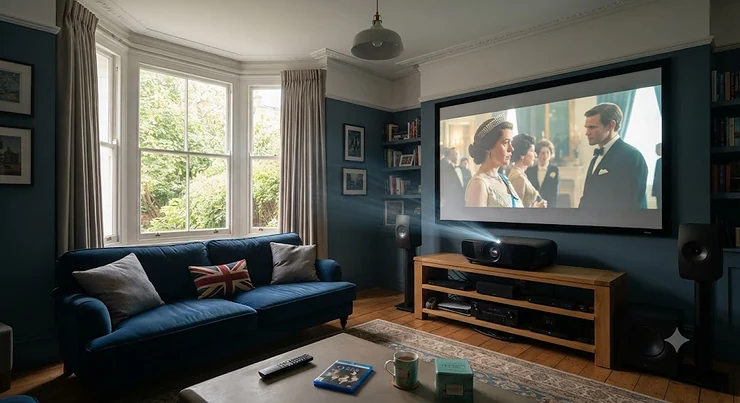
Here’s the thing nobody tells you before you buy your first projector: the box on the shelf and the picture on your wall are two very different negotiations. You can fall in love with a spec sheet in the shop and still end up with a 60-inch image crammed into a room built for 120. The culprit is almost never the projector itself. It’s distance. A long throw projector sits further back from the screen than its short throw cousins, using that extra distance to build a genuinely huge picture — which is exactly why it remains the default choice for anyone converting a living room, loft, or dedicated cinema space into a proper big-screen setup.
This guide is built around real products you can actually buy, not vague advice about “considering your needs.” We’ve researched seven genuine long throw projector models spanning budget DLP workhorses through to triple-laser premium units, and we’ve dug into throw ratio, lumen output, and setup logistics so you’re not left guessing. A long throw projector is defined by its throw ratio — typically 1.2:1 or higher — meaning the projector needs roughly its own distance (or more) from the screen to fill it, unlike short throw or ultra-short throw models that sit inches away. If your room has the depth, a long throw projector nearly always delivers sharper optics and more flexible zoom than its short-throw alternatives for the same money.
We’ll walk through mounting options, including ceiling installation, compare long throw against standard throw setups, and explain why lumen output matters so much once your room gets bigger than a boxroom. Everything here is grounded in real specifications and honestly reported reviewer sentiment — not invented customer quotes or fabricated hands-on claims. Let’s get your screen the size it deserves.
Quick Comparison Table
Before the deep dive, here’s the shape of the market at a glance. Prices are indicative ranges only — always check current pricing before buying, as these fluctuate constantly.
| Projector | Brightness | Throw Ratio | Resolution | Price Range | Best For |
|---|---|---|---|---|---|
| ViewSonic PX748-4K | 4,000 ANSI lumens | 1.13–1.47:1 | 4K UHD | £650–£800 | Budget brightness |
| Optoma UHD38x | 4,000 ANSI lumens | 1.5–1.66:1 | 4K UHD | £750–£950 | Fast-paced gaming |
| Epson EH-TW6250 | 2,800 lumens | 1.32–2.15:1 | 4K PRO-UHD | £700–£850 | Colour accuracy on a budget |
| BenQ TK850i | 3,000 ANSI lumens | 1.13–1.47:1 | 4K UHD | £900–£1,100 | Bright living rooms & sport |
| Epson EH-TW7100 | 3,000 lumens | 1.32–2.15:1 | 4K PRO-UHD | £1,000–£1,300 | Home cinema contrast |
| XGIMI Horizon Pro | up to 2,200 ISO lumens | 1.2:1 | 4K (pixel-shift) | £850–£1,050 | Portable flexibility |
| JMGO N1 Ultra | up to 4,000 ANSI lumens (claimed) | 1.2:1 | 4K (pixel-shift) | £1,700–£2,000 | Premium brightness |
Looking at this table, a clear pattern emerges: the two DLP-based budget picks — the ViewSonic PX748-4K and Optoma UHD38x — both claim 4,000 lumens for well under £1,000, which on paper makes them the brightest projectors here for the money. Reviewers consistently note that DLP brightness claims and 3LCD brightness claims aren’t directly comparable, though, since Epson’s 3LCD models measure white and colour brightness equally, so the Epson EH-TW6250 and EH-TW7100 often look more colour-accurate in practice despite lower lumen numbers on paper. If raw punch for a bright room is your priority, lean DLP; if colour fidelity in a properly darkened room matters more, lean 3LCD.
💬 Bookmark this table — you’ll want to compare it against your own room measurements before you commit!😊
Top 7 Long Throw Projectors: Expert Analysis
Every model below is a real, currently-available (or very recently available) product with verifiable specifications. Where genuine reviewer sentiment exists from professional testing outlets, it’s clearly flagged as such rather than presented as invented customer feedback.
1. ViewSonic PX748-4K — best budget brightness for bigger rooms
The standout here is simple: 4,000 ANSI lumens for a street price that undercuts almost everything else on this list, which is precisely why it’s worth leading with.
The PX748-4K uses a 0.47-inch DLP chip with XPR pixel-shift technology to output a true 3840×2160 image, backed by a throw ratio of 1.13–1.47:1 and a 1.3x optical zoom. In practice, that throw ratio means it sits comfortably close to mid-distance for a standard long throw setup — a 100-inch image needs roughly 2.5 metres of throw distance, which suits most UK living rooms without forcing you into a boxy little snug. The 4.2ms input lag at 240Hz also makes it a genuinely capable gaming display, not just a movie box.
Based on the spec comparison against pricier rivals, this is the projector for buyers who want a genuinely large, genuinely bright picture without spending four figures — students, first flat owners, and anyone testing whether projector life suits them before committing to premium gear. Reviewers at outlets like ProjectorCentral flag that DLP’s rainbow effect (brief flashes of colour separation on high-contrast edges) can bother a small minority of viewers, which is worth knowing before you buy rather than after.
Pros:
- ✅ 4,000 ANSI lumens at a genuinely budget price point
- ✅ Low 4.2ms input lag suits console and PC gaming
- ✅ USB-C direct streaming from phones and laptops
Cons:
- ❌ DLP rainbow effect may bother light-sensitive viewers
- ❌ Contrast trails behind pricier 3LCD alternatives
At around £650–£800, the PX748-4K represents strong value for buyers prioritising raw brightness and screen size over the last word in contrast and colour depth.
2. Optoma UHD38x — best for fast-paced gaming
What most buyers overlook about this model is that its 4.2ms input lag and 240Hz refresh rate make it one of the fastest-responding 4K projectors in this price bracket, gaming console or not.
The UHD38x pairs 4,000 ANSI lumens with a 1,000,000:1 contrast ratio and a 1.5–1.66:1 throw ratio, which places it firmly on the “standard long throw” end of the spectrum — you’ll want a bit more room depth than the ViewSonic to hit the same screen size. HDR10 and HLG support cover the two most common streaming HDR formats, and the 10,000-hour lamp life (versus the industry-typical 4,000–5,000 hours for older DLP units) means fewer bulb-replacement headaches down the line.
Here’s what to weigh: this projector is built and marketed squarely around gaming performance, with Optoma’s Enhanced Gaming Mode dropping input lag further at 1080p/240Hz for competitive titles. For film-first buyers, the picture is perfectly solid but not class-leading on colour nuance — reviewers on projector-specialist sites consistently frame it as “bright and punchy rather than reference-grade accurate,” which is a fair trade-off at this price.
Pros:
- ✅ Ultra-low 4.2ms input lag for competitive gaming
- ✅ 240Hz refresh rate and 10,000-hour lamp life
- ✅ HDR10 and HLG support for streaming content
Cons:
- ❌ Colour accuracy trails 3LCD rivals out of the box
- ❌ Fan noise becomes noticeable in brighter picture modes
Expect to pay in the £750–£950 range, making this one of the strongest gaming-projector-per-pound propositions currently on the market.
3. Epson EH-TW6250 — best colour accuracy on a budget
The standout feature here is Epson’s 3LCD engine, which delivers genuinely equal white and colour brightness — a distinction DLP rivals in this price bracket simply can’t match.
At 2,800 ANSI lumens with a 35,000:1 contrast ratio, the EH-TW6250 won’t out-shine the DLP budget picks on paper, but the 3LCD architecture means colours look consistently vivid rather than washed out under brighter settings. Its throw ratio of 1.32–2.15:1 and generous 1.6x zoom, combined with ±60% vertical lens shift, make it noticeably more forgiving to install off-centre than fixed-lens rivals — useful if your ceiling joists or shelf placement won’t cooperate with a dead-centre mount.
Based on the spec comparison, this is the projector for buyers who watch more film and box-set content than fast-twitch gaming, where Epson’s traditionally warmer, more filmic colour rendering earns its keep. What Hi-Fi’s testing team has praised the EH-TW6250’s sibling models in this range for exactly this reason: reliable, unfussy colour over headline-grabbing brightness numbers. The trade-off is a plain halogen-style lamp rather than a laser light source, meaning eventual bulb replacement is part of the ownership cost.
Pros:
- ✅ 3LCD delivers equal white and colour brightness
- ✅ Generous ±60% vertical lens shift eases installation
- ✅ Compact and lightweight for a home cinema projector
Cons:
- ❌ Lower peak lumens than DLP rivals at this price
- ❌ Traditional lamp needs eventual replacement
Typical UK pricing sits around £700–£850, positioning it as a genuine colour-first alternative to the brightness-chasing DLP crowd.
4. BenQ TK850i — best all-rounder for bright living rooms and sport
The standout advantage is BenQ’s HDR-PRO processing, specifically tuned to keep HDR content watchable even when your curtains stay open — a genuinely useful trait most home cinema projectors quietly ignore.
Rated at 3,000 ANSI lumens with 98% Rec.709 colour coverage and a 30,000:1 contrast ratio, the TK850i sits in a sensible middle ground: brighter than the Epson 3LCD pair, more colour-conscious than the pure-gaming Optoma. Its throw ratio of 1.13–1.47:1 and 1.3x zoom make it one of the more flexible fixed-lens units here, and the 10% vertical lens shift gives some breathing room for shelf or low-ceiling mounting without triggering keystone correction (which can soften image detail).
The spec sheet won’t tell you this, but user reports and reviewer commentary consistently single out the TK850i’s Sports mode and motion enhancement as genuinely useful rather than gimmicky — frame interpolation smooths fast camera pans during football or rugby coverage noticeably better than most rivals in this bracket. It comes bundled with an Android TV dongle, so streaming apps are built in from day one rather than requiring a separate stick.
Pros:
- ✅ HDR-PRO tuning stays watchable in bright rooms
- ✅ Sports-specific picture and motion modes
- ✅ Bundled Android TV dongle with Google Play access
Cons:
- ❌ Input lag is on the higher side for competitive gaming
- ❌ 10-watt speaker is functional rather than impressive
At the time of research, the TK850i typically lands in the £900–£1,100 range, which feels fair given its all-rounder positioning between the budget and premium tiers.
5. Epson EH-TW7100 — best contrast for a proper home cinema feel
What most buyers overlook is the 100,000:1 contrast ratio, which is roughly triple the TK850i’s figure and translates directly into deeper, more convincing black levels in a darkened room.
The EH-TW7100 shares its 3,000-lumen white and colour brightness with the BenQ above it in this list, but leans harder into home-cinema-first specifications: a wider 1.32–2.15:1 throw ratio range, a 1.62x zoom (noticeably more generous than most rivals here), and ±60% vertical plus ±24% horizontal manual lens shift. That combination means it’s genuinely one of the easier long throw projectors to fit into an awkward room, whether that’s an off-centre ceiling joist or a shelf that isn’t quite aligned with the screen.
Based on the spec comparison, this is the pick for buyers building a semi-dedicated home cinema corner rather than a bright, multi-purpose living room screen. What Hi-Fi’s own review team named this model a Best Projector award winner in the £1,500–£2,000 category shortly after launch, praising how strongly the picture quality justifies the outlay — high praise for a non-native-4K, lamp-based unit competing against laser rivals. Bluetooth output for a soundbar or wireless speakers is a genuinely handy modern touch that many rivals in this bracket still lack.
Pros:
- ✅ 100,000:1 contrast ratio for deep, convincing blacks
- ✅ Generous 1.62x zoom and dual-axis manual lens shift
- ✅ Bluetooth audio output built in
Cons:
- ❌ Not native 4K — uses pixel-shift enhancement
- ❌ Lamp-based light source needs periodic replacement
Current UK pricing typically runs £1,000–£1,300, occasionally dipping lower during promotional periods — always check the current price before buying, as retailers vary.
6. XGIMI Horizon Pro — best portable long throw for flexible living
The standout here is genuine portability paired with a proper 1.2:1 long throw lens — a combination that’s surprisingly rare, since most portable projectors compromise on throw flexibility to stay compact.
XGIMI rates the Horizon Pro at up to 2,200 ISO lumens, though independent lab measurement from ProjectorCentral’s testing found real-world brightness closer to 1,500 ANSI lumens in Movie mode — worth knowing honestly rather than taking the headline figure at face value. The LED light source needs no bulb replacement across a rated 25,000-hour lifespan, and built-in Harman Kardon speakers with DTS Studio Sound mean it can double as a genuinely capable Bluetooth speaker when you’re not watching anything.
Here’s what to weigh: this is squarely a lifestyle projector, designed to move between the living room, garden, and spare bedroom rather than live bolted to a ceiling mount permanently. Reviewers at Trusted Reviews found it struggled in daylight-flooded rooms compared with brighter laser rivals, but delivered a genuinely watchable large-screen image once curtains were drawn or evening arrived — a fair trade for something this portable. Note that XGIMI has since released the newer Horizon 20 series with brighter triple-laser engines, so it’s worth checking whether the original Horizon Pro is still in current production before buying, or whether a Horizon 20 model better suits your budget.
Pros:
- ✅ Genuine portability without sacrificing 1.2:1 throw flexibility
- ✅ LED light source needs no bulb replacement
- ✅ Harman Kardon speakers double as a Bluetooth speaker
Cons:
- ❌ Real-world brightness measures below the claimed 2,200 lumens
- ❌ Struggles in daylight-flooded rooms versus laser rivals
Pricing typically sits around £850–£1,050 where still available — check current stock and consider the newer Horizon 20 range as an alternative.
7. JMGO N1 Ultra — best premium pick for serious brightness
The standout feature is JMGO’s triple RGB laser light engine, delivering a genuinely wide 110% BT.2020 colour gamut that dwarfs the Rec.709 coverage most rivals on this list quote.
JMGO rates the N1 Ultra at up to 4,000 ANSI lumens, though it’s worth noting honestly that independent reviewers who attempted to verify this figure found the projector’s more conservative 2,200 CVIA lumen specification to be a more realistic real-world benchmark — a useful reminder that brightness claims vary wildly by measurement standard across brands. Even taking the more conservative figure, this remains one of the brightest projectors here, comfortably outshining the XGIMI above it. Its 1.2:1 throw ratio and distinctive gimbal design — 360-degree horizontal pan and 135-degree vertical tilt — mean it can be angled onto a ceiling or awkward wall without a separate mount.
Based on the spec comparison, this is the projector for buyers who’ve outgrown budget and mid-range picks and want laser-grade brightness with genuine flexibility. Trusted Reviews’ testing team found the N1 Ultra comfortably produced a watchable 60-inch image even with office lights on and blinds open — a genuinely useful real-world benchmark that most projectors in this price range simply can’t match. The built-in automatic dimming safety feature, which cuts brightness if someone walks in front of the lens, is a thoughtful touch for households with children.
Pros:
- ✅ Triple RGB laser delivers 110% BT.2020 colour coverage
- ✅ Gimbal design angles onto ceilings without extra hardware
- ✅ Genuinely watchable image even with some ambient light
Cons:
- ❌ Premium price puts it well above the rest of this list
- ❌ Brightness claims vary significantly depending on measurement standard
At around £1,700–£2,000, the N1 Ultra sits at the top of this list’s price range — but for buyers who need brightness in a semi-lit room, it’s arguably the only projector here that fully delivers on that brief.
Setting Up a Long Throw Projector Ceiling Mount
A ceiling mount is, for most long throw projectors, the tidiest way to reclaim floor space and keep cabling out of foot traffic — but getting it right the first time saves a genuinely painful re-drill later. Start by calculating your throw distance using the projector’s specific throw ratio (distance ÷ screen width), not a generic average, since even models on this list range from 1.13:1 to 2.15:1. Mount height matters just as much as distance: most long throw projectors project slightly upward or downward from centre, expressed as a lens offset percentage, so check that figure before drilling — get it wrong and you’ll be fighting keystone correction, which softens image sharpness by digitally distorting the picture rather than optically aligning it.
For first-time installs, use a universal ceiling mount with at least 15cm of drop-arm adjustability, since exact projector height rarely lines up with joist positions on the first attempt. Run HDMI and power cabling through cable trunking or, better, inside the ceiling void if you’re comfortable with that level of DIY — loose cables draped across a ceiling are both an eyesore and a genuine trip-and-pull hazard for anything hanging below them. In the first 30 days, the most common mistake is skipping a proper focus and keystone check after the adhesive or fixings have fully settled; a mount that felt solid on day one can shift by a few millimetres as fixings bed in, which is enough to visibly soften a 100-inch image. Always test your setup with the projector powered and projecting before committing to a permanent cable run.
Real-World Scenarios: Who Should Buy What
Matching the right projector to your actual living situation matters more than chasing the highest spec sheet number. Here are three genuinely common UK buyer profiles and the reasoning behind each recommendation.
The student or first-flat renter with a modest budget and a room roughly 3–4 metres deep is best served by the ViewSonic PX748-4K: its compact 1.13–1.47:1 throw ratio suits smaller rooms, and 4,000 lumens copes reasonably well with curtains that don’t quite block out streetlight. The family wanting a genuine TV replacement for sport, films, and gaming in a bright, multi-use living room should look at the BenQ TK850i — its HDR-PRO tuning and Sports mode are built precisely for exactly that mixed-use, lights-on scenario, and the bundled Android TV dongle removes one more box from under the telly. Serious film enthusiasts converting a spare room or loft into a semi-dedicated cinema, where ambient light can be properly controlled, get the most from the Epson EH-TW7100 or the JMGO N1 Ultra depending on budget — the former for contrast-led picture quality on a tighter budget, the latter for laser brightness and colour gamut if money allows.
Problem → Solution: Common Long Throw Projector Issues
Even a well-chosen projector runs into predictable snags. Here’s how to solve the five most common ones without buying new hardware.
Problem: the image is too small for the wall. This is almost always a throw ratio mismatch — you’re too close to the screen for that lens. Solution: recalculate using the projector’s stated throw ratio range and either move the mount back or, if space is fixed, switch to a shorter-throw-ratio model like the XGIMI Horizon Pro or JMGO N1 Ultra, both rated at 1.2:1.
Problem: washed-out colours during the day. Ambient light is overwhelming the projector’s lumen output. Solution: blackout curtains solve this cheaply, but if that’s not practical, prioritise higher-lumen models like the ViewSonic PX748-4K or Optoma UHD38x, both rated at 4,000 ANSI lumens.
Problem: a trapezoid or skewed image. This means the projector isn’t perpendicular to the screen. Solution: use lens shift (available on the Epson EH-TW7100 and EH-TW6250) rather than digital keystone correction wherever possible, since lens shift preserves image sharpness while keystone softens it.
Problem: visible rainbow flashes on bright edges. This is a known DLP characteristic, not a fault. Solution: it affects a genuine minority of viewers; if you’re one of them, a 3LCD model like the Epson EH-TW6250 avoids the effect entirely.
Problem: input lag ruining fast-paced games. Solution: switch to the projector’s dedicated gaming mode if it has one, or upgrade to a model built for it, like the Optoma UHD38x at 4.2ms.
How to Choose a Long Throw Projector
Working through these seven criteria in order will narrow the field faster than browsing specs at random.
- Measure your actual throw distance first. Everything else is secondary to whether the projector can physically fill your screen from where it needs to sit.
- Match lumen output to your room’s ambient light. A pitch-dark cinema room needs far fewer lumens than a bay-windowed living room.
- Decide between DLP and 3LCD. DLP tends to win on raw brightness-per-pound; 3LCD tends to win on colour accuracy and consistency.
- Check the lens shift and zoom range. Generous ranges forgive imperfect mounting positions — a genuine lifesaver if your ceiling joists don’t cooperate.
- Confirm HDR and refresh rate support match your use case. Gamers need low input lag and high refresh rates; film buyers should prioritise contrast ratio instead.
- Factor in total cost of ownership. Lamp-based projectors need periodic bulb replacement; laser and LED models cost more upfront but rarely need it.
- Read genuine aggregated reviewer sentiment, not just spec sheets. Real-world brightness and colour performance regularly differ from manufacturer claims, as several models on this list demonstrate.
Long Throw vs Standard Throw Projectors: What’s the Real Difference?
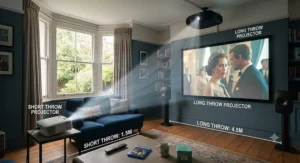
The terms “long throw” and “standard throw projector” are frequently used almost interchangeably in the UK market, and there’s good reason for that: most projectors sold for home cinema use, including every model reviewed above, sit in the 1.1:1 to 2.2:1 throw ratio band that both terms describe. A standard throw projector needs roughly its own distance from the screen (or more) to fill it — so a 100-inch image typically demands somewhere between 2.5 and 4 metres of room depth, depending on the exact lens. This differs meaningfully from short throw projectors (throw ratios below 1.0:1) and ultra-short throw models (below 0.4:1), which sit much closer to the screen or wall.
| Type | Typical Throw Ratio | Distance for 100″ Image | Best For |
|---|---|---|---|
| Long/Standard Throw | 1.1:1–2.2:1 | 2.5m–4.5m | Living rooms, dedicated cinema rooms |
| Short Throw | 0.4:1–1.0:1 | 1m–2.5m | Small or shallow rooms |
| Ultra-Short Throw | Below 0.4:1 | Under 0.5m | Space-constrained walls, TV replacement |
The analysis here matters practically: if your room has the depth, a standard or long throw projector — like the BenQ TK850i or Epson EH-TW7100 — nearly always delivers sharper optics, better lens shift flexibility, and more competitive pricing than a short throw equivalent with matching specs, simply because long-throw lens engineering is cheaper to manufacture well. Short throw and ultra-short throw models earn their premium by solving a genuine space problem, not by outperforming long throw optics on picture quality. In other words: don’t pay the short-throw premium unless you actually need it.
Best Projector for Large Room: What Actually Matters
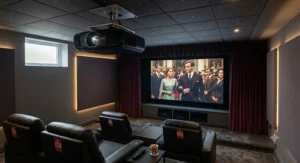
Room size changes the calculus considerably. In a large room — think open-plan living-diners, converted garages, or anything beyond roughly 20 square metres — two factors dominate over everything else: lumen output and throw distance headroom.
For a genuinely large room, prioritise projectors rated at 3,000 lumens or above, which on this list means the ViewSonic PX748-4K, Optoma UHD38x, BenQ TK850i, Epson EH-TW7100, and JMGO N1 Ultra. Below that threshold, a large screen in a large, naturally-lit room risks looking washed out even after dark, simply because more ambient light has more surface area to compete against. Throw distance headroom matters just as much: a projector with a wide zoom range, like the EH-TW7100’s 1.62x, gives you flexibility to mount further back in an open-plan space without being locked into one exact screen size.
According to Which?’s independent testing of home projectors, screen size and picture quality trade-offs become far more noticeable in larger, brighter rooms than in small, controllable spaces — reinforcing that lumen output deserves more weight than resolution alone when a room genuinely dwarfs the typical living room. For open-plan spaces specifically, also budget for a proper projector screen rather than a bare wall; a high-gain or ambient-light-rejecting screen can meaningfully boost perceived brightness without spending another penny on the projector itself.
Understanding Throw Ratio 1.5:1 to 2.0:1
If you’ve been comparing spec sheets, you’ve likely noticed throw ratio figures clustering around the 1.5:1 to 2.0:1 range across a huge number of home projectors — and understanding what that range actually means in practice saves a lot of tape-measure frustration later.
Throw ratio is calculated as distance ÷ image width. A throw ratio of 1.5:1 means the projector needs to sit 1.5 times the width of the desired image away from the screen; at 2.0:1, that doubles to twice the image width. Practically, for a 100-inch diagonal 16:9 screen (roughly 2.2 metres wide), a 1.5:1 throw ratio needs about 3.3 metres of distance, while a 2.0:1 ratio needs a full 4.4 metres. The Optoma UHD38x, rated at 1.5–1.66:1, sits right at the tighter end of this band, making it noticeably more forgiving for medium-depth UK living rooms than a projector fixed at exactly 2.0:1 would be.
This range represents the sweet spot for most standard long throw home cinema projectors precisely because it balances lens simplicity (and therefore cost) against realistic UK room dimensions. Go much below 1.5:1 and you’re edging toward short-throw territory, which typically costs more for equivalent picture quality; go much above 2.0:1 and you risk needing more room depth than most UK properties comfortably offer.
Lumen Output for Large Room Projectors: How Much Is Enough?
Lumens measure total light output, and it’s the single spec most likely to disappoint buyers who under-budget for it — a dim projector in a bright room is simply unwatchable, no matter how good its contrast ratio looks on paper.
As a rough guide, 1,500–2,000 lumens suffices only for a fully darkened room; 2,500–3,000 lumens copes with moderate ambient light such as curtained daytime viewing; and 3,500 lumens or above is genuinely needed for larger rooms with some unavoidable daylight, such as open-plan spaces with skylights or bay windows. On this list, the ViewSonic PX748-4K and Optoma UHD38x both claim the full 4,000 ANSI lumens, putting them at the top end for large-room brightness, while the XGIMI Horizon Pro‘s independently-measured 1,500 ANSI lumens marks it as better suited to evening or curtained daytime use rather than a bright open-plan space.
It’s worth flagging honestly that lumen measurement standards vary between manufacturers — ANSI lumens is the most rigorously standardised and comparable figure, while ISO and CVIA lumens (used by some brands, including two on this list) can measure more generously under different conditions. When comparing large-room suitability across brands, favour ANSI-rated figures where available, and treat other standards as a rough indication rather than a like-for-like comparison.
Common Mistakes When Buying a Long Throw Projector
Even careful buyers repeat a handful of avoidable errors. Watch for these before you commit.
Buying on lumens alone, ignoring throw ratio entirely, is the single most common mistake — a 4,000-lumen projector is useless if your room physically can’t accommodate its throw distance for the screen size you want. A close second is assuming all “4K” projectors are equal: several models on this list, including the Epson EH-TW7100 and BenQ TK850i, use pixel-shift technology from a native 1080p or sub-4K chip rather than true native 4K resolution, which is honest and genuinely effective but worth knowing before you compare against a pricier native-4K rival. Buyers also frequently underestimate ambient light in their actual room — a space that looks dim on a grey afternoon can flood with light on a bright summer evening, so budget lumens for your worst-case lighting, not your best.
Skipping a proper throw distance calculation before purchase, rather than after, causes more returns than any other single factor according to retailer feedback patterns across the projector category. Finally, many buyers overlook total cost of ownership: a cheaper lamp-based projector can cost more over five years of bulb replacements than a pricier laser or LED model that needs none.
Long-Term Cost & Maintenance
Upfront price only tells half the story. Lamp-based projectors — including the Epson EH-TW6250, EH-TW7100, and BenQ TK850i — typically need a replacement bulb every 4,000 to 10,000 hours depending on the mode used, and genuine replacement bulbs commonly cost a meaningful fraction of the projector’s original price. If you watch two hours of content daily, a 5,000-hour lamp lasts roughly six to seven years before needing replacement — a reasonable ownership window for most households, but worth factoring into your total budget rather than treating the sticker price as the final number.
Laser and LED light sources, found in the XGIMI Horizon Pro and JMGO N1 Ultra, are rated for 25,000 to 30,000 hours — potentially the projector’s entire useful life — eliminating bulb replacement costs entirely, which partly justifies their higher upfront price. Beyond light source, maintenance is genuinely minimal across all seven models: periodic dust filter cleaning (where fitted) and occasional lens wiping with a proper microfibre cloth are the extent of routine upkeep. Avoid compressed air directly on the lens coating, and never use household glass cleaner, which can strip anti-reflective coatings over time. If you’re importing a projector directly from overseas rather than buying through a UK retailer, it’s worth checking the UKCA marking requirements that apply to electrical goods sold in Great Britain, since compliant UK-market units carry different safety certification to grey-import versions.
Features That Actually Matter (And Those That Don’t)
Marketing copy loves to bury genuinely useful specs under flashier-sounding but less impactful ones — here’s an honest filter.
Lens shift and zoom range actually matter enormously, because they determine how forgiving installation is in a real (imperfect) room; a projector with generous shift, like the Epson EH-TW7100, can save you from an awkward permanent mount position. Contrast ratio genuinely matters for perceived picture depth, though be aware manufacturer-quoted “dynamic” contrast figures (sometimes in the millions:1) are measured very differently from native contrast and shouldn’t be compared directly across brands. Input lag matters enormously for gaming but is largely irrelevant for film-only households.
Conversely, headline “3D-ready” claims matter to almost nobody in 2026, given how few 3D sources remain in circulation. Extremely high maximum screen size claims (often 300+ inches) are technically true but practically meaningless for most UK rooms, since you’d rarely have the throw distance or lumen output to make a screen that large watchable anyway. Built-in speakers, while a nice bonus, shouldn’t heavily influence your buying decision if you already own or plan to buy a soundbar — even the better built-in speakers on this list, like the BenQ TK850i‘s 10-watt driver, are a convenience rather than a genuine home cinema audio solution.
Frequently Asked Questions
❓ What is a long throw projector?
❓ What's the difference between a long throw 4K projector and standard 1080p models?
❓ How many lumens do I need for a large room?
❓ Can I ceiling mount any long throw projector?
❓ Is a long throw projector better than a short throw for a living room?
Conclusion
Choosing a long throw projector genuinely comes down to three honest questions: how much room depth do you actually have, how much ambient light will you realistically be fighting, and what’s your budget ceiling. Get those three answers straight and the shortlist narrows itself dramatically — the ViewSonic PX748-4K and Optoma UHD38x cover brightness-on-a-budget territory convincingly, the Epson EH-TW6250 and EH-TW7100 own the colour-accuracy middle ground, the BenQ TK850i splits the difference nicely for bright, multi-use living rooms, and the XGIMI Horizon Pro and JMGO N1 Ultra cater to buyers who value flexibility and premium brightness respectively.
None of these seven projectors is universally “the best” — that title depends entirely on your room, your viewing habits, and how much you’re willing to spend on light-source longevity versus upfront price. What matters more than any single spec is matching throw ratio to your actual measured room depth before you buy, since no amount of contrast ratio or colour gamut fixes a picture that simply doesn’t fit your wall. Take the throw distance calculations from this guide, measure your own space honestly, and the right choice from this list should be genuinely obvious.
✨ Don’t Miss These Exclusive Deals!
🔍 Take your long throw projector search to the next level with these carefully selected products. Click on any highlighted item to check current pricing and availability. These picks will help you build the big-screen setup your household will actually love!
Recommended for You
- Short Throw vs Long Throw Projector: 7 Real Picks for 2026
- Short Throw Projector for Gaming: 7 Best Picks for 2026
- Best Short Throw Projector 2026: 7 Top UK Picks Ranked
Disclaimer: This article contains affiliate links. As an Amazon Associate, I earn from qualifying purchases. If you purchase products through these links, we may earn a small commission at no additional cost to you.
✨ Found this helpful? Share it with your friends! 💬🤗
