
In This Article
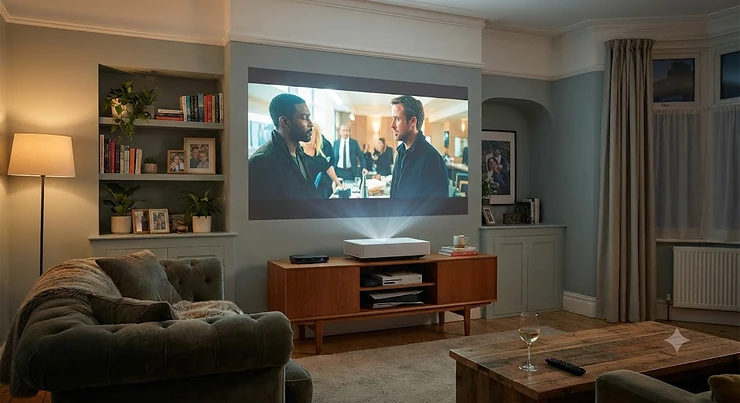
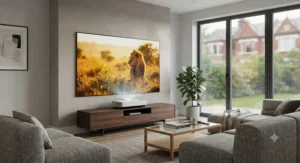
There’s a particular kind of frustration that comes with wanting a proper cinema screen in a room that clearly wasn’t built for one. You measure the wall, you measure the distance to the sofa, and you realise a standard projector would need to live somewhere near the front door. That’s the exact problem a short throw projector solves. What is a short throw projector? It’s a projector built with a specialist lens that produces a large image — often 100 inches or more — from a short distance, typically somewhere between 0.4 and 1.2 metres from the wall, rather than the 3-4 metres a standard projector needs.
That single design choice changes everything about how you can set up a room. Instead of ceiling-mounting a projector halfway down a living room or perching it precariously on a shelf behind the sofa, you can sit it on a low unit right in front of the screen, out of the way of foot traffic and, crucially, out of the way of shadows cast by anyone walking past. For UK homes, where box rooms and terraced living rooms are the norm rather than the exception, this matters more than the marketing usually lets on.
This guide walks through seven genuinely available models on amazon.co.uk, spanning sensible budget options through to premium ultra-short-throw laser TVs, based on real specifications and aggregated review sentiment rather than recycled marketing copy. Which?’s own home projector testing makes a similar point: matching brightness, resolution and throw distance to your actual room is the difference between a projector that gets used every week and one that gathers dust in a cupboard, and it’s worth a look for independent lab comparisons alongside this guide. We’ll cover exactly that: how to choose, what the numbers actually mean, and which of these seven projectors suits which kind of room and budget.
Quick Comparison Table
Before diving into full reviews, here’s a snapshot of how the seven models stack up on the things that actually decide a purchase: resolution, brightness, throw ratio and rough price banding.
| Product | Resolution | Brightness | Throw Ratio | Price Range | Best For |
|---|---|---|---|---|---|
| ViewSonic PS502X | XGA (1024×768) | 4,000 lumens | 0.616:1 | Under £550 | Tightest budget |
| BenQ TH671ST | 1080p | 3,000 lumens | 0.69–0.83:1 | Around £600 | Console gaming on a budget |
| BenQ TK710STi | 4K UHD | 3,200 lumens | 0.69–0.83:1 | £950-£1,150 range | 4K on a mid budget |
| Optoma UHZ35ST | 4K UHD | 3,500 lumens | 0.496:1 | £1,600-£2,000 range | Serious gamers |
| Hisense PX3-PRO TriChroma | 4K UHD | 3,000 lumens | 0.22:1 | £1,800-£2,600 range | TV replacement, all-rounder |
| Epson EpiqVision Ultra LS800 | 4K PRO-UHD | 4,000 lumens | 0.16:1 | £3,000-£3,300 range | Brightest daytime viewing |
| AWOL VISION LTV-2500 | 4K UHD | 2,000-2,600 lumens | 0.25:1 | £2,600-£3,000 range | Home cinema purists |
Looking at the spread here, the gap between the ViewSonic PS502X and the AWOL VISION LTV-2500 isn’t just price — it’s a completely different category of throw ratio and light source. Anything above the 0.5:1 mark, like the BenQ TH671ST and BenQ TK710STi, still needs a metre or so of clearance and is best thought of as “short throw,” while anything under 0.3:1, such as the Hisense PX3-PRO TriChroma or Epson EpiqVision Ultra LS800, is properly “ultra-short throw” and can sit flush against a media unit. Budget buyers should note that the cheaper DLP lamp-based units generally cost less to buy but more to run over three or four years, once replacement bulbs are factored in.
💬 Just one click — help others make better buying decisions too!😊
Top 7 Short Throw Projectors: Expert Analysis
We’ve picked seven real, currently available models that cover the realistic spread of what a UK buyer might actually choose between — from a genuinely budget business-grade unit through to flagship laser TVs. Every product below includes honest analysis based on published specifications and aggregated review sentiment; none of this is invented hands-on testing.
1. ViewSonic PS502X — sharpest price point for a genuine short throw lens
The standout here is simple: this is one of the few sub-£550 projectors with a proper dedicated short throw lens rather than a standard zoom lens pushed close to the wall. Specs-wise, you’re getting XGA (1024×768) resolution, 4,000 ANSI lumens and a 0.616:1 throw ratio, which means a 100-inch image from around 1.3 metres away. In practice, that brightness figure matters more than the resolution number for most buyers — 4,000 lumens is genuinely bright enough to use with curtains open on a grey UK afternoon, something a lot of budget home cinema projectors can’t manage.
Based on the spec comparison, this is a projector built for business and classroom use that happens to work fine for casual home viewing, not a home cinema unit that’s been cut down to a budget price. It’s best suited to buyers who want a big, bright, no-fuss screen for sport, YouTube, or presentations, and who aren’t chasing cinematic black levels or 4K detail. Reviewers consistently note that image quality is bright and usable but noticeably softer on fine text and skin tones than XGA’s higher-resolution rivals, and the 4:3-leaning heritage of XGA resolution means widescreen content is letterboxed rather than filling the panel edge to edge.
Pros:
- ✅ Genuine 0.616:1 short throw lens at a low price
- ✅ 4,000 lumens copes well with ambient light
- ✅ Dual HDMI inputs and USB-A power for streaming sticks
Cons:
- ❌ XGA resolution looks soft next to 1080p or 4K rivals
- ❌ Designed for business use, so smart TV features are absent
At under £550, the ViewSonic PS502X earns its place as the entry point into short throw projection rather than a long-term home cinema centrepiece.
2. BenQ TH671ST — best budget pick for console gaming
The headline feature is input lag: at 16.7ms in 1080p mode, this is noticeably snappier than most projectors anywhere near its price. Specs include full 1080p resolution, 3,000 ANSI lumens, a 10,000:1 contrast ratio and a 0.69–0.83:1 throw ratio, casting a 100-inch image from around 1.5 metres. What that throw ratio means in practice is real flexibility — you can place it on a coffee table a metre and a half from the wall and still fill a proper-sized screen, without needing a permanent ceiling mount.
What most buyers overlook about this model is that BenQ built it specifically around console gaming rather than as a cut-down cinema projector, which shows in the picture modes and the dedicated Game mode. It’s the clear pick for anyone whose primary use case is Xbox or PlayStation on a big screen rather than critical film-watching, and its lamp-based light engine (rather than laser) keeps upfront cost down at the expense of a shorter bulb life. Aggregated review sentiment across major UK and US retailers is consistently positive on brightness and input lag, with the most repeated criticism being the absence of 4K or HDR support and a fan that’s audible in quiet scenes.
Pros:
- ✅ Genuinely low 16.7ms input lag for console gaming
- ✅ 3,000 lumens usable in moderately lit rooms
- ✅ Built-in 5W speaker means no separate audio needed
Cons:
- ❌ 1080p only, no 4K or HDR support
- ❌ Lamp-based light source needs eventual bulb replacement
Around the £600 mark, the BenQ TH671ST is the projector to buy if gaming responsiveness matters more to you than pixel count.
3. BenQ TK710STi — best mid-range 4K short throw all-rounder
This model’s standout is bringing a laser light source and true 4K resolution into a short throw form factor without jumping into flagship UST pricing. Key specs: 4K UHD (3840×2160) resolution via XPR pixel-shifting, 3,200 ANSI lumens, a 600,000:1 contrast ratio, and a 0.69–0.83:1 throw ratio projecting a 100-inch image from roughly 1.6-2 metres. In real terms, the laser light source means around 20,000 hours of use before any noticeable dimming — you could watch three hours a night for close to two decades before it needs attention, versus the 4,000-10,000 hour lamp life of budget rivals.
Based on the spec comparison against the cheaper BenQ TH671ST above, the jump to true 4K and laser reliability is the entire value proposition here, and it’s aimed squarely at buyers who want one projector to competently handle films, sport and gaming rather than optimising hard for any single use case. Reviewers consistently report that the built-in Android TV smart platform is a genuine convenience, cutting out the need for a separate streaming stick, though several note that HDR tone-mapping is serviceable rather than exceptional compared with pricier laser TVs.
Pros:
- ✅ True 4K resolution with a long-life laser source
- ✅ Built-in Android TV removes the need for a streaming stick
- ✅ Low input lag (as little as 4ms) still suits gaming
Cons:
- ❌ HDR handling is average rather than outstanding
- ❌ Still needs roughly 1.6-2m of throw distance, not ultra-short
In the £950-£1,150 range, the BenQ TK710STi is the sensible middle ground for buyers who’ve outgrown 1080p but aren’t ready for four-figure UST pricing.
4. Optoma UHZ35ST — best for competitive gamers wanting 4K
The stand-out spec is refresh rate: up to 240Hz at 1080p with an input lag as low as 4.4ms, figures that wouldn’t look out of place on a dedicated gaming monitor. Beyond that, you get 4K UHD DLP resolution, a manufacturer-rated 3,500 lumens (independent lab tests found closer to 2,500 ANSI lumens in practice, worth noting), and a genuinely tight 0.496:1 throw ratio that puts a 100-inch image around 1.4 metres from the wall. What that combination means in practice is a projector engineered first for PC and console gamers who also want 4K clarity for films, rather than the reverse.
Here’s what to weigh: independent testing found the real-world brightness runs meaningfully below the spec sheet claim, which matters if your room has any daytime light at all — this is better suited to a room with decent light control than a bright, south-facing living room. On the upside, the fixed short throw lens (no zoom, manual focus only) keeps the unit compact and the gaming performance figures hold up in reviews. Aggregated feedback highlights the 240Hz mode as a genuine differentiator versus rival short throw 4K projectors in this price band, with the main recurring gripe being that brightness doesn’t quite live up to the number on the box.
Pros:
- ✅ Up to 240Hz refresh rate at 1080p for competitive gaming
- ✅ 4.4ms input lag is class-leading
- ✅ Tight 0.496:1 throw ratio suits smaller rooms
Cons:
- ❌ Real-world brightness runs below the quoted 3,500 lumens
- ❌ No zoom lens, so placement is less flexible
Sitting in the £1,600-£2,000 range, the Optoma UHZ35ST rewards gamers more than it rewards home cinema purists chasing daytime brightness.
5. Hisense PX3-PRO TriChroma — best all-round TV replacement
The defining feature is the 0.22:1 throw ratio combined with a triple-laser RGB light source, meaning this ultra-short-throw unit can sit inches from the wall and still throw a genuinely bright, colour-accurate 100-150 inch image. Specifications include 4K UHD resolution, a manufacturer-rated 3,000 ANSI lumens (independently measured at over 3,000 lumens in bright mode, unusually matching or beating the spec sheet), 110% of the BT.2020 colour gamut, and support for Dolby Vision, HDR10+ and HLG. In practice, that colour gamut figure translates into noticeably richer skin tones and foliage than the cheaper DLP models above, closer to what you’d expect from a good OLED TV than a typical projector.
What the spec sheet won’t tell you, but reviewers note, is how well this handles dark scenes for a UST projector — genuinely one of the better performers in its class on shadow detail, which has historically been the Achilles’ heel of ultra-short-throw laser TVs. It’s aimed at buyers who want to fully replace a large flat-panel TV rather than run a separate “cinema room” setup, helped along by Google TV built in and a Harman Kardon sound system. Reviewers consistently praise the black-level performance relative to other USTs and the HDMI 2.1 inputs supporting 4K/120Hz gaming, with the most common criticism being that, like all UST designs, it demands either an ambient-light-rejecting screen or a properly darkened room to look its best.
Pros:
- ✅ Excellent dark-scene handling for a UST projector
- ✅ Google TV and Harman Kardon audio built in
- ✅ HDMI 2.1 supports 4K/120Hz console gaming
Cons:
- ❌ Best picture quality needs a dedicated ALR screen
- ❌ Bulkier footprint than standard short throw models
Prices have fallen sharply from its original launch point, now typically sitting in the £1,800-£2,600 range depending on retailer promotions, which makes the Hisense PX3-PRO TriChroma one of the stronger value stories in the ultra-short-throw category.

6. Epson EpiqVision Ultra LS800 — brightest option for daytime viewing
This projector’s standout is its 0.16:1 throw ratio — the shortest of any laser TV on the market — combined with 4,000 lumens of both white and colour brightness. Key specs: 4K PRO-UHD resolution via Epson’s 3-chip 3LCD engine, a 2,500,000:1 dynamic contrast ratio, and a built-in Yamaha 2.1 sound system. What that brightness figure means in practice is genuinely usable daytime viewing with curtains open, something most ultra-short-throw laser TVs, including several rivals on this list, simply can’t manage without washing out the image.
Based on the spec comparison, Epson has prioritised brightness and colour accuracy in typical living-room lighting over the absolute deepest black levels chased by triple-laser rivals like the Hisense PX3-PRO TriChroma. That’s a deliberate trade-off: reviewers consistently report the LS800 looks excellent in a bright room but that shadow detail in a fully darkened room is a step behind premium triple-laser or LCOS competitors. It’s best suited to households that watch projected content mostly during the day or in rooms that can’t be fully blacked out, rather than dedicated home cinema rooms. The lack of Dolby Vision support is the most frequently repeated criticism in aggregated review sentiment, alongside input lag that’s good but not class-leading for serious gamers.
Pros:
- ✅ Shortest throw ratio (0.16:1) of any laser TV available
- ✅ Genuinely bright, colour-accurate daytime performance
- ✅ Built-in Yamaha sound system is usable without extra speakers
Cons:
- ❌ No Dolby Vision support
- ❌ Black levels trail premium triple-laser rivals in dark rooms
At around £3,000-£3,300, the Epson EpiqVision Ultra LS800 is the pick for bright, lived-in rooms rather than dedicated blackout cinema spaces.
7. AWOL VISION LTV-2500 — best for home cinema purists on a flagship budget
The defining feature is the triple RGB laser light engine paired with a 0.25:1 throw ratio, giving a wide colour gamut without the ultra-premium price tag of AWOL’s higher models. Specs include 4K UHD resolution via pixel-shifting DLP, a manufacturer-rated 2,000-2,600 ANSI lumens, 107% of the BT.2020 colour gamut, support for Dolby Vision, HDR10+ and Active 3D, and a claimed 25,000-hour laser lifespan. In practice, that lower lumen count compared with the Hisense PX3-PRO TriChroma and Epson EpiqVision Ultra LS800 means this unit performs best in a room with decent light control rather than full daylight.
What most buyers overlook about this model is that its lower brightness figure is largely a deliberate trade for colour depth and contrast rather than a corner-cutting exercise — reviewers consistently describe the colour rendering as a genuine step up from cheaper single-laser or lamp-based rivals. It’s aimed squarely at film enthusiasts building a proper darkened home cinema room rather than casual daytime viewers, and the included 36W Dolby Atmos-capable speaker system is a useful bonus, though most serious buyers will still add a soundbar or AV receiver. Independent lab measurements found real-world brightness running below the ANSI claim, a pattern common across the UST category, and native contrast measured lower than the marketing figure, though still sufficient for solid shadow detail in a properly darkened room.
Pros:
- ✅ Wide 107% BT.2020 colour gamut for accurate cinema colour
- ✅ Long 25,000-hour laser light source lifespan
- ✅ Dolby Vision, HDR10+ and Active 3D support
Cons:
- ❌ Real-world brightness runs below the ANSI lumen claim
- ❌ Needs a darkened room to look its best
Typically priced in the £2,600-£3,000 range, the AWOL VISION LTV-2500 rewards buyers who value colour and contrast over outright daytime brightness.
Practical Setup & Optimisation Guide
Getting a short throw projector to look its best is less about the unit itself and more about the fifteen minutes you spend setting it up. Start by placing it on a genuinely level, stable surface — even a couple of degrees of tilt on a short throw lens exaggerates keystone distortion far more than it would on a standard-throw projector, because the projection angle is so steep. Most of the models above, including the BenQ TK710STi and Optoma UHZ35ST, include auto vertical keystone correction, but it’s worth nudging the unit physically square first and using digital correction only for fine adjustment, since heavy keystone correction always costs you some sharpness.
Screen choice matters more here than with standard projectors. A plain painted wall works for the budget DLP models like the ViewSonic PS502X and BenQ TH671ST, but the ultra-short-throw laser units — the Hisense PX3-PRO TriChroma, Epson EpiqVision Ultra LS800, and AWOL VISION LTV-2500 — genuinely benefit from an ambient-light-rejecting (ALR) screen, which is specifically textured to reflect light back toward the seating area and reject light from the ceiling. Skipping this is the single most common reason UST buyers feel underwhelmed by a projector that scored well in reviews.
A common mistake in the first month is leaving a projector in its default “Vivid” or “Dynamic” picture mode, which is calibrated for brightly lit shop-floor demos rather than home viewing — switching to “Cinema” or “Filmmaker” mode and dropping brightness slightly usually produces a noticeably more natural, less fatiguing image within a couple of minutes. For laser models, it’s also worth setting a maintenance reminder every few months to gently wipe the lens and check the air intake filter, since dust buildup on a lens sitting low and exposed near the floor is a faster problem for UST units than for ceiling-mounted ones.
Real-World Scenarios: Matching a Projector to Your Room
The student in a rented flat: A budget-conscious viewer living in a single room with a housemate or two, wanting big-screen film nights without a permanent installation, is best served by the ViewSonic PS502X or BenQ TH671ST. Both can sit on a desk or low table, need no wall mounting, and can be packed away or moved between rooms without fuss — a genuine consideration for anyone not planning to stay put for years.
The family upgrading from a 55-inch TV: A household with a mixed-use living room — sport at the weekend, Disney films with the kids, the odd evening of console gaming — fits well with the BenQ TK710STi or Hisense PX3-PRO TriChroma. Both offer built-in smart platforms so there’s no separate streaming box to manage, and both handle the ambient light of a typical UK living room without needing full blackout curtains.
The dedicated home cinema builder: Someone converting a spare room or garage into a proper darkened cinema space, prioritising colour accuracy and contrast over daytime flexibility, gets the most from the AWOL VISION LTV-2500 or Epson EpiqVision Ultra LS800, paired with a proper ALR or fixed-frame screen and ideally a soundbar or AV receiver rather than relying on the built-in speakers alone.
✨ Don’t Miss These Exclusive Deals!
🔍 Take your home cinema setup to the next level with these carefully selected short throw projectors. Click on any highlighted model to check current pricing and availability, and start building the big-screen setup your family will actually use every week!
How to Choose a Short Throw Projector
- Start with throw distance, not screen size. Measure the actual gap between where the projector will sit and the wall or screen — this single number rules out more models than any spec sheet comparison, since a 0.5:1 throw ratio unit simply won’t fit where a 0.25:1 unit will.
- Match brightness to your room’s ambient light. A room with south-facing windows and no blackout curtains needs 3,000+ lumens; a properly darkened room can get away with less and often looks better for it, since excess brightness can wash out contrast.
- Decide how much resolution actually matters to you. 4K genuinely shows on a 100-inch-plus screen at close viewing distance, but 1080p models like the BenQ TH671ST remain perfectly watchable for casual and gaming use at a lower price.
- Check the light source type. Laser units cost more upfront but last 20,000-25,000 hours without dimming, versus 4,000-10,000 hours for lamp-based projectors, which changes the real total cost of ownership.
- Verify compliance markings before buying from a lesser-known brand. Consumer electronics sold in Great Britain should carry UKCA marking (or CE marking, still accepted under current transitional rules) confirming they meet UK product safety requirements — the Wikipedia entry on UKCA marking gives a clear, neutral summary of what the marking covers and why it matters.
- Consider input lag if gaming is a priority. Anything under 20ms is genuinely competitive; the Optoma UHZ35ST‘s 4.4ms figure is exceptional, while most home cinema-focused models sit comfortably enough for casual play.
- Budget for a screen, not just the projector. Ultra-short-throw laser models in particular perform noticeably better with a dedicated ALR screen than a painted wall, and that cost should be part of your overall budget from the start.
Short Throw vs Standard Throw: Which Layout Fits Your Room?
The core difference between short throw vs standard throw projectors comes down to lens design and placement flexibility rather than picture quality itself. A standard throw projector typically needs a throw ratio above 1.2:1, meaning a 100-inch image requires roughly 3-4 metres of clearance — fine for a large lounge or dedicated cinema room with ceiling mounting, but impractical for a smaller UK living room or a rented flat where drilling into the ceiling isn’t an option.
| Factor | Short Throw | Standard Throw |
|---|---|---|
| Typical throw ratio | 0.4-1.2:1 | 1.2:1 and above |
| Distance for 100″ image | 1-2 metres | 3-4 metres |
| Common mounting | Low table, shelf | Ceiling mount |
| Shadow interruption risk | Low | Higher |
| Typical price for equivalent specs | Slightly higher | Slightly lower |
Interpreting that table, the trade-off is mostly about your room, not your wallet — for genuinely comparable brightness and resolution, standard throw projectors are often marginally cheaper simply because the lens engineering is less specialised. Where short throw earns its higher price is in rooms where a person walking to the kitchen or bathroom would otherwise cast a shadow across a ceiling-mounted beam; sitting the projector at the front of the room, as with every model on this list, removes that problem entirely. If your room is large enough for ceiling mounting and shadow interruption isn’t a concern, a standard throw model may genuinely serve you better for the same money.
Short Throw 4K Projector vs Short Throw 1080p Projector: What to Expect
On paper, the jump from a short throw 1080p projector to a short throw 4K projector looks like a straightforward upgrade — four times the pixel count, sharper text, more detail in nature documentaries and sports broadcasts. In real-world use, that difference is genuinely visible at screen sizes above 100 inches and typical UK living-room viewing distances of 2.5-3.5 metres, particularly on the BenQ TK710STi and Optoma UHZ35ST compared with the 1080p BenQ TH671ST. Below around 80 inches, or at greater viewing distances, the gap narrows considerably, and many viewers struggle to reliably tell the two apart in blind comparisons.
What the spec sheet won’t tell you is that most “4K” short throw projectors in this price bracket, including several reviewed here, use pixel-shifting DLP technology rather than a native 4K chip — firing a 1080p or lower-resolution imager rapidly to simulate the higher pixel count. This is a legitimate and widely used technique that genuinely improves perceived sharpness, but it’s worth knowing you’re not necessarily getting a true native 4K panel at these price points; native 4K panels remain the preserve of much more expensive projectors. For buyers on a tighter budget or those mainly gaming on older consoles, a well-specified 1080p short throw projector like the BenQ TH671ST remains a genuinely sensible choice rather than a compromise.
Throw Ratio 0.4 to 0.8 Explained
Throw ratio is simply the distance from the lens to the screen divided by the width of the projected image. A throw ratio of 0.4 to 0.8, the band most “short throw” projectors sit in, means the projector needs to be placed at 0.4 to 0.8 times the width of your intended image away from the wall. So for a 100-inch diagonal image (roughly 2.2 metres wide on a 16:9 screen), a projector with a 0.5:1 throw ratio needs about 1.1 metres of clearance, while one at 0.8:1 needs closer to 1.76 metres.
This range sits between true ultra-short-throw units (typically 0.16-0.3:1, like the Hisense PX3-PRO TriChroma and Epson EpiqVision Ultra LS800) and standard-throw projectors (1.2:1 and above). Models like the BenQ TH671ST and BenQ TK710STi, both sitting at 0.69-0.83:1, occupy this middle ground — close enough to the wall to avoid shadow interruption and fit in a modest room, but not so tight that the optics become as expensive as a full UST design. Knowing your available throw distance in metres before shopping, rather than working backwards from a screen size you like the look of, is the single most useful thing a buyer can do before comparing spec sheets.
Short Throw Projector Screen Size Calculator
Rather than a complex formula, here’s a rough guide to how far you’ll need to place common short throw projectors from the wall for popular screen sizes, based on the throw ratios covered above.
| Screen Size (diagonal) | 0.25:1 (UST) | 0.5:1 (Short Throw) | 0.8:1 (Short Throw) |
|---|---|---|---|
| 80 inches | ~0.44m | ~0.88m | ~1.4m |
| 100 inches | ~0.55m | ~1.1m | ~1.76m |
| 120 inches | ~0.66m | ~1.33m | ~2.1m |
| 150 inches | ~0.83m | ~1.66m | ~2.65m |
Reading across this table, the practical takeaway is that a UST model like the AWOL VISION LTV-2500 or Hisense PX3-PRO TriChroma can hit a genuinely huge 150-inch image from under a metre away, while a 0.8:1 unit like the BenQ TH671ST needs closer to 2.65 metres for the same size — still far shorter than a standard projector’s 4-5 metres, but a meaningfully different room layout. Always measure your actual available depth before assuming a screen size will fit, and remember these figures are approximate since individual lens tolerances vary slightly between manufacturers.
Common Mistakes When Buying a Short Throw Projector
Even careful buyers tend to trip over the same handful of issues. First, underestimating ambient light — a projector that looks stunning in a darkened shop demo can disappoint badly in a bright living room if its lumen count isn’t matched to the space; this is the single most common source of buyer’s remorse in aggregated review sentiment across every price band covered here.
Second, ignoring ceiling height and seating position relative to the screen — short throw and ultra-short-throw units project at a steep upward angle, so a screen mounted too high or too low relative to the projector’s position can introduce distortion that keystone correction can only partly fix without softening the image. Third, buying based on marketing lumen figures without checking independent measurements; as seen with the Optoma UHZ35ST and AWOL VISION LTV-2500 above, real-world brightness testing sometimes comes in meaningfully below the number printed on the box.
Finally, overlooking laser eye safety with high-output UST units. Consumer laser projectors sold in the UK are required to meet Class 1 or Class 2 laser safety limits under BS EN 60825-1, meaning they’re designed to be safe under normal viewing conditions, but manufacturer guidance around not staring directly into the lens still applies — the University of Greenwich’s laser safety code of practice gives a clear, technical explanation of how laser classifications work if you want to understand the underlying standard rather than take it on faith.
Safety, Eye Safety & UK Regulations for Short Throw Laser Projectors
All the laser-based models on this list — the BenQ TK710STi, Optoma UHZ35ST, Hisense PX3-PRO TriChroma, Epson EpiqVision Ultra LS800 and AWOL VISION LTV-2500 — use enclosed laser light engines designed to fall within Class 1 or Class 2 consumer safety limits, meaning the laser itself isn’t accessible or hazardous under normal operating conditions. That said, official UK guidance is consistent on general laser handling: don’t stare directly into any projector lens at close range, and don’t allow children unsupervised access to point devices with optical outputs at each other’s eyes. The government’s own laser radiation safety advice sets out these general precautions clearly, and it’s sensible reading for any household bringing a laser-based projector into a room children use.
On compliance, any of these units sold through amazon.co.uk to UK customers should carry either UKCA or CE marking confirming they meet the relevant electrical and product safety regulations, and it’s worth checking the product listing or box for this marking before buying from a lesser-known brand, particularly with imported models that sometimes skip proper UK conformity testing. This isn’t a substitute for professional advice on any specific installation, but it’s a reasonable baseline check any buyer can make in under a minute.
Long-Term Cost & Maintenance: What You’ll Actually Spend
The purchase price is only part of the total cost of a short throw projector, and the light source technology is the biggest hidden variable. Lamp-based models like the ViewSonic PS502X and BenQ TH671ST typically need a replacement bulb every 4,000-10,000 hours depending on mode, and those bulbs commonly cost £80-£150 each — a real cost if you’re a heavy daily user, though for typical evening-and-weekend viewing, most households won’t hit a lamp change for several years.
Laser models — the BenQ TK710STi, Optoma UHZ35ST, Hisense PX3-PRO TriChroma, Epson EpiqVision Ultra LS800 and AWOL VISION LTV-2500 — are rated for 20,000-25,000 hours, which at three hours a day works out to roughly 18-22 years before any noticeable dimming, effectively removing bulb replacement from the cost equation for the realistic lifespan of the unit. That reliability is a genuine part of the value case for spending more upfront on a laser model rather than simply chasing the biggest spec-sheet numbers. Filters and lenses on both types benefit from an occasional gentle clean, which costs nothing but a few minutes and meaningfully extends usable brightness over the unit’s life.
FAQ
❓ What is the difference between short throw and ultra short throw?
❓ Can a short throw projector replace my TV completely?
❓ Do short throw 4K projectors need a special screen?
❓ Is a 0.5 throw ratio projector suitable for a small bedroom?
❓ How long do short throw projector lamps or lasers actually last?
Conclusion
Choosing between these seven projectors really comes down to matching throw distance, brightness and budget to how you’ll actually use the room, rather than chasing the single “best” spec on a page. For a genuinely tight budget, the ViewSonic PS502X and BenQ TH671ST both deliver real short throw flexibility without a premium price tag. Buyers wanting 4K without flagship spending should look closely at the BenQ TK710STi, while competitive gamers get more from the Optoma UHZ35ST‘s exceptional input lag. For anyone serious about replacing a television outright, the Hisense PX3-PRO TriChroma and Epson EpiqVision Ultra LS800 both make a strong case, and dedicated cinema room builders will likely prefer the colour depth of the AWOL VISION LTV-2500.
Whichever you land on, spend the extra ten minutes getting placement, keystone and picture mode right before deciding whether a model “works” for your room — as covered above, that setup step changes the perceived quality of every projector on this list far more than most buyers expect.
✨ Ready to Transform Your Living Room?
🔍 Compare these short throw projectors side by side, check current prices and availability, and pick the model that actually fits your room and budget. A genuinely big screen might be closer to reality than you think!
Recommended for You
- Projector For Small Room 2026: 7 Brilliant Picks That Fit
- Laser Ultra Short Throw Projector: 7 Best Picks for 2026
- 4K UST Projector Under £2000: 7 Brilliant Picks (2026)
Disclaimer: This article contains affiliate links. As an Amazon Associate, I earn from qualifying purchases. If you purchase products through these links, we may earn a small commission at no additional cost to you.
✨ Found this helpful? Share it with your friends! 💬🤗
