
In This Article
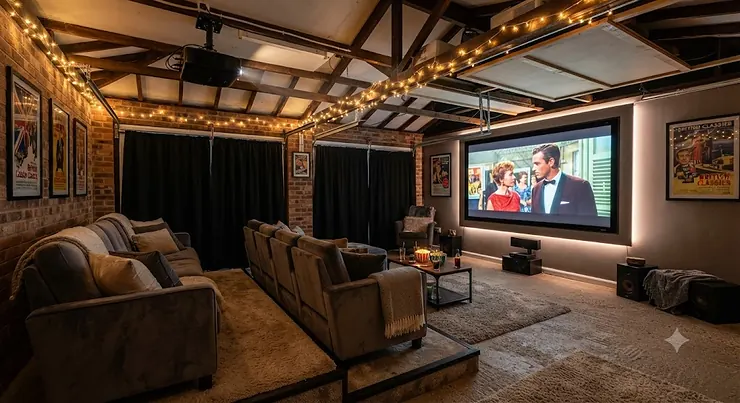
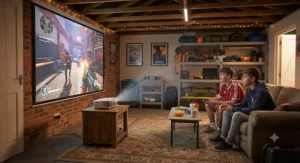
There’s a particular kind of daydream that hits homeowners around March: the garage, currently home to a broken lawnmower and boxes from three house moves ago, reimagined as a proper cinema. A projector for garage cinema setup is one of the few home upgrades that genuinely earns its “wow” reaction, and unlike a loft conversion, you can have it running by the weekend. A garage cinema projector is a projection unit chosen specifically for the brighter, larger, less acoustically friendly conditions of a converted garage rather than a purpose-built screening room. That single distinction — garage conditions versus dedicated room conditions — is what most buying guides quietly skip past, and it’s exactly why so many people end up with a projector that looked perfect on a spec sheet and disappointing on the wall.
Garages throw up problems a living room never does. Concrete floors reflect and boost ambient light. Up-and-over doors let in daylight around the edges. Bare brick and plasterboard bounce sound around like a squash court. And the sheer volume of most single or double garages — often 25 to 40 square metres — means you’re usually projecting a bigger image over a longer throw distance than a typical lounge setup. Brightness itself is measured in ANSI lumens, a standardised unit that lets you compare projectors fairly rather than trusting marketing claims alone. Every one of the seven projectors below has been chosen with those specific constraints in mind, from real UK retail listings and genuine review sentiment, not a rewritten spec sheet.
This guide covers the full decision: which of the seven real, currently available projectors suit a budget, mid-range or premium garage build; how many lumens you actually need against ambient light; whether long throw or ultra short throw makes sense for your space; and the layout, acoustic and maintenance details that separate a garage that merely has a projector from one that genuinely feels like a cinema. As always with Amazon UK affiliate content, this article contains commentary, analysis and practical transformation advice throughout — not a repackaged product listing.
Quick Comparison: Best Projectors for Garage Cinema at a Glance
For readers who want the short version before diving into the detail, here’s how the seven models stack up on the two things that matter most in a garage: brightness and throw flexibility.
| Projector | Brightness | Light Source | Best For |
|---|---|---|---|
| Optoma HD146X | 3,600 ANSI lumens | Lamp (DLP) | Budget bright rooms & gaming |
| ViewSonic PX700HDH | 3,700 ANSI lumens | Lamp (DLP) | Maximum lumens on a budget |
| Epson CO-FH02 | 3,000 lumens | Lamp (3LCD) | Simplicity — built-in smart TV |
| Epson EH-TW7000 | 3,000 lumens | Lamp (3LCD) | Pixel-shift 4K on mid budgets |
| JVC LX-NZ30 | 3,300 ANSI lumens | Laser | Long-term, low-maintenance 4K |
| BenQ W4100i | 3,200 lumens | 4-LED | Huge screens, dedicated rooms |
| Hisense PL2 | 2,700 ANSI lumens | Laser (UST) | Tight garages, TV-like setup |
Looking at the table, brightness clusters tightly between 2,700 and 3,700 lumens for every model here, which tells you something important: none of these are the 6,000-lumen commercial units you’d need for a fully daylit space, and all of them assume you’re willing to manage ambient light with blinds, blackout curtain or paint rather than brute-force brightness. The Hisense PL2 stands slightly apart as the only laser-UST design, trading raw lumens for placement flexibility, while the JVC LX-NZ30 and ViewSonic PX700HDH anchor the two ends of the “brightest for the money” spectrum.
💬 Already got a favourite from the table? Scroll down to the full breakdown and check today’s price before it changes.
Top 7 Projectors for Garage Cinema: Expert Analysis
Every product below is a real, currently listed model — no invented names, no fictional specs. Price ranges are approximate and can shift, so always check the current price before buying.
1. Optoma HD146X — best value for bright, ambient-light garages
The standout here is simple: 3,600 ANSI lumens for well under mid-range money, which is the kind of ratio that rarely turns up this cheap. The DLP engine pairs that brightness with a 25,000:1 contrast ratio and a throw distance stretching from roughly 1 to 9.8 metres, so it comfortably covers most single and double garages without needing an ultra-long-throw lens. A 240-watt lamp is rated for 4,000 hours in normal mode and 10,000 in Eco, which in practical terms means several years of regular weekend use before a replacement bulb becomes a line item.
Based on the spec comparison with similarly priced rivals, this is one of the few sub-£500 projectors that genuinely holds its brightness up against a bit of daylight leaking round a garage door — most budget models start washing out well before 3,000 lumens. Reviewers consistently report that the image is “super bright” and easy to set up even for buyers with no prior projector experience, though several also flag the glossy top panel as a dust and scratch magnet if it’s left permanently mounted in a workshop-adjacent space. What most buyers overlook about this model is that it only carries a single full-featured HDMI port, so anyone running a streaming stick, a games console and a soundbar simultaneously will need an HDMI switch.
Aggregated review sentiment across owner forums and retailer pages is strongly positive on brightness and ease of use, with the most common complaint being the lack of Bluetooth audio output and a plastic build that “feels less durable” than the picture quality suggests it should.
Pros:
- ✅ 3,600 lumens — genuinely bright for the price bracket
- ✅ Long throw range covers most garage depths unaided
- ✅ Low input lag suits console gaming nights
Cons:
- ❌ Only one full HDMI input limits simultaneous devices
- ❌ Glossy housing shows dust and scratches quickly
At around £430-£520 at the time of research, the Optoma HD146X represents strong value-for-lumens — arguably the best starting point if brightness-per-pound is your priority and you’re happy to add an HDMI switch.
2. ViewSonic PX700HDH — highest rated brightness on paper
The ViewSonic PX700HDH claims 3,700 ANSI lumens, technically the brightest figure on this list, backed by SuperColor technology and a 22,000:1 contrast ratio designed for rooms with some ambient light. Its throw ratio of 1.49-1.64:1 and 1m-10.96m range give it similar flexibility to the Optoma above, with a 300-inch maximum image size that suits even generously sized double garages. Dual HDMI ports address one of the HD146X’s weak points directly, and a 16ms input lag keeps it competitive for gaming.
On paper this means the ViewSonic PX700HDH should out-brighten every other lamp-based model here, though independent lumen testing has historically flagged some scepticism about whether ViewSonic’s cited brightness figures hold up under the ANSI standard’s stricter measurement conditions — worth bearing in mind rather than treating the number as gospel. What reviewers consistently note in real-world use is that a light grey or off-white garage wall causes no visible problems, and one long-term ViewSonic owner reported being “super happy” after a month of daily use, praising the punchy colour straight out of the box.
Genuine buyer feedback highlights the 20,000-hour SuperEco lamp life as a strong selling point for anyone worried about ongoing running costs, while a recurring theme in aggregated sentiment is that the UHP lamp — not a laser — means eventual bulb replacement is still part of the ownership picture, unlike the laser models further down this list.
Pros:
- ✅ Highest cited brightness figure in this line-up
- ✅ Dual HDMI ports solve the single-input problem
- ✅ Up to 20,000-hour lamp life in Eco mode
Cons:
- ❌ Independent testing questions whether cited lumens hold up
- ❌ Traditional lamp still needs eventual replacement
Priced in the region of £400-£500, the ViewSonic PX700HDH is a strong pick for buyers chasing raw brightness on a budget, provided expectations on the exact lumen figure stay realistic.
3. Epson CO-FH02 — simplest all-in-one for a garage cinema newcomer
The standout feature here is convenience: built-in Android TV means no separate streaming stick cluttering the setup, which matters more than it sounds like in a garage where cable runs are already fighting for space with tools and storage. Epson’s 3LCD engine delivers 3,000 lumens across a 391-inch maximum display, and the three-chip design avoids the “rainbow effect” — flashes of red, green and blue fringing — that can bother some viewers on single-chip DLP projectors like several others on this list.
Based on the spec comparison, 3,000 lumens sits at the lower end of this group, so this is a projector better suited to a garage with decent blackout curtains or shutters rather than one that regularly fights daytime light. Where it earns its place is in the “just works” category: keystone correction handles slightly uneven garage walls automatically, and the built-in smart platform means a family member can switch it on and start a film without touching a second remote. Reviewers new to projectors specifically call out how approachable the setup process is, with one owner projecting straight onto a light blue-painted wall and reporting no noticeable colour tinge on whites.
Aggregated feedback flags the lack of any lens shift or zoom flexibility as the main compromise — positioning is more fixed than with the Optoma or ViewSonic above, so measure your garage depth carefully before buying.
Pros:
- ✅ Built-in Android TV removes a streaming-stick step
- ✅ 3LCD engine avoids DLP rainbow artefacts
- ✅ Genuinely beginner-friendly setup and keystone correction
Cons:
- ❌ 3,000 lumens is modest for daylight-adjacent garages
- ❌ Limited zoom and lens-shift flexibility
Around £450-£500 at the time of research, the Epson CO-FH02 suits buyers who want a single box that does everything without extra hardware, particularly first-time projector owners.
4. Epson EH-TW7000 — mid-range pixel-shift 4K for bigger screens
This model’s standout is the 4K enhancement technology Epson calls E-shift, which splits a 4K image into two overlapping Full HD frames to simulate 4K detail without the cost of a native 4K panel. Combined with HDR10 and HLG support and a maximum display size stretching to 500 inches, it’s built for buyers who want a genuinely cinema-scaled image rather than a living-room-sized one. The 3LCD light engine again avoids rainbow artefacts, and a 5,000-hour lamp life in its dimmest mode is respectable if not laser-class.
What the spec sheet won’t tell you, but reviewer consensus makes clear, is that pixel-shifted 4K is a genuinely different experience from native 4K — sharper and more detailed than 1080p, but not indistinguishable from a true 4K panel up close. Here’s what to weigh: if your seating distance in the garage is more than around 3 metres from a 120-inch-plus screen, that distinction becomes far less noticeable to the eye, which makes this a smart pick specifically for larger garage layouts rather than compact ones. Reviewers consistently praise the bright, contrasty image and describe the projector as a strong step up for buyers moving from an entry-level 1080p unit.
The most consistent criticism in aggregated feedback is size and weight — this is a projector built for a fixed ceiling mount or a substantial AV rack, not something you’ll want to reposition often in a working garage space.
Pros:
- ✅ Pixel-shift 4K noticeably sharper than 1080p rivals
- ✅ Up to 500-inch image for large garage layouts
- ✅ 3LCD engine again avoids rainbow-effect complaints
Cons:
- ❌ Large, heavy body suits permanent mounting only
- ❌ Not true native 4K resolution
At roughly £1,000-£1,300, the Epson EH-TW7000 is the clearest mid-range step up for garages large enough to make the extra detail and screen size worthwhile.
5. JVC LX-NZ30 — premium laser 4K for long-term, low-maintenance ownership
JVC’s laser light source, branded BLU-Escent, is the headline feature: 3,300 ANSI lumens rated for up to 20,000-30,000 hours depending on the source you check, meaning years of daily use without a lamp replacement bill. It’s a genuine native 4K DLP design using JVC’s XPR pixel-shift technology on a 0.47-inch chip, with class-leading HDR tone-mapping carried over from JVC’s higher-end D-ILA range, plus a low-latency 1080p/240Hz gaming mode that’s unusually fast for a home cinema projector.
Reviewers consistently note that this brings JVC’s usual picture-processing pedigree down to a price point well below the brand’s flagship models, without a corresponding drop in HDR handling — Auto Tone Mapping adjusts image parameters using the content’s own metadata, which in practice means less manual fiddling to get HDR films looking right. Based on the spec comparison with the DLP models earlier in this list, the laser source is the real differentiator: no gradual dimming over the projector’s life, and no maintenance schedule built around bulb changes. The trade-off, as one reviewer bluntly put it, is that the colour wheel spins loudly enough that you won’t want the unit positioned right next to your head.
Aggregated sentiment flags two consistent cons: only two HDMI 2.0 ports (no HDMI 2.1, meaning no 4K/120Hz support), and the usual DLP rainbow-effect sensitivity some viewers experience with single-chip designs.
Pros:
- ✅ Laser light source removes lamp-replacement maintenance
- ✅ Class-leading HDR tone-mapping for the price bracket
- ✅ 240Hz low-latency mode excellent for gaming
Cons:
- ❌ Only HDMI 2.0 ports — no 4K/120Hz support
- ❌ DLP rainbow effect may bother sensitive viewers
At around £3,700-£3,900, the JVC LX-NZ30 is a premium buy, but the laser source genuinely changes the long-term cost-of-ownership maths compared with every lamp-based model on this list. For a second opinion on laser projectors generally, What Hi-Fi?’s home cinema testing is a useful independent benchmark worth cross-checking before you commit.
✨ Don’t Miss These Exclusive Deals!
🔍 Take your garage cinema project to the next level with these carefully selected projectors. Click on any highlighted model to check current pricing and availability, and start planning movie nights your family will genuinely look forward to!
6. BenQ W4100i — best for genuinely huge garage screens
The BenQ W4100i is built for scale: a 4-LED light engine pushing 3,200 lumens can drive a screen up to 300 inches diagonally, with a dynamic contrast ratio quoted at 3,000,000:1. It supports the broadest HDR format spread on this list — HDR10+, HDR10 and HLG — and uses a large 0.65-inch DLP chip with XPR pixel-shifting to generate its 4K image from 8 million addressable pixels. BenQ specifically positions it to work across environments “from bright living rooms to dedicated theatre spaces,” which maps neatly onto the mixed-light reality of most garage conversions.
Based on the spec comparison with the JVC above, the LED light engine trades a little peak brightness for a genuinely broad HDR format list, which matters if your household streams from multiple services with different HDR standards. What most buyers overlook about LED-sourced projectors specifically is that, like laser, they sidestep lamp replacement entirely — LED light engines are typically rated for tens of thousands of hours with negligible brightness decay, which is a genuine long-term saving over a garage cinema’s lifespan. The trade-off is size and price: this is very much a projector for a garage that’s being converted into a proper, semi-permanent room rather than a flexible multi-use space.
Pros:
- ✅ Drives screens up to 300 inches with strong contrast
- ✅ Broadest HDR format support on this list (HDR10+, HDR10, HLG)
- ✅ LED engine avoids lamp replacement and brightness decay
Cons:
- ❌ Large, heavier unit suited to permanent installation
- ❌ Premium price bracket limits it to committed cinema builds
Typically priced in the £2,700-£3,000 range, the BenQ W4100i earns its place for garages being converted into a genuine dedicated cinema room rather than a casual weekend setup.
7. Hisense PL2 — best for tight garages that need ultra short throw
The Hisense PL2 flips the whole placement problem on its head: as an ultra short throw (UST) laser projector with a 0.22:1 throw ratio, it can produce an 80-inch image from around 18cm away from the wall, scaling up to 130-150 inches without needing metres of clear floor space behind the unit. That single feature solves the most common garage-specific headache — a shallow or oddly shaped space where a standard long-throw projector simply can’t be positioned far enough back. A single X-Fusion laser delivers a claimed 2,700 ANSI lumens, with independent measurement suggesting it can reach higher in its brightest picture modes.
Here’s what to weigh: because the image is bounced off a very shallow angle, a UST design like this genuinely benefits from an ambient-light-rejecting (ALR) screen rather than a plain wall or standard screen — skipping that add-on undercuts a good chunk of the picture quality this projector is capable of. Reviewers consistently praise the built-in 30-watt Dolby Atmos speaker system, which is a genuine advantage in a garage where running a full separate speaker package isn’t always practical, plus support for Google TV, AirPlay 2 and Wi-Fi 6E streaming out of the box. What the spec sheet won’t tell you is that the single-laser design covers roughly 85% of the DCI-P3 colour gamut — good, not class-leading — which tri-laser models further up the market improve on at significantly higher prices.
Pros:
- ✅ Ultra short throw solves tight or shallow garage layouts
- ✅ Built-in 30W Dolby Atmos sound reduces extra hardware
- ✅ TV-like plug-and-play setup with Google TV built in
Cons:
- ❌ Best results need a dedicated ALR screen, adding cost
- ❌ Colour gamut narrower than tri-laser premium rivals
At around £1,600-£2,000, the Hisense PL2 is the standout pick specifically for garages too shallow for a conventional throw distance.
Setting Up Your Garage Cinema: A Practical Usage Guide
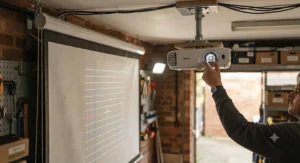
Getting a projector for garage cinema use humming isn’t just a case of plugging it in and hoping. A sensible dedicated projector room layout starts with measuring throw distance against your chosen screen size before you buy anything — every model above lists a throw ratio, and a five-minute calculation with a tape measure saves a returns hassle later. Mount height matters just as much: most home projectors are designed to sit at, or just above, screen-top height, either ceiling-mounted or on a rear shelf, and getting this wrong is what causes the keystone distortion so many first-time buyers wrongly blame on the projector itself.
If your garage conversion involves any new sockets, lighting circuits or a consumer unit change, it’s worth checking planning and building control requirements before work starts, since most conversions still need building regulations sign-off even when planning permission itself isn’t required. In the first 30 days, the most common mistake is skipping light control entirely. Garages typically have at least one source of daylight leakage — an up-and-over door seal, a side window, a loft hatch — and blocking these with basic blackout curtain or box-section foam strips does more for perceived picture quality than any lumens upgrade. Second on the list: running the projector straight off an extension lead shared with power tools or a chest freezer, which can introduce visible flicker on sensitive lamp-based units. A dedicated circuit, run by a qualified electrician, avoids this and keeps you compliant with the Building Regulations covering electrical safety that apply to converted garage spaces in the UK.
For ongoing maintenance, filter cleaning is the task people forget most. Garage air carries more dust than a typical living room, and a clogged intake filter both dims the picture over time and shortens lamp or laser life. A monthly wipe-down with a soft brush, done during a routine “movie night prep,” takes under five minutes and meaningfully extends the working life of any model on this list.
Real-World Scenarios: Which Projector Suits Your Garage?
Picture a couple in a semi-detached house with a single integral garage, roughly 2.7 by 5 metres, used for weekend film nights and the occasional five-a-side match on the big screen. Their garage door lets in a fair bit of afternoon light even with the up-and-over closed, and there’s no appetite for major structural work. For that scenario, the Optoma HD146X or ViewSonic PX700HDH make the most sense — both bright enough to handle imperfect blackout, both flexible on throw distance for a room that size, and both inexpensive enough that a first-time garage cinema project doesn’t become a five-figure gamble.
Now picture a family who’ve committed to a proper double-garage conversion — insulated, plastered, wired to a dedicated circuit — with a fixed 130-inch screen and permanent tiered or reclined seating. That’s a genuinely dedicated cinema room in all but planning-permission paperwork, and it’s where the BenQ W4100i or JVC LX-NZ30 earn their higher price tags: ceiling-mounted, rarely moved, run for years without a lamp change, and matched to a room where light and sound have already been engineered rather than improvised.
Finally, consider a household with a shallow single garage — perhaps 2.4 metres deep — where a standard long-throw unit simply can’t sit far enough back from the screen wall to fill it properly. That’s the Hisense PL2‘s scenario exactly: its ultra short throw design turns a layout constraint that would rule out five of the other six projectors on this list into a non-issue, provided the budget stretches to include a proper ALR screen alongside it.
Problem → Solution: Fixing Common Garage Cinema Snags
Problem: washed-out picture during the day. The fix isn’t always a brighter projector — it’s usually cheaper and more effective to add a proper blackout blind over any garage door glazing and a mid-grey (rather than white) screen surface, which improves perceived contrast without spending a penny more on lumens.
Problem: distracting echo or “boomy” bass. Bare brick, concrete floors and a metal up-and-over door create exactly the reflective surfaces that cause flutter echo. A handful of acoustic panels on the two side walls, plus a rug on the floor, resolves most of this without needing a full acoustic fit-out.
Problem: condensation or damp affecting equipment. Garages that aren’t fully insulated can see real humidity swings across seasons. A simple dehumidifier on a timer, run before movie nights, protects both the projector and any AV equipment stored in the space.
Problem: overheating in summer. Projectors, especially lamp-based ones, generate real heat, and an un-ventilated garage in July can push internal temperatures higher than manufacturers recommend. A small extractor fan or even a cracked door with a blackout curtain hung just inside solves this without compromising the room’s darkness.
Problem: uneven or discoloured projection surface. Painted brick rarely gives a neutral white for accurate colour. A basic pull-down or fixed-frame projector screen, even an inexpensive one, corrects this far more reliably than trying to find “the right shade of white” paint.
How to Choose a Projector for Garage Cinema
Choosing the right projector for garage cinema use comes down to matching a handful of specs to your specific room, in roughly this order of priority:
- Measure your throw distance first. Every projector has a minimum and maximum throw ratio — get this wrong and no other spec matters, because the image simply won’t fit your screen at the distance available.
- Set a realistic lumens target based on ambient light, not a generic “brighter is better” instinct — a fully blacked-out garage needs far less brightness than one with daylight leakage.
- Decide between lamp, laser and LED light sources based on how often you’ll actually use the room — heavy users benefit disproportionately from laser or LED’s lower long-term running costs.
- Check HDMI count and version against what you’ll actually plug in — streaming stick, console and soundbar can easily need three ports, not one.
- Confirm keystone correction and lens shift range, since garage walls are rarely perfectly square to a ceiling mount.
- Factor in noise level, especially for a garage that shares a wall with a bedroom — fan noise is far more noticeable in a quiet late-night viewing.
- Budget for the screen and blackout separately from the projector itself — as the Problem→Solution section above makes clear, these often affect picture quality more than the projector spec sheet does.
Projector Lumens for Garage: How Much Brightness Do You Actually Need?
This is the single most-searched, most-misunderstood spec in the entire category. Manufacturers quote ANSI lumens as a standardised brightness measure, but “how many lumens for a garage” genuinely depends on how much ambient light that garage lets in, not a fixed number that applies everywhere. As a rough guide grounded in the seven models above: a garage with solid blackout — heavy curtain over any glazing, door sealed, evening or weekend-only use — is well served by 2,700-3,000 lumens, which is exactly where the Hisense PL2 and Epson CO-FH02 sit. A garage with some unavoidable daylight leakage, or one used for daytime viewing, benefits from the 3,300-3,700 lumens bracket occupied by the JVC LX-NZ30, Optoma HD146X and ViewSonic PX700HDH.
What most buyers overlook is that screen size interacts directly with perceived brightness — the same projector throwing a 100-inch image looks noticeably brighter than it does stretched to 150 inches, because the same total light output is spread across a larger area. Based on the spec comparison across this list, buyers planning a genuinely large screen (120 inches-plus) should lean toward the higher end of the lumens range regardless of how well-controlled the ambient light is, simply to maintain punch at that size.
Long Throw Projector for Large Space vs Ultra Short Throw
A long throw projector for large space use is the traditional approach: mount it on the ceiling or a rear shelf, several metres back from the screen, and let the zoom lens do the work of filling a big image. Five of the seven models here — the Optoma HD146X, ViewSonic PX700HDH, Epson CO-FH02, Epson EH-TW7000 and JVC LX-NZ30 — use this conventional layout, and for most garages with reasonable depth, it remains the more flexible and better-value option: more model choice, generally sharper optics per pound spent, and easier to reposition if your layout changes.
Ultra short throw, as demonstrated by the Hisense PL2, solves a narrower but real problem: garages too shallow for a long-throw unit to sit far enough back, or layouts where a ceiling mount simply isn’t practical. The trade-off is cost and screen sensitivity — UST designs generally need a purpose-matched screen to perform at their best, and the BenQ W4100i‘s huge-screen long-throw approach shows the other end of the spectrum, where a deep garage and a genuinely oversized image are the priority instead. The honest answer to “which is better” is that it depends entirely on how many metres of clear space sit between your intended mounting point and the screen wall — measure that before deciding, not after.
Home Theatre Projector for Big Room: Screen Size, Seating and Sightlines
A home theatre projector for big room use has to solve two things a smaller lounge setup doesn’t: filling a genuinely large image without the picture falling apart, and keeping every seat within a sensible viewing angle. As a rough rule, seating distance of roughly 1 to 1.5 times the screen’s diagonal width gives the most cinema-like experience without eye strain — for a 130-inch screen like the one the Hisense PL2 is built for, that’s somewhere around 2.7 to 4 metres back, which conveniently matches the depth of many single or double garages once a couple of metres are given up to the projector and its mount.
Bigger rooms also change the acoustic maths — sound has more distance and more hard surfaces to bounce off before it reaches the seating position, which is exactly why the acoustic treatment covered later in this guide matters more in a garage-sized room than it would in a smaller den. The Epson EH-TW7000 and BenQ W4100i, both capable of 300-500-inch images, are the two models here genuinely built with a big-room brief in mind, rather than simply being scaled-up living-room projectors.
Best Bright Projector for a Dedicated Cinema Room vs a Garage Conversion
It’s worth being honest about a distinction most buying guides blur: a projector for a dedicated cinema room and a projector for a garage conversion aren’t always chasing the same spec. A purpose-built cinema room typically has controlled lighting, treated acoustics and permanent seating from day one, which means the best bright projector for that space can prioritise contrast and colour accuracy over raw lumens — exactly the reasoning behind the JVC LX-NZ30‘s laser-driven HDR performance and the BenQ W4100i‘s wide HDR format support.
A garage conversion, by contrast, is usually a hybrid space — used for the car in winter, for cinema at the weekend, for storage year-round — and rarely gets the same degree of light and acoustic control from the outset. That’s precisely why brightness-first models like the Optoma HD146X and ViewSonic PX700HDH make more practical sense for a garage than they would in a fully treated dedicated room: they’re compensating for a space that hasn’t been, and may never be, optimised purely for viewing. Reviewers consistently note that buyers who try to run a lower-lumen, contrast-focused projector in an untreated garage end up disappointed not because the projector is faulty, but because it was specified for the wrong kind of room.
Acoustic Panels for Home Cinema: Do You Need Them in a Garage?
Acoustic panels for home cinema use work by absorbing sound energy that would otherwise bounce off hard surfaces and back into the room as echo or “flutter,” and a garage — typically bare brick, concrete floor, plasterboard ceiling and a metal door — is about as reflective an environment as you can build a cinema in. Reviewers and acousticians broadly agree that home cinema spaces benefit from a reverberation time in roughly the 0.8 to 1.2 second range; an untreated garage frequently runs well beyond that, which shows up as muddy dialogue and boomy bass rather than the crisp sound a good projector’s picture deserves.
The practical fix doesn’t need to be a full acoustic-consultant job. Covering somewhere around 40-60% of the two side walls with basic absorptive panels, focusing on the “first reflection points” roughly level with your speakers and ears, resolves most of the flutter-echo problem in a typical garage. A rug over the concrete floor and a heavy curtain over the garage door itself both contribute meaningfully too, since soft, irregular surfaces scatter and absorb sound far better than the smooth, hard ones a garage starts with. This is genuinely one of the highest-value, lowest-cost upgrades in this entire guide — cheaper than any lumens upgrade, and more noticeable to most viewers than the jump from 3,000 to 3,700 lumens.
Common Mistakes When Buying a Garage Cinema Projector
The single most common mistake is buying on lumens alone without checking throw distance — a brilliantly bright projector that can’t physically fit the required image at your garage’s depth is simply the wrong purchase, full stop. A close second is underestimating ambient light: garages with an up-and-over door almost always leak more daylight than owners initially assume, which is why several models on this list deliberately favour brightness over ultimate contrast.
A third recurring error is treating the projector as the only spend that matters. As covered above, screen surface and acoustic treatment routinely have as much impact on the finished experience as the projector itself, yet they’re the first things cut when a budget gets tight. Finally, buyers regularly skip checking HDMI port count and version against their actual device list, only to discover after installation that a streaming stick, console and soundbar can’t all stay connected at once — an easily avoidable oversight caught by simply listing your devices before ordering.
Long-Term Cost & Maintenance
The real cost-of-ownership story on this list splits cleanly along light-source lines. The lamp-based Optoma HD146X, ViewSonic PX700HDH, Epson CO-FH02 and Epson EH-TW7000 all carry an eventual bulb-replacement cost, typically every few years of regular use, which is worth factoring into any value comparison even though the upfront prices are lower. The laser-driven JVC LX-NZ30 and Hisense PL2, plus the LED-engine BenQ W4100i, sidestep that recurring cost almost entirely, with light sources rated for 20,000-30,000 hours — often longer than most households will own the unit.
On paper this means the higher upfront price of the laser and LED models partly offsets over a five-to-ten-year ownership window, particularly for households using the garage cinema several times a week rather than occasionally. For lighter, more casual use, the lower purchase price of the lamp-based models is harder to beat, since the bulb replacement cost may never actually come due before the household upgrades anyway. Filters, in every case, are the maintenance item people forget — a monthly clean is free and meaningfully extends whichever light source you’ve chosen.
Frequently Asked Questions
❓ What is the best projector for a garage cinema?
❓ How many lumens do I need for a garage projector?
❓ Do I need acoustic panels in a garage cinema?
❓ Is a long throw or ultra short throw projector better for a garage?
❓ Can I use a garage projector during the day?
Conclusion
A projector for garage cinema use rewards buyers who think about the room before the spec sheet — throw distance, ambient light and acoustic reality all shape which of these seven genuinely good projectors will actually feel great once it’s mounted and running. Budget-conscious buyers with a garage that leaks a bit of daylight are well served by the Optoma HD146X or ViewSonic PX700HDH; those wanting the simplest possible setup should look at the Epson CO-FH02; buyers with a shallow layout need the Hisense PL2‘s ultra short throw; and anyone building a genuinely dedicated, long-term cinema room should weigh the laser and LED longevity of the JVC LX-NZ30 or BenQ W4100i against their higher upfront cost.
None of these choices are wrong on their own terms — they’re simply matched to different rooms, budgets and levels of commitment. Measure your space, be honest about your light control, and the right projector on this list becomes a fairly obvious call rather than a guessing game.
Recommended for You
- Long Throw Projector UK: 7 Brilliant Picks for 2026
- Short Throw vs Long Throw Projector: 7 Real Picks for 2026
- Short Throw Projector for Gaming: 7 Best Picks for 2026
Disclaimer: This article contains affiliate links. As an Amazon Associate, I earn from qualifying purchases. If you purchase products through these links, we may earn a small commission at no additional cost to you.
✨ Found this helpful? Share it with your friends! 💬🤗
