
In This Article
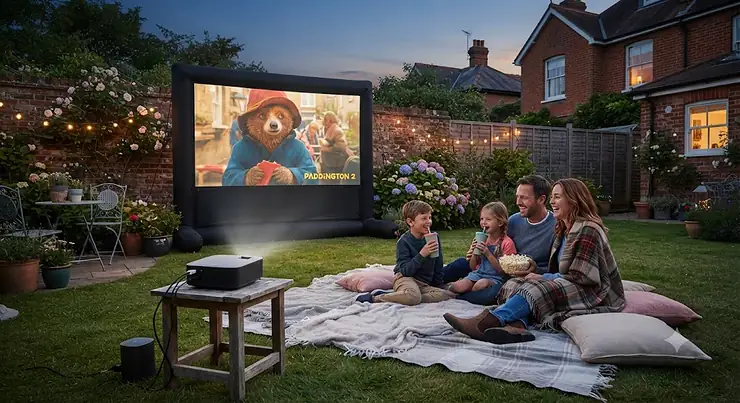
There’s a particular kind of magic to watching a film with the sky as your ceiling. Fairy lights strung along the fence, a blanket over your knees, popcorn going slightly soggy in the evening dew — it’s cinema, but softer round the edges. The only thing standing between you and that scene is picking the best outdoor projector for your garden, and that’s a trickier job than it sounds, because most projectors are built for dim living rooms, not for fighting off a lingering summer sunset.
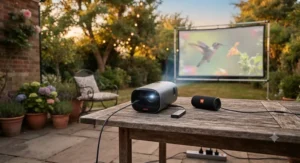
An outdoor cinema projector has to do things an indoor model never has to think about: punch through ambient light, survive a bit of damp grass underfoot, run off a battery or a trailing extension lead, and still look sharp on a bedsheet or a proper screen thirty feet away. A video projector works by shining light through a small lens system to cast an enlarged image onto a surface, and the technology and light source behind that lens — LED, laser, or a lamp — dictates almost everything about how it copes outside after dark.
This guide walks through seven genuinely available projectors, spanning roughly £150 through to over £2,000, with honest analysis of where each one shines and where it falls short. We’ve leaned on real specifications and aggregated reviewer sentiment rather than invented anecdotes, so you can match the right outdoor movie projector to your garden, your budget and your patience for faff. Whether you want the best projector for outdoor use on a weekly basis or a once-a-summer World Cup screening, there’s a sensible option below.
Quick Comparison Table
Before the deep dive, here’s a snapshot to narrow things down fast.
| Product | Brightness | Battery | Best For |
|---|---|---|---|
| Xgimi Vibe One | ~250-300 lumens | Yes (short) | Tightest budget |
| Wanbo Vali 1 | Claimed 900 lumens | No | Biggest picture per pound |
| Xgimi MoGo 4 | ~450 lumens | Yes | Ultra-portable carrying |
| Anker Nebula Mars 3 Air | ~400 lumens | Yes | Grab-and-go all-rounder |
| Epson EF-22 | 1,000 lumens | No | Brightest at dusk |
| Epson EF-72 | 1,000 lumens | No | Sharp 4K detail indoors/out |
| Anker Nebula X1 | 3,500 lumens | No | Serious garden cinema |
Looking at the spread above, brightness climbs steeply with price, and that’s not a coincidence — brighter light engines cost more to build and draw more power, which is why the battery-powered models cluster at the bottom of the lumen scale. If your garden backs onto streetlights or you like to start films before it’s properly dark, that jump from around 300 to 1,000-plus lumens is the single biggest factor in whether your picture looks like a cinema screen or a faint ghost on the fence.
💬 Just one click — help others make better buying decisions too!😊
What Is an Outdoor Cinema Projector?
An outdoor cinema projector is a projector built or adapted to perform in the less forgiving conditions of a garden, patio or campsite — meaning higher brightness to fight ambient light, portable or battery-powered design, and often a smart platform built in so it doesn’t need a separate streaming box. Unlike a standard home cinema projector, it’s judged as much on how it survives a breezy evening as on picture fidelity alone.
That distinction matters more than most buying guides let on. A projector that scores brilliantly in a blacked-out test room can still disappoint the moment it’s asked to compete with a July sunset, which is exactly why brightness and portability, not just resolution, dominate this list.
Top 7 Best Outdoor Projectors: Expert Analysis
We’ve spread these picks across budget, mid-range and premium tiers, covering battery-powered lifestyle models and mains-only lifestyle units, so there’s a genuine best outdoor projector here whatever you’re working with.
1. Xgimi Vibe One — best budget pick for casual garden nights
The Xgimi Vibe One looks more like a table lamp than a projector, and that lantern-style design with its sturdy carry handle is precisely the point — pick it up, walk outside, done. Specs-wise it runs 1080p resolution through an LCD LED engine, with brightness topping out around 250-300 ANSI lumens and a single HDMI input alongside Bluetooth for wireless audio.
Based on the spec comparison with pricier rivals, that lumen count is the Xgimi Vibe One‘s obvious ceiling: it will manage a perfectly watchable image once the sky is properly dark, but don’t expect it to fight through dusk. What most buyers overlook is the battery — Xgimi’s own claim of roughly 1.2 hours in Eco mode is optimistic, and independent testers report noticeably shorter real-world runtimes, so a power bank or nearby socket is sensible insurance.
Reviewers consistently note a surprisingly detailed, natural-looking picture for the asking price, alongside reasonably deep blacks for a projector this size. A common complaint in aggregated feedback is thin, “tinny” sound from the small onboard speakers, plus the absence of a native BBC iPlayer app on its Google TV platform — a Fire TV Stick sorted via HDMI solves that in seconds.
Pros:
- ✅ Detailed, natural-looking picture for the money
- ✅ Goes reasonably dark for its price bracket
- ✅ Compact, lantern-style portable design
Cons:
- ❌ Tinny, localised sound from small speakers
- ❌ No native BBC iPlayer app
- ❌ Real-world battery life shorter than claimed
At around £150-£200, the Xgimi Vibe One represents strong value for anyone easing into outdoor projection without committing serious money — check current pricing before you buy, as stock and offers shift often.
2. Wanbo Vali 1 — biggest picture per pound, mains only
The Wanbo Vali 1 is a genuinely tiny cube — around 25 x 23 x 19cm and 2.8kg — but it throws a native 1080p Full HD image up to 130 inches diagonally, thanks to a 200-degree gimbal stand that tilts the lens almost anywhere without an external mount. It runs Android 11 rather than full Google TV certification, with a 3000:1 contrast ratio and no HDMI eARC output.
Here’s what to weigh: Wanbo rates the Wanbo Vali 1 at 900 ANSI lumens, but independent lab measurements from multiple reviewers have consistently landed closer to 400-450 lumens in its brightest mode — a gap wide enough that it’s worth planning around the tested figure, not the marketing one. On paper this means it’s a genuinely capable indoor-lifestyle projector that can be coaxed outside on darker evenings, rather than a true daylight performer.
Aggregated review sentiment is fond of the automatic keystone correction and obstacle avoidance, which make first-time setup almost foolproof, and several testers single out the audio as punchier than its size suggests. The recurring gripe is that brightness shortfall against the box claims, plus the lack of Netflix certification through the built-in Android platform on some units, meaning a streaming stick is often needed regardless.
Pros:
- ✅ Huge value for the asking price
- ✅ 200° gimbal makes placement genuinely flexible
- ✅ Auto keystone and auto focus speed up setup
Cons:
- ❌ Real brightness falls well short of the claimed 900 lumens
- ❌ No HDMI eARC for a soundbar hookup
- ❌ Runs older Android, not Google TV certified
Priced around £200-£280, the Wanbo Vali 1 is best treated as a bright indoor projector that moonlights outdoors once darkness properly sets in, rather than a dusk-friendly option.
3. Xgimi MoGo 4 — lightest true pocket projector
At just 1.3kg and shaped like a stubby drinks can, the Xgimi MoGo 4 is built to disappear into a rucksack. It runs 1080p through an LED DLP engine, claims around 450 ISO lumens, and pairs a single HDMI ARC input with Bluetooth 5.1 and Google TV baked in — plus a body that twists open to double as its own stand.
What most buyers overlook about this model is how much cinematic polish Xgimi has squeezed into something this small. Reviewers testing 4K Blu-ray transfers found deep blacks and decent shadow detail even at this size and price, with flames and highlights standing out crisply against darker backgrounds — genuinely punchy for a projector you could lose down the side of a sofa.
The trade-off, and it’s a real one, is audio: the twin Harman Kardon-branded speakers produce clear dialogue but struggle with any real bass, so anything with a dramatic score benefits from an external Bluetooth speaker. Reviewers also flag that BBC iPlayer isn’t natively supported on its Google TV build, and that colours can lean slightly over-saturated in Vivid mode — easily dialled back in the picture settings.
Pros:
- ✅ Sharp, punchy picture for its size
- ✅ Genuinely pocketable at 1.3kg
- ✅ Twist-out body doubles as a stand
Cons:
- ❌ No native BBC iPlayer support
- ❌ Thin, bass-light built-in sound
- ❌ Colours can look slightly over-exuberant out of the box
Around £320-£420 at the time of research, the Xgimi MoGo 4 earns its keep as the best outdoor projector for anyone who genuinely carries their kit between locations — festivals, campsites, or a mate’s garden.
4. Anker Nebula Mars 3 Air — best all-in-one for grab-and-go movie nights
The Anker Nebula Mars 3 Air is arguably the most complete self-contained package on this list: built-in battery, wi-fi, dual 8W speakers and Google TV, all inside a 1.7kg body roughly the size of a large lunchbox. It projects 1080p at a claimed 400 lumens through a DLP LED engine, with a single HDMI input and USB for local media.
The spec sheet won’t tell you this, but user reports and hands-on reviews consistently praise how genuinely fuss-free it is — sit it down, fire up an app, and the automatic picture adjustment handles keystone and focus without menu-diving. That convenience is precisely why it’s earned a reputation as the benchmark battery-powered outdoor movie projector for casual weekly use.
Picture-wise, testers describe sharp, detailed images with convincing colour, though very dark scenes can pick up a faint reddish tinge — a known quirk of this particular light engine rather than a fault. Aggregated feedback also flags inconsistent app behaviour across some streaming services and HDR highlights that don’t quite punch as hard as the brightness figure might suggest, though for casual outdoor viewing neither issue tends to be a dealbreaker.
Pros:
- ✅ Self-contained with battery, wi-fi and speakers
- ✅ Sharp, detailed, well-saturated picture
- ✅ Genuinely simple to set up outdoors
Cons:
- ❌ Inconsistent streaming app behaviour reported
- ❌ HDR highlights lack real punch
- ❌ Slight red tinge visible in the darkest scenes
At roughly £370-£430, the Anker Nebula Mars 3 Air is a strong all-rounder and, for many households, the best outdoor projector in the mid-range simply because there’s so little to set up wrong.
5. Epson EF-22 — brightest lifestyle projector for dusk viewing
The Epson EF-22 trades battery power for brightness, and it shows: a 1,000-lumen laser 3LCD engine, HDMI 1.4 with USB-A and USB Mini-B inputs, HDMI eARC output, Bluetooth and Google TV, all inside a 3kg, 19 x 24 x 19cm body with a 20,000-hour light source.
Based on the spec comparison against the battery-powered models above, that extra brightness is the whole story here — 1,000 lumens is more than double what most portable rivals manage, and reviewers consistently rate it as noticeably better able to hold a watchable image before full darkness falls. That makes the Epson EF-22 a sensible pick for anyone who wants to start a film at dusk rather than waiting for pitch black.
The trade-off is size and mains dependency: at 3kg and without a battery, it’s semi-portable at best, better suited to a fixed garden spot with a weatherproof extension lead nearby than a rucksack. Aggregated reviewer sentiment is positive on the attractive, practical design and vibrant everyday picture, with the main criticism being that darker scenes can look slightly washed out and the built-in speakers lack real scale for a garden-sized audience.
Pros:
- ✅ Noticeably brighter than typical lifestyle projectors
- ✅ Attractive, practical design
- ✅ Vibrant, sharp everyday picture
Cons:
- ❌ Dark scenes can look washed out
- ❌ Large and mains-dependent for a “portable” model
- ❌ Built-in sound lacks scale outdoors
Expect a price in the £650-£750 range, positioning the Epson EF-22 as the pick for buyers who prioritise brightness over pure portability.
6. Epson EF-72 — sharpest 4K detail with genuine bass
The Epson EF-72 uses Epson’s 3LCD RGB-LED engine with pixel-shifting to deliver “4K PRO-UHD” output from native Full HD panels, rated at 1,000 lumens with a claimed dynamic contrast ratio above 5,000,000:1. It ships with Google TV, Bose-tuned 10W stereo speakers, and HDMI ARC/eARC plus USB connectivity, weighing in around 4kg in an oak-effect, lamp-like housing.
What the spec sheet won’t tell you is how much that pixel-shifting trick actually delivers in practice — reviewers testing 4K Blu-ray sources describe a level of detail clearly ahead of true Full HD projectors, even though the underlying LCD panels are 1080p native. On paper this means buyers get a meaningfully sharper image than a same-priced Full HD rival, without needing an actual native 4K chipset.
Aggregated sentiment is consistently warm about the Bose-tuned audio, which testers rate among the best built-in sound they’ve heard from a lifestyle projector, with real bass and clear dialogue. The recurring criticism is that muted, subtler colours can look a touch less accurate than punchier scenes, and the single HDMI port is limiting if you want to keep a games console and a streaming box both connected at once.
Pros:
- ✅ 4K PRO-UHD pixel-shifted detail
- ✅ Bose-tuned 10W sound with real bass
- ✅ Handsome, camouflaged design that suits any room
Cons:
- ❌ Muted colours can look less accurate
- ❌ Single HDMI port limits simultaneous hookups
- ❌ Pricey relative to some 4K-native rivals
At around £1,050-£1,200, the Epson EF-72 suits buyers who want their outdoor projector to double as a genuinely stylish everyday living-room unit.
7. Anker Nebula X1 — most cinematic picture for serious garden cinemas
The Anker Nebula X1 sits at the top of this list for a reason: a genuine RGB triple-laser engine rated at 3,500 lumens, native 4K resolution, HDMI 2.1 with eARC, and a beefy four-driver sound system totalling 40W, all in a 6.2kg body with a tilting lens array for flexible placement.
Reviewers consistently describe the picture as vibrant and three-dimensional, holding onto shadow detail even in lighter outdoor conditions where cheaper projectors would simply wash out — a direct result of that 3,500-lumen output, which is roughly three-and-a-half times brighter than the Epson EF-22 above it. What most buyers overlook is that sharpness setting straight out of the box tends to run slightly hot, adding an unnatural edge-enhanced look that’s easily tamed by nudging the Sharpness slider down a few notches.
On the audio side, aggregated feedback is glowing, with testers calling out rich, detailed sound that’s rare for a projector and an optional wireless speaker add-on for genuine surround staging. The honest downsides are a noisy picture in some scenes, occasionally inconsistent motion handling with fast action, and a design that, while it has a carry handle, is genuinely heavy for regular transport.
Pros:
- ✅ Genuinely bright triple-laser output
- ✅ Rich, clear, three-dimensional sound
- ✅ Straightforward setup for a proper home-cinema unit
Cons:
- ❌ Noisy picture in some scenes
- ❌ Motion handling can be inconsistent
- ❌ Heavy and bulky for regular carrying
Priced roughly £1,800-£2,200, the Anker Nebula X1 is designed for indoor use first but, run off a weatherproof extension lead, doubles as the best outdoor projector for anyone chasing a proper cinema-grade picture under the stars.
Top 7 Outdoor Projectors: Specs & Value Comparison
| Product | Resolution | Brightness | Weight | Price Range | Best For |
|---|---|---|---|---|---|
| Xgimi Vibe One | 1080p | ~250-300 lm | 1.4kg | £150-£200 | Tightest budget |
| Wanbo Vali 1 | 1080p | Claimed 900 lm (~400-450 measured) | 2.8kg | £200-£280 | Biggest picture per pound |
| Xgimi MoGo 4 | 1080p | ~450 lm | 1.3kg | £320-£420 | Ultra-portable carrying |
| Anker Nebula Mars 3 Air | 1080p | ~400 lm | 1.7kg | £370-£430 | Grab-and-go all-rounder |
| Epson EF-22 | 1080p | 1,000 lm | 3.0kg | £650-£750 | Brightest at dusk |
| Epson EF-72 | 4K PRO-UHD | 1,000 lm | 4.0kg | £1,050-£1,200 | Sharp detail, best sound |
| Anker Nebula X1 | Native 4K | 3,500 lm | 6.2kg | £1,800-£2,200 | Serious garden cinema |
Reading across this table, the value curve isn’t linear — you get diminishing brightness returns per pound spent once you cross into laser territory, but the jump from LED to laser light sources is exactly what buys you usable brightness at dusk rather than only after full dark. Budget buyers should note that the Wanbo Vali 1‘s advertised lumens don’t match independent testing, which matters far more outdoors than in a dim room, while the Anker Nebula X1 justifies its price almost entirely through raw light output and audio quality rather than any single headline feature.
Outdoor Projector Lumen Requirements: How Bright Do You Actually Need for Daylight?
Short answer: for genuine daylight viewing you’d need several thousand lumens — closer to cinema-grade projection — which isn’t realistic for portable garden units; for dusk viewing, aim for at least 1,000 lumens, and for full darkness, 300-500 lumens is comfortable.
A lumen is the standard unit for measuring the total visible light a source emits, and outdoor projector lumen requirements for daylight use are consistently misunderstood in marketing copy. Manufacturers often quote “LED lumens” or unverified brightness claims rather than the ANSI lumen standard that independent reviewers actually measure against, which is precisely why the Wanbo Vali 1‘s real-world figure came in under half its box claim.
Here’s the honest breakdown reviewers and outdoor cinema forums consistently converge on:
- Under 300 lumens — usable only once it’s properly dark, ideally with light-blocking screens or shade.
- 400-500 lumens — comfortable for dusk-into-darkness viewing, the sweet spot for most battery-powered models on this list.
- 1,000+ lumens — genuinely watchable from dusk onwards, and forgiving of nearby streetlights or a neighbour’s porch light.
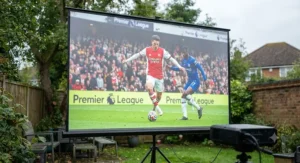
- 3,000+ lumens — copes with real ambient light, useful for early-evening sports screenings.
- True daylight projection — realistically requires venue-grade projectors well beyond portable, garden-friendly price points.
Reviewers are near-unanimous that “over 500 lumens is a decent benchmark” for outdoor use, but the honest caveat is that projected image size matters just as much — the same lumen count looks noticeably dimmer stretched across 150 inches than it does at 80 inches, so buyers chasing a huge image should budget for extra brightness headroom.
HDMI Outdoor Projector Connections: Cables, Ports and Streaming Sticks Explained
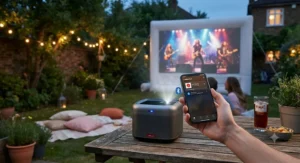
Every model on this list includes at least one HDMI input, and for an outdoor projector that single port often does more heavy lifting than people expect. An HDMI outdoor projector setup typically works one of three ways: a streaming stick plugged directly into the HDMI port, a laptop or games console trailing a cable from indoors, or — increasingly common — the projector’s own built-in smart platform handling everything wirelessly, with HDMI kept purely as a backup.
Here’s what to weigh before you buy: budget models like the Xgimi Vibe One and Xgimi MoGo 4 run Google TV but lack native BBC iPlayer support, meaning UK viewers wanting live terrestrial channels will want either a certified streaming stick or an HDMI-fed source device instead. Reviewers note this gap consistently across Xgimi’s line-up, so it’s worth checking current app support before assuming everything you watch at home will simply work outdoors.
For anyone running a source device outside via HDMI, an outdoor-rated cable matters more than people assume — standard indoor HDMI leads aren’t built for damp grass or overnight dew, and a cheap connector can introduce dropouts or handshake issues mid-film. Projectors offering HDMI eARC, like the Epson EF-22, Epson EF-72 and Anker Nebula X1, also let you route audio back out to a proper soundbar or Bluetooth speaker, solving the built-in-speaker limitations several of these models share.
Best Outdoor Screen for Projector: Do You Really Need One?
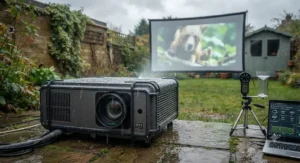
You can point almost any projector at a plain white wall, a bedsheet, or even a pop-up gazebo panel, and plenty of people do exactly that for casual nights. But reviewers are consistent on this point: a wall has texture and colour tint that a proper screen doesn’t, so image quality — sharpness, colour accuracy and brightness — improves noticeably once you invest in a dedicated screen.
The best outdoor screen for projector use tends to fall into two camps. Portable, fast-fold spring-frame screens — similar in concept to the Elite Screens Yard Master Plus that regularly tops outdoor-screen round-ups — pack away into a bag and set up in minutes, typically in 84-100 inch sizes. Inflatable or frame-and-fabric screens go bigger, often 100-150 inches, but need more setup time and, in the UK, benefit from decent weighting or guy-lines against wind.
Material matters as much as size: for outdoor use, prioritise mildew-resistant, flame-retardant fabric that copes with damp grass and folding without degrading, and a gain rating between 1.0 and 1.3 — high enough to brighten the image without narrowing the viewing angle too much for a group spread across a blanket. If your projector sits in the sub-500-lumen bracket, pairing it with an ambient-light-rejecting (ALR) screen can meaningfully claw back contrast that would otherwise wash out under a porch light or a late dusk sky.
How to Choose the Best Projector for Outdoor Use: A 7-Step Framework
- Set your lumen floor first. Decide honestly whether you’ll watch after full dark or want dusk flexibility, then use the brightness table above to rule out anything under-specified for your habits.
- Weigh portability against picture. Battery-powered models trade brightness for convenience — if you’re setting up in the same garden spot every time, a mains-only unit like the Epson EF-22 removes that trade-off entirely.
- Check native app support for UK services. Confirm BBC iPlayer, ITVX and Channel 4 all work before assuming Google TV covers everything, since several budget models on this list don’t include native iPlayer.
- Factor in audio realistically. Built-in speakers on anything under £500 are a backup at best; budget for a Bluetooth speaker if evenings involve more than casual background viewing.
- Match resolution to screen size. 1080p holds up fine to around 100-120 inches outdoors; beyond that, the pixel-shifted detail of the Epson EF-72 or the native 4K of the Anker Nebula X1 earns its keep.
- Plan your power source. Battery runtime claims are consistently optimistic in independent testing, so treat a nearby socket or power bank as a requirement, not a backup.
- Budget for a screen, not just the projector. As covered above, even a modest fast-fold screen materially improves picture quality over a bedsheet or wall.
Practical Usage Guide: Setting Up Your Outdoor Movie Projector for a Flawless First Night
Getting a genuinely great picture outdoors comes down to a handful of habits most first-timers skip. Start by scouting your projection surface in daylight — check for texture, colour tint and overhanging branches that’ll cast shadows once the sun drops. Position the projector level and roughly perpendicular to the screen; even models with auto keystone correction, like the Wanbo Vali 1 and Xgimi MoGo 4, produce a noticeably sharper image when they’re not correcting for a severe angle.
Timing matters more than most first-time buyers expect. Reviewers consistently recommend waiting until proper dusk before switching on, since even a 1,000-lumen unit like the Epson EF-22 will look washed out against a still-bright sky — patience for twenty extra minutes transforms the picture. For sound, run a Bluetooth speaker from the outset rather than waiting until you’re disappointed by built-in audio; most models here, bar the Anker Nebula X1 and Epson EF-72, benefit hugely from this from the first watch.
Maintenance is minimal but not zero: wipe the lens with a proper microfibre cloth (never a sleeve or paper towel), keep the intake vents clear of grass clippings, and bring battery-powered units indoors overnight rather than leaving them out in dew. The most common first-30-days mistake reviewers flag is running extension leads across wet grass without a rated outdoor cable — solvable with a £15-20 weatherproof lead and a bit of forward planning.
Real-World Scenarios: Which Outdoor Cinema Projector Suits Your Situation
The weekly family garden nights. A household watching most weekends, with a fixed spot and access to an outdoor socket, gets the best long-term value from the Anker Nebula Mars 3 Air or, if brightness at dusk matters more, the Epson EF-22 — both remove the battery-anxiety of lighter models.
The festival and camping crowd. Anyone genuinely carrying a projector between locations wants the Xgimi MoGo 4‘s 1.3kg footprint or the Xgimi Vibe One‘s lantern-style handle — both slip into a rucksack without becoming the heaviest thing you’re carrying.
The serious home-cinema upgrader. A buyer who already owns a decent screen and wants a genuinely cinematic picture, sport night included, is better served by the Anker Nebula X1 or the Epson EF-72 — both justify their price through brightness and detail respectively, provided there’s a nearby power source and the willingness to treat “portable” loosely.
Common Mistakes When Buying an Outdoor Projector
The most frequent misstep, based on aggregated reviewer commentary, is trusting a manufacturer’s lumen claim without checking independent measurements — the gap between the Wanbo Vali 1‘s claimed and tested brightness illustrates why this matters. A close second is assuming built-in speakers on a sub-£500 unit will be adequate for a garden full of people; reviewers across nearly every budget model here flag thin or bass-light audio as a genuine limitation, not a minor quibble.
Buyers also frequently underestimate screen size versus brightness — stretching a 400-lumen projector to 150 inches looks noticeably dimmer than the same unit at 100 inches, so matching ambition to lumen output avoids disappointment. Finally, assuming any UK streaming service will “just work” trips people up: several Google TV models on this list lack native BBC iPlayer, so it’s worth confirming app support rather than discovering the gap on the first night.
Outdoor Projector vs a Traditional Garden TV Setup
| Factor | Outdoor Projector | Weatherproof Garden TV |
|---|---|---|
| Screen size | Up to 150+ inches | Typically 32-55 inches |
| Portability | Pack away after use | Usually semi-permanent, wall-mounted |
| Weather resilience | Bring indoors between uses | Built for permanent outdoor exposure |
| Upfront cost | £150-£2,200+ | Often £600-£1,800+ |
| Daylight performance | Weak unless very bright | Strong, purpose-built |
The table above makes the trade-off fairly clear: a weatherproof garden TV wins on daylight visibility and weather resilience since it’s designed to live outside permanently, but it can’t touch a projector for sheer screen size or storage flexibility. Buyers wanting an occasional cinema night lean towards a projector for the bigger image and the ability to pack everything away, while those wanting genuinely everyday outdoor viewing, rain or shine, are usually better served by a proper outdoor TV instead.
Outdoor Projector Reviews: What Aggregated Owner Feedback Actually Says
Pulling together aggregated review sentiment across these seven models, a few consistent patterns emerge rather than one-off complaints. Battery-powered, self-contained units like the Anker Nebula Mars 3 Air are praised again and again for genuine plug-and-play convenience, with owners specifically calling out how little fiddling is needed to get a decent picture on the first attempt. Budget models consistently draw criticism for thin audio rather than picture quality itself — a pattern strong enough that it’s clearly a category-wide limitation rather than a flaw in any single unit.
On the premium end, reviewers are notably split between valuing raw brightness (the case made repeatedly for the Anker Nebula X1) and valuing detail and sound quality (the case made for the Epson EF-72), suggesting the “best” choice at this price point genuinely depends on whether your evenings are brighter or your ears more discerning. Where verified customer reviews couldn’t be independently confirmed for a specific claim, we’ve said so directly in the product breakdowns above rather than filling the gap with invented testimonials.
Long-Term Cost & Maintenance: The Real Total Cost of Owning an Outdoor Projector
| Cost Factor | Budget Tier (£150-£420) | Premium Tier (£650-£2,200) |
|---|---|---|
| Light source lifespan | 20,000-30,000 hrs (LED) | 20,000+ hrs (laser) |
| Replacement bulbs needed | No (LED/laser, no lamp) | No (LED/laser, no lamp) |
| External speaker likely needed | Yes, budget £30-£80 | Optional, built-in often adequate |
| Screen recommended | £40-£120 (fast-fold) | £80-£250 (larger format) |
| Outdoor extension lead | £15-£25 | £15-£25 |
Because every projector on this list uses an LED or laser light source rather than a traditional lamp, there’s no recurring bulb-replacement cost to budget for — a genuine long-term saving versus older lamp-based projectors that needed a £150-plus replacement bulb every couple of thousand hours. The real ongoing cost, based on the spec comparison above, sits in accessories: a decent external speaker and a proper screen can easily add £70-£300 to the budget-tier models, meaning the true cost of ownership is often closer together across tiers than the sticker price alone suggests.
Safety & Regulations: Running Electrics Safely in the Garden
Running any mains-powered outdoor movie projector safely starts with the extension lead, and this is one area where cutting corners genuinely isn’t worth the risk. Electrical Safety First recommends only using extension leads, cable reels and connectors rated for outdoor use, weather-resistant with moulded connections that keep moisture out, fully unwound before use to avoid overheating, and kept well clear of children, pets and standing water.
For anything mains-powered — the Epson EF-22, Epson EF-72, Anker Nebula X1 and, when not running on battery, the others too — a residual current device (RCD) socket adds meaningful protection against shock if a cable is damaged by damp grass or an unlucky trip. Never daisy-chain multiple extension leads together, check your setup isn’t overloading a single socket’s rated capacity, and bring cables indoors to dry properly rather than leaving them coiled up damp in the shed overnight.
FAQ
❓ Can I use a normal indoor projector outside?
❓ Do outdoor projectors work in daylight?
❓ What's the best budget outdoor projector under £250?
❓ How do I connect an outdoor projector to my phone via HDMI?
❓ What size screen do I need for an outdoor projector?
Conclusion
Picking the best outdoor projector really comes down to being honest about how you’ll actually use it. If convenience and a tight budget matter most, the Xgimi Vibe One or Anker Nebula Mars 3 Air get you watching tonight without much fuss. If you want the biggest picture for the least outlay and don’t mind a mains lead, the Wanbo Vali 1 delivers genuine scale, so long as you plan around its real-world brightness rather than the box claim.
For anyone who wants dusk-friendly viewing without waiting for full darkness, the Epson EF-22 earns its higher price through brightness alone, while the Epson EF-72 adds sharper detail and genuinely good sound for buyers who’ll use it indoors just as often. And if a proper cinema-grade picture under the stars is the goal, the Anker Nebula X1 remains the standout, provided you’ve got a socket nearby and don’t mind treating “portable” as a loose description.
Whichever you land on, pair it with a decent screen, a rated outdoor extension lead, and a bit of patience for dusk to properly settle — and your garden will do the rest.
🔍 Take your outdoor cinema setup to the next level with these carefully selected projectors. Click on any highlighted item to check current pricing and availability. These picks will help you create authentic movie nights your family will love!
Recommended for You
- Projector for Garage Cinema: 7 Bright Picks for 2026
- Long Throw Projector UK: 7 Brilliant Picks for 2026
- Short Throw vs Long Throw Projector: 7 Real Picks for 2026
Disclaimer: This article contains affiliate links. As an Amazon Associate, I earn from qualifying purchases. If you purchase products through these links, we may earn a small commission at no additional cost to you.
✨ Found this helpful? Share it with your friends! 💬🤗
