
In This Article
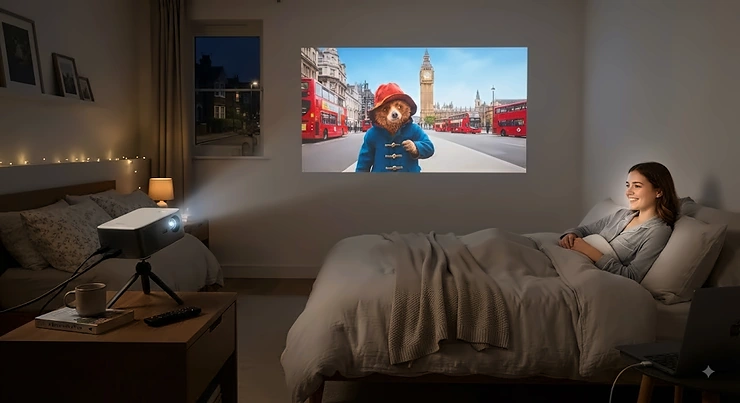
There’s a particular kind of magic in dimming the lights, propping yourself up on a pillow, and watching a film stretch across your bedroom wall instead of squinting at a laptop balanced on your knees. That’s the appeal driving the sudden popularity of the small projector for bedroom category — compact, quiet-ish, and small enough to live on a nightstand rather than dominate a room. A small projector for bedroom use is a compact projection device, typically under 2kg, designed to cast a large image onto a wall or ceiling from a short distance, prioritising portability and low noise over the raw brightness of a living-room unit. Brightness in this category is measured in ANSI lumens, a standardised industry measurement, which is worth knowing since cheap unbranded listings often quote inflated, non-standard figures instead.
The trouble is that “mini projector” has become something of a marketing free-for-all. Search Amazon UK and you’ll find dozens of near-identical black boxes claiming “15,000 lumens” and “4K Ultra HD” for £40, numbers that simply aren’t physically possible at that price. We’ve stripped out the noise (pun intended) and focused on seven real, verifiable models from established brands — XGIMI, Samsung, Anker, BenQ, LG and Kodak — each tested and reviewed by independent UK and international outlets. Whether you’re after a portable bedroom projector for lazy Sunday mornings, a ceiling projector for bedroom cinema nights, or simply the quietest fan you can find for late-night viewing, this guide covers the real trade-offs: brightness versus battery life, throw distance versus room size, and price versus what you’ll actually use night after night. We’ll also flag where the marketing overreaches, because a projector that keeps you awake with fan whine is worse than no projector at all.
Quick Comparison Table
| Projector | Brightness | Resolution | Best For |
|---|---|---|---|
| Kodak Luma 350 | 150-350 ANSI lumens | 854×480 (1080p support) | Tightest budget |
| Anker Nebula Capsule 3 Laser | 300 ANSI lumens | 1080p | Pocket-sized portability |
| XGIMI MoGo 3 Pro | 450 ISO lumens | 1080p | Short throw in tight rooms |
| Samsung Freestyle 2nd Gen | 230 ANSI lumens | 1080p | Ceiling & wall flexibility |
| Anker Nebula Mars 3 Air | 400 ANSI lumens | 1080p | Brightest all-rounder |
| BenQ GS50 | 500 ANSI lumens | 1080p | Rugged, shared spaces |
| LG CineBeam Q | 500 ANSI lumens | 4K UHD | Premium picture quality |
Looking at the table, brightness ranges from a modest 150 lumens on the Kodak Luma 350 up to 500 on the BenQ GS50 and LG CineBeam Q — and in a small, curtained bedroom that gap matters less than it would in a sunlit lounge, because you’re almost always watching in low ambient light. Resolution tells a similar story: every model here handles 1080p content comfortably, but only the LG CineBeam Q offers genuinely native 4K detail, which is the main reason it costs roughly double the mid-range options. If your bedroom already has decent blackout curtains, the extra lumens on the pricier models buy you headroom rather than a night-and-day difference.
💬 Just one click — help others make better buying decisions too!😊
Top 7 Small Projectors for Bedroom Use: Expert Analysis
1. Kodak Luma 350 — budget pico pick under £200
If your budget is tight and your expectations are realistic, the Kodak Luma 350 is the obvious entry point into projected viewing. Its palm-sized DLP engine won’t win any brightness contests, but it’s genuinely pocketable and runs Android out of the box. The native 854×480 resolution is modest by 2026 standards — think early smartphone screen rather than crisp HD — though it accepts and scales 1080p input from a Fire TV Stick reasonably well for casual viewing. Based on the spec comparison with pricier rivals, what you’re really paying for here is size and simplicity rather than image fidelity; this isn’t a projector for scrutinising fine detail, it’s one for winding down with a sitcom rerun on the ceiling.
Reviewers consistently note that the Luma 350’s picture looks best in a fully darkened room, with one common complaint being a slight colour imbalance and occasional DLP “rainbow” artefacts during fast motion — a known quirk of single-chip colour-wheel projectors rather than a fault unique to this unit. Aggregated feedback also flags the roughly two-hour battery life as a genuine limitation for anything longer than a film’s first act, so most owners end up running it on mains power at bedtime anyway. What most buyers overlook is that the Luma 350’s low native resolution actually reduces perceived fan noise relative to brighter 1080p rivals, because the projector isn’t working as hard to push light through the lens.
Pros:
- ✅ Genuinely pocket-sized and light enough for a nightstand
- ✅ Built-in Android streaming without extra hardware
- ✅ Lowest price point of any name-brand model here
Cons:
- ❌ Native resolution well below Full HD
- ❌ Around two hours of battery before mains power is needed
The Kodak Luma 350 typically sits in the under-£200 range, and check current price before buying, as retailers vary. As a value verdict, it’s the right call for a first projector or a child’s room, but anyone wanting crisp text or detailed cinematography should look further down this list.
2. Anker Nebula Capsule 3 Laser — pocket-sized laser brightness
The Anker Nebula Capsule 3 Laser squeezes a genuine laser light engine into a body barely bigger than a soft drinks can, which on paper sounds like a contradiction — lasers usually mean bulk and heat. In practice, the 300 ANSI lumen output punches above its size, resolving shadow detail and rich colour that budget LED units simply can’t match. Paired with Google TV and officially licensed Netflix, it sidesteps the sideloading headaches that plague cheaper Android projectors, and the auto keystone and autofocus mean it’s genuinely a drop-and-play device rather than something you fiddle with for ten minutes first.
Independent lab testing measured fan noise at around 38.6dB in standard mode, dropping to roughly 32dB in Eco mode at one metre — noticeable in silence, but reviewers note it becomes inaudible once dialogue or music is playing at a normal bedroom volume. The built-in battery claims two and a half hours of movie playback, comfortably covering most films without a cable trailing across the duvet. What the spec sheet won’t tell you, but user reports suggest, is that running it at 10% brightness for a sleepy, low-key viewing session drops the fan almost to silence — a trick worth knowing if you plan to fall asleep mid-episode.
Pros:
- ✅ Laser light source delivers punchy colour for its size
- ✅ Google TV with native Netflix, no sideloading required
- ✅ Auto keystone and autofocus for genuinely instant setup
Cons:
- ❌ Fan is audible in silent scenes at full brightness
- ❌ 300 lumens still needs a properly dark room
Prices for the Anker Nebula Capsule 3 Laser generally sit in the £400-500 range, positioning it as a mid-tier investment rather than an impulse buy. For anyone prioritising a genuinely portable bedroom projector they can also take on holiday, the value proposition holds up well against pricier, less portable rivals.
3. XGIMI MoGo 3 Pro — shortest throw distance for tight rooms
Small bedrooms are exactly where throw ratio starts to matter more than brightness, and the XGIMI MoGo 3 Pro is built around that reality. Its 1.2:1 throw ratio means a 100-inch image from just 2.66 metres, or a 60-inch image from 1.6 metres — genuinely workable in a box room where a standard-throw projector would need to sit in the hallway. The 450 ISO lumen LED engine is a step up from its predecessor, and intelligent obstacle avoidance automatically shrinks the image around light switches and picture frames, a small but genuinely useful trick when you’re projecting onto an imperfect bedroom wall.
Here’s what to weigh: the MoGo 3 Pro swapped its old Android TV software for Google TV, which most reviewers rate as a meaningful upgrade in app selection and interface polish, but it also dropped from 2x8W to 2x5W Harman Kardon speakers, and aggregated review sentiment consistently flags the built-in audio as its weakest point. There’s no internal battery either, so despite the “portable” branding it needs a wall socket or a hefty power bank to run. On the plus side, the 130-degree rotating barrel and Ambient Light party mode make it a genuinely fun object to own, not just a viewing tool.
Pros:
- ✅ Short throw ratio ideal for small or box-shaped bedrooms
- ✅ Google TV interface with wide app support
- ✅ Intelligent obstacle avoidance around wall fixtures
Cons:
- ❌ Built-in speakers are noticeably underpowered
- ❌ No internal battery, so mains power is mandatory
At around £400-450, the XGIMI MoGo 3 Pro sits mid-pack on price but towards the top for placement flexibility, making it the pick for anyone whose bedroom simply doesn’t have the floor space a standard-throw unit demands.
4. Samsung Freestyle 2nd Gen — 180° swivel for ceiling projection
Few projectors handle a ceiling projector for bedroom setup as elegantly as the Samsung Freestyle 2nd Gen. Its cylindrical body pivots through 180 degrees on a compact podium base, so it genuinely doesn’t matter whether you’re bouncing the image off a wall, a blackout blind, or straight up at the ceiling above your bed — auto levelling and keystone correction handle the geometry without you touching a menu. The 230 ANSI lumen LED source is on the modest side, a point several reviewers have criticised given the asking price, but Tizen’s smart platform brings every major UK streaming and catch-up app natively, which is more than some rivals manage.
Reviewers consistently note that picture quality is genuinely impressive for the size, with good detail and colour in a darkened room, though the below-average brightness becomes obvious if you try to use it with any ambient light on. Aggregated sentiment also flags the lack of a built-in battery and the reliance on a micro-HDMI connector as minor but recurring annoyances. On paper this means it’s less a grab-and-go device than the XGIMI or Anker options, and more a projector you set up once — likely ceiling-mounted or clipped to a bedside shelf — and leave in place.
Pros:
- ✅ 180° swivel makes wall or ceiling projection effortless
- ✅ Tizen smart platform with full UK streaming app support
- ✅ Auto levelling and keystone handle awkward bedroom angles
Cons:
- ❌ 230 lumens is dim compared with same-price rivals
- ❌ No internal battery limits true portability
The Samsung Freestyle 2nd Gen has fluctuated significantly in price since launch, from an original £899 down to promotional prices well under £400, so it’s worth checking current price closely; at a discount it represents strong value, at full price less so. Whether you’re projecting on a wall or ceiling, this is the model built specifically for that flexibility.
5. Anker Nebula Mars 3 Air — brightest all-rounder under £550
Positioned deliberately as a crossover between a true portable and a proper home cinema unit, the Anker Nebula Mars 3 Air delivers 400 ANSI lumens from an LED engine rated for roughly 30,000 hours of use — long enough that most owners will replace the whole device before the light source degrades meaningfully. Dual 8W Dolby-tuned speakers give it noticeably fuller sound than most compact rivals, and Google TV with native Netflix support removes a common frustration with cheaper Android-based units. Based on the spec comparison, this is the projector in our list best suited to genuinely replacing a small bedroom television, rather than supplementing one.
What most buyers overlook is that “portable” here is relative — it’s too large and heavy to be a true pocket rocket, though a well-made carry strap keeps it liveable. Reviewers rate the 2.5-hour battery life as solid without being exceptional, and picture quality earns consistent praise for sharpness and detail at typical bedroom viewing sizes of 70-90 inches, even if the maximum 150-inch image loses noticeable brightness. Streaming app support has occasionally been flagged as inconsistent in aggregated feedback, worth bearing in mind if a specific app is a dealbreaker for you.
Pros:
- ✅ Highest brightness of any true portable model here
- ✅ Dual 8W speakers genuinely fill a bedroom
- ✅ Google TV with native, full-resolution Netflix
Cons:
- ❌ Larger and heavier than pocket-style rivals
- ❌ Streaming app performance can be inconsistent
Prices for the Anker Nebula Mars 3 Air typically fall in the £430-550 range depending on promotions, placing it as a considered mid-range purchase rather than a casual one — but for buyers wanting one projector that does almost everything well, it’s hard to beat.
6. BenQ GS50 — toughest build for shared spaces
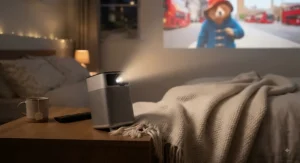
Marketed primarily as an outdoor projector, the BenQ GS50 earns its place here precisely because a rugged, splash-resistant, drop-tolerant design also happens to survive life in a household with children, pets, or a habit of knocking things off the nightstand half-asleep. Its IPX2 splashproof rating and roughly 70cm drop tolerance are overkill for most bedrooms, but the 500 ANSI lumen brightness and genuinely strong 2.1-channel audio system — dual 5W speakers plus a 10W woofer — make it one of the best-sounding units on this list without needing an external speaker.
Reviewers consistently note the fan is noticeable when nothing is playing, described by one outlet as blending into white noise over time, but not distracting once dialogue or music starts. Aggregated feedback across several independent reviews agrees the fan gets audibly louder in “Normal” power mode versus “Low Power,” so anyone sensitive to noise should default to the quieter setting and accept the dimmer image that comes with it. The 2.5-hour battery life matches most rivals here, and 45W USB-C power delivery means an ordinary power bank can extend a session considerably.
Pros:
- ✅ Genuinely strong built-in 2.1-channel audio
- ✅ Rugged, splash-resistant design survives real-world knocks
- ✅ 500 lumens among the brightest portable options here
Cons:
- ❌ Fan noise is more noticeable than laser-based rivals
- ❌ Outdoor-focused design is arguably overbuilt for a bedroom
The BenQ GS50 generally sells in the £400-700 range depending on retailer promotions. For a household where the projector might migrate between the bedroom, the garden and a friend’s living room, its durability arguably justifies the premium over less rugged rivals.
7. LG CineBeam Q — sharpest 4K laser picture
Sitting clearly at the premium end of this list, the LG CineBeam Q is the only model here offering genuinely native 4K resolution, built around an RGB laser light engine paired with a DLP chip. Reviewers across multiple outlets single out its colour accuracy and black levels as class-leading for a projector this size, with one describing the picture in a darkened room as “absolutely beautiful.” The industrial, Braun-inspired aluminium design and full webOS smart platform — genuinely LG’s best software experience — add a sense of polish the more utilitarian rivals on this list can’t match.
Here’s the honest complication: fan noise measurements vary noticeably between reviewers and settings. LG’s own spec sheet claims as low as 25dB in Energy Saving Max mode, and one lab measured a real-world 35-37dB range across power modes at a typical seating distance; another reviewer using a handheld meter recorded closer to 42-49dB depending on proximity and testing method. Reviewers consistently note that the fan pitch is more noticeable during quiet dialogue scenes than its dB figure alone suggests, so anyone buying primarily for near-silent bedtime viewing should manage expectations here rather than trust the headline spec. The mono 3W speaker is universally criticised as inadequate, effectively requiring a Bluetooth speaker for serious use — but LG does bundle a compatible speaker with some direct purchases.
Pros:
- ✅ Only genuinely native 4K resolution on this list
- ✅ Class-leading colour and black-level performance
- ✅ Full webOS smart platform with excellent app support
Cons:
- ❌ Built-in mono speaker is widely criticised as inadequate
- ❌ Fan noise reports vary and can be noticeable up close
The LG CineBeam Q launched at £1,299 but has since settled to a more competitive £700-800 range, check current price for the latest figure. As a value verdict, it’s the pick for buyers who prioritise picture quality above all else and are willing to pair it with a separate speaker and accept some fan noise trade-off.
Practical Usage Guide: Setting Up for Movie Nights in Bed
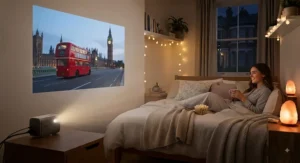
Getting the most from a projector for watching in bed starts before you even switch it on. Position matters more than most buyers expect: aim for the projector to sit roughly level with, or slightly below, the ceiling or wall surface you’re projecting onto, since most auto-keystone systems correct vertical distortion far better than extreme horizontal angles. A simple shelf bracket, tripod, or even a stack of books at the right height solves ninety percent of image-wonkiness complaints. In the first thirty days, the most common mistake is skipping the “throw distance calculator” most manufacturers publish online — projecting a 100-inch image in a room only offering 80 inches of clear wall space produces a soft, oversized picture that no amount of focus adjustment will fix.
For genuinely restful bedtime viewing, it’s worth being honest about screen exposure before sleep. According to NHS guidance on reducing screen time, devices emitting blue light before bed can delay the release of melatonin and make it harder to fall asleep, an effect that applies to projected images just as much as phone or laptop screens. A sensible compromise many projector owners adopt is switching to a warmer colour profile and lower brightness setting an hour before their intended sleep time, and using a sleep timer — a feature built into most Android and Google TV-based models on this list — to auto-shut-off rather than leaving a projector running all night.
Real-World Scenarios: Who Needs Which Bedroom Projector
Picture three genuinely different buyers. First, a university student in a shared house with a single small room and a strict budget: the Kodak Luma 350 or Anker Nebula Capsule 3 Laser suit this brief perfectly, offering portability between rooms and a low enough price that losing or damaging it isn’t catastrophic. Second, a couple converting a box room into a proper media nook, with a fixed wall and the budget to invest properly: the XGIMI MoGo 3 Pro’s short throw ratio and the Anker Nebula Mars 3 Air’s brighter, fuller sound both make sense here, since neither needs to travel and both benefit from a semi-permanent setup.
Third, a family wanting one projector that moves between a child’s bedroom, the garden for summer evenings, and the living room for the odd film night: the BenQ GS50’s rugged, splash-resistant build is specifically engineered for exactly that lifestyle. If money genuinely isn’t the constraint and picture quality is the priority above all else — perhaps a dedicated adult bedroom cinema corner — the LG CineBeam Q’s native 4K output justifies its higher price and modest speaker limitations, especially paired with a separate Bluetooth speaker.
Ceiling Mounting in a Small Bedroom: Problem → Solution Guide
Problem: Limited floor and shelf space. A small bedroom often has nowhere sensible to permanently place a projector at wall height. Solution: a ceiling projector for bedroom setups typically uses an inverted mount bracket (widely available and inexpensive) screwed into a joist, with the projector’s built-in “ceiling mount” or “rear projection” menu setting flipping the image automatically — most models on this list, including the Samsung Freestyle 2nd Gen and XGIMI MoGo 3 Pro, support this natively.
Problem: Keystone distortion from an off-centre ceiling position. Solution: rely on auto-keystone rather than manual adjustment wherever available; every projector in this guide includes some form of automatic correction, though results are best when the unit is mounted as close to centred as the room allows.
Problem: Cabling looks messy and is a trip hazard. Solution: route HDMI and power along the ceiling-wall junction using adhesive cable clips, or invest in a projector with Wi-Fi casting (all seven models here support this) to eliminate a permanent HDMI run altogether.
Problem: A projector for small bedroom ceiling use needs regular access for cleaning or software updates. Solution: choose a bracket with a quick-release plate rather than a fixed screw mount, so the unit can be taken down in seconds rather than requiring a full re-installation each time.
How to Choose a Small Projector for Bedroom Use
Choosing the right small projector for bedroom viewing comes down to weighing a handful of practical factors against how you’ll actually use it, rather than chasing the biggest number on the box.
- Measure your throw distance first. Know the actual distance between your likely projector position and the wall or ceiling before comparing models — this single measurement rules out more unsuitable projectors than any spec sheet.
- Prioritise ANSI lumens over generic “lumens” claims. As TrustedReviews’ portable projector testing consistently shows, real-world brightness measured under lab conditions often falls well short of inflated marketing figures, so stick to ANSI-rated brightness for honest comparisons.
- Decide whether battery life matters to you. If the projector will live permanently on a shelf or ceiling mount, a battery is a nice-to-have rather than essential; for genuine portability between rooms, it’s close to mandatory.
- Check the smart platform supports the apps you actually use. Google TV, Tizen and webOS all differ in app availability, and losing access to a favourite streaming service is a common regret.
- Weigh fan noise against your sleep sensitivity. If you plan to fall asleep with it running, favour laser or Eco-mode-capable models over brighter, louder LED units running at full power.
- Set a realistic budget band. Roughly £150-£250 buys a genuine budget pico projector; £400-£600 covers the bulk of genuinely capable mid-range options; £700+ enters premium 4K laser territory.
- Consider built-in audio honestly. Several models here have widely criticised speakers, so factor in whether you’ll need a separate Bluetooth speaker as part of your total budget.
What to Expect: Real-World Performance in a Small Bedroom
Specs on a box rarely translate directly into lived experience, so it’s worth setting expectations. A 300-400 ANSI lumen projector, the range most of this list occupies, produces a genuinely watchable image once curtains are closed and main lights are off — comparable to a mid-sized television in perceived brightness, though blacks won’t be as deep as an OLED screen. Push into full daylight or leave a lamp on, and even the brighter 500-lumen models start to wash out, particularly in lighter-coloured rooms where the wall itself reflects ambient light back at you.
Fan noise, similarly, reads very differently on paper than it does at 11pm with the rest of the house silent. A projector rated at 30dB sounds negligible next to a washing machine, but in a genuinely quiet bedroom it’s audible as a soft hum during dialogue-heavy scenes — reviewers across nearly every model in this guide flag this same pattern, regardless of price point. The practical takeaway is that no projector on this list is silent; the meaningful difference is how quickly that hum fades into the background once content is actually playing.
Short Throw vs Standard Throw Projectors for Bedrooms
A short throw projector bedroom setup and a standard throw model solve the same problem — a big image — via different geometry, and the distinction matters enormously in a small room. Standard throw projectors, with ratios typically between 1.4:1 and 2.3:1, need considerably more distance between the lens and the wall to produce a given image size, which is fine in a spacious lounge but often impossible in a box room without projecting a comically small image or angling awkwardly from a corner.
Short throw models, like the XGIMI MoGo 3 Pro with its 1.2:1 ratio, close that distance dramatically — a 100-inch image from under 2.7 metres rather than the 3.5-4 metres a standard-throw unit might demand. The trade-off is usually price and occasionally brightness uniformity, since short-throw optics are more complex to manufacture well. For the smaller box rooms and second bedrooms common in UK homes, a short-throw or near-short-throw model removes a genuine placement headache rather than being a mere nice-to-have.
Quiet Fan Projectors: Noise Levels Compared
| Model | Reported Fan Noise | Notes |
|---|---|---|
| Anker Nebula Capsule 3 Laser | ~32-39dB | Quieter in Eco mode; laser engine runs cooler |
| LG CineBeam Q | ~25-49dB (varies by test) | Claims are low; independent close-range tests measured higher |
| BenQ GS50 | Noticeable in Normal mode | Quieter in Low Power mode, at a brightness cost |
| Samsung Freestyle 2nd Gen | Not independently dB-tested here | LED engine, generally moderate |
Looking at the table, the spread in reported figures for the same category of device — anywhere from a claimed 25dB up to a measured 49dB on the LG CineBeam Q alone — illustrates why manufacturer specs deserve healthy scepticism. A quiet fan projector for bedroom use is less about chasing the lowest advertised number and more about choosing a laser-based engine, which generally runs cooler and quieter than LED at equivalent brightness, and defaulting to Eco or Low Power modes for late-night sessions. The Anker Nebula Capsule 3 Laser offers the best-documented balance of genuine quietness and picture quality among the models tested here.
✨ Don’t Miss These Exclusive Deals!
🔍 Take your bedroom cinema setup to the next level with these carefully selected projectors. Click on any highlighted item to check current pricing and availability. These picks will help you create authentic movie nights your family will love!
Small Bedroom Projector vs Smart TV
The comparison most buyers actually need to make isn’t between two projectors, but between a small projector for bedroom use and simply buying a compact smart TV instead.
| Factor | Small Projector | Smart TV |
|---|---|---|
| Screen size | 60-150 inches, adjustable | Fixed, typically 32-50 inches for a bedroom |
| Daytime viewing | Poor without blackout curtains | Excellent in any light |
| Portability | High (most models here) | None once mounted |
| Setup complexity | Moderate (throw distance, keystone) | Low (plug and play) |
| Typical price | £150-£800 | £150-£600 |
A projector wins decisively on scale — even the budget Kodak Luma 350 can outsize a modest bedroom television — and on flexibility, since several models here genuinely travel between rooms or outdoors. A smart TV wins on convenience and daylight usability, requiring no room-darkening ritual before every viewing session. For a bedroom specifically, where evening and night viewing dominates and curtains are usually closed anyway, the daylight disadvantage matters far less than it would in a kitchen or conservatory, tipping the practical balance back toward projectors for this specific use case.
Common Mistakes When Buying a Small Projector for Bedroom Use
The single most common mistake is trusting inflated “lumens” figures on ultra-cheap listings rather than verified ANSI ratings — a genuine 200 ANSI lumen budget model will often outperform a “10,000 lumen” unlisted-brand projector in practice. Second, many buyers skip checking throw distance entirely and discover only after unboxing that their room can’t produce a usable image size. Third, underestimating fan noise sensitivity is common; what sounds fine in a shop demo can feel intrusive in a silent bedroom at midnight.
A less obvious but costly mistake is total cost of ownership blindness: several models here have widely criticised built-in speakers, meaning the “real” price includes a separate Bluetooth speaker most owners end up buying regardless. Finally, ignoring smart platform lock-in catches people out — discovering a favourite streaming app isn’t supported natively, after the return window has closed, is an entirely avoidable frustration if checked beforehand.
Safety, Regulations & Healthy Screen Habits Before Bed
Any electrical projector sold in Great Britain must meet the Electrical Equipment (Safety) Regulations and carry appropriate conformity marking. According to GOV.UK’s official guidance on using the UKCA marking, electrical products supplied in England, Scotland and Wales generally need to demonstrate compliance with recognised safety standards before sale, covering everything from electric shock protection to construction quality — worth a quick check on the product listing or packaging before buying from an unfamiliar third-party seller, since counterfeit or unmarked units occasionally slip through online marketplaces.
Beyond electrical safety, there’s a genuine wellbeing dimension to bedroom projector use worth taking seriously rather than dismissing as fussy advice. As covered earlier, NHS-aligned guidance links screen use close to bedtime with delayed melatonin release, and a projected image is, physiologically, still a bright screen. Using a warmer colour temperature setting, capping brightness in the evening, and setting an automatic sleep timer are all small habits that let you enjoy a small projector for bedroom viewing without undermining the very sleep quality the cosy setup is meant to support.
Frequently Asked Questions
❓ What is the best small projector for a bedroom?
❓ How many lumens do I need for a bedroom projector?
❓ Can I mount a projector on my bedroom ceiling?
❓ Are mini projectors quiet enough for bedroom use at night?
❓ How much should I spend on a small projector for bedroom viewing?
Conclusion
A small projector for bedroom viewing genuinely changes how a room feels in the evening, turning a plain wall into a cinema screen without the cost or commitment of a dedicated home theatre. What matters most isn’t chasing the single “best” model, but matching throw distance, brightness, noise tolerance and budget to how you’ll actually use it — a student wanting portability has very different needs from a couple fitting out a permanent box-room cinema corner. Of the seven models covered here, the Anker Nebula Capsule 3 Laser and XGIMI MoGo 3 Pro offer the strongest all-round value for typical UK bedrooms, while the LG CineBeam Q rewards anyone prioritising picture quality above all else, fan noise caveats included.
Whichever you choose, take the throw-distance measurement seriously before ordering, be honest with yourself about how sensitive you are to a background fan hum at bedtime, and factor in a separate speaker if built-in audio matters to your evenings. Do that groundwork, and a modest projector genuinely earns its keep, turning ordinary nights into something a little more like an occasion.
✨ Ready to Transform Your Bedroom Into a Cinema?
🔍 Browse today’s prices on the models above and find the small projector for bedroom viewing that fits your space and budget. Check current availability before stock or pricing changes!
Recommended for You
- Mini Projector Under £200: 7 Best Picks Tested for 2026
- Best Portable Projector 2026: 7 Top Picks Tested; Compared
- Garden Cinema Projector Screen: 7 Top Picks for 2026
Disclaimer: This article contains affiliate links. As an Amazon Associate, I earn from qualifying purchases. If you purchase products through these links, we may earn a small commission at no additional cost to you.
✨ Found this helpful? Share it with your friends! 💬🤗
