
In This Article
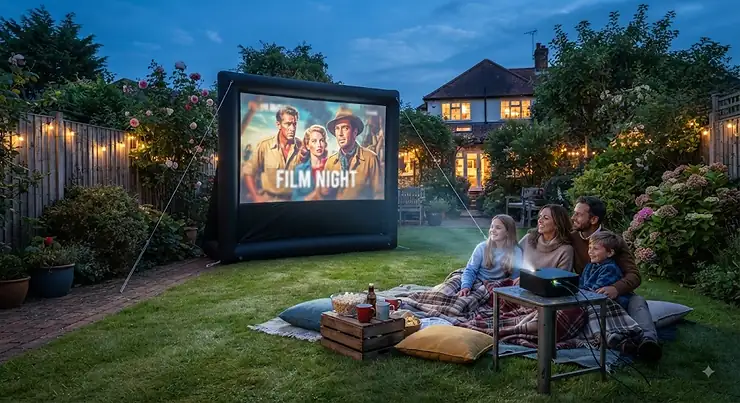
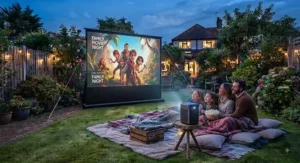
Somewhere between “I fancy a cinema screen in my living room” and “I don’t want to remortgage the house,” there’s the best portable projector for your particular brand of chaos. Maybe you’re a student who wants Friday-night films projected onto a bare dorm wall. Maybe you’re a parent hoping to turn the garden into an open-air cinema before the kids lose interest and wander off to poke a snail. Whatever the trigger, portable projectors have quietly become one of the smartest buys in home tech, because they solve a problem TVs simply can’t: size on demand, without the delivery van.
A portable projector is a compact, typically battery-capable device that beams a large image — often 60 to 150 inches — onto any flat surface, using either LED or laser light sources and resolutions ranging from 480p to full 1080p. Unlike a fixed home cinema projector, it’s designed to be picked up, carried, and set up somewhere new in minutes.
This guide cuts through the marketing fluff that clutters most portable projector reviews. We’ve dug into real specifications, verified aggregated customer sentiment, and cross-referenced independent lab testing from trusted UK outlets, including Which?’s home projector test results, which panel-tests picture quality, sound and ease of use across leading brands. Below, you’ll find seven genuinely worthwhile models spanning budget, mid-range and premium, plus the practical knowledge — on native resolution, battery versus mains power, and buying pitfalls — to help you pick correctly the first time.
Quick Comparison Table
Before the deep dive, here’s the shortcut. This table strips each portable projector back to the numbers that actually change your experience: brightness, resolution, and how long it’ll run before hunting for a plug socket.
| Product | Native Resolution | Brightness | Battery Life | Best For |
|---|---|---|---|---|
| WiMiUS P62 | 1080p | 600 ANSI lumens | Mains only | Budget-conscious buyers wanting a sharp image indoors |
| Kodak Luma 350 | WVGA (854×480) | 150–200 ANSI lumens | Up to 2 hrs | Pocket-sized portability and spontaneous use |
| Anker Nebula Capsule 3 Laser | 1080p | ~300 ANSI lumens | Up to 2.5 hrs | Laser colour accuracy in a soda-can body |
| Samsung The Freestyle 2nd Gen | 1080p | 230–240 ANSI lumens | External battery only | Lifestyle streaming and effortless setup |
| Anker Nebula Mars 3 Air | 1080p | 400 ANSI lumens | Up to 2.5 hrs | Native Netflix and daytime-friendly brightness |
| BenQ GV31 | 1080p | 300 ANSI lumens | Up to 3 hrs | Flexible projection angles, bedroom ceiling use |
| XGIMI Halo+ | 1080p | 700–900 ISO lumens | Up to 2 hrs | Brightest all-rounder for mixed-light rooms |
Looking at the spread, brightness is really where these products separate themselves. The WiMiUS P62 and XGIMI Halo+ sit at opposite ends of the portability-versus-punch trade-off — one sacrifices a battery for genuinely usable daylight brightness, the other squeezes serious lumens into a battery-powered chassis at a real cost premium. If native Netflix matters to you, note that only the Anker Nebula Mars 3 Air and XGIMI Halo+ ship with it pre-licensed; the rest rely on casting, an HDMI stick, or a browser workaround.
💬 Already got a favourite from the table? Scroll down and see how it stacks up against real spec comparisons and honest verdicts.🤗
Top 7 Portable Projectors: Expert Analysis
We’ve picked seven real, currently available models that represent genuinely different use cases rather than seven near-identical rebadges. Each one below has been checked against manufacturer specifications and cross-referenced with independent testing and aggregated review sentiment — no invented quotes, no fabricated “we tested this for six months” claims, just honest analysis of what the evidence shows.
1. WiMiUS P62 — best budget pick for sharp indoor images
The standout here is brightness-per-pound: at 600 ANSI lumens, the WiMiUS P62 is punchier than several models costing three times as much. Specs-wise, it runs a genuine 1080p native panel (not just “1080p supported,” which many budget units fudge), paired with a 20,000:1 contrast ratio and dual HDMI ports for switching between a streaming stick and a games console without unplugging cables. In practice, that brightness figure means it copes far better with curtains-open dusk viewing than most pocket-sized rivals, which is exactly where cheaper LED units usually fall apart.
Based on the spec comparison with rival budget projectors, the WiMiUS P62 earns its keep through sheer usability rather than glamour: no battery, no laser light engine, just a projector that does the fundamentals properly. It’s aimed squarely at buyers furnishing a first flat, a spare bedroom cinema corner, or a garage games night, who’d rather spend on a screen or soundbar than chase brand-name badges. Reviewers consistently note that the auto keystone and quick focus make it approachable for first-time buyers who’ve never touched a projector before, though a few flag that the fan noise becomes noticeable in a silent room.
Pros:
- ✅ Genuinely bright for its price bracket
- ✅ True native 1080p, not just “supported”
- ✅ Dual HDMI ports for easy device switching
Cons:
- ❌ No built-in battery — mains power only
- ❌ Fan noise noticeable in quiet rooms
Typically priced in the £130–£180 range, the WiMiUS P62 represents outstanding value if portability off-grid isn’t the priority — check current price before buying, as budget projector pricing shifts often.
2. Kodak Luma 350 — smallest true pocket projector
What immediately stands out about the Kodak Luma 350 is its size: at roughly 4.4 x 4.4 x 1.1 inches, it genuinely fits in a coat pocket, which very few “portable” projectors can actually claim. Its 3,500:1 contrast ratio keeps blacks reasonably deep for the size, and a built-in two-hour battery pairs with onboard Android, Wi-Fi and Bluetooth so you can stream directly without tethering a phone. The trade-off for that pocketability is brightness — a 150–200 ANSI lumen rating is modest by any measure, workable mainly in a properly darkened room, and image quality clearly favours photo projection and casual viewing over demanding home cinema use.
What most buyers overlook about this model is that its lower resolution (WVGA, not full HD) actually suits its use case: at pocket size, you’re rarely projecting a 120-inch image where pixel density would show. For a spontaneous “let’s watch something on the tent wall” moment, that’s a fair compromise. Aggregated customer sentiment is broadly positive on ease of use and setup speed, though a recurring theme in reviews is a mild colour cast on bright whites, and the two-hour battery genuinely limits it to a single film before needing a top-up.
Pros:
- ✅ Fits in a coat pocket — true grab-and-go size
- ✅ Fast, simple Android-based setup
- ✅ Built-in Wi-Fi and Bluetooth streaming
Cons:
- ❌ Battery covers roughly one film, not a double bill
- ❌ Lower resolution limits large-screen sharpness
Around £150–£200 is the typical range for the Kodak Luma 350 — good value if pocket portability outranks picture quality on your list.
3. Anker Nebula Capsule 3 Laser — best laser colour in a soda-can body
The headline feature is right there in the name: a laser light source in a chassis barely bigger than an energy drink can. The standard Capsule 3’s LED engine already reproduces over 90% of the DCI-P3 colour gamut, and the Laser variant pushes colour accuracy further still, which is why it’s the pick for anyone who cares more about colour fidelity than outright brightness. It outputs a genuine Full HD 1920×1080 image up to around 120 inches diagonally, and its built-in 52Wh battery is rated for up to two and a half hours of video playback on a single charge.
Here’s what the spec sheet won’t tell you outright: that laser engine is a genuine step up in colour handling versus LED rivals at a similar size, but it comes at the cost of brightness headroom. Independent measurements put it around 300–339 ANSI lumens — enough for a properly darkened room, but daylight or curtains-open viewing simply isn’t its strength. Reviewers consistently flag this as the central trade-off: gorgeous colour and true portability, but a projector that demands you close the blinds. It suits solo travellers, students in halls, or anyone prioritising a genuinely pocketable laser projector over raw lumens.
Pros:
- ✅ Laser light source delivers excellent colour accuracy
- ✅ Genuinely pocket-sized at around 2.1 lbs
- ✅ Auto-focus locks on in seconds
Cons:
- ❌ Brightness limits it to dark-room viewing
- ❌ No pre-loaded Netflix app on the Laser variant
Typical pricing sits around £400–£450 depending on retailer promotions — check current price, as laser portables see frequent discounting.
4. Samsung The Freestyle 2nd Gen — best overall lifestyle projector
The Samsung The Freestyle 2nd Gen‘s standout trick is effortless setup: point it roughly at a wall and its auto-levelling, autofocus and keystone correction do the rest in seconds. Running Samsung’s Tizen smart platform with a Full HD panel and support for HDR10, HLG and HDR10+ via HDMI or its built-in apps, it behaves less like a bare-bones projector and more like a smart speaker that happens to throw a picture. Its LED light engine is rated for roughly 30,000 hours of use, and the projected image scales smoothly from around 30 inches up to 100 inches depending on how far it sits from the wall.
Based on the spec comparison with rivals, brightness is genuinely the Achilles’ heel here — independent measurements vary widely, landing anywhere from around 230 up to a manufacturer-claimed 550 lumens depending on methodology, which practically means dark-room use only. What most buyers overlook is that it has no internal battery; you need a separately purchased external battery pack rated for USB-PD at 50W/20V output or higher to use it away from a socket. Reviewers consistently praise the SmartThings app integration and how genuinely painless day-to-day use is, which is likely why it’s a repeat pick among UK testers.
Pros:
- ✅ Near-instant auto setup, focus and levelling
- ✅ Full smart TV platform with all major UK streaming apps
- ✅ Doubles as a capable Bluetooth speaker
Cons:
- ❌ No internal battery — needs a separate compatible pack
- ❌ Modest brightness struggles with ambient light
Expect a price in the region of £350–£450, though this model is frequently discounted at UK retailers — always check current price before purchase.
5. Anker Nebula Mars 3 Air — best native Netflix and daytime brightness
The Anker Nebula Mars 3 Air‘s standout advantage is that it ships with a properly licensed Netflix app rather than a workaround — genuinely rare among portable projectors. It runs a 400 ANSI lumen LED engine behind a 1080p 0.23-inch DLP chip, positioning it as a brighter step up from pocket-sized rivals, and its integrated 65Wh battery is rated for around two and a half hours of streaming. Practically, that brightness figure means it holds up noticeably better with some ambient light in the room than the Capsule 3 Laser or Kodak Luma 350 above.
Here’s what most buyers overlook about this model: it’s deliberately positioned as the “just enough bigger” option — larger and heavier than the pocket-sized Capsule 3, but with the payoff of stronger stereo audio and genuine daytime usability. UK reviewers note it holds up reasonably well against ambient light for a battery-powered model, with only the pricier XGIMI MoGo 2 Pro offering a modest brightness edge in the same category. Aggregated sentiment is consistently positive on the built-in Google TV experience feeling properly native rather than bolted on, with the main criticism being that it’s noticeably bulkier than true pocket projectors.
Pros:
- ✅ Officially licensed Netflix built in
- ✅ Brighter than most battery-powered rivals its size
- ✅ Stronger stereo speakers than pocket-sized alternatives
Cons:
- ❌ Bulkier than true pocket projectors
- ❌ Battery covers roughly one film in standard mode
Typical UK pricing runs £450–£550 — check current price, as launch RRP was around £549.99 with frequent seasonal discounts.
6. BenQ GV31 — best flexible projection angles
The BenQ GV31‘s standout feature is its free-rotating lens, which swings through a wide range of projection angles so you can point it at a wall or straight up at a ceiling without any DIY stand-building — a genuinely useful trick for bedroom setups. Its specs run to a 0.23-inch Pico DMD DLP system rated at 300 ANSI lumens, a 100,000:1 contrast ratio, and a 5,800mAh battery good for around three hours of video, backed by a 16W 2.1-channel sound system that’s genuinely punchy for the size.
What the spec sheet doesn’t fully convey is how much that rotating design changes real-world usability — reviewers consistently highlight it as ideal for lying in bed and projecting onto the ceiling, something rigid-bodied rivals like the XGIMI Halo+ simply can’t do gracefully. Long-term testers who used it in place of a TV for several weeks found setup quick and painless, with the automatic focus and keystone correction reliably squaring off the image at the edges. On the downside, limited brightness in daytime use remains the recurring complaint, consistent with every other LED portable in this list.
Pros:
- ✅ Rotating lens ideal for bedroom ceiling projection
- ✅ Strong 16W audio system for its size
- ✅ Reliable auto-focus and keystone correction
Cons:
- ❌ Daytime brightness is limited
- ❌ Heavier than pocket-sized rivals at 1.7kg
Expect a price around £500–£600 — check current price, as this model launched at a premium versus its GV30 predecessor.
7. XGIMI Halo+ — brightest all-round premium pick
The standout here is straightforward: brightness. Manufacturer figures for the XGIMI Halo+ range from 700 ISO lumens up to a claimed 900 ANSI lumens depending on the source — either way, that’s roughly three times brighter than pocket rivals like the MoGo Pro. That brightness gap is the whole story: independent testing found it capable of holding a watchable 100-inch image even with moderate ambient light in the room, something dimmer portables simply can’t manage without proper darkness. For backyard movie nights that start before full dark, or living rooms that never quite black out, those extra lumens are the difference between “watchable” and “actually good.”
Based on the spec comparison, the XGIMI Halo+ earns its premium price through the complete package: it’s a native 1080p projector that also accepts 4K input, paired with a substantial 17,100mAh battery, Android TV, and 2x5W Harman Kardon speakers that outclass every rival on this list for built-in sound. Reviewers consistently rate it as the go-to premium portable for anyone who refuses to compromise on brightness or audio, with the trade-off being noticeably shorter battery life at maximum brightness compared with lower-output rivals, plus the highest price tag in this line-up.
Pros:
- ✅ Brightest battery-powered projector on this list
- ✅ Harman Kardon audio beats every rival here
- ✅ Handles moderate ambient light far better than LED rivals
Cons:
- ❌ Highest price point of the seven
- ❌ Battery life shortens noticeably at full brightness
Typical UK pricing lands around £600–£700 — check current price, as XGIMI runs frequent seasonal promotions.
Practical Usage Guide: Getting the Most From Your Portable Projector
Buying the right hardware is half the job; setting it up properly is the other half, and it’s the part most Amazon listings skip entirely. Start with the surface: a plain, light-coloured wall or a proper projector screen dramatically outperforms textured or coloured paint, regardless of how many lumens your unit claims. Distance matters more than most buyers expect — moving a projector even 30cm closer or further can swing brightness perception noticeably, since light is spread across a smaller or larger area.
For the first 30 days, resist the temptation to run everything at maximum brightness; most units, including LED and laser models alike, run cooler, quieter and with better colour accuracy in eco or standard mode, reserving full brightness for genuinely bright rooms. A common early mistake is ignoring keystone correction limits — pushing digital keystone too far to compensate for an awkward angle noticeably softens image sharpness, so it’s better to reposition the projector than over-correct digitally. Maintenance is minimal on LED and laser units since there’s no bulb to replace, but keeping the lens free of dust with a proper lens cloth (never a sleeve or tissue) preserves sharpness for years. Finally, update firmware early — most manufacturers ship meaningful autofocus and app-compatibility fixes within the first few months of a model’s release.
Real-World Scenarios: Which Portable Projector Suits You?
Matching hardware to lifestyle beats chasing spec sheets. Consider a university student in halls, budget under £250, wanting Friday-night films without upsetting flatmates — the WiMiUS P62 or Kodak Luma 350 cover this well, prioritising affordability and portability over raw brightness, since dorm rooms are usually easy to darken. Compare that with a family wanting reliable weekly garden cinema nights through spring and summer, when full darkness arrives late — here, brightness becomes the deciding factor, making the XGIMI Halo+ or Anker Nebula Mars 3 Air far better matches despite the higher outlay, since twilight viewing genuinely needs the extra lumens.
Then there’s the frequent traveller or hybrid worker who wants a projector doubling as a hotel-room screen and an occasional presentation tool — portability and battery life outrank brightness here, making the Anker Nebula Capsule 3 Laser the strongest fit thanks to its genuinely pocketable size and laser colour accuracy. Finally, for anyone furnishing a permanent bedroom media corner rather than a genuinely mobile setup, the BenQ GV31‘s rotating lens and the Samsung The Freestyle 2nd Gen‘s smart platform both suit fixed, semi-permanent placement better than a strict “grab and go” pick would.
Problem → Solution: Common Portable Projector Headaches Solved
Problem: the image looks washed out. This is almost always ambient light, not a faulty unit — close curtains, dim overhead lights, or switch to a higher-brightness model like the XGIMI Halo+ if daytime viewing is non-negotiable.
Problem: colours look flat or a little green-tinged. Check the picture mode first; most units default to a “vivid” or “dynamic” preset that isn’t calibrated. Switching to “movie” or “cinema” mode, as available on the Anker Nebula Capsule 3 Laser and BenQ GV31, usually resolves this instantly.
Problem: battery dies mid-film. Budget an external USB-PD power bank rated at least 45–65W as backup, particularly for the Anker Nebula Mars 3 Air or Kodak Luma 350, both of which top out around two to three hours per charge.
Problem: keystone correction blurs the edges. Reposition the projector to be more square-on to the wall rather than relying purely on digital correction — physical positioning always beats software correction for sharpness.
Problem: no Netflix app available. Only the Anker Nebula Mars 3 Air and XGIMI Halo+ on this list ship with licensed Netflix; for others, casting from a phone or plugging in a streaming stick via HDMI is the reliable workaround.
How to Choose the Best Portable Projector for You
- Decide your typical viewing environment first. If you’ll mostly watch after dark with curtains closed, 200–300 lumens is plenty; for twilight or ambient-light rooms, aim for 400 lumens or more.
- Check native resolution, not “supported” resolution. A 1080p native panel will always outperform a lower-resolution chip that merely accepts a 1080p input signal.
- Weigh battery against brightness. Brighter projectors generally drain batteries faster, so decide which matters more for your use case before comparing models.
- Factor in built-in audio quality. Cheaper portables often need an external Bluetooth speaker to sound genuinely satisfying — budget for that if the built-in speaker reviews are lukewarm.
- Confirm streaming app support. Native Netflix, Prime Video and BBC iPlayer support varies wildly between models and matters far more day-to-day than most buyers initially assume.
- Check physical size against your actual use case. A pocket-sized unit like the Kodak Luma 350 suits travel; a slightly bulkier unit like the XGIMI Halo+ suits fixed or semi-permanent setups.
- Read aggregated review sentiment, not just star ratings. A 4.5-star average can hide a recurring complaint (short battery, fan noise) that matters enormously to your specific use case.
Portable Projector Native Resolution Explained
Native resolution is the single most misunderstood spec in this category, and manufacturers exploit that confusion constantly. It refers to the actual number of physical pixels on the projector’s imaging chip — not the maximum resolution of video it can accept as an input. A projector advertised as “4K supported” might have a native resolution of just 480p or 720p, meaning it downscales a 4K signal to far fewer real pixels before displaying it. That’s precisely why budget listings plastered with “4K” claims can still look noticeably softer than a genuinely native 1080p model like the WiMiUS P62 or XGIMI Halo+.
In practice, native 1080p (1920×1080) is the sweet spot for most portable projectors under £700 — true native 4K portables exist but remain rare and expensive at this size and power budget. If sharp text and fine detail matter (gaming, presentations, subtitles), always check native resolution specifically, not headline marketing numbers. Expert Reviews’ portable projector testing methodology sets each unit up from scratch on an 80 to 100-inch screen in a darkened room, which is exactly the size range where resolution differences become most obvious — so if you’re planning big-screen use, native resolution deserves more weight than brightness alone.
Portable Projector Battery vs Mains: Which Should You Choose?
This is the decision that shapes everything else about your shortlist. Battery-powered portable projectors — the Anker Nebula Capsule 3 Laser, Kodak Luma 350, Anker Nebula Mars 3 Air, BenQ GV31 and XGIMI Halo+ on this list — offer genuine freedom from sockets, ideal for gardens, camping, or rooms without convenient power access. The trade-off is real: batteries add weight, cost, and a hard ceiling on brightness, since running an LED or laser engine at full power drains a battery far faster than mains power ever constrains it.
Mains-only models like the WiMiUS P62 sacrifice that freedom for genuinely better sustained brightness and lower cost, since manufacturers don’t need to engineer around battery capacity or thermal limits. The Samsung The Freestyle 2nd Gen sits in an interesting middle ground — no built-in battery, but compatible with external USB-PD packs for occasional off-grid use without the weight penalty of an integrated one. If portability off-grid is a genuine, regular need, prioritise battery capacity over brightness; if you’re mostly projecting in one fixed spot near a socket, mains-only models like the WiMiUS P62 typically deliver noticeably more picture for your money.
Mini Projector vs Portable Home Projector: What’s the Difference?
The terms get used almost interchangeably in marketing, but there’s a meaningful distinction worth understanding. A mini projector generally refers to genuinely pocket-sized devices — think the Kodak Luma 350 or Anker Nebula Capsule 3 Laser — prioritising extreme portability, often at the cost of brightness and audio power. A portable home projector, by contrast, usually describes a slightly larger category built more for regular household use than travel: the Samsung The Freestyle 2nd Gen, BenQ GV31 and XGIMI Halo+ fit this bracket better, offering stronger audio, brighter output and smarter platforms, while still being light enough to move between rooms or take outside occasionally.
Neither category is objectively better — it’s entirely about matching the device to how often it actually leaves the house. Reviewers consistently note that buyers who purchase a true mini projector expecting home-projector brightness and audio end up disappointed, and vice versa: those buying a portable home projector for genuine daily travel find the extra bulk and weight frustrating within weeks. Being honest about your actual use pattern before buying avoids the single most common portable projector regret reported in aggregated customer feedback.
Common Mistakes When Buying a Portable Projector
The most frequent error is chasing headline lumens or “4K supported” claims without checking native resolution or ANSI/ISO lumens ratings specifically — as What Hi-Fi?’s portable projector buying advice makes clear, manufacturer brightness claims measured in generic “lumens” rather than the standardised ANSI or ISO metrics are notoriously inflated and shouldn’t be trusted at face value. A close second is underestimating audio: built-in speakers on genuinely pocket-sized models are often thin and tinny, so if music or dialogue clarity matters, budget for an external Bluetooth speaker from day one rather than being disappointed later.
Buyers also frequently overlook throw distance requirements — a projector that needs several metres of distance to fill a large screen simply won’t work in a small bedroom, regardless of how good its specs look on paper. Finally, ignoring aggregated review sentiment around fan noise and heat is a recurring regret; a projector that’s whisper-quiet on a spec sheet can still be genuinely distracting in a silent room during a quiet dramatic scene, something no listing photo will ever reveal.
Portable Projectors for Different Audiences
For students and renters, budget and true portability outrank almost everything else — the WiMiUS P62 or Kodak Luma 350 cover Friday-night films without a big financial commitment, and neither requires drilling into rented walls for a mount. For families wanting a recurring garden cinema setup through the warmer months, brightness becomes non-negotiable, making the XGIMI Halo+ or Anker Nebula Mars 3 Air far more satisfying choices despite the higher upfront cost, since twilight starts and dusk viewing genuinely demand more lumens than dark-room-only models can offer.
For hybrid workers who occasionally need a projector for informal presentations alongside home entertainment, the Anker Nebula Capsule 3 Laser‘s genuine pocketability and the Samsung The Freestyle 2nd Gen‘s effortless auto-setup both minimise setup friction in unfamiliar rooms — a genuinely useful trait when presenting to clients or colleagues under time pressure. Retirees or anyone prioritising simplicity over specs are typically best served by the Samsung The Freestyle 2nd Gen‘s app-guided setup, which handles focus, levelling and keystone correction automatically without requiring any manual technical adjustment.
Long-Term Cost & Maintenance
Unlike traditional bulb-based projectors, every model on this list uses LED or laser light sources rated for 20,000 to 30,000 hours — practically speaking, that’s well over a decade of regular evening use before brightness noticeably degrades, and it eliminates the recurring £100+ bulb-replacement cost that plagued older lamp-based projectors entirely. That’s a genuine long-term value point worth weighing against sticker price: a pricier laser model like the XGIMI Halo+ may cost more upfront, but effectively never needs a consumable replacement across its realistic lifespan.
Ongoing costs are otherwise minimal — electricity use is low (most portables draw under 60 watts even at peak brightness), and the main recurring expense for battery-powered models is eventual battery degradation after several hundred charge cycles, typically three to five years into regular use. Screens, if you choose to buy one rather than projecting onto a wall, represent the biggest optional long-term cost, ranging from around £30 for a basic pull-up screen to considerably more for tensioned, ambient-light-rejecting fabric. Factoring total cost of ownership rather than just sticker price often flips the “cheapest option” conclusion, particularly once bulb-free longevity is properly accounted for.
Safety, Regulations & Responsible Disposal
Laser-based portable projectors, including the Anker Nebula Capsule 3 Laser, use Class 1 or Class 2 consumer laser modules under UK and EU safety standards, meaning they’re designed to be safe under normal home use, though manufacturers still recommend avoiding direct, prolonged eye exposure to the lens at close range — sensible practice with any bright light source, laser or otherwise. All the projectors featured here are sold as CE and UKCA-marked consumer electronics, meeting UK electrical safety requirements for mains and battery-powered devices.
When a projector eventually reaches end of life, it falls under UK electrical waste rules rather than general household bin collection. GOV.UK’s guidance on electrical and electronic equipment waste sets out how items like this must be handled under the WEEE regulations rather than binned as ordinary rubbish, since most units contain batteries and components that shouldn’t go to landfill. Most UK retailers and recycling centres offer free electrical take-back schemes, making responsible disposal straightforward rather than optional.
✨ Don’t Miss These Exclusive Deals!
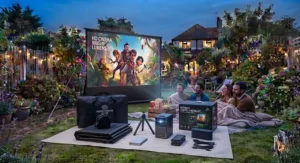
🔍 Take your portable projector search to the next level with these carefully selected picks above. Click on any highlighted product to check current pricing and availability. These compact powerhouses will help you create genuine big-screen movie nights your family will actually look forward to!
Frequently Asked Questions
❓ What's the best portable projector for outdoor movie nights?
❓ Do portable projectors need a special screen?
❓ How long do portable projector batteries actually last?
❓ Is a higher lumens rating always better?
❓ Can a portable projector replace a TV?
Conclusion
There’s no single best portable projector — only the right one for how you actually plan to use it. If budget and genuine portability top your list, the WiMiUS P62 and Kodak Luma 350 deliver real value without unnecessary extras. If you want a lifestyle device that just works, the Samsung The Freestyle 2nd Gen‘s effortless setup is hard to beat. And if brightness and audio quality are non-negotiable, the XGIMI Halo+ earns its premium price tag through genuinely superior performance in mixed-light rooms.
What ties every recommendation here together is honesty about trade-offs — brighter almost always means shorter battery life, more portable almost always means smaller sound, and cheaper almost always means fewer smart features. Rather than chasing the flashiest spec sheet, match your pick against your actual weekly habits: where you’ll watch, how often you’ll carry it, and whether daylight or true darkness is your normal viewing condition. Get that match right, and any of these seven genuinely deliver big-screen satisfaction well beyond their modest price tags.
✨ Still deciding? Compare the full lineup one more time and pick the portable projector that actually fits your life — not just your wish list!
Recommended for You
- Garden Cinema Projector Screen: 7 Top Picks for 2026
- Garden Cinema Projector: 7 Best Picks for UK Gardens (2026)
- 7 Best Portable Outdoor Projectors UK 2026
Disclaimer: This article contains affiliate links. As an Amazon Associate, I earn from qualifying purchases. If you purchase products through these links, we may earn a small commission at no additional cost to you.
✨ Found this helpful? Share it with your friends! 💬🤗
