
In This Article
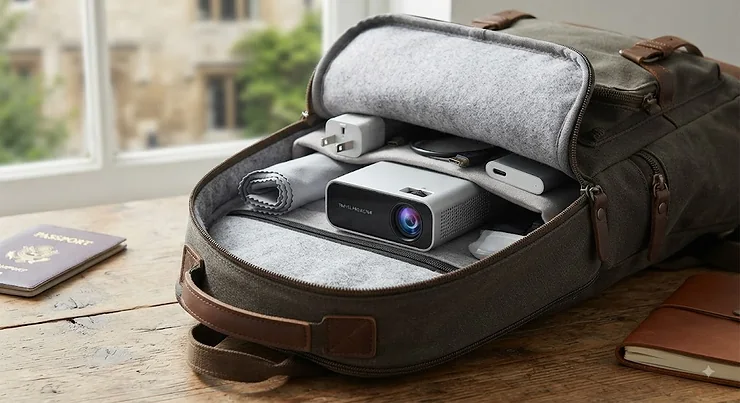
Somewhere between “I’ll just watch on my phone” and “let’s book a hotel with a decent telly,” there’s a better option most travellers never consider: a projector that fits in a jacket pocket and turns a plain hostel wall into a cinema screen. A portable projector for travel isn’t a luxury gadget anymore — it’s become the kind of thing digital nomads, van-lifers and long-haul commuters quietly swear by, the way people once swore by noise-cancelling headphones. What is a portable projector for travel? In short, it’s a compact, battery-friendly or USB-C-powered projector — usually under 1.5kg — designed to survive being tossed into hand luggage and still throw a watchable image onto any flat surface, indoors or out.
The category has genuinely matured. Where early travel projectors were dim, laggy toys best suited to a dark cupboard, 2026’s crop uses laser and LED light sources, Google TV or Tizen smart interfaces, and batteries rated for a full film. That said, “portable” is doing a lot of heavy lifting in the marketing copy, and the gap between a device that’s genuinely pocketable and one that’s merely “smaller than a home cinema projector” is enormous.
This guide compares seven real, currently available models spanning budget, mid-range and premium tiers, with honest analysis of weight, brightness, battery life and how they actually behave in a carry-on bag rather than a marketing photo. We’ve dug into verified specs, aggregated review sentiment and the practicalities of getting one through UK airport security, so you can pick the right travel projector without guessing.
Quick Comparison Table
| Projector | Weight | Brightness | Power | Best For |
|---|---|---|---|---|
| Wanbo T2 Max | ~900g | ~150 ANSI lumens | Mains only | Tightest budgets |
| Kodak Luma 350 | ~340g | Up to 350 lumens (marketing) | Built-in battery | Pocket & business trips |
| BenQ GV11 | 970g | 200 ANSI lumens | Mains / power bank via barrel input | Hotel room ceilings |
| Nebula Capsule 3 Laser | ~900g | ~300 ANSI lumens (laser) | Built-in battery (2.5h) | Best all-round image |
| XGIMI MoGo 4 | 1.31kg | 450 ISO lumens | Built-in battery (2.5h) | Versatile all-rounder |
| XGIMI Elfin Flip Plus | Featherweight, foldable | 500 ISO lumens | Mains only | Brightest compact pick |
| Samsung The Freestyle 2nd Gen | ~0.82kg (body) | 230 ANSI lumens | Mains (battery base optional) | Premium smart-TV feel |
Looking at the spread here, there’s a genuine trade-off between brightness and portability: the Kodak Luma 350 wins on sheer pocketability but can’t match the punchy daylight visibility of the XGIMI Elfin Flip Plus, which trades battery independence for a brighter, sharper picture. Meanwhile, models with built-in batteries like the Nebula Capsule 3 Laser and XGIMI MoGo 4 cost a brightness or weight premium compared with mains-only rivals, because a lithium cell simply adds mass no manufacturer can engineer away. If you’re flying, remember that battery-powered projectors fall under the same hand-luggage-only rule as power banks and laptops — worth checking gov.uk’s hand luggage restrictions guidance before you pack.
💬 Just one click — help others make better buying decisions too!😊
✨ Don’t Miss These Exclusive Deals!
🔍 Take your portable projector for travel search to the next level with these carefully selected products. Click on any highlighted item to check current pricing and availability. These compact powerhouses will help you build authentic movie nights your travel companions will love!
Top 7 Portable Projectors for Travel: Expert Analysis
1. Wanbo T2 Max — best entry point for cash-strapped travellers
The Wanbo T2 Max is the projector equivalent of dipping a toe in the water before committing to the category, and its standout feature is simply how little it asks you to spend to get something watchable.
At roughly 900 grams with a native 1080p LCD panel, the Wanbo T2 Max covers the basics: HDMI and USB-A inputs, automatic vertical keystone correction, and a 20,000-hour LED light source that should outlast most people’s interest in the device itself. Its 150 ANSI lumens rating means what it always means at this price point — you’ll want blackout curtains or genuine darkness, because this isn’t a projector that fights back against a hotel room’s ambient light. Based on the spec comparison with pricier rivals, what most buyers overlook about entry-level models like this is that resolution and brightness are two different battles, and the Wanbo T2 Max wins the first while conceding the second.
This is squarely a projector for the traveller who wants to test whether “projector nights” will actually become a habit before spending serious money — students, occasional campers, or anyone furnishing a first flat-share. Reviewers consistently note that the picture quality is respectable for the price but that outdoor or daylight use is a non-starter, and a common complaint in user reviews concerns inconsistent build quality across different retailer batches, since several near-identical “T2 Max” variants circulate under the Wanbo name.
Pros:
- ✅ Genuinely affordable entry point into travel projection
- ✅ Native 1080p resolution beats many similarly priced rivals
- ✅ Simple auto-keystone setup with minimal fuss
Cons:
- ❌ No built-in battery — mains power only
- ❌ Brightness limits use to dark rooms after sunset
Typically found in the under-£180 range at the time of research, the Wanbo T2 Max represents solid value if your expectations match its price tag — just don’t expect it to double as a daylight presentation tool.
2. Kodak Luma 350 — smallest true pocket projector for business trips
If the phrase “pocket projector for business travel” describes exactly what you’re after, the Kodak Luma 350 is the most literal answer on this list — at around 340 grams, it slips into a laptop bag’s side pocket without you noticing the extra weight.
Running Android 6.0 with Wi-Fi, Bluetooth and screen mirroring, the Kodak Luma 350 is built around convenience rather than raw image quality: HDMI, USB and microSD inputs cover most laptop and phone connections, and the built-in rechargeable battery means you can pull it out in a client’s meeting room without hunting for a socket. What most buyers overlook about a projector this size is that “up to 200-inch display” claims are theoretical maximums in ideal darkness — in a lit conference room, you’re realistically looking at a crisp 40 to 60-inch image, which is still more than enough for a slide deck or a product demo. Based on the spec comparison with the rest of this list, the trade-off for that pocket-friendly size is a dimmer, lower-resolution image than bulkier rivals — this is a tool for convenience-first scenarios, not movie-night image quality.
Aggregated customer sentiment for the Luma range consistently flags the compact size and simple interface as strengths, while several reviewers note that battery life and brightness fall short of headline claims once you’re a year into ownership — a pattern common across budget Android-based pico projectors as batteries age.
Pros:
- ✅ Genuinely pocket-sized at roughly 340g
- ✅ Built-in rechargeable battery for socket-free use
- ✅ Android interface enables direct app streaming
Cons:
- ❌ Image brightness drops noticeably in lit rooms
- ❌ Android 6.0 interface feels dated next to Google TV rivals
Prices typically sit in the £220-£280 range, making the Kodak Luma 350 a sensible pick for business travellers who need “good enough” projection in a genuinely pocketable footprint rather than the sharpest picture in the room.
3. BenQ GV11 — best for hotel-room ceiling projection
Most travel projectors assume you’re pointing at a wall. The BenQ GV11 assumes you might be lying in bed, which is exactly why its standout feature — a 135-degree rotating lens — earns it a spot here.
At 970 grams with 200 ANSI lumens and a treVolo-tuned 5W speaker doubling as a Bluetooth speaker, the BenQ GV11 is built for the specific scenario of a small hotel room where the ceiling, not the wall, is the only clear projection surface. Its native WVGA resolution (854×480) is genuinely low by 2026 standards, and here’s what the spec sheet won’t tell you upfront: this projector upscales everything to fill a bigger image, so text and fine detail look noticeably softer than on the 1080p models further down this list. On the plus side, Android TV 10 access to over 5,000 apps means you’re not tethered to casting from a phone, though it’s worth flagging that Netflix isn’t natively supported on BenQ’s smart projectors — you’ll need to cast it from a compatible device instead.
Reviewers consistently praise the rotating lens and drop-resistant design for hotel and camping use, while a recurring theme in user feedback is that the lack of a USB-C charging port — it relies on a proprietary barrel adapter — makes it less convenient to top up on the road than USB-C rivals.
Pros:
- ✅ Unique 135° rotating lens for ceiling projection
- ✅ Doubles as a standalone Bluetooth speaker
- ✅ Rugged, drop-resistant “table-height” build
Cons:
- ❌ Low native resolution (854×480) softens detail
- ❌ No native Netflix app and no USB-C charging
Typically listed in the mid-£300s to low-£400s range, the BenQ GV11 earns its keep through a genuinely different use case — if your travel routine involves small rooms and tired legs, its ceiling-friendly design is hard to replicate elsewhere on this list.
4. Nebula Capsule 3 Laser — best image quality with a built-in battery
Anker’s Nebula range has built its reputation on portable laser projection, and the Nebula Capsule 3 Laser is the clearest evidence yet that “compact” and “genuinely good picture” aren’t mutually exclusive anymore.
Weighing around 900 grams — Anker describes it as fitting comfortably in one hand — the Nebula Capsule 3 Laser pairs a laser light source with native 1080p resolution and Google TV, complete with officially licensed Netflix built in rather than cast from a phone. The 15,000mAh internal battery delivers roughly 2.5 hours of playback, enough for the vast majority of feature films, and the laser source’s CAIC pixel-conservation technology is what most buyers overlook when comparing lumens on paper: a laser-lit 300 ANSI lumens tends to look punchier and more colour-accurate in practice than an LED projector’s equivalent rating, because laser sources maintain colour saturation better as brightness climbs. On the spec sheet, this is one of the more balanced all-rounders here — not the lightest, not the brightest, but consistently good across the board.
A common theme in aggregated reviews is genuine enthusiasm for picture quality relative to size, with several users specifically praising it for campervan and outdoor use, though a recurring complaint involves inconsistent post-purchase customer support experiences when hardware issues arise — worth factoring in given this is a device you’ll be relying on away from home.
Pros:
- ✅ Laser light source delivers punchier, richer colour
- ✅ Officially licensed Netflix built into Google TV
- ✅ 2.5-hour built-in battery covers most films
Cons:
- ❌ 300 lumens still needs a genuinely dark room
- ❌ Mixed reports on after-sales support responsiveness
Sitting in the roughly £380-£430 range, the Nebula Capsule 3 Laser is a strong mid-range pick for travellers who prioritise picture quality over ultimate brightness or lightest-possible weight.
5. XGIMI MoGo 4 — most versatile all-rounder for regular travellers
If you want one projector to handle everything from a campsite movie night to a spontaneous presentation, the XGIMI MoGo 4‘s standout feature is its 360-degree built-in stand, which removes the “what do I balance this on?” problem entirely.
At 1.31kg, the XGIMI MoGo 4 is heavier than the pocket-focused options on this list, but that weight buys you 450 ISO lumens, Google TV with licensed Netflix, dual 6W Harman Kardon speakers and an integrated stand that adjusts to almost any angle without external tripods. Here’s what most spec sheets bury in fine print: XGIMI’s optional PowerBase stand accessory roughly doubles battery life to around five hours by adding a second cell, which is a meaningful upgrade path if you know you’ll be off-grid for extended stretches — camping trips, garden parties, long train journeys. Based on the spec comparison with its own predecessor, the MoGo 3 Pro, the MoGo 4’s headline addition is that built-in battery, a genuinely useful upgrade for anyone who found themselves hunting for sockets before.
What Hi-Fi’s testing found the XGIMI MoGo 4 delivered sharp, punchy picture quality that pleasantly surprised reviewers relative to its size, while also noting thinner sound and slightly oversaturated colours as the trade-offs — a fair summary that lines up with wider aggregated review sentiment praising the design and setup speed.
Pros:
- ✅ Built-in 360° stand removes tripod hassle
- ✅ Strong 450 ISO lumen brightness for the category
- ✅ Optional PowerBase accessory extends runtime
Cons:
- ❌ At 1.31kg, noticeably heavier than pocket rivals
- ❌ Thin default sound without external speakers
Launched around £509 and typically found in the roughly £480-£560 range depending on bundle, the XGIMI MoGo 4 is the pick for travellers who want genuine versatility and are willing to trade a little pocket-friendliness for it.

6. XGIMI Elfin Flip Plus — brightest compact pick for well-lit rooms
Some travel projectors compete on weight; the XGIMI Elfin Flip Plus competes on brightness, and its standout feature — 500 ISO lumens in a genuinely slim, foldable body — makes it the strongest option here for rooms you can’t fully darken.
The XGIMI Elfin Flip Plus uses a 150-degree rotating integrated stand that also folds flat to protect the lens in transit, a thoughtful touch for anyone who’s ever worried about scratching a lens loose in a rucksack. Its 25% brightness increase over the standard Elfin Flip is the headline upgrade, and in practice that translates to genuine daytime usability in moderately lit rooms — something several models on this list simply can’t manage. On paper this means the XGIMI Elfin Flip Plus occupies a specific niche: it’s mains-powered only, so it sacrifices the off-grid flexibility of battery models, but what you gain in exchange is real-world visibility that battery-powered rivals at similar brightness ratings often can’t sustain for a full film without draining fast.
One verified UK reviewer who’d previously owned a comparable Anker Nebula model specifically praised the XGIMI Elfin Flip Plus for its quieter operation and more reliable auto-focus performance in day-to-day use, a sentiment echoed in wider aggregated feedback that consistently highlights the automated setup as near-effortless.
Pros:
- ✅ Highest brightness on this list at 500 ISO lumens
- ✅ Foldable integrated stand protects the lens in transit
- ✅ Fast, automated keystone and focus setup
Cons:
- ❌ Mains-powered only — no built-in battery for off-grid use
- ❌ Lighter sound output than battery-equipped rivals
Priced at roughly under €450 in European testing and comparably positioned in the UK market, the XGIMI Elfin Flip Plus rewards travellers who value picture quality over battery independence — think hotel rooms and Airbnbs with sockets, rather than campsites without them.
7. Samsung The Freestyle 2nd Gen — best premium smart-TV experience
For travellers who want their projector to feel less like a gadget and more like a proper Smart TV replacement, the Samsung The Freestyle 2nd Gen‘s standout feature is its full Tizen operating system — the same software running Samsung’s actual televisions.
At around 0.82kg for the body alone, the Samsung The Freestyle 2nd Gen supports HDR10+ and HLG, 360-degree sound, and voice control via Bixby and Alexa, alongside Samsung’s SmartThings ecosystem for anyone already invested in that world. Here’s what the marketing glosses over: this is a mains-powered device by default, and true portability requires Samsung’s separately sold battery base — an important honest caveat, because buying “The Freestyle” alone doesn’t automatically get you an off-grid travel projector. Based on the spec comparison with the rest of this list, what you’re really paying the premium for is smart-platform polish and Samsung’s app ecosystem, not raw brightness — at 230 ANSI lumens, it sits in the middle of the pack rather than leading it.
Aggregated review sentiment is genuinely mixed here in a way worth being upfront about: while many users report a smooth, TV-like experience with easy setup via Samsung’s Tap View feature, a recurring and serious complaint across UK retailer reviews concerns long-term reliability, with multiple users reporting remote or panel failures within the first year of ownership — worth weighing against the premium price tag.
Pros:
- ✅ Full Tizen Smart TV platform with wide app support
- ✅ HDR10+ and HLG support unusual at this size
- ✅ Voice control via Bixby and Alexa built in
Cons:
- ❌ True portability requires a separately sold battery base
- ❌ Recurring reliability complaints in aggregated reviews
Prices vary substantially — commonly listed anywhere from the £350s to over £800 depending on bundle and retailer — so shop around and check current pricing carefully before choosing between the Samsung The Freestyle 2nd Gen and its rivals here.
Practical Usage Guide: Getting the Most From Your Travel Projector
Setting up any of these seven projectors for the first time follows a similar rhythm, but a few habits separate a smooth trip from a frustrating one. Before you leave home, fully charge any built-in battery and, crucially, run a test projection onto a plain wall — don’t discover a faulty auto-focus motor for the first time in a hostel. Pack a lightweight, light-coloured bedsheet or a purpose-made portable screen; even the brightest models on this list look noticeably sharper on a flat, neutral surface than on textured wallpaper or a patterned duvet cover.
Once you’re set up, the most common first-30-days mistake is projecting onto a wall that isn’t perfectly perpendicular to the lens — auto-keystone correction helps, but it works by digitally squashing the image, which softens detail at the edges. Where possible, position the projector dead-centre rather than relying entirely on software correction. For maintenance, keep the lens clean with a microfibre cloth (never anything abrasive), and if your model has a fan, avoid projecting directly against fabric or pillows that could block ventilation — heat build-up is the single biggest cause of premature failure in compact projectors. Finally, a genuinely underrated optimisation trick: most smart-projector interfaces have a “movie” or “cinema” picture mode buried in settings that trades brightness for colour accuracy — worth switching to once the room is properly dark.
Real-World Scenarios: Which Projector Suits Your Trip?
The weekend city-breaker on a budget: picture someone flying easyJet with just hand luggage, staying in budget hotels, and wanting the occasional in-room film night without paying for the fanciest tech. The Wanbo T2 Max or Kodak Luma 350 both make sense here — cheap enough that losing or damaging one on the road isn’t devastating, and light enough that neither adds meaningful bulk to a 10kg cabin bag.
The consultant doing back-to-back client presentations: this traveller needs something that looks professional pulled out of a laptop bag, connects instantly via HDMI to a client’s laptop, and doesn’t need a dark room to be legible. The Kodak Luma 350‘s pocket size suits the bag-space constraint, though anyone regularly presenting in daylight-lit meeting rooms should seriously weigh the brighter XGIMI Elfin Flip Plus instead, accepting the larger footprint for genuine daytime visibility.
The van-lifer or campsite regular: frequent off-grid use with unpredictable access to power sockets calls for strong built-in battery life and rugged tolerance for imperfect setups. The XGIMI MoGo 4, especially paired with its optional PowerBase stand, or the Nebula Capsule 3 Laser for its punchier laser-lit picture, are the strongest matches — both prioritise the off-grid flexibility this scenario actually needs.
How to Choose a Portable Projector for Travel
Picking between seven credible options gets easier once you rank your own priorities. Here’s the honest, expert-reasoned order to work through:
- Decide if you need built-in battery power. If you’re camping, van-living or presenting somewhere sockets aren’t guaranteed, this narrows your list immediately to battery-equipped models like the Nebula Capsule 3 Laser or XGIMI MoGo 4.
- Weigh brightness against your typical room. Genuinely dark rooms only need 150-300 lumens; anything with ambient light — hotel rooms with curtains that don’t quite close, daytime meeting rooms — pushes you toward the XGIMI Elfin Flip Plus or XGIMI MoGo 4.
- Check the actual weight, not just the marketing word “portable.” There’s a real difference between 340 grams and 1.31kg once it’s the fifth item competing for space in a 7kg cabin bag.
- Confirm native resolution. 1080p models render text and fine detail far better than the 854×480 native panel found in budget picks like the BenQ GV11.
- Think about smart platform lock-in. Google TV (Nebula, XGIMI models) offers the broadest native app support with licensed Netflix; Samsung’s Tizen suits anyone already in the Samsung ecosystem; Android-based budget models require more manual casting.
- Factor in charging convenience. USB-C PD support (where confirmed) means one cable does double duty for your phone and projector; proprietary barrel chargers, like the BenQ GV11‘s, mean one more cable to remember.
- Set a realistic total budget including accessories. A screen, a case and possibly a tripod can add £30-£80 on top of the projector itself — worth budgeting for from the start.
Portable Projector Weight: Why Grams Matter More Than You’d Think
It’s tempting to treat “portable” as a marketing checkbox rather than a hard number, but when you’re already juggling a laptop, chargers and clothes in a single cabin bag, every 100 grams genuinely registers. Among the seven models here, the spread runs from the Kodak Luma 350‘s roughly 340 grams up to the XGIMI MoGo 4‘s 1.31kg — nearly a fourfold difference that has real consequences for how a lightweight compact projector actually feels in daily carrying, not just on a spec sheet.
What most buyers overlook is that weight and image quality aren’t purely a straight trade-off — they’re a trade-off mediated by battery inclusion. The lightest models on this list, like the Kodak Luma 350, achieve their weight partly through smaller batteries and simpler optics, while heavier models like the XGIMI MoGo 4 carry genuine performance gains alongside their extra mass: a bigger battery, stronger speakers, and a mechanically more capable stand. If your priority genuinely is a lightweight compact projector above all else, accept that you’re also accepting reduced brightness and shorter runtime as the honest cost of that choice — there’s no way around that physics with current battery and optics technology.
USB-C Powered Projector Travel: What Actually Works in 2026
USB-C Power Delivery has become the industry’s preferred charging standard, and it’s genuinely useful for travellers — one cable and one charger can potentially cover your phone, laptop and projector, cutting down on cable clutter in a way that matters when every gram and every pocket counts. BenQ’s own technical guidance confirms that a USB-C powered projector setup requires matching three things carefully: the projector’s PD input rating, a genuinely PD-certified cable (not just any USB-C cable, since uncertified ones frequently can’t sustain the required wattage), and a power bank whose output actually meets the projector’s specified requirements — mismatch any one of these and you’ll see failed charging or unexpected shutdowns rather than a working setup, as detailed in BenQ’s official USB-C projector guide.
Here’s the honest caveat for this specific lineup: not every model here confirms full USB-C PD charging in its public specifications, and the BenQ GV11 explicitly does not support USB-C charging at all, relying instead on a proprietary barrel adapter. If USB-C power-bank compatibility is a genuine dealbreaker for your travel setup — useful for extending runtime beyond a projector’s built-in battery — check the current listing and manual for your specific model before buying, since manufacturers do periodically revise charging hardware between production runs.
HDMI Adapter Projector Travel: Don’t Get Caught Without One
Even the smartest travel projector occasionally needs a wired connection — hotel Wi-Fi that blocks casting, a laptop presentation that needs zero lag, or simply a more reliable connection than Bluetooth screen mirroring can guarantee. Every model in this guide includes at least one HDMI input, but the adapter you actually need depends entirely on what you’re connecting.
MacBooks and many modern Windows ultrabooks ship without a full-size HDMI port, so a USB-C-to-HDMI adapter is close to essential travel kit regardless of which projector you choose. iPhone owners need Apple’s Lightning or USB-C Digital AV adapter depending on model year, while most Android phones with USB-C support direct HDMI-alt-mode adapters that skip an extra dongle entirely. What most travellers overlook until it’s too late: cheap, uncertified HDMI adapters are a genuinely common cause of flickering or no-signal issues, particularly with 4K-capable sources — spending a little more on a reputable-brand adapter is one of the cheapest insurance policies against a ruined movie night.
Pocket Projector for Business Travel: What Changes When It’s for Work
Business travel adds constraints leisure trips don’t have: you’re often presenting to colleagues or clients rather than watching for pleasure, working in daylight-lit meeting rooms rather than dark hotel rooms, and carrying the projector alongside a laptop, not instead of one. A genuine pocket projector for business travel needs to prioritise fast, reliable HDMI or wireless connection to a work laptop, decent legibility for text and spreadsheets rather than just video, and — often underrated — a battery that survives an unpredictable meeting running long.
Among this list, the Kodak Luma 350 best satisfies the literal “fits in a laptop bag pocket” brief, while the XGIMI Elfin Flip Plus‘s superior brightness makes it the stronger choice specifically for daylight meeting rooms where dimming the lights isn’t practical or professional. One practical business-travel tip that’s easy to miss: test your presentation software’s external-display settings before you travel, not in the meeting room — some conferencing tools default to mirroring rather than extending the display, which can mean your notes end up projected for the whole room to see.
Portable Projector Carry-On: Airport and Packing Rules
Every projector on this list, along with its charger and any spare batteries, needs to travel in your hand luggage rather than checked baggage — this isn’t projector-specific advice so much as standard practice for any lithium-battery-powered electronic device on UK flights. According to Northern Ireland’s official government guidance on air travel baggage rules, all baggage is screened, and airport security won’t allow anything through they consider a risk, regardless of whether it’s normally permitted — so a fully charged, functioning device that powers on when asked is the safest bet.
Practically speaking, that means packing your projector somewhere accessible rather than buried at the bottom of a bag, since some UK airports still require electronics to be removed from hand luggage for separate screening — though a growing number of airports with newer CT scanners have relaxed this requirement, so it’s worth checking your specific departure airport’s current rules before you fly. A padded neoprene sleeve or a repurposed camera pouch protects the lens without adding meaningful weight, and it’s worth double-checking your chosen airline’s watt-hour limits for the internal batteries in models like the Nebula Capsule 3 Laser or XGIMI MoGo 4, since most fall comfortably under standard limits but it’s a five-minute check worth doing before departure day.
Common Mistakes When Buying a Travel Projector
The single most common mistake is buying on lumens alone without checking whether that figure is ANSI lumens (a standardised, comparable measurement) or a vaguer “LED lumens” or “lux” rating that manufacturers sometimes use to inflate perceived brightness — always compare like-for-like where the spec sheet allows it. A second frequent misstep is underestimating how much a built-in battery affects weight and bulk; buyers drawn to a slim product photo are often surprised when the real unit feels chunkier in hand than pictures suggest.
Third, many first-time buyers skip checking native resolution entirely, assuming any projector marketed for “4K” content actually processes at 4K natively — in reality, several budget and even some mid-range travel projectors, including the BenQ GV11 on this list, upscale from a much lower native resolution, and that distinction genuinely affects how sharp text and fine detail appear. Finally, a subtler mistake: not checking whether Netflix (or any specific streaming service you rely on) is natively supported before buying, since casting workarounds add friction and occasionally hit compatibility snags mid-trip.
Long-Term Cost & Maintenance
Beyond the sticker price, a travel projector’s total cost of ownership includes replacement bulbs or LED sources (rarely needed given LED and laser sources commonly rated for 20,000-30,000 hours — effectively the device’s entire useful life), a protective case if one isn’t bundled, and potentially a portable screen for sharper image quality than a bare wall provides. Battery degradation is the most relevant long-term cost for models like the Nebula Capsule 3 Laser and XGIMI MoGo 4 — like any lithium battery, expect gradual capacity loss over a few years of regular charge cycles, meaning that headline “2.5 hours” runtime figure will quietly shrink with age, similar to how a smartphone’s battery life declines over time.
Value-wise, budget picks like the Wanbo T2 Max carry lower upfront risk if a fault develops early, while premium models like the Samsung The Freestyle 2nd Gen justify their higher price partly through smart-platform longevity — software updates and app support tend to continue longer on established ecosystems than on smaller, less resourced brands. For most travellers, the mid-range tier — the Nebula Capsule 3 Laser or XGIMI MoGo 4 — offers the strongest cost-per-use balance: durable enough for years of regular trips without the premium price tag of Samsung’s smart-TV polish.
Frequently Asked Questions
❓ Can I take a portable projector for travel in hand luggage?
❓ What is the lightest portable projector for travel?
❓ Do portable projectors need a dark room to work properly?
❓ Can a portable projector charge from a USB-C power bank?
❓ Is a pocket projector good enough for business presentations?
Conclusion
There’s no single best portable projector for travel — only the best one for how and where you actually travel. If budget is the priority, the Wanbo T2 Max gets you into the category cheaply; if pocket space is non-negotiable, the Kodak Luma 350 is genuinely hard to beat on size alone. Travellers who want a real cinematic picture without hunting for sockets should look seriously at the Nebula Capsule 3 Laser, while anyone who needs brightness above all else — daylight rooms, unreliable curtains, business presentations — will get more consistent results from the XGIMI Elfin Flip Plus.
For most people splitting the difference between versatility, battery independence and picture quality, the XGIMI MoGo 4 remains the strongest all-round pick on this list, and premium buyers already invested in Samsung’s ecosystem may still find the Samsung The Freestyle 2nd Gen‘s smart-platform polish worth its higher price, reliability concerns notwithstanding. Whichever you choose, weigh it in your hand against your actual cabin bag before committing — the number on a spec sheet rarely tells the full story of what a device feels like at 6am on your way to a gate.
✨ Ready to Pack Smarter for Your Next Trip?
🔍 Compare these seven portable projectors for travel side by side, check current pricing on each, and pick the one that actually matches how you travel — not just how the marketing photos look. Your next hotel room, campsite or client meeting deserves a proper screen.
Recommended for You
- 7 Best Small Projectors for Bedroom Use in 2026 (UK Buyer’s Guide)
- Mini Projector Under £200: 7 Best Picks Tested for 2026
- Best Portable Projector 2026: 7 Top Picks Tested; Compared
Disclaimer: This article contains affiliate links. As an Amazon Associate, I earn from qualifying purchases. If you purchase products through these links, we may earn a small commission at no additional cost to you.
✨ Found this helpful? Share it with your friends! 💬🤗
