
In This Article
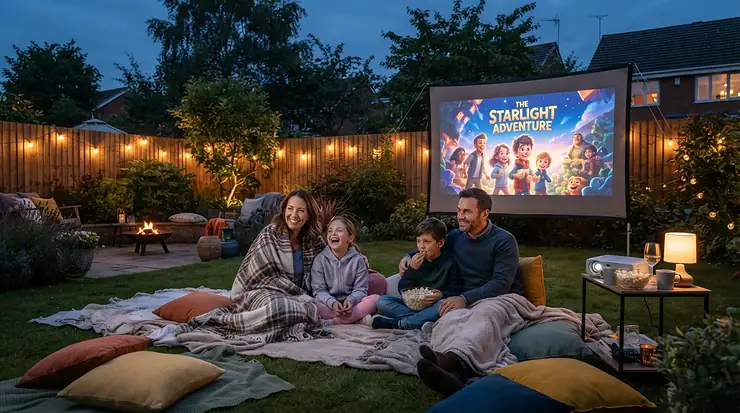
There’s a particular kind of magic to watching a film on a screen that’s bigger than your garden fence. No armrests digging into your ribs, no queue for overpriced popcorn — just a deckchair, a blanket for when the evening cools off, and a picture stretched across the side of your shed. The good news for anyone chasing that experience without remortgaging the house is that an outdoor projector under £300 will genuinely get you there in 2026. The bad news is that “outdoor projector” has become one of those catch-all terms slapped on absolutely everything with a lens and an HDMI port, and not every one of them will survive a British garden party.
This guide cuts through that noise. We’ve dug into real specs, real owner feedback, and honest trade-offs across seven projectors that actually sit within (or very close to) that £300 ceiling, covering everything from pocket-sized battery units you can sling in a rucksack to brighter mains-powered models built for bigger screens. Whether you want a battery-powered projector for camping trips, a no-nonsense budget projector for movies in the back garden, help sorting out portable speaker pairing when the built-in speakers inevitably disappoint, or a straight answer on weatherproofing before you leave a few hundred quid’s worth of electronics out under a cloudy British sky, it’s all here — grounded in genuine analysis rather than recycled marketing copy. Every model featured is a genuine, currently available product intended for the Great Britain market, meaning it should carry the UKCA safety marking that’s replaced CE marking for electricals sold here — worth a quick glance at the box before you buy from any unfamiliar seller.
Quick Comparison Table
If you’re in a hurry, here’s the shape of the market before we go deep on each model.
| Projector | Power | Brightness | Bluetooth Audio | Best For | Price Range |
|---|---|---|---|---|---|
| VANKYO Leisure 3 | Mains only | Entry-level LED | No | Absolute budget movie nights | Under £110 |
| WiMiUS Q2 | Battery (5000mAh) | Low, pico-class | Yes | Backpack and camping trips | Under £100 |
| AKASO WT50 | Battery (5000mAh) | Low-mid | Yes | Pairing with a Bluetooth speaker | £90-£140 |
| WiMiUS P62 Pro | Mains only | Mid-bright | Yes (two-way) | Bigger garden screens | £150-£190 |
| Kodak Luma 350 | Battery | Low-mid | Yes | Pocket-sized smart streaming | £220-£260 |
| Emotn N1 | Mains only | Mid-bright | Yes (speaker mode) | Simple Netflix-first setups | £220-£260 |
| WiMiUS K13 | Mains only | Brightest here | Yes | Twilight garden parties | £250-£300 |
The pattern that jumps out here is a genuine trade-off between portability and punch: the battery-powered projector options at the top of the table are wonderfully grab-and-go, but they simply can’t match the brightness of the mains-powered models further down. Meanwhile, the WiMiUS K13 earns its premium-of-the-bunch status through sheer lumen output rather than any battery cleverness, which matters enormously the moment your garden movie night starts before the sky has fully committed to darkness. Treat this table as a starting point rather than a verdict — the right pick depends entirely on whether you’re prioritising freedom from plug sockets or freedom from squinting.
Enjoying this comparison? A quick share helps other film fans find it too! 💬
Top 7 Outdoor Projectors Under £300: Expert Analysis
Picking an outdoor projector under £300 isn’t really about finding “the best” — it’s about matching a specific set of compromises to your specific garden, patio, or camping trip. Here’s our honest breakdown of seven genuinely available models, spanning true budget to the edge of premium.
1. VANKYO Leisure 3 — best true budget pick for simple movie nights
The Leisure 3 has been a fixture of “cheapest projector that actually works” lists for years, and there’s a reason it refuses to go away: it does the basics without drama. This is an LCD projector using white LEDs rather than a lamp, which keeps running costs low and means you’re not budgeting for a replacement bulb somewhere down the line.
On the spec sheet you’ll find 1080p support (not native 1080p — more on why that distinction matters later), a claimed peak output that’s best treated as a marketing figure rather than a measured ANSI rating, and a 200-inch maximum display size that you’ll never realistically use outdoors. In practice, on a dark evening at a sensible 80-100 inch image size, it produces a perfectly watchable picture for the money. Based on the spec comparison with pricier options on this list, what you’re sacrificing is smart features, brightness headroom, and any kind of wireless audio — this is a projector that expects you to plug in via HDMI or USB and nothing more sophisticated than that.
Reviewers consistently note that setup is genuinely plug-and-play, with manual focus being the only real fiddle. The trade-off reviewers flag most often is fan noise creeping up during longer sessions, and black levels that wash out unless the garden is properly dark. For a first outdoor projector under £300, or a spare unit you don’t mind getting a bit rained on eventually, it’s hard to argue with the value.
Pros:
- ✅ Genuinely low price even by budget projector for movies standards
- ✅ Simple plug-and-play setup with no smart platform to wrestle with
- ✅ LED light source means no lamp replacement costs down the line
Cons:
- ❌ No Bluetooth, so portable speaker pairing isn’t an option
- ❌ Weak in anything but full darkness
Price range: typically under £110, making it one of the cheapest genuine entries into outdoor projection — decent value if your expectations match the spend.

2. WiMiUS Q2 — smallest pocket-sized battery projector
If the Leisure 3 is the projector you leave in the garden shed, the Q2 is the one that lives in your rucksack side pocket. This is a proper pico projector, built around a 5000mAh internal battery that WiMiUS rates at roughly 2.5 hours of playback — enough for most feature films, provided you’re not watching the extended cut of anything Peter Jackson has ever directed.
What most buyers overlook about this model is that its native resolution sits well below full HD (it works from an 854×480 panel while supporting 1080p input), so “1080p support” on the box means it can accept that signal, not display it at full fidelity. On paper this means images look genuinely sharp at pocket-cinema sizes — a 40-60 inch tent wall or campervan ceiling — but start to look soft the bigger you push them. The auto keystone correction is a genuinely useful touch at this price, correcting up to 40 degrees automatically so you’re not fiddling with feet and books to get a square image.
Aggregated review sentiment around WiMiUS’s pico range points to solid build quality and easy device pairing via WiFi and Bluetooth 5.2, with the most common gripe being the underwhelming built-in speaker — which, to be fair, is true of virtually every projector this small. If you’re after a battery-powered projector purely for portability rather than picture perfection, this earns its place.
Pros:
- ✅ True battery-powered projector with roughly 2.5 hours of runtime
- ✅ Small enough to fit in a jacket pocket or daypack
- ✅ Auto keystone correction is rare at this size and price
Cons:
- ❌ Native resolution is well below full 1080p
- ❌ Built-in speaker needs a Bluetooth partner for anything beyond whispering distance
Price range: generally under £100, occasionally dipping lower during sales — one of the most affordable ways into genuinely portable projection.
3. AKASO WT50 — best for pairing with a Bluetooth speaker
The WT50 sits in a similar bracket to the Q2 on paper — another 5000mAh battery, another Android-powered pocket unit — but it distinguishes itself with a feature that deserves more attention than it gets: it can function as a standalone Bluetooth speaker in its own right, and it pairs cleanly with external Bluetooth speakers when the built-in audio isn’t cutting it.
Here’s what the spec sheet won’t tell you, but user reports suggest: the honest battery life sits closer to two to three hours of continuous use rather than the more optimistic four-hour figure sometimes quoted, which is a pattern that holds across almost every battery-powered projector on this list — treat manufacturer runtime claims as best-case rather than guaranteed. The DLP chip here produces noticeably crisper edges than comparable LCD pico units, avoiding the “screen door” pixelation effect that can plague budget projectors when you push the image size up.
Reviewers consistently note that portable speaker pairing is genuinely simple — a few taps in the settings menu and you’re routing audio to a proper Bluetooth speaker sat beside your deckchairs, which transforms the experience more than almost any other single upgrade you could make. Given that Netflix and Hulu-style apps can’t be cast wirelessly to it due to DRM restrictions, you’ll want to either sideload apps directly on the built-in Android system or connect via HDMI from a phone or streaming stick.
Pros:
- ✅ Doubles as a genuine Bluetooth speaker, not just a paired accessory
- ✅ DLP chip gives sharper edges than LCD rivals at this price
- ✅ Compact enough for camping, caravanning, or garden use interchangeably
Cons:
- ❌ Copyrighted streaming apps can’t be wirelessly cast, only sideloaded or wired
- ❌ Real-world battery life runs shorter than headline claims
Price range: typically £90-£140 depending on retailer promotions — a fair ask for a device that’s as much a speaker as it is a screen.
4. WiMiUS P62 Pro — best all-rounder for bigger garden screens
Step up from pocket projectors and into mains-only territory, and the P62 Pro is where things start to feel like a proper home cinema replacement rather than a novelty. WiMiUS rates this at up to 600 ANSI lumens on their own specification sheet (some retail listings quote higher figures using less standardised measurement methods, so treat the higher numbers with a healthy pinch of salt), paired with native 1080p resolution and 4K input support.
Based on the spec comparison with the battery-powered models above, this is where the difference in brightness becomes obvious rather than theoretical — a 100-inch garden screen actually looks vivid rather than merely visible once dusk properly sets in. The two-way Bluetooth 5.2 connectivity is a standout feature that most competitors in this bracket lack entirely: not only can you stream audio out to a Bluetooth speaker, you can also use the projector itself as a Bluetooth receiver for your phone, which is a small but genuinely useful bit of flexibility.
Aggregated customer sentiment on this model is notably positive around ease of setup, with several reviewers specifically praising the auto focus and 6D auto keystone correction for producing a clean rectangular image within seconds of powering on — a real time-saver if you’re setting up after the kids are already asking when the film starts. The fully sealed optical engine, a WiMiUS design choice across their range, also reduces dust ingress over repeated outdoor use, which matters more than it sounds for long-term image quality.
Pros:
- ✅ Genuine two-way Bluetooth for both speaker output and audio input
- ✅ Auto focus and keystone correction that actually works quickly
- ✅ Dual HDMI and USB ports for streaming sticks and consoles alike
Cons:
- ❌ No built-in battery, so you’re tied to an extension lead outdoors
- ❌ Fan noise becomes noticeable on quieter scenes
Price range: commonly £150-£190, making it arguably the strongest value pick if brightness matters more to you than portability.
5. Kodak Luma 350 — most pocketable smart battery projector
Kodak’s projector range trades on brand recognition more than raw spec-sheet dominance, and the Luma 350 is a fair example of that trade-off working in the buyer’s favour. At a compact 4.4 x 4.4 x 1.1 inches, it’s genuinely pocketable, running Android 6.0 with built-in WiFi and Bluetooth, plus a rechargeable lithium-ion battery rated for roughly two to three hours of wireless playback.
What most buyers overlook about this model is that its 150 ANSI lumen rating puts it firmly in “dark room or dark garden only” territory — this isn’t a projector for anyone hoping to start their film before the sun has fully given up for the day. Auto vertical keystone correction handles warped or angled surfaces reasonably well, and Miracast and DLNA support mean screen mirroring from most Android devices is straightforward, though iOS users will find the process fiddlier and occasionally frustrating.
Reviewers consistently flag the limited app store as the Luma 350’s weakest point, with one common complaint being that popular apps simply aren’t available and sideloading is required for anything beyond the basics — a fair trade for the size and battery independence, but worth knowing before you buy. Based on the spec comparison with the Emotn N1 later on this list, the Luma 350 wins on true portability but loses meaningfully on brightness and app support.
Pros:
- ✅ Genuinely pocket-sized at just over 4 inches square
- ✅ Battery-powered projector freedom with WiFi and Bluetooth built in
- ✅ Auto keystone handles imperfect garden surfaces well
Cons:
- ❌ Limited app store means sideloading is often necessary
- ❌ 150 ANSI lumens strictly limits use to genuinely dark conditions
Price range: typically £220-£260, positioning it as a mid-to-premium portable pick rather than a rock-bottom bargain.

6. Emotn N1 — simplest way to get Netflix outdoors
The N1’s whole reason for existing is right there on the box: officially licensed Netflix, no streaming stick required, no HDCP black-screen headaches. For a household whose “outdoor cinema” ambitions begin and end with finishing a Netflix series in the garden, that single feature removes more friction than any spec upgrade could.
Native 1920×1080 resolution here is genuinely native rather than merely “supported,” which — based on the spec comparison with several projectors on this list that only support 1080p input at a lower native panel resolution — produces a noticeably crisper image at the same brightness level. Dual 5W speakers with Dolby Audio processing sound better than the numbers suggest, and reviewers consistently note that the picture quality punches above its price point, particularly for HDR10 content in a properly darkened space.
The honest catch, and it’s a significant one for this particular buying guide, is that the N1 has no built-in battery and is powered exclusively via a barrel-pin connector — meaning any garden setup requires an extension lead, and true off-grid camping use is off the table entirely. It’s also worth noting the app selection beyond Netflix, Prime Video and YouTube is thin; if your household lives on Disney+ or Apple TV+, you’ll need a streaming stick plugged into the spare HDMI port regardless.
Pros:
- ✅ Officially licensed Netflix built in, no extra hardware needed
- ✅ Genuinely native 1080p resolution rather than merely 1080p-supported
- ✅ Dual 5W Dolby Audio speakers that outperform their size
Cons:
- ❌ No battery, so it’s mains-only and needs an extension lead outside
- ❌ Slim app selection beyond the big three streaming services
Price range: generally £220-£260 in the UK, a fair ask for the plug-and-play simplicity on offer.
7. WiMiUS K13 — brightest pick for twilight garden parties
Closing out the list at the upper edge of the £300 ceiling is the K13, and it earns its spot through one number above all others: 1200 ANSI lumens, a genuinely bright figure for a projector at this price that’s the difference between “wait until it’s properly dark” and “start the film as the sky’s still fading from orange to navy.”
This is a Google TV projector with built-in access to over 10,000 apps, WiFi 6 for stable streaming even in a busy neighbourhood full of competing networks, and Bluetooth 5.2 for portable speaker pairing when the dual built-in speakers aren’t quite loud enough for a garden full of guests. Based on the spec comparison with the P62 Pro further up this list, the extra brightness here comes at the cost of roughly £80-£100 more, which is a meaningful jump but arguably justified if daylight-adjacent viewing genuinely matters to your household.
Aggregated review sentiment has been notably enthusiastic, with several buyers specifically calling out the daytime usability as “a game changer” compared with typical budget projectors that demand near-total darkness. The trade-off is straightforward and honest: no tripod mounting holes limit your placement flexibility somewhat, and there’s no built-in battery, so this is firmly a mains-powered proposition for a fixed garden setup rather than a grab-and-go camping companion.
Pros:
- ✅ Genuinely bright at 1200 ANSI lumens, usable before full darkness
- ✅ Google TV built in with WiFi 6 for stable streaming
- ✅ Bluetooth 5.2 makes portable speaker pairing simple
Cons:
- ❌ No tripod mounting holes limits placement options
- ❌ Sits at the very top of the £300 budget ceiling
Price range: commonly £250-£300 depending on retailer deals, sitting right at the edge of what this guide’s budget allows — but arguably worth stretching for if brightness is your priority.
Setting Up Your Garden Cinema: A Practical Guide
Getting a decent picture outdoors is less about the projector and more about everything around it, and this is exactly the kind of practical detail that no Amazon listing bothers to mention. Start with your screen surface: a plain white bedsheet pinned reasonably taut against a washing line or fence produces a far better image than most people expect, and costs nothing beyond a few pegs. If you want to invest properly, a basic inflatable or portable projection screen in the £30-£60 range noticeably improves brightness and colour accuracy compared with painted brick or a garden wall, largely because dedicated screen material reflects light more evenly than most household surfaces.
Distance and darkness matter more outdoors than almost any other spec on the box. As a general rule, position the projector so the throw distance produces your target image size at the projector’s native aspect ratio — most budget models in this guide sit somewhere around a 1.2:1 to 1.5:1 throw ratio, meaning roughly 8-12 feet of distance for a 100-inch image. Common mistakes in the first 30 days tend to cluster around the same handful of issues: starting too early while ambient light is still washing out the picture, positioning the projector on an unstable surface that vibrates every time someone walks past, and forgetting that grass is rarely level, which throws keystone correction off more than you’d expect.
For maintenance, a soft microfibre cloth and compressed air for the lens and vents once a month during heavy summer use keeps dust from settling into the optical path — WiMiUS’s sealed engine models handle this better than open-vent competitors, but no projector is entirely immune. Finally, always let the unit cool with the fan running for a minute or two before switching off at the wall; cutting power mid-cycle on a genuinely hot lamp or LED array is one of the more common causes of premature failure that reviewers report.
Real-World Scenarios: Who Should Buy What
Rather than a generic “it depends,” here’s how three realistic UK households actually map onto this list. First, picture a couple in a first-floor flat with a small communal garden they share with three other households, wanting the occasional evening screening without hauling anything heavy down two flights of stairs. The WiMiUS Q2 or AKASO WT50 fit this brief precisely — light enough to carry in one hand, battery-powered so there’s no trailing extension lead across a shared space, and genuinely done in fifteen minutes flat.
Second, consider a family with a proper back garden, a patio, and two children who will absolutely lose interest if the picture looks washed out. Here the calculation shifts entirely towards brightness and native resolution over portability, which points squarely at the WiMiUS P62 Pro or, budget stretching to the ceiling, the K13 — mains power is a non-issue when you’re setting up permanently on a patio anyway, and the extra lumens buy you an earlier start time before the kids’ bedtime becomes a factor.
Third, picture a camper or festival-goer who wants one device that handles both a tent-side film and doubles as portable music on the drive there. This is the AKASO WT50’s sweet spot precisely, thanks to its standalone Bluetooth speaker mode — one purchase covering two jobs, which matters when boot space and budget are both tight. In every case, honestly assessing how often you’ll actually use the thing outdoors versus indoors should weigh at least as heavily as brightness specs when narrowing down your shortlist.
Weatherproofing Your Outdoor Projector: Problems and Solutions
Here’s an honest starting point that most outdoor projector guides skip entirely: none of the seven models covered here carry an official IP rating for water or dust resistance. This isn’t a flaw specific to budget models — genuinely weatherproof projectors with proper IP54 or IP65 certification exist, but they sit in a completely different price bracket, well beyond what any outdoor projector under £300 can realistically offer. Understanding this upfront changes how you should actually use these devices outside.
The most common problem is condensation, which forms when a projector is moved from a warm house into a cooler evening garden and the internal optics briefly mist over — the fix is simple: power it on ten minutes before you need it and let the fan clear any moisture before use. The second common issue is light drizzle catching a projector left running unattended; a cheap plastic rain hood or even an upturned clear storage box propped on sticks above the unit (leaving vents clear) solves this for the price of a trip to a hardware shop. Third, damp grass wicking moisture up through a projector’s feet during a long evening session is a genuinely underrated risk — a simple wooden board, plastic tray, or even an old chopping board beneath the unit breaks that contact entirely.
For anyone regularly setting up in genuinely unpredictable British weather, a soft neoprene sleeve or padded camera case (often under £15) adds meaningful protection during transport and storage, which is where most accidental damage actually happens rather than during use itself, according to consistent patterns in owner reviews across this category. As the Met Office has documented, UK summers regularly bring far more rainfall than people plan around when scheduling an evening outdoors — the Met Office’s own seasonal reporting shows entire summers coming in well above the long-term rainfall average, which is as good a reason as any to always have a backup indoor plan and never leave any of these units out overnight regardless of how confident the forecast looked at 6pm.
How to Choose an Outdoor Projector Under £300
What is an outdoor projector under £300? It’s a portable or semi-portable video projector, typically LED or DLP-based, priced up to £300, designed for evening use in gardens, patios or campsites — prioritising brightness, connectivity and often battery power over the ultra-high resolution or lumen output found in pricier home cinema projectors.
Choosing between these seven genuinely comes down to answering a handful of honest questions in order:
- Decide if portability or brightness matters more. Battery-powered projector models sacrifice lumens for freedom from plug sockets — if your use case is truly off-grid, that trade-off is worth it; if you’ve got an outdoor socket, mains models like the K13 pull ahead comfortably.
- Check native resolution, not just “1080p support.” A projector that natively displays 1080p (like the Emotn N1) will look noticeably sharper than one that merely accepts a 1080p signal and downscales it internally (like several of the pico units here).
- Prioritise ANSI lumens over marketing lumens. As the Wikipedia entry on the lumen explains, brightness measured under the ANSI standard is comparable across brands in a way that unregulated “peak lumen” figures simply aren’t — always hunt for the ANSI-specific number where manufacturers provide one.
- Factor in audio realistically. Built-in speakers on every projector in this guide are adequate at best; if portable speaker pairing via Bluetooth is available, budget for a genuine bluetooth speaker as a near-mandatory accessory rather than an optional extra.
- Think about your actual garden geometry. Throw distance and available flat, stable surfaces matter more outdoors than indoors, where furniture rarely helps you.
- Be realistic about weatherproofing. None of these projectors are built to survive rain; budget in a £10-£20 cover or case rather than assuming resilience that isn’t there.
- Match your streaming habits to the built-in apps. A Netflix household should lean towards the Emotn N1; a household spread across Disney+, Apple TV+ and Prime Video is better served by a Google TV model like the K13 or a streaming stick plugged into any of the others.
Common Mistakes When Buying a Budget Projector for Movies
The single most common mistake is chasing headline lumen or resolution figures without checking whether they’re independently measured. A projector advertised at “9000 lumens” for £80 is almost certainly using an unregulated marketing metric rather than ANSI lumens, and will likely underperform a genuinely-rated 300 ANSI lumen model costing the same. What most buyers overlook about this entire category is that manufacturer-quoted “4K support” almost always means the projector can accept and downscale a 4K signal to a lower native resolution, not that it displays true 4K detail — worth remembering before assuming a “4K” badge guarantees a sharper picture than a well-specified native 1080p projector.
A second frequent error is underestimating how much ambient light ruins the experience. Streetlights, a neighbour’s security light, or simply starting the film too early in a British summer evening (when full darkness can arrive as late as 10pm in June) will wash out even a genuinely bright projector. Third, buyers regularly skip checking speaker specs entirely, then discover on the first outdoor use that a single 3W speaker simply cannot fill an open garden space the way it fills a living room — sound dissipates far faster outdoors with nothing to reflect it back. Finally, a surprisingly common mistake is buying a battery-powered projector for a permanent patio setup, when a mains-powered model would have offered significantly more brightness for the same money, purely because “battery” sounded more convenient on the box than it turned out to be in practice.
Battery-Powered Projector vs Mains-Powered: Which Wins Outdoors?
This is genuinely the single biggest fork in the road when shortlisting an outdoor projector under £300, and it deserves a proper side-by-side rather than a quick aside.
| Factor | Battery-Powered Projector | Mains-Powered Projector |
|---|---|---|
| Typical brightness | 150-350 ANSI lumens | 400-1,200+ ANSI lumens |
| Setup flexibility | Anywhere, no cables | Needs a socket or long extension lead |
| Best use case | Camping, festivals, balconies | Fixed patios and back gardens |
| Runtime limit | 2-3 hours typical | Unlimited while plugged in |
| Examples in this guide | WiMiUS Q2, AKASO WT50, Kodak Luma 350 | VANKYO Leisure 3, WiMiUS P62 Pro, Emotn N1, WiMiUS K13 |
Looking at the table above, the honest takeaway is that battery power and brightness are still fundamentally at odds with each other at this price point — squeezing a genuinely bright light engine into a battery-powered chassis remains expensive technology, which is exactly why brighter models like the K13 skip the battery entirely to keep costs down. If your garden has an accessible outdoor socket or you’re happy running an extension lead through an open window, a mains-powered model will almost always out-picture a battery-powered projector at the same price. The exception worth flagging is genuinely off-grid use — camping, festivals, or communal gardens without power access — where no amount of extra brightness matters if there’s nowhere to plug in.

Portable Speaker Pairing: Getting Decent Sound in the Garden
Every single projector on this list, without exception, ships with a built-in speaker that’s adequate indoors and noticeably thin outdoors — this isn’t a criticism unique to any one model, it’s simply physics. Sound that bounces off walls and ceilings indoors just disperses into open air in a garden, which is why portable speaker pairing genuinely transforms the experience more than almost any other single upgrade available.
The good news is that six of the seven projectors covered here support Bluetooth audio output, meaning pairing with an external Bluetooth speaker typically takes under a minute: enable Bluetooth in the projector’s settings, put a speaker into pairing mode, and select it from the available devices list. The WiMiUS P62 Pro and K13 go a step further with two-way Bluetooth 5.2, letting the projector itself act as a receiver as well as a transmitter — useful if you’d rather stream music from your phone through the projector’s own speaker for pre-film ambience, then switch to a proper external speaker once the film starts. For anyone using the VANKYO Leisure 3 (which lacks Bluetooth entirely), a simple 3.5mm audio cable to any wired speaker remains the fallback, and it’s worth keeping one in your setup kit regardless of which projector you own, purely as insurance against a Bluetooth connection dropping mid-film.
When choosing a Bluetooth speaker specifically for outdoor projector use, prioritise battery life over sound signature — a speaker rated for eight-plus hours of playback will comfortably outlast even a double bill, whereas a punchier-sounding speaker that dies after three hours will leave you finishing the second half in silence. IPX-rated water resistance on the speaker itself is also worth paying attention to, since unlike the projectors on this list, plenty of genuinely affordable Bluetooth speakers do carry proper splash resistance.
What to Expect: Real-World Performance After Dark
Specs on a page rarely translate directly into what you’ll actually see once the sun goes down, so here’s the honest, transformed version of those numbers. A 200-300 ANSI lumen battery-powered projector like the Q2 or WT50 produces a genuinely watchable 60-80 inch image once full darkness sets in, but colours will look noticeably muted compared with indoor viewing, and any residual ambient light — a nearby streetlamp, a phone screen, even a bright kitchen window — will visibly wash out darker scenes.
Step up to the 400-600 ANSI lumen mains-powered bracket occupied by the P62 Pro and Emotn N1, and the difference is immediately obvious: images hold their colour and contrast at 100+ inches, and you gain roughly 30-45 minutes of usable “not quite full darkness yet” viewing time compared with the dimmer battery models, which in British summer terms can be the difference between starting a film at 9pm rather than waiting until nearly 10. At the top of this guide’s range, the K13’s 1200 ANSI lumens genuinely changes the calculation again — reviewers report comfortably usable images even with some residual dusk light present, which is the single biggest practical advantage that extra £80-£100 buys you over the mid-range options.
Across every model, expect a soft whirring fan noise that becomes more noticeable in quiet garden settings than it ever would indoors, and expect autofocus and auto-keystone features (where fitted) to occasionally need a manual nudge on uneven grass or when a passing gust shifts the projector’s angle slightly.
Long-Term Cost & Maintenance
Total cost of ownership for any projector on this list extends well beyond the sticker price, and it’s worth budgeting honestly for the extras. A basic portable screen (£30-£60), a padded case for transport and storage (£10-£20), a decent Bluetooth speaker if your chosen model supports pairing (£25-£60 for something genuinely serviceable), and a simple rain cover or storage tray (£10-£15) collectively add somewhere between £75 and £155 on top of the projector itself — a meaningful sum that rarely gets mentioned in headline pricing.
| Cost Category | Typical UK Price Range | Frequency |
|---|---|---|
| Projection screen | £30-£60 | One-off |
| Carry case or sleeve | £10-£20 | One-off |
| Bluetooth speaker | £25-£60 | One-off |
| Rain cover/tray | £10-£15 | One-off |
| Replacement remote (if lost) | £8-£15 | Occasional |
Looking at the table above, the real-world total for setting up an outdoor projector under £300 properly often lands closer to £350-£450 once these extras are factored in, which is worth knowing before you commit to a headline price that only tells half the story. On the ongoing side, LED and DLP light sources across every model in this guide are rated for tens of thousands of hours, meaning bulb replacement — a genuine ongoing cost with older lamp-based projectors — simply isn’t a factor here, which is one of the quieter advantages of buying into this generation of budget projector technology rather than an older lamp-based unit from a secondhand marketplace. When a unit does eventually reach the end of its life, remember that projectors count as electrical waste under UK rules — Recycle Your Electricals has a straightforward postcode locator for your nearest drop-off point, so it needn’t end up in landfill.
Features That Actually Matter (And Those That Don’t)
Cutting through the marketing noise, a handful of features genuinely earn their place on a spec sheet, while several others are largely decorative. ANSI-rated brightness matters enormously and should be your first filter; native resolution matters meaningfully but less dramatically than brightness for outdoor use, since darkness itself softens perceived detail more than resolution differences do at typical garden viewing distances. Bluetooth connectivity for portable speaker pairing matters a great deal given how universally weak built-in speakers are across this entire price category, and battery life, where fitted, matters enormously if your use case genuinely requires it — but is entirely irrelevant if you’re setting up permanently on a patio with an accessible socket.
On the other side of the ledger, “4K support” badges on sub-£300 projectors rarely reflect true 4K detail and shouldn’t heavily influence your decision over a well-specified native 1080p alternative. Headline peak lumen figures that aren’t ANSI-rated are, frankly, close to meaningless for comparison purposes and should be treated with real scepticism. Maximum supported screen size (frequently quoted as “up to 200 inches” or similar) is almost always far larger than any of these projectors can usefully fill with a genuinely bright image outdoors, making it one of the least useful numbers on the entire box despite being one of the most prominently displayed.
Frequently Asked Questions
❓ What's the best outdoor projector under £300 in the UK?
❓ Do outdoor projectors work in daylight?
❓ How long does a battery-powered projector last on one charge?
❓ Do I need a proper screen, or can I project onto a wall?
❓ Are these projectors weatherproof for outdoor use?
Conclusion
The outdoor projector under £300 category has quietly become one of the better value corners of home entertainment tech, and the seven models covered here prove it doesn’t take a huge budget to get a genuinely good garden cinema evening. If portability is everything, the WiMiUS Q2 or AKASO WT50 will slot into a rucksack without complaint; if brightness and a bigger, punchier picture matter more, the WiMiUS P62 Pro or K13 pull ahead comfortably once you accept the trade-off of needing a plug socket nearby.
What ties every recommendation in this guide together is honesty about what a sub-£300 projector can and can’t do: none of them will replace a proper home cinema setup, none of them are genuinely weatherproof, and every single one benefits enormously from a cheap external Bluetooth speaker. Match those realistic expectations to your actual garden, your actual streaming habits, and how often you’ll genuinely use the thing outdoors rather than as an occasional novelty, and any of these seven picks should deliver a properly enjoyable evening under the stars — British weather permitting, of course.
Recommended for You
- Projector Under £300 For Gaming: 7 Brilliant UK Picks (2026)
- Wireless Portable Projector: 7 Best Cable-Free Picks (2026)
- Smart Projector For Streaming: 7 Best Picks With Netflix (2026)
Disclaimer: This article contains affiliate links. As an Amazon Associate, I earn from qualifying purchases. If you purchase products through these links, we may earn a small commission at no additional cost to you.
Found this helpful? Share it with your friends! 💬🤗
