
In This Article
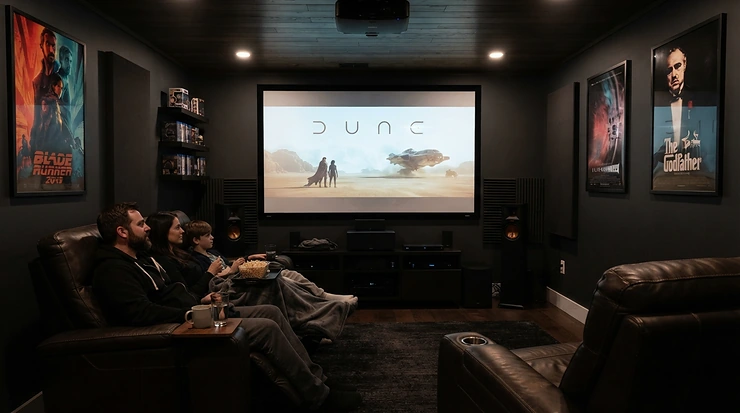
An acoustic transparent screen for small cinema room use is a projection surface woven or micro-perforated so finely that sound passes through it almost untouched. That lets you hide the left, centre and right speakers behind the picture. In a compact room, dialogue lands on the actor’s mouth and you get back every spare centimetre of wall.
Why does this matter more in a small space than a big one? Because a small cinema room has nowhere to hide. Speakers beside a solid screen eat into limited width, and the screen itself bounces sound straight back at your ears. Acoustically transparent screens come in two broad families, woven and perforated. Each has quirks, from moiré patterns to minimum seating distances, that bite harder when your sofa sits under three metres from the picture.
Think of this as a field guide for the box room, the loft conversion and the garage that finally got insulated. I’ve weighed seven real fixed-frame models against their published specifications and the review themes buyers keep repeating. Most are from Elite Screens, with Sapphire AV and Pure Theatre alongside. It’s analysis, not a lab bench. I haven’t handled these screens, and where review evidence is thin, I’ll say so plainly.
Along the way we’ll tackle the questions UK buyers keep asking. How big can you go before screen size limits (and your neck) object? Does near-field listening still work behind fabric? And what do compact room acoustics do to the whole plan? Let’s start with the shortlist.
Quick Comparison: Acoustic Screen for Home Theatre at a Glance
Short on time? Here are four of the seven models, sorted by what each does best.
| Pick | Standout | Gain | Frame | Best For |
|---|---|---|---|---|
| Elite Screens Sable Frame AcousticPro1080P3 | Cheapest way into AT | 1.0 | 2.36″ black velvet | First-time AT buyers on a budget |
| Elite Screens Aeon AcousticPro UHD | Edge-free, 180° viewing angle | 1.0 | Edge-free aluminium | 4K projectors and close seating |
| Elite Screens Pro Frame Acoustic | Higher listed gain, long warranty | 1.1 | 3.5″ black velvet | Rooms that don’t fully black out |
| Sapphire AV SFSC203AT | Compact ~92″ format | 0.8 | 8 cm black velvet | Tight, properly dark rooms |
Looking at the comparison above, the Sable Frame is the cheapest way in. The Aeon justifies its step up if you sit close and run a 4K projector. The Pro Frame Acoustic‘s higher listed gain helps when you can’t fully blackout the room. The Sapphire AV SFSC203AT‘s lower 0.8 gain rewards a dark box room paired with a bright projector.
💬 Just one click — help others make better buying decisions too!😊
Top 7 Acoustic Transparent Screen for Small Cinema Room Picks: Expert Analysis
Prices below are indicative bands, not quotes. Always check current price before buying.
1. Elite Screens Sable Frame AcousticPro1080P3 — cheapest sensible route to hidden speakers
The Sable Frame is the on-ramp to this whole hobby. It’s the same fixed-frame idea as the pricier screens, with a perforated acoustically transparent weave doing the heavy lifting.
The 100-inch 16:9 version (ER100WH1-A1080P3) gives roughly 49 by 87 inches of picture, about 1.24 by 2.2 metres. It has 1.0 gain and a 160-degree viewing angle. Gain of 1.0 is a neutral reflector: it won’t flatter a weak projector, but it won’t hotspot either, which suits a blacked-out small room. The 2.36-inch velvet frame swallows projector overshoot, and a detachable black backing is listed for the AT versions to curb light bleeding through the weave.
On the spec sheet, this suits a first-time AT buyer with in-wall or shelf speakers who wants to test the idea without a big outlay. One caveat: the listing describes the material as designed around 1080p while still supporting 4K. Finer 4K pixel grids are where a tighter weave, like the Aeon below, earns its money.
Aggregated retailer reviews repeatedly say the sound comes through convincingly and that you’d never guess the surface is perforated. The recurring grumbles are too few screen clips in the box and a velvet frame that collects fluff during assembly.
Pros:
- ✅ Convincing sound transmission, per buyer feedback
- ✅ Velvet frame absorbs projector overshoot
- ✅ Light enough for a careful solo mount
Cons:
- ❌ Weave aimed at 1080p, less ideal for close 4K
- ❌ Reports of too few screen clips
Indicatively in the £300-£450 range. Check current price. It’s the best value of the seven for a first AT screen.
2. Elite Screens Aeon AcousticPro UHD — edge-free frame, wide viewing angle
The Aeon drops the chunky border, so the picture runs almost to the frame edge. It looks less like a screen and more like a very large, very flat window.
The AcousticPro UHD weave is listed from 100 inches upward in 16:9. Retailers disagree on the top size, so verify on your listing. It has 1.0 gain, a 180-degree viewing angle, a black-backing mesh to reduce reflected light, and a lightweight split aluminium frame. A tighter weave means less visible texture when your seats sit close. The wide angle keeps brightness even for whoever draws the end of the sofa. An LED backlight kit is available separately.
Based on the spec comparison, this is for 4K projector owners with seating around three metres away who want the cleanest picture. Elite positions the material for Ultra HD and HDR. The trade-off is that there’s no velvet border to forgive sloppy alignment, so you’ll need to set zoom and lens shift precisely, or overshoot lands on your wall.
I couldn’t verify a meaningful pool of independent UK reviews for this exact model. Treat the performance claims as manufacturer claims until you’ve read recent buyer comments.
Pros:
- ✅ Edge-free design maximises picture per wall width
- ✅ 180-degree viewing angle helps side seats
- ✅ Tighter weave positioned for 4K and HDR
Cons:
- ❌ No velvet border to absorb overshoot
- ❌ Backlight kit costs extra
Indicatively in the £450-£600 range. Check current price. It’s worth the premium if you sit close and run 4K.
3. Elite Screens Pro Frame Acoustic — higher gain and the longest warranty
The Pro Frame Acoustic is the sturdy one, with a broad velvet frame and a warranty that outlasts most projector bulbs.
Listed sizes run 100, 106, 110 and 135 inches in 16:9, using the AcousticPro1080P3 weave in a 3.5-inch velvet frame. The retailer I checked lists 1.1 gain and a five-year warranty; confirm both on your listing. That extra ten percent of reflectivity helps in a living room where curtains dim the light but don’t kill it. The wider frame crops overshoot generously, though it adds a little over two inches to the overall width. In a compact room, that’s wall you may not have.
My read is that this suits dual-use rooms and anyone who can’t fully blackout. The trade-off with any gain above 1.0 is a slightly narrower sweet spot, so side seats may look a touch dimmer.
I couldn’t verify enough independent reviews of this specific AT variant to summarise sentiment honestly. Check recent buyer comments before committing.
Pros:
- ✅ 1.1 listed gain helps in imperfect darkness
- ✅ Long listed warranty offers peace of mind
- ✅ Wide velvet frame absorbs overshoot well
Cons:
- ❌ Bulkier frame eats limited wall width
- ❌ Higher gain trims off-axis brightness slightly
Indicatively in the £430-£550 range. Check current price. Good value if light control is your weak spot.
4. Elite Screens Lunette AcousticPro1080P3 — curved frame for a premium look
The Lunette takes the familiar AcousticPro1080P3 weave and wraps it in a gently curved frame, which gives the wall a more sculpted, furniture-grade presence.
The 100-inch 16:9 model carries a 160-degree viewing angle and wall-mount hardware. The material is the same family as the Sable Frame, so sound transmission should be comparable. What changes is the look, and the curve is where I’d stay sceptical. Elite markets it as a cinematic touch. Evidence that a curve improves anything measurable at 100 inches in a small room is thin, so treat it as an aesthetic choice first.
It suits design-led living rooms where the screen is on permanent show and a flat black rectangle feels clinical. Check the frame depth on your listing before you fix anything. A curved fabric sitting proud of the wall changes how close the speakers can be to it, and the sound benefit relies on that gap staying small.
Verified independent reviews for this model were scarce, so I won’t pretend otherwise.
Pros:
- ✅ Distinctive curved frame suits visible installs
- ✅ Same proven AT weave as the Sable Frame
- ✅ Wall-mount hardware included
Cons:
- ❌ Curve adds cost without proven small-room payoff
- ❌ Frame depth needs checking for speaker spacing
Indicatively in the mid-£400s to mid-£600s. Check current price. You’re paying mostly for looks.
5. Sapphire AV SFSC203AT — compact 92-inch format for tight rooms
The Sapphire SFSC203AT is the one to look at when 100 inches already feels too big for your wall.
The viewing area is 2037 by 1145 mm (about 92 inches diagonal), and the listing gives overall dimensions around 1.3 by 2.19 metres. It’s a woven matte-white fabric with 0.8 gain, a tensioned surface and an 8 cm black velvet frame. A 0.8 gain reflects less light than the Elite screens, so contrast rises in a dark room but a dim projector will look dull. The listing also pitches it for ultra and short throw projectors. Check your projector maker’s guidance, as the fit depends on the model.
It suits a properly blacked-out box room with a bright projector, seats around 3 metres away, and an owner who values a smaller, tidier picture.
I couldn’t verify independent review volume. The maker’s wider range lists a three-year warranty, so confirm on your listing. Availability on amazon.co.uk can be patchy for this brand, so confirm stock first, or match the spec elsewhere.
Pros:
- ✅ 92-inch size suits genuinely small rooms
- ✅ Woven fabric, positioned for speakers behind
- ✅ Black velvet frame helps contrast
Cons:
- ❌ 0.8 gain demands a brighter projector
- ❌ Often special-order or quote-led
Quote-led pricing at many UK stockists. Expect a premium over the Elite range and check current price. Good value only if the size is right.
6. Sapphire AV SFSC234AT — larger sibling for slightly deeper rooms
The Sapphire SFSC234AT steps up to a roughly 106-inch picture without leaving the same design language.
The viewing area is 2340 by 1320 mm, with overall dimensions around 1.48 by 2.5 metres. Like its sibling, it has 0.8 gain, a tensioned matte-white woven surface and an 8 cm black velvet frame. At that width, expect a two-person, stud-fixed job. The larger 120-inch Sapphire weighs 14.2 kg on its listing, and the weight climbs with size.
Here’s the analysis: it makes sense when your seats sit around 3.2 to 3.6 metres back and you want a more immersive picture than 92 inches. The 0.8 gain matters more as the image grows, because the same projector light spreads across more area.
As with the smaller model, I couldn’t verify independent review volume, so check recent buyer comments and the stock position.
Pros:
- ✅ Larger picture at 106 inches
- ✅ Tensioned woven surface stays flat
- ✅ Black frame improves perceived contrast
Cons:
- ❌ Low gain stretches a modest projector
- ❌ Heavier install, quote-led buying
Quote-led. Check current price. Only worth it if your room has the depth and your projector has the lumens.
7. Pure Theatre Acoustic Fixed Frame Screen — slim bezel, TV-style look
The Pure Theatre screen leans into aesthetics, with a thin bezel designed to resemble a premium TV, only far larger.
Standard 16:9 sizes are 100, 120 and 150 inches, with a listed gain of 1.1. The maker pitches it at left, centre and right speakers placed behind the fabric. A slim frame means more picture per wall width, which is a genuine plus when the wall is 2.5 metres across. Gain of 1.1 offers a touch of brightness insurance, though without a velvet border you’ll want careful projector alignment.
It suits modern interiors where the screen needs to look deliberate rather than DIY. The testimonial on the maker’s own site is enthusiastic, but it isn’t independent, so I won’t count it as verified review sentiment.
Pros:
- ✅ Slim bezel maximises picture on narrow walls
- ✅ 1.1 listed gain adds brightness margin
- ✅ Sizes from 100 to 150 inches
Cons:
- ❌ Thin frame offers less overshoot forgiveness
- ❌ Independent review evidence is hard to find
Check current price. A tidy pick if looks matter.
Top 7 at a Glance
| Product | Sizes (16:9) | Gain | Frame | Warranty listed | Indicative price band | Best For |
|---|---|---|---|---|---|---|
| Elite Screens Sable Frame AcousticPro1080P3 | 100″-150″ | 1.0 | 2.36″ velvet | 2 years | £300-£450 | First-time AT buyers |
| Elite Screens Aeon AcousticPro UHD | 100″-180″ | 1.0 | Edge-free | 2 years | £450-£600 | 4K, close seating |
| Elite Screens Pro Frame Acoustic | 100″-135″ | 1.1 | 3.5″ velvet | 5 years | £430-£550 | Dual-use rooms |
| Elite Screens Lunette AcousticPro1080P3 | 100″ (check range) | 1.0 (material) | Curved velvet | Check listing | £450-£650 | Design-led rooms |
| Sapphire AV SFSC203AT | ~92″ | 0.8 | 8 cm velvet | 3 years (range) | Quote-led | Tight, dark rooms |
| Sapphire AV SFSC234AT | ~106″ | 0.8 | 8 cm velvet | 3 years (range) | Quote-led | Deeper dark rooms |
| Pure Theatre Acoustic Fixed Frame Screen | 100″, 120″, 150″ | 1.1 | Ultra-thin | Check listing | Check current price | Slim, TV-style look |
Read across the table and a pattern emerges. The Sable Frame wins on cost, the Aeon on picture finesse, and the Pro Frame Acoustic on brightness insurance and warranty. The two Sapphire screens trade brightness for contrast in a dark room, so match them to your projector’s output. Price bands are indicative, drawn from converted overseas listings and UK stockist notes, so verify before budgeting.
✨ Don’t Miss These Carefully Selected Picks!
🔍 Take your small cinema room to the next level with these screens.Click on any highlighted product name to check current pricing and availability. They’ll help you create the authentic cinematic evenings your family will love!
Fitting an Acoustically Transparent Fixed Frame Screen: A Step-by-Step Usage Guide
Amazon listings tell you how big the box is. They won’t tell you how not to ruin your first weekend. Here’s a sequence that avoids the classic faceplants.
- Find your studs first. A large frame on plasterboard needs proper fixings or timber behind it. The 120-inch Sapphire weighs 14.2 kg on its listing, so even mid-sized frames are no job for a single plug.
- Assemble on a clean floor. Velvet frames collect fluff. Lay down a clean dust sheet and wipe the fabric side gently as you tension it.
- Mind the speaker gap. The closer the fabric sits to the speaker grille, the better. Aim for a hand’s width at most, and let the frame brackets slide so the screen centres over the speakers.
- Line up tweeters. Treble is the most directional part of the sound, so keep tweeters near seated ear height.
- Do the paper test. Hold a spare scrap of fabric to the light. If light shows through, sound can too.
- Calibrate after hanging. Run your AV receiver’s room-correction routine with the screen in place, not before. The fabric changes the treble slightly.
- Re-check at 30 days. Fixings settle. Look for sag or a wavy edge and re-tension if needed.
For maintenance, a soft brush attachment on low suction beats wet wipes. Never use liquid cleaners unless the maker says so.
Three Small Cinema Rooms, Three Screens: Real-World Scenarios
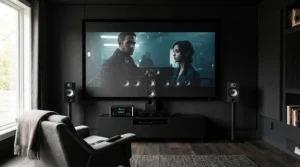
Abstract specs only get you so far. Here are three imagined rooms, each matched with reasoning.
The Loft Box Room
Picture a 2.6-metre-wide loft, blackout blinds, seats about 3 metres from the wall, a modest 4K projector and a tight budget. The Elite Screens Sable Frame AcousticPro1080P3 at 100 inches lands near a 40-degree viewing angle, which is immersive without being claustrophobic. Its neutral 1.0 gain keeps a modest projector honest. A bright projector and a pure blackout might tempt you towards the 92-inch Sapphire AV SFSC203AT instead.
The Dual-Use Living Room
Now imagine a sofa 3.6 metres back, curtains that dim but don’t blackout, and a family who watch football as often as films. The Elite Screens Pro Frame Acoustic at 106 inches suits it. At that distance it lands near a 36-degree angle, and its 1.1 listed gain claws back brightness on lighter evenings.
The Garage Conversion for Cinephiles
Finally, a dark, treated room with seats about 3.1 metres back and a 4K projector. The Elite Screens Aeon AcousticPro UHD at 100 inches sits near a 40-degree angle, and its tighter weave handles close, fine-pixel viewing better than the 1080p-centred weaves. Budget matters less than picture here. Allow for the LED backlight kit if you want a floating look.
Problem → Solution: Fixing Moiré, Muddy Dialogue and Boomy Bass
Every AT setup has gremlins. Fortunately, they’re predictable.
Moiré shimmer. Moiré appears when the projector’s pixel grid aligns with the weave or perforations. Increase seating distance slightly, soften focus a hair, or choose a tighter weave such as the Aeon. A taut, flat fabric helps too.
Dull treble and thin dialogue. Every AT screen costs the sound something, mostly at high frequencies. Fix it with room correction run after hanging, tweeters near ear height, and speakers close behind the fabric. Never paint speaker grilles, because paint fills their perforations and seals them.
Washed-out blacks. Light passing through the weave bounces off whatever’s behind. Use the supplied black backing where listed, and paint the wall behind the screen a dark matte colour.
Boomy bass. Small rooms excite bass modes, and the screen won’t help. Keep the subwoofer out of the screen wall zone, try corners, and move it before you buy more gear.
How to Choose an Acoustic Screen for Home Theatre: 6 Steps
Here’s the short version, in the order that saves you money.
- Measure seating distance first. Everything else follows. Screen size is a function of where you sit, not the other way round.
- Pick weave to match distance. Close seats favour tighter weaves, and perforated materials can show texture if you sit too near.
- Match gain to your projector. A 0.8 gain screen needs lumens to spare. A 1.0-1.1 screen forgives modest projectors.
- Check the frame. Velvet borders forgive overshoot. Edge-free frames save wall but demand precision.
- Check speaker depth. The fabric should sit as close to the speaker grille as safely possible.
- Confirm weight, fixings and availability. Heavy frames need studs, and quote-led brands need lead-time checks.
Magazine coverage has noted that THX has historically tested and certified some acoustically transparent screens for sonic and visual performance. Treat any certification as a bonus, not a substitute for your own seating-distance check.
Screen Size Limits: How Big Is Too Big in a Small Room?
Here’s the awkward truth. Most AT fixed frames start at 92 or 100 inches, which sets a floor on how close you can sit. Screen size limits in a small room aren’t just about wall width. They’re about your field of view. Audio Advice’s screen-size guide explains that SMPTE recommends roughly a 30-degree viewing angle for 16:9, while THX suggests about 36 degrees. Sit closer than that and your eyes work harder.
Converting those angles to rough distance multipliers (diagonal × 1.2 for 40 degrees, × 1.34 for 36, × 1.63 for 30):
| Screen diagonal | 40° (immersive) | 36° (THX main row) | 30° (SMPTE minimum) | Best For |
|---|---|---|---|---|
| 92″ | ~2.8 m | ~3.1 m | ~3.8 m | Sapphire AV SFSC203AT in tight rooms |
| 100″ | ~3.0 m | ~3.4 m | ~4.1 m | Elite Screens Sable Frame AcousticPro1080P3, Elite Screens Aeon AcousticPro UHD |
| 106″ | ~3.2 m | ~3.6 m | ~4.4 m | Elite Screens Pro Frame Acoustic, Sapphire AV SFSC234AT |
The table shows why a 100-inch screen is already ambitious in a room with only 2.8 metres of seating depth. If your seats are closer than the 40-degree column, go smaller or accept a more immersive, head-turning view. Tape the image outline on the wall with painter’s tape first. It costs nothing and settles arguments quickly.
Near-Field Listening Behind a Screen: Can It Work?
Near-field listening means sitting close enough to your speakers that direct sound dominates over room reflections. It’s the logic behind studio monitors and desktop setups. In audio circles, “close” usually means within a metre or two.
Can that idea survive in a small cinema room with an AT screen? Partially. Because AT screen minimum sizes push your seating back to roughly three metres, you’re realistically in mid-field territory for the front speakers. That’s not a disaster. The fabric sits only millimetres from the grilles, so the direct sound still reaches you with modest high-frequency loss.
Where near-field thinking helps is in speaker choice and placement. Speakers with controlled dispersion put more energy at your ears and less on the walls, which is a gift in a compact room. Pair that with tweeters at seated ear height and speakers close behind the fabric.
If you do sit closer, say on a small sofa 2.5 metres back, tighter weaves like the Aeon‘s become more important, because both moiré and visible perforations are distance-sensitive.
Compact Room Acoustics: Where the Screen Helps and Where It Can’t
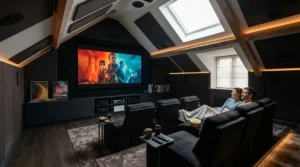
Small rooms have strong early reflections and stubborn bass modes. A solid screen makes the first problem worse, because it’s a big flat reflector right in front of you. Sound & Vision’s feature on acoustically transparent screens points out that an AT screen doesn’t reflect room sound the way a solid one does. That’s a real, free improvement to compact room acoustics.
But the screen only solves the front wall. For the rest:
- 🔊 First reflection points: Add absorbent panels at the side-wall points between you and the speakers.
- 🔊 Corners: Bass traps tame the low-end boom that small rooms love to produce.
- 🔊 Floor and ceiling: A thick rug and a softer ceiling treatment cut flutter echo.
- 🔊 Behind the screen: Don’t leave bare, shiny surfaces right behind the fabric. Soft, dark material is kinder to sound and to picture contrast.
The honest takeaway is that an AT screen is a great start, not a cure. Treat it as the first step of a three-step plan: screen, speakers, then treatment.
Acoustically Transparent Fixed Frame Screen vs Solid Screen
An acoustically transparent fixed frame screen and a solid screen aren’t rivals for every room. They’re tools for different problems.
| Factor | AT fixed frame | Solid fixed or pull-down | Best For |
|---|---|---|---|
| Speaker placement | Hidden behind the fabric | Beside or below the screen | Elite Screens Sable Frame AcousticPro1080P3 on narrow walls |
| Dialogue position | Voices appear from the picture | Offset by centre speaker position | Sapphire AV SFSC203AT in dark dedicated rooms |
| Light efficiency | Slightly lower | Highest | Elite Screens Pro Frame Acoustic when light is imperfect |
| Moiré risk | Present, distance-dependent | None | Elite Screens Aeon AcousticPro UHD for close 4K seating |
| Cost | Higher | Lower | Solid screens for tight budgets |
Based on the table, an AT screen earns its premium when wall width is your bottleneck or when you care about voices matching faces. If your speakers already sit comfortably beside a solid screen and your seating is close, a solid screen avoids moiré entirely and costs less. Neither is “better”. It’s a trade you make with open eyes.
Common Mistakes When Buying an Acoustic Transparent Screen for Small Cinema Room Setups
Most regrets come from the same handful of errors.
- Buying the biggest size. Bigger isn’t better if your seats sit too close. See the screen size limits table above.
- Ignoring weave versus distance. Perforation texture is a close-seating problem, so match weave to seat.
- Painting speaker grilles. Paint seals them and kills the sound you hid the speakers to preserve.
- Forgetting the speaker gap. Elite Screens’ own guidance describes a flush screen over an in-wall speaker as leaving about an inch to the dust cap and roughly 5 mm to the grille. Large gaps invite reflections.
- Pairing a 0.8 gain screen with a dim projector. The picture will look flat, however good the sound is.
- Skipping calibration. Hang the screen, then run room correction.
Long-Term Cost and Maintenance
A screen is a one-off buy, so judge it on cost per hour rather than sticker shock. As a worked example, a screen in the mid-£400s used six hours a week for five years clocks roughly 1,560 hours. That’s about 25p per hour of cinema.
Running costs are almost nil. There’s no motor, no remote and no moving parts, which is one of the quiet virtues of a fixed frame. Watch three things instead:
- Warranty: The Elite models list two years for the Sable Frame and Aeon, and five years for the Pro Frame Acoustic on one retailer listing. Verify yours.
- Tension: Check for sag or ripples at 30 days and annually.
- Dust: A soft brush on low suction keeps the weave clear.
The hidden cost is room correction and speakers. A great screen can’t rescue poor speakers, so keep some budget back.
Features That Actually Matter (And Those That Don’t)
Matter:
- ⚡ Weave quality versus seating distance. It decides whether you see texture or shimmer.
- ⚡ Gain versus projector brightness. The wrong match makes the picture look washed out or muddy.
- ⚡ Frame depth and speaker clearance. It decides how close the fabric sits to the grilles.
- ⚡ Black backing quality. It protects contrast.
Barely matter:
- ❌ “8K ready” badges. Your projector, content and seating distance matter far more.
- ❌ “3D ready” labels. A near-universal tick that tells you little.
- ❌ Small differences in viewing-angle claims. In a small room, 160 versus 180 degrees rarely changes your seat.
Be wary of marketing adjectives. If a spec can’t be explained in terms of where you sit and what you watch, it probably isn’t earning its place.
FAQ
❓ Is an acoustically transparent fixed frame screen worth it in a room only three metres wide?
❓ Do I need a black backing behind an acoustic screen for home theatre use?
❓ Will a 4K projector look sharp on an acoustic transparent screen for small cinema room use?
❓ Can I pair a short throw projector with an acoustically transparent screen?
❓ How much should I budget for an acoustic screen for home theatre?
Conclusion
An acoustic transparent screen for small cinema room use isn’t a gimmick. It’s the single move that frees wall space, lines dialogue up with faces and stops a solid screen bouncing sound around a tiny room. But the best one depends on where you sit and what you watch.
If you want the cheapest sensible entry, the Elite Screens Sable Frame AcousticPro1080P3 is the pick. If you sit close and run a 4K projector, the Elite Screens Aeon AcousticPro UHD earns its premium. The Elite Screens Pro Frame Acoustic suits rooms that never go fully dark. The Elite Screens Lunette AcousticPro1080P3 is for visible installs, and the Sapphire AV SFSC203AT and SFSC234AT reward dark rooms with bright projectors. The Pure Theatre Acoustic Fixed Frame Screen is for slim, TV-style looks.
Before you buy anything, measure your seating distance and respect the screen size limits table. Most regrets come from a screen that’s too big, not too small.
Recommended for You
- Acoustically Transparent Screen For Dolby Atmos Setup: 7 Best (2026)
- Acoustically Transparent Projector Screen: 7 Best UK Picks (2026)
- Fixed Frame Projector Screen: 7 Best Picks For UK Homes (2026)
Disclaimer: This article contains affiliate links. As an Amazon Associate, I earn from qualifying purchases. If you purchase products through these links, we may earn a small commission at no additional cost to you.
✨ Found this helpful? Share it with your friends! 💬🤗
