
In This Article
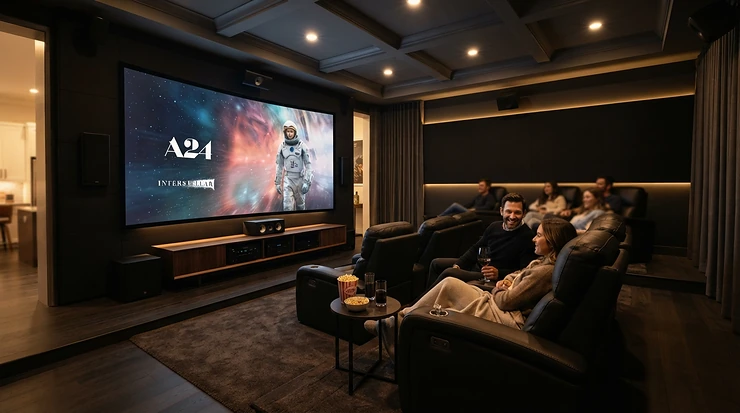
A curved projector screen is a fixed-frame projection surface bowed gently towards the audience (Elite Screens uses a 40-foot, or roughly 12-metre, radius) so light travels more evenly to the centre and edges. It works best with wide 2.35:1 cinemascope images and gives a dedicated home cinema room that proper picture-palace look.
That’s the tidy definition. The messier truth is that a curved projector screen is a niche within a niche. Elite Screens dominates the affordable end, with a few European and premium names around it, so any honest list is built from a small pool. I’ve drawn seven real models from it, from entry-level 16:9 frames to a premium Stewart Filmscreen option. I haven’t tested any of them. Everything here rests on published specs and professional reviews.
Why bother? Because the projection screen is the cheapest upgrade in home cinema, and a curved fixed frame screen adds tension, geometry and a light-swallowing velvet border that a painted wall never will. The trade-offs are real, though. Nobody makes a retractable version. Wall-fixing needs planning. And the curve’s benefits depend heavily on the aspect ratio you watch.
Below you’ll find a quick comparison, seven deep dives and a curved projector screen review of the practical pitfalls: curvature radius, edge distortion and viewing distance. There’s also a realistic look at budget options, installation advice and five FAQs. Prices are ranges only, loosely converted from overseas listings, so check current price before buying.
Quick Comparison: Curved Projector Screen Options at a Glance
Seven screens, one table. Skim it first, then read the detail on whichever catches your eye.
| Screen | Format and size | Material (gain) | Price range | Best for |
|---|---|---|---|---|
| Elite Screens Lunette 2 CURVE92WH2 | 16:9, 92″ | CineWhite (1.1) | £300-£650 | First curved fixed frame screen, living rooms |
| Elite Screens Lunette CineWhite 96-inch 2.35:1 | 2.35:1, 96″ | CineWhite (1.1) | £350-£550 | Film fans wanting scope on a budget |
| Elite Screens Lunette 2 CURVE235-115W2 | 2.35:1, 115″ | CineWhite (1.1) | £700-£950 | Dedicated rooms, easier install |
| Lumene Movie Palace UHD 4K Curve 240C | 16:9, 106″ | UHD 4K (1.0) | £800-£1,000 | Buyers wanting a European brand |
| Elite Screens Lunette AcousticPro1080P3 100-inch | 16:9, 100″ | Acoustic weave (about 1.0) | £700-£1,100 | Speakers hidden behind the picture |
| EPV Screens Curve 235 AcousticPro 4K 96-inch | 2.35:1, 96″ | A4K acoustic weave | £500-£800 | 4K projectors plus hidden speakers |
| Stewart Filmscreen Cine-W | About 2.4:1 scope | Stewart materials | £3,000-£4,500+ | Money-no-object dedicated cinemas |
The pattern is straightforward. The three CineWhite Lunette models are the sensible value tier, and the acoustic weaves cost extra because they let your speakers sit behind the picture. The Stewart Filmscreen Cine-W is in a different postcode on price, and only dedicated-room builders should look at it. If you’re choosing between the Lunette 2 CURVE92WH2 and the Lumene Movie Palace UHD 4K Curve 240C, the real question is how much extra screen and brand preference are worth.
💬 Just one click — help others make better buying decisions too!😊
Curved Projector Screen Review: The Top 7 Compared
My method is simple. For each screen I looked at the maker’s specifications, retailer listings and any professional reviews I could verify. Where I couldn’t find genuine review evidence, I say so rather than dress up a guess. Treat “reviewer sentiment” below as aggregated published opinion, not my own verdict from owning the thing.
1. Elite Screens Lunette 2 CURVE92WH2 — the cheapest ticket to a curved fixed frame screen
The Lunette 2 CURVE92WH2 is the 92-inch 16:9 model from Elite’s second-generation curved range, and it’s the gentlest way into curved territory.
The CineWhite surface has a 1.1 gain and a black backing, and Elite quotes viewing angles up to 180 degrees. In plain English: slightly brighter than a reference white, colour that holds up when someone’s sprawled at the end of the sofa, and no light leaking through to the wall. The 3.5-inch velvet frame swallows overspill. By my arithmetic, the 40-foot curve adds only about 1.7 inches of bow across the width. Version 2 adds a rubber-edge border and an install kit with anchors, brackets, screwdriver and mallet.
Here’s the honest take. Elite itself calls the immersion benefit of a curved 16:9 screen “mostly a myth”, which is refreshingly candid. At 92 inches with that shallow bow, you’re buying tension, a velvet frame and a stylish profile, with a whisper of curve as the cherry on top. It suits you if you want a neat permanent screen with some character. It’s less compelling if you want a dramatic wrap-around effect.
Reviewer sentiment: I couldn’t verify a large pool of reviews for this exact model. The closest evidence is Sound & Vision’s review of the original Lunette. It praised uniform picture quality and a wrinkle-free surface, and Elite says Lunette 2 keeps the same frame and material.
Pros:
- ✅ Tensioned, wrinkle-free surface with black backing
- ✅ Velvet frame absorbs projector overspill
- ✅ Install kit included in the box
Cons:
- ❌ Curve is too subtle to transform 16:9
- ❌ Fixed to the wall; no retractable option
Price range: around £300-£650, depending on retailer and promotions (check current price). Verdict: fair value, and the safest first step into curved fixed frame screens.

2. Elite Screens Lunette CineWhite 96-inch 2.35:1 — scope-format curve on a tighter budget
If you mostly watch films, this is the more interesting screen. The Lunette CineWhite 96-inch 2.35:1 is cinemascope-shaped, roughly 88 inches wide by 38 inches tall, so widescreen movies fill it edge to edge with no letterbox bars.
Specs, translated: the same 1.1 gain CineWhite with a black backing, and a 3.5-inch velvet frame. Sliding wall mounts let you centre the screen sideways, and adjustable fix plates even out the tension. Retailer listings quote a 160-degree viewing angle, while Elite’s own pages say 180, so read it as “very wide” rather than gospel.
Here’s what the spec sheet won’t tell you. A 2.35:1 screen only pays off if your projector can fill it, either with lens memory (zoom and shift presets) or an anamorphic lens. Without one, scope films spill light above and below onto the velvet, and 16:9 television shrinks into a central box. Elite has also released the newer Lunette 2 design, so check which version is currently listed.
Reviewer sentiment: Sound & Vision’s reviewer tested a CineWhite Lunette and found the picture uniform from side to side, even at ridiculously wide seating angles. He saw faint surface texture only from inches away. He also spotted a hint of pincushion on test patterns, which disappeared on real programme material with careful setup. It wasn’t this size, so treat it as family evidence.
Pros:
- ✅ Native scope shape for theatrical films
- ✅ Sliding brackets make side-to-side centring easy
- ✅ Cheaper route into 2.35:1 than most rivals
Cons:
- ❌ Needs zoom memory or anamorphic lens
- ❌ 16:9 content appears with side borders
Price range: around £350-£550 (check current price). Verdict: strong value if you’re a film-first household with a capable projector.
3. Elite Screens Lunette 2 CURVE235-115W2 — scope scale with the easier install
Step up to 115 inches and the Lunette 2 CURVE235-115W2 is where a curved projector screen starts making proper sense. It measures roughly 106 inches wide by 45 inches tall, and the arc is closer to three inches deep by my calculation.
This is the second-generation design, so you get the rubber-edge border and the install kit. It still has 1.1 gain CineWhite, black backing and the 3.5-inch velvet frame. In practice, the rubber edge and the kit mean fewer fiddly moments on the day. Given that the screen is wide and fixed, fewer fiddly moments matter.
My analysis: Elite’s own FAQ says the curve exists to help cinemascope projection. This model is the clearest expression of that. At 115 inches you want seats around four metres back (more on that later), and you want a room you can darken. It’s overkill for a casual lounge and ideal for a dedicated cinema, loft or garden room.
Reviewer sentiment: no model-specific pool I could verify. The family-level Sound & Vision praise for the original Lunette applies, with the caveats above on pincushion and setup.
Pros:
- ✅ Properly cinematic 2.35:1 proportions
- ✅ Rubber-edge border simplifies assembly
- ✅ Same black-backed CineWhite as cheaper siblings
Cons:
- ❌ Large and heavy; needs a strong wall
- ❌ Demands lens memory or anamorphic setup
Price range: around £700-£950 (check current price). Verdict: good value for serious film rooms, wasted on casual viewing.
4. Lumene Movie Palace UHD 4K Curve 240C — the continental 16:9 alternative
The Lumene Movie Palace UHD 4K Curve 240C is a 106-inch 16:9 curved frame from a French brand. A retailer listing calls the range the best-selling frame screen in France, which I’d treat as a sales claim rather than a ranking.
The specs: a 234 by 132 cm picture, gain of 1.0, black backing, and 80 mm velvet-finish borders. Directivity is quoted at about 150-160 degrees depending on the datasheet. Gain 1.0 means a neutral, no-boost surface, so brightness depends entirely on your projector. The whole frame is just 9 cm deep and weighs about 12.7 kg, so plan the fixings accordingly. Note that Lumene says its curved models don’t suit short-throw or ultra-short-throw projectors.
The honest take: this is the pick if you want a bigger 16:9 canvas and a different maker from Elite. Like the Lunette 2 CURVE92WH2, the curve is gentle on a 16:9 frame, so the appeal is as much about build and look as geometry. The projector restriction is a genuine limitation.
Reviewer sentiment: I couldn’t find verifiable independent English-language reviews, so I can’t summarise owner feedback. Lumene offers a two-year warranty.
Pros:
- ✅ Large 106-inch 16:9 picture area
- ✅ Black-backed surface with velvet-finish frame
- ✅ Slim frame depth keeps it close to the wall
Cons:
- ❌ Not compatible with short-throw or UST projectors
- ❌ Limited verifiable independent review evidence
Price range: around £800-£1,000, based on one European retailer’s listing (check current price). Verdict: pricier than the Elite equivalent, so buy it for the size and brand preference.
5. Elite Screens Lunette AcousticPro1080P3 100-inch — speakers hide behind the picture
The Lunette AcousticPro1080P3 100-inch swaps solid CineWhite for a perforated acoustically transparent weave. That means your centre speaker can sit behind the screen, so dialogue comes from the actors’ mouths rather than from a shelf below.
Elite says the weave avoids moiré and keeps colours warm and neutral for 1080p and 4K projectors. The frame is the familiar 3.5-inch velvet curved design on a 100-inch 16:9 canvas. Sound & Vision describes the family’s AcousticPro material as having around 1.0 gain. That’s lower than CineWhite, so you give up a little brightness in exchange for hidden speakers.
My take: pick this when sound placement is the point. If your projector has brightness to spare and you’re building a proper room, it’s elegant. If you only want a better picture, the solid CineWhite versions cost less and keep more light.
Reviewer sentiment: Sound & Vision’s 2013 review noted that the AcousticPro material raises the price dramatically. A separate Sound & Vision screen roundup positioned the Elite AcousticPro 1080 as the money-saving route to acoustic transparency. Both are professional views, not owner polls.
Pros:
- ✅ Centre speaker can sit behind the screen
- ✅ Moiré-resistant weave designed for HD and 4K
- ✅ Curved velvet frame like the cheaper models
Cons:
- ❌ Costs noticeably more than CineWhite versions
- ❌ Slightly lower brightness than solid surfaces
Price range: around £700-£1,100, indicative only (check current price). Verdict: worthwhile only if hidden speakers matter to you.
6. EPV Screens Curve 235 AcousticPro 4K 96-inch — 4K-ready acoustic scope
The EPV Screens Curve 235 AcousticPro 4K is Elite’s sister-brand take on a curved, acoustically transparent cinemascope screen, listed in sizes from 96 inches upwards. It’s the model to look at if you own a 4K projector and want hidden speakers.
Elite describes the A4K material as moiré-free, with a 160-degree viewing angle and a black-backed surface. It’s listed as 4K, Active 3D and HDR ready, though that last label is marketing, since a passive screen can’t be “HDR”. The frame is the 40-foot-radius velvet design with sliding wall mounts. The listing says standard-throw projectors only, so ultra-short-throw owners should look elsewhere.
My take: a dedicated 4K-weave scope screen is a more logical match for a native 4K projector than the 1080P3 weave. That makes it the specialist’s pick here, combining scope proportions, hidden speakers and 4K intent in one frame.
Reviewer sentiment: Elite’s own listing showed no customer reviews at the time of research, so there’s nothing honest to aggregate. Weigh the specs and warranty instead.
Pros:
- ✅ Scope shape with a dedicated 4K acoustic weave
- ✅ Hidden-speaker friendly for proper cinema rooms
- ✅ Same sturdy curved velvet frame family
Cons:
- ❌ Standard-throw projectors only
- ❌ No verifiable reviews found
Price range: around £500-£800 for the 96-inch size (check current price). Verdict: decent value for a niche, well-matched use case.
7. Stewart Filmscreen Cine-W — premium reference for curved scope
The Stewart Filmscreen Cine-W is a curved fixed-frame cinemascope screen from one of the most respected names in the business. It sits at the “you build a room around it” end of the market.
Stewart’s datasheet lists a US base price of roughly four thousand dollars for the smallest size with no upgrades. Maximum image width runs to about 192 inches. For comparison, the pricier CineCurve system adds motorised masking and starts well into five figures. What does that buy you? Tight manufacturing, a reputation for flatness and consistency, and a professional installer network. Sound & Vision uses a Stewart screen as its reference.
My take: this is for dedicated cinemas where the screen is a long-term fixture that will outlive several projectors. For most households it’s the wrong purchase, because the Lunette 2 CURVE235-115W2 gets you the same shape for a fraction of the cost.
Reviewer sentiment: I found no independent reviews of the Cine-W specifically. Stewart’s broader standing comes from its flat reference screens, so don’t read that as a verdict on this model.
Pros:
- ✅ Premium pedigree and build reputation
- ✅ Large sizes for big dedicated cinemas
- ✅ Native scope proportions
Cons:
- ❌ Several times the price of Elite rivals
- ❌ Mostly sold through specialist installers, not Amazon staples
Price range: roughly £3,000-£4,500+ depending on size and importer (check current price). Verdict: superb if budget isn’t the constraint, absurd otherwise.
Top 7 Curved Projector Screens: Spec and Evidence Comparison
| Screen | Projector fit | Review evidence | Price range | Best for |
|---|---|---|---|---|
| Elite Screens Lunette 2 CURVE92WH2 | Standard, short, UST (per Elite) | Family-level professional praise | £300-£650 | Starter curved screen |
| Elite Screens Lunette CineWhite 96-inch 2.35:1 | Standard, short, UST (per listings) | Family-level professional praise | £350-£550 | Budget scope |
| Elite Screens Lunette 2 CURVE235-115W2 | Standard, short, UST (per Elite) | Family-level professional praise | £700-£950 | Dedicated film rooms |
| Lumene Movie Palace UHD 4K Curve 240C | Standard or long throw only | None verified | £800-£1,000 | Larger 16:9 canvas |
| Elite Screens Lunette AcousticPro1080P3 100-inch | Standard throw | Positioning notes from reviewers | £700-£1,100 | Hidden speakers |
| EPV Screens Curve 235 AcousticPro 4K 96-inch | Standard throw only | No reviews on Elite’s listing | £500-£800 | 4K scope with hidden speakers |
| Stewart Filmscreen Cine-W | Check with installer | None verified | £3,000-£4,500+ | Premium cinemas |
Looking at the table, the Elite models share a family, so the real choice is aspect ratio and material, not brand. The Lumene Movie Palace UHD 4K Curve 240C and the EPV Screens Curve 235 AcousticPro 4K both come with projector restrictions that could rule them out before price does. Review evidence is thin for most models, so warranty terms and the retailer’s returns policy matter more than usual.
Installing a Curved Fixed Frame Screen: Setup and Your First 30 Days
Fixed frame screens are heavy, long and awkward, so the installation is half the battle. The Lumene Movie Palace UHD 4K Curve 240C weighs about 12.7 kg, and the 92-inch Lumene sibling about 11.3 kg. Sound & Vision’s reviewer recommended at least two people for a Lunette install.
Before you drill
- Check your wall. Solid masonry, plasterboard and stud walls need different fixings, and the supplied anchors may not suit every UK wall.
- Leave clearance above. Elite advises placing brackets roughly four to six inches below the ceiling so the frame can be lifted over and dropped onto them. Flush-mounting to the ceiling line won’t work.
- Mark the centre, then use the sliding brackets to fine-tune sideways position.
- Larger frames have a centre support bar; check it sits correctly in the groove on the back.
After mounting
- Align the projector to the screen’s centre and set lens shift before applying any digital correction.
- Recalibrate your picture settings. Different screens need different calibration settings, according to Sound & Vision.
- Keep fingers off the surface. Elite says CineWhite can be cleaned with a damp cotton cloth, but wait until you really need to.
Common first-month mistakes: over-relying on keystone correction, mounting too high, and ignoring daylight. Matte white surfaces wash out quickly in bright rooms, so budget for blackout blinds.
Real-World Scenarios: Which Curved Projector Screen Fits Which Room
Let’s turn specs into situations.
The living-room cinema. A 4K projector, a sofa roughly 3.5 metres back, football and films in equal measure, and blinds you can close. The Elite Screens Lunette 2 CURVE92WH2 fits the seating distance and the 16:9 mix. It’s your sensible, low-risk entry, with a total spend that stays in the mid-hundreds.
The film-obsessed loft. A dedicated room, seating around four metres from the wall, a projector with lens memory and a collection of scope Blu-rays. The Elite Screens Lunette 2 CURVE235-115W2 fits properly. You’ll watch maybe three films a week, so the extra cost over the Elite Screens Lunette CineWhite 96-inch 2.35:1 buys scale you’ll use.
The speakers-behind-the-screen build. A purpose-built room with a native 4K projector and a centre speaker you’d love to hide. The EPV Screens Curve 235 AcousticPro 4K 96-inch is the closest match on paper, with the Elite Screens Lunette AcousticPro1080P3 100-inch as a 16:9 alternative.
The no-limits installation. If a custom installer is specifying the whole room, the Stewart Filmscreen Cine-W is the premium reference. For everyone else, it’s a lovely thing to admire from a distance.
Curved Fixed Frame Screen: What You’re Actually Buying
Strip away the marketing and a curved fixed frame screen is three things: a rigid aluminium frame bent to a fixed radius, a screen fabric stretched tight across it, and a velvet border that eats stray light. That tension is the real luxury. Fixed frames avoid the ripples that plague roller screens, and the black backing stops light shining through to the wall behind.
The compromises are structural. Sound & Vision points out that no maker offers a retractable curved screen, so the thing lives on your wall permanently. The reviewer also noted that a large concave surface can influence room acoustics, though he suspected the gentle Lunette curve would barely register. You’ll also need a wall that can take the weight and a room where a permanent black-bordered rectangle isn’t a problem.
If you want a screen that disappears into the ceiling, skip curved entirely. If you’re happy to dedicate a wall, a curved fixed frame screen is the most cinema-like thing you can add.
Screen Curvature Radius: What 40 Feet Really Means
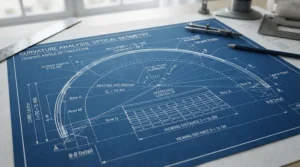
Elite specifies a 40-foot screen curvature radius for its Lunette range, around 12.2 metres. The idea is that a screen curved on that radius keeps the projector-to-screen distance consistent across the width. That’s true when the projector sits at the centre of the circle.
Here’s the catch, and it’s my own geometry, not a manufacturer claim. A typical UK living-room throw is three to five metres, nowhere near twelve. So the screen is flatter than the “perfect” arc for your room. On a back-of-envelope calculation with a four-metre throw to a 138-inch scope screen, the curve trims the extra distance to the edges by roughly a third compared with a flat screen. That’s a real improvement, but not a complete cure.
The arc itself is modest. Over a 92-inch 16:9 screen it spans roughly ten degrees, and over a 138-inch scope screen around fifteen, which matches Elite’s stated figure. Stewart takes a different approach on its pricier CineCurve system, where it can specify the radius to suit your projection lens or seating. Elite offers a fixed radius, which keeps costs down but offers no tuning.
Edge Distortion: What the Curve Fixes (and What It Doesn’t)
Edge distortion on wide screens usually shows up as pincushion, where horizontal lines at the top and bottom bow slightly, producing a faint hourglass shape. Elite explains it as uneven throw distance: light has further to travel to the edges of a flat widescreen than to the middle.
A curve helps by pulling the edges towards the projector. Elite also says its 16:9 models don’t suffer the same effect because the format is narrower. But the curve isn’t magic. Sound & Vision’s reviewer did see a trace of pincushion on test patterns, and noted that the outcome depends on the projector’s lens design and its vertical position. It vanished on real films with careful setup.
Wikipedia adds a useful caveat: viewers sitting nearer or further than the intended position can see pincushion or barrel effects, and the curve becomes noticeable off-axis. So sit near the centre line.
Practical fixes:
- Mount the projector at the screen’s vertical centre or use lens shift.
- Use geometric correction sparingly, since digital correction can soften the image.
- Test with a grid pattern before blaming the screen.
For an everyday film, edge distortion rarely spoils anything once the setup is right.
Viewing Distance for a Curved Projector Screen
Viewing distance is where most buyers go wrong. The two standards to know are SMPTE, which recommends about a 30-degree viewing angle, and THX, which suggests about 36 degrees. As a rule of thumb for 16:9 screens, Sound & Vision’s viewing distance guide suggests multiplying the diagonal by about 1.63 for SMPTE, or the width by about 1.54 for the 36-degree THX figure.
I’ve scaled published figures to the screens in this guide. The numbers below are THX 36 degrees, SMPTE 30 degrees and the outer 26-degree limit, in metres:
- Elite Screens Lunette 2 CURVE92WH2 (92″, 16:9): roughly 3.1 / 3.8 / 4.4
- Elite Screens Lunette CineWhite 96-inch 2.35:1: roughly 3.5 / 4.2 / 4.9
- Lumene Movie Palace UHD 4K Curve 240C (106″): roughly 3.6 / 4.4 / 5.1
- Elite Screens Lunette 2 CURVE235-115W2 (115″, scope): roughly 4.1 / 5.0 / 5.8
Curved screens add a wrinkle. They look best from the middle of the room, and the more you sit off-axis, the more the curve shows. If your seating is a wide sofa, test with someone sitting at each end before committing.

Curved Projector Screen vs Flat Fixed Frame Screen
Is curved better? It depends entirely on the content.
| Factor | Curved fixed frame | Flat fixed frame |
|---|---|---|
| Scope (2.35:1) films | Better geometry, more cinematic | Fine with correct setup |
| 16:9 television and gaming | Mostly cosmetic | Equally good |
| Price | Higher | Lower |
| Installation | Heavier, fussier | Easier |
| Retractable option | None | Widely available |
| Best for | Dedicated scope cinemas | Mixed living-room use |
Looking at the comparison, the curve earns its premium mainly on wide-format films in a dedicated room. For a living room where the projector mostly shows football, streaming and games, a flat fixed frame gives nearly the same picture for less money. Curved is a cinema choice, not a general upgrade.
Budget Curved Projector Screen: What Realistically Works
Let’s be straight: a budget curved projector screen doesn’t really exist at the bargain-bin level. The cheap, fold-up screens you’ll see in marketplaces are flat fabric with no rigid frame, so they can’t hold a curve. A genuinely curved fixed frame starts in the mid-hundreds of pounds.
Within that, the best budget curved projector screen routes are the entry-level Elite models.
| Tier | Pick | Price range | Trade-off | Best for |
|---|---|---|---|---|
| Budget | Elite Screens Lunette 2 CURVE92WH2 | £300-£650 | Subtle curve | Living rooms |
| Budget scope | Elite Screens Lunette CineWhite 96-inch 2.35:1 | £350-£550 | Needs lens memory | Film fans |
| Mid-range | EPV Screens Curve 235 AcousticPro 4K 96-inch | £500-£800 | Standard throw only | Hidden speakers |
| Premium | Stewart Filmscreen Cine-W | £3,000-£4,500+ | Very expensive | Dedicated cinemas |
The value story is clear. The cheapest curved options give you most of the benefit, because the screen material is the same CineWhite across the range. Paying more mostly buys size, acoustic weave or prestige. Stock for curved models on amazon.co.uk can fluctuate and some are sold by third-party sellers, so check current price, availability and returns terms before ordering.
✨ Don’t Miss These Exclusive Deals!
🔍 Take your home cinema to the next level with these carefully selected curved screens. Click on any highlighted product name to check current pricing and availability. These picks will help you create the authentic cinema feel your family will love!
How to Choose a Curved Projector Screen
Short answer: pick your aspect ratio, measure your room, then match the screen to your projector. In more detail:
- Decide your main format. Mostly films means 2.35:1 is worth considering. A mix of television, games and films points to 16:9.
- Measure your seating distance. Work backwards from the SMPTE and THX figures above rather than buying the biggest screen you can afford.
- Check your projector’s throw type. The Lumene Movie Palace UHD 4K Curve 240C and the EPV Screens Curve 235 AcousticPro 4K 96-inch restrict which projectors suit them.
- Match the material to the room. Solid matte white suits dark rooms; an acoustic weave suits hidden speakers.
- Confirm your wall and fixings. Weight and bracket clearance matter more than they seem.
- Plan for scope. A 2.35:1 screen needs lens memory or an anamorphic lens.
- Check warranty and returns. Elite and Lumene both quote two years on these models.
Features That Actually Matter (And Those That Don’t)
What matters: material, black backing, frame quality and honest compatibility. Screen gain is a ratio against a reference white. As Wikipedia’s explanation of gain points out, higher gain brings a brighter image but a narrower viewing angle. That’s why a 1.0 or 1.1 matte white suits most rooms.
The velvet frame matters too, because it absorbs overspill and sharpens apparent contrast. A black backing matters because it stops light passing through the fabric.
What doesn’t matter much: “4K ready” and “HDR ready” labels, since a passive surface can’t be either. Active 3D readiness is largely irrelevant now that most people have moved on from 3D. And lofty immersion claims for 16:9 curved screens deserve scepticism, given Elite’s own admission.
Spend your money on size appropriate to your seating, the right material, and a wall you trust.
FAQ
❓ Can a curved projector screen work with a short throw projector?
❓ Do I need an anamorphic lens for a curved projector screen?
❓ Can I hang a curved fixed frame screen on any wall?
❓ Where can I buy a curved projector screen in the UK?
❓ Does a curved projector screen need a special projector?
Conclusion
Here’s the honest verdict. A curved projector screen is a cinema purchase, not a universal upgrade. If you watch mostly scope films in a dedicated, dark room, the curve and the wide format are a lovely match. If your projector mainly shows football and streaming, a flat fixed frame gets you nearly the same picture for less.
For most people, the Elite Screens Lunette 2 CURVE92WH2 is the lowest-risk way in. Film-first households should look at the Elite Screens Lunette CineWhite 96-inch 2.35:1 or the Elite Screens Lunette 2 CURVE235-115W2. If hidden speakers are the goal, the EPV Screens Curve 235 AcousticPro 4K 96-inch and Elite Screens Lunette AcousticPro1080P3 100-inch are the specialists. The Lumene Movie Palace UHD 4K Curve 240C is the European alternative, and the Stewart Filmscreen Cine-W is the aspirational pick.
Measure your seating distance, check your projector’s throw type and plan the wall properly before you click anything.
✨ Ready to Build Your Home Cinema?
🎬 Click on any highlighted product name above to check current pricing and availability, then pick the curved screen that suits your room. Your film nights are about to get a lot more theatrical! 🍿
Recommended for You
- Acoustic Transparent Screen For Small Cinema Room: 7 Best (2026)
- Acoustically Transparent Screen For Dolby Atmos Setup: 7 Best (2026)
- Acoustically Transparent Projector Screen: 7 Best UK Picks (2026)
Disclaimer: This article contains affiliate links. As an Amazon Associate, I earn from qualifying purchases. If you purchase products through these links, we may earn a small commission at no additional cost to you.
✨ Found this helpful? Share it with your friends! 💬🤗
