
In This Article
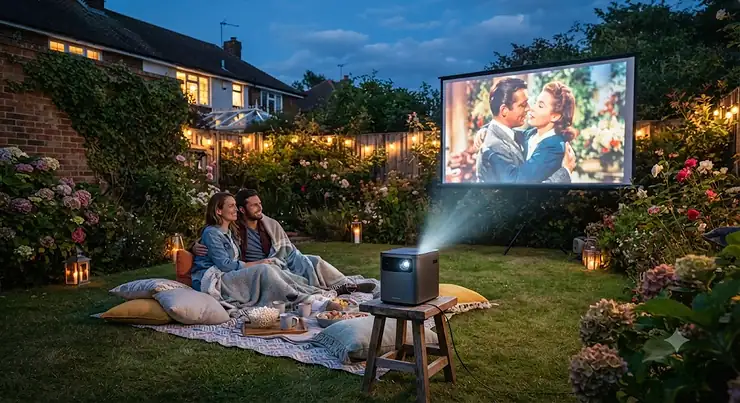
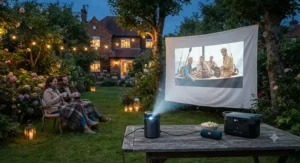
There’s a particular kind of magic in watching a film under an open sky, the neighbour’s cat prowling the fence line while your screen flickers to life against the garden wall. Chasing that magic, though, usually means one thing: hunting for the best portable outdoor projector that won’t leave you trailing an extension lead across wet grass like a hazard waiting to happen. The good news is that 2026’s crop of battery-powered projectors has genuinely closed the gap on brightness, sound and smart features that used to be the preserve of bulky, mains-only home cinema kit.

This guide isn’t a rewritten spec sheet. We’ve dug into real product data, aggregated review sentiment from trusted testers, and honest comparative analysis to help you actually choose. Whether you’re after something cordless for a festival, a lightweight option for camping, or simply the brightest picture your garden fence has ever seen, you’ll find a proper breakdown here — battery life, brightness trade-offs, and the buying mistakes that trip up first-timers. Let’s get into it.
Quick Comparison Table
Before the deep dive, here’s the shape of the market at a glance. All prices are approximate UK ranges at the time of research and will fluctuate, so always check current pricing before buying.
| Projector | Brightness | Battery Life | Best For | Price Range |
|---|---|---|---|---|
| XGIMI Vibe One | 250 ISO lumens | Up to 1.2 hrs | Ultra-budget, occasional use | Around £200-£230 |
| Anker Nebula Capsule 3 | 200 ANSI lumens | Up to 2.5 hrs | Lightest, most pocketable | £350-£450 range |
| Anker Nebula Mars 3 Air | 400 ANSI lumens | Up to 2.5 hrs | All-round garden cinema | £500-£600 range |
| BenQ GS50 | 500 ANSI lumens | Up to 2.5 hrs | Weatherproof, drop-resistant | £500-£600 range |
| XGIMI Halo+ | 700-900 ISO lumens | Up to 2.5 hrs | Balanced sound and brightness | £650-£750 range |
| XGIMI MoGo 4 Laser | 550 ISO lumens | Up to 2.5-5 hrs* | Best picture quality (laser) | £700-£800 range |
| Anker Nebula Mars 3 | 1,000 ANSI lumens | Up to 5 hrs | Brightest, best for larger gardens | Under £900 |
*With optional PowerBase Stand accessory, sold separately.
A glance at that table tells you most of what you need to know about trade-offs in this category: brightness and battery life rarely improve together, so the projectors that push past 500 lumens tend to lean on bigger batteries to compensate, which pushes up both weight and price. The XGIMI Vibe One sits at one extreme — genuinely tiny and cheap, but its battery genuinely won’t get you through a full film. At the other end, the Anker Nebula Mars 3 trades portability for a picture bright enough to watch before full darkness falls, something worth weighing carefully if your garden gets evening sun.
💬 Found the right shortlist already? Compare current prices on your favourites and see which one fits your garden this summer.
Top 7 Portable Outdoor Projectors: Expert Analysis
We’ve picked seven real, currently available models spanning budget, mid-range and premium, all genuinely cordless and battery-powered so they qualify as a true portable projector outdoor movies solution rather than something that needs a socket within reach.
1. XGIMI Vibe One — cheapest genuinely portable option
The XGIMI Vibe One undercuts almost everything else on this list, and it does it by being honest about its limits rather than pretending to be something it isn’t. Weighing around 1.4kg with a lantern-like design and a carry handle built into its 160-degree tilting stand, it’s the kind of thing you’ll actually grab on a whim.
At 250 ISO lumens on paper (independent testing measured closer to 229 lumens in its brightest mode), this isn’t a projector for twilight viewing — you’ll want proper darkness before the picture looks its best. The 1080p LCD panel and 1500:1 contrast ratio deliver a perfectly watchable image once the sun’s fully down, and Google TV with native Netflix support means no faffing with a separate streaming stick. Based on the spec comparison with its rivals, the XGIMI Vibe One is clearly built for younger, casual buyers rather than home cinema purists — the sticker sheet in the box says as much.
Reviewers consistently report that the battery life is the projector’s biggest catch: around 1.2 hours in Eco mode, dropping to under an hour of streaming in Standard mode, with no USB power bank support to top it up mid-film. What most buyers overlook is that this makes it more of a “short film and games” device outdoors than a full backyard cinema solution unless you’re within reach of a plug for the second half.
Pros:
- ✅ Genuinely lightweight and grab-and-go portable
- ✅ Native Google TV and Netflix built in
- ✅ Cheapest genuinely cordless projector on this list
Cons:
- ❌ Battery lasts under 90 minutes even in Eco mode
- ❌ 250 lumens is too dim for anything but full darkness
At a price range in the low £200s, the XGIMI Vibe One represents strong value if your outdoor viewing is short clips, sports highlights or gaming rather than feature-length films — for a full movie, budget for a power bank or stay near a socket.
2. Anker Nebula Capsule 3 — lightest true movie-night projector
If the XGIMI Vibe One is about price, the Anker Nebula Capsule 3 is about size. It’s roughly can-shaped, small enough to slip into a rucksack side pocket, and it’s the pick reviewers most consistently single out as the best lightweight outdoor projector for people who genuinely carry their kit any distance.
The 200 ANSI lumens brightness rating sounds modest next to some rivals here, but ANSI lumens are a stricter measurement than the ISO lumens some competitors quote, so the real-world gap is smaller than the numbers suggest. What most buyers overlook is that a DLP chip covering 90% of the DCI-P3 colour gamut, paired with a 52Wh battery rated for 2.5 hours of video playback, punches well above its size class — this is genuinely enough for most feature films once darkness falls. Google TV, Chromecast built-in and an 8W Dolby Audio speaker round out a package that needs nothing else plugged in.
Aggregated review sentiment across UK and US testers is consistently positive about the build quality and portability, with the most common complaint being that, like most compact projectors in this bracket, it isn’t bright enough for early-evening ambient light — a limitation shared by nearly everything under 400 lumens.
Pros:
- ✅ Can-sized and genuinely pocket-friendly
- ✅ 2.5-hour battery covers most full films
- ✅ USB-C charging works with common power banks
Cons:
- ❌ 200 ANSI lumens needs full darkness to shine
- ❌ Speaker is fine solo, thin without a boost
Priced in the £350-£450 range, the Anker Nebula Capsule 3 is arguably the best all-round answer if “lightweight outdoor projector” is the exact phrase you typed into Google — it’s built for people who walk further than they drive to their viewing spot.
3. Anker Nebula Mars 3 Air — best balanced wireless outdoor cinema pick
The Anker Nebula Mars 3 Air was clearly designed with gardens in mind rather than adapted for them, and reviewers consistently point to it as the sweet spot for anyone searching specifically for a wireless outdoor cinema projector. At 1.7kg and roughly the size of a large lunchbox, it’s carryable without being flimsy.
Its 400 ANSI lumens brightness is double that of the Anker Nebula Capsule 3, translating into a picture that holds up reasonably well against a bit of residual dusk glow rather than demanding total blackout. The twin 8W speakers with Dolby Digital support genuinely fill a garden with sound in a way pocket-sized rivals can’t match, and Google TV means you’re streaming within a minute of switching on. Based on the spec comparison, the 2.5-hour battery life matches most of its rivals rather than beating them, but the brightness-to-portability ratio here is what earns it repeated recommendations from UK tech reviewers as the default pick for anyone without a specific reason to go cheaper or brighter.
What reviewers note consistently is build quality that feels a cut above budget rivals, with a soft-touch fabric-wrapped body that’s pleasant to handle and doesn’t scream “cheap plastic” the way some sub-£400 alternatives do.
Pros:
- ✅ 400 lumens copes with mild ambient light
- ✅ Genuinely loud, room-filling dual speakers
- ✅ Google TV built in, no extra streaming stick needed
Cons:
- ❌ Heavier than the Capsule 3 for backpack trips
- ❌ No official water resistance rating
Sitting in the £500-£600 range, the Anker Nebula Mars 3 Air is the projector we’d point most first-time buyers toward if they want one machine that does everything reasonably well without a specific niche need.
4. BenQ GS50 — toughest, most weather-resistant pick
Gardens involve dew, the odd spilled drink and the occasional dog with excitable paws, and the BenQ GS50 is the one projector on this list actually engineered around that reality. It carries an IPX2 splash-resistance rating and is tested to survive drops of up to 2.3 feet, protected by a TPU inner layer and a drop-resistant resin shell — durability specs. that Amazon listings mention but rarely explain in practical terms.
An IPX2 rating specifically means the unit is protected against light water spray hitting it at up to a 15-degree angle for ten minutes, roughly equivalent to being caught in a short, light shower — not a downpour, but enough to cover the accidental sprinkler mishap. At 500 ANSI lumens, it’s brighter than the Anker Nebula Mars 3 Air, and its 2.1-channel speaker system (two 5W tweeters plus a 10W woofer) is, based on the spec comparison, the most capable built-in audio setup below the £700 mark. Reviewers consistently rate the input lag — just 22.7ms in Game Mode — as the lowest in this class, which matters if garden movie night sometimes turns into garden gaming night.
The trade-off, and it’s one worth weighing honestly, is battery life: BenQ’s own figures put non-stop movie time at around 150 minutes, in line with most rivals here, but real-world use with volume and brightness pushed up tends to shave that down, a pattern reviewers note across nearly every battery projector in this guide.
Pros:
- ✅ IPX2 splash and drop resistance built in
- ✅ Best-in-class audio for the price bracket
- ✅ Lowest input lag here, good for casual gaming
Cons:
- ❌ Bulkier and heavier than the sleeker rivals
- ❌ Needs a separate Android TV dongle plugged in
At a price range of roughly £500-£600, the BenQ GS50 earns its place for anyone whose garden setup involves genuine risk of knocks, splashes or a boisterous family — durability here isn’t marketing fluff, it’s measurable.
5. XGIMI Halo+ — best sound and brightness balance
The XGIMI Halo+ has been a fixture of “best portable projector” lists for several years now, and the newer version hasn’t lost the formula that got it there. Its 700-900 ISO lumen brightness range (XGIMI’s own figures have crept up across revisions) puts it comfortably ahead of the Anker and BenQ mid-range options, while a 59Wh battery still delivers roughly 2.5 hours of playtime.
What most buyers overlook about the XGIMI Halo+ is the audio hardware: dual 5W Harman Kardon speakers deliver noticeably cleaner, more distortion-free sound than the generic drivers found in cheaper rivals, a detail that’s easy to miss on a spec sheet but obvious the moment you actually watch something on it. Its Intelligent Screen Adaption system — combining auto keystone correction, auto focus and obstacle avoidance — genuinely reduces setup time to seconds rather than the fiddly manual corner-dragging still common on budget models. Reviewers consistently single out the compact, minimalist design as a strength; it looks more like a stylish speaker than a projector, which matters if it’s going to live on a shelf rather than in a cupboard.
Aggregated customer sentiment does flag one recurring issue worth noting honestly: several owners report that the auto screen-alignment feature, while clever, occasionally takes longer than expected or misjudges an angle, requiring a manual nudge to get right.
Pros:
- ✅ Genuinely bright for its size, up to 900 ISO lumens
- ✅ Harman Kardon speakers outclass most rivals
- ✅ Auto keystone, focus and obstacle avoidance built in
Cons:
- ❌ Auto-alignment can be slow or slightly inaccurate
- ❌ 2.5-hour battery, no longer than cheaper rivals
Priced in the £650-£750 range, the XGIMI Halo+ is the pick for anyone who prioritises sound quality and setup speed as much as picture brightness — a common priority for people who watch outdoors regularly rather than as a once-a-summer event.
6. XGIMI MoGo 4 Laser — best picture quality on this list
Step up to the XGIMI MoGo 4 Laser and you’re paying for genuine optical hardware improvement rather than just a bigger battery. Its triple-laser light engine claims 550 ISO lumens, a figure that undersells how the image actually looks thanks to 110% coverage of the BT.2020 colour gamut — a noticeably wider range than the DLP and LED-lamp projectors elsewhere in this guide — and a 1,000:1 contrast ratio that keeps dark scenes from washing out the way cheaper lifestyle projectors often do.
Based on the spec comparison, laser light sources like this one also tend to hold their brightness and colour accuracy for far longer than LED or lamp-based units before needing replacement, which matters for long-term value even if it rarely shows up in a first-week review. Dual 6W Harman Kardon speakers and a set of four magnetic creative filters — designed to shift ambient lighting mood rather than the picture itself — round out a package that’s clearly aimed at people treating the projector as a lifestyle object as much as a screen. The 360-degree adjustable stand means it can throw an image onto a fence, a bedroom ceiling or a tent wall with equal ease.
The honest catch, and it’s one XGIMI is upfront about: the standard 2.5-hour battery only stretches to five hours with the PowerBase Stand accessory, which is sold separately and adds meaningfully to the total cost of ownership.
Pros:
- ✅ Triple-laser light source with wide colour gamut
- ✅ Excellent 1,000:1 contrast for deep dark scenes
- ✅ 360° stand adapts to almost any throw angle
Cons:
- ❌ Five-hour battery life needs a separate paid accessory
- ❌ Premium pricing versus similarly bright rivals
At a price range of roughly £700-£800 (with the PowerBase bundle costing more), the XGIMI MoGo 4 Laser suits buyers who care most about image fidelity and are happy to budget for accessories to unlock its full potential.
7. Anker Nebula Mars 3 — brightest and best for larger gardens
Top of this list on raw specification is the Anker Nebula Mars 3, and reviewers who’ve tested it consistently describe it as the “complete package” for anyone serious about outdoor cinema rather than casual garden viewing. At 1,000 ANSI lumens — genuinely rare in this portable category — it’s the only projector here bright enough to be clearly visible while there’s still some ambient twilight in the sky, rather than requiring you to wait for full darkness.
That brightness is backed by hardware to match: a 40W speaker system with Dolby Digital Plus support that testers say genuinely eliminates the need to pair a separate Bluetooth speaker, an increasingly rare claim in this category. What most buyers overlook is the battery capacity behind that performance — an 185Wh cell, several times larger than the batteries in cheaper rivals, delivering up to five hours of continuous playback on medium brightness, comfortably covering a double feature. IPX3 water resistance and drop resistance add genuine ruggedness, and Android TV 11 with Chromecast built in means streaming setup takes seconds.
Aggregated review sentiment is close to unanimous that this is the projector to buy if budget stretches far enough and portability is a secondary concern — at 3-4kg depending on configuration, it’s noticeably heavier than everything else on this list, a trade-off testers consistently flag as the one real compromise.
Pros:
- ✅ 1,000 ANSI lumens, brightest projector on this list
- ✅ 40W Dolby Digital Plus audio, no speaker needed
- ✅ Up to 5 hours of battery life, IPX3 rated
Cons:
- ❌ Noticeably heavier than every other pick here
- ❌ Priced close to the £900 mark before deals
For under £900, the Anker Nebula Mars 3 is the projector we’d recommend for anyone whose garden movie nights are a regular fixture rather than an occasional novelty — it’s the closest thing on this list to a genuine mains-projector replacement.
Spec Snapshot: All Seven Side by Side
| Projector | Resolution | Speaker | Weight (approx) | Standout Feature |
|---|---|---|---|---|
| XGIMI Vibe One | 1080p | 2 x 3W | ~1.4kg | Cheapest genuinely portable pick |
| Anker Nebula Capsule 3 | 1080p | 8W | ~0.7kg | Can-sized and pocketable |
| Anker Nebula Mars 3 Air | 1080p | 2 x 8W | ~1.7kg | All-round garden balance |
| BenQ GS50 | 1080p | 2.1 CH | ~1.9kg | IPX2 splash and drop resistant |
| XGIMI Halo+ | 1080p | 2 x 5W HK | ~1.3kg | Harman Kardon sound quality |
| XGIMI MoGo 4 Laser | 1080p | 2 x 6W HK | ~1.2kg | Triple-laser picture quality |
| Anker Nebula Mars 3 | 1080p | 40W | ~3-4kg | Brightest, longest battery |
Lay all seven out like this and a clear pattern emerges: as brightness and audio power climb, so does weight, almost in lockstep. If you genuinely need to carry your projector any distance — to a festival, on a train, up a hillside for a stargazing double bill — the top two entries in this table are your realistic shortlist. If your “portable” simply means “not permanently bolted to the ceiling,” the heavier, brighter options at the bottom of the table will reward you with a picture you won’t need to squint at.
Cordless Outdoor Projector Setup: A Practical Usage Guide
Getting a cordless outdoor projector into position properly makes more difference to picture quality than almost any spec on the box, yet it’s the bit Amazon listings never cover. Start with distance: most portable projectors have a fixed or narrow-range throw ratio, so check the manual for the ideal metres-to-screen-size relationship before you commit to a spot — setting up too close or too far is the single most common reason first-time buyers think their new projector is faulty when it isn’t.
Surface matters more outdoors than in. A plain white bedsheet pulled taut between two poles outperforms a patchy garden wall every time, and a proper inflatable or pop-up outdoor screen (typically £30-£80) is a worthwhile add-on if you’re going to do this more than once or twice. Auto keystone and auto focus, present on most of the projectors above, handle the geometry for you, but they work best on a flat, unobstructed surface — branches, guttering or an uneven fence line will confuse even the cleverest auto-alignment system.
For the first 30 days, the most common mistake is charging habits: most built-in lithium batteries prefer partial, frequent top-ups over being run flat and fully recharged each time, and leaving a projector on charge indefinitely once full can shorten long-term battery health, the same principle that applies to phones and laptops. A simple maintenance routine — wiping the lens with a microfibre cloth, keeping the intake vents free of grass clippings, and storing it somewhere dry between uses — will meaningfully extend the life of any of the seven picks above. One optimisation trick worth knowing: most of these units run noticeably cooler and last longer on battery in their “Eco” or “Standard” brightness mode rather than maximum, and outdoors after dark you rarely need the extra lumens anyway.
✨ Ready to Build Your Own Outdoor Cinema Night?
🔍 Pick the projector that fits your garden and grab a screen, some blankets and good speakers to match. Click through on any highlighted pick above to check current pricing and availability — your next movie night starts here!
Real-World Scenarios: Choosing a Battery Projector for Garden Movie Nights
Specs only tell half the story, so here’s how three different buyer profiles map onto the picks above.
Picture a young couple in a terraced house with a modest 4×3 metre garden and no outdoor power socket within reach. Their priority is simplicity over raw brightness, and something they can carry out, set up in under five minutes, and bring back in before the dew sets in. The Anker Nebula Capsule 3 or XGIMI Vibe One both fit this brief neatly — light enough to carry one-handed, small enough to store in a kitchen drawer, and bright enough for a garden that’s fully dark by 9pm most of the year.
Now picture a family with two children, a dog, and a larger garden that regularly hosts weekend get-togethers. Here, durability and audio matter as much as picture quality, since the projector is likely to get bumped, occasionally rained on, and needs to fill a bigger space with sound everyone can hear from the patio. The BenQ GS50, with its splash and drop resistance plus genuinely capable 2.1-channel speaker, is built almost exactly for this use case, while the Anker Nebula Mars 3 Air offers a similar balance with a slightly softer, less rugged shell.
Finally, consider a small business or events host running regular outdoor screenings for paying groups, where picture quality, brightness in partial daylight and total reliability matter more than price. For that user, the Anker Nebula Mars 3 or XGIMI MoGo 4 Laser justify their higher price with genuinely different-class brightness, colour accuracy and battery capacity — the difference between “watchable” and “genuinely cinematic” becomes obvious the moment you’re projecting for a paying audience rather than close family.
How to Choose the Best Portable Projector for Outdoor Movies
Choosing the right portable projector outdoor movies setup comes down to seven weighted decisions, roughly in order of importance for most UK gardens.
- Decide your realistic viewing window. If you’ll only ever watch after full dark, brightness matters less than battery life. If you want to start at dusk in British summer evenings, you need 500+ ANSI lumens minimum.
- Measure your actual throw distance. Check the projector’s throw ratio against the space between your likely seating and screen position before buying, not after.
- Weigh portability against battery capacity honestly. The lightest projectors here have the shortest batteries — accept that trade-off consciously rather than being surprised by it later.
- Check the built-in speaker power against your garden size. A 3-4W speaker is fine for four people on a patio; it won’t cut it for a garden party of twenty.
- Confirm smart TV platform support for the apps you actually use. Google TV and Android TV cover most UK streaming services, but always check Netflix, iPlayer and Disney+ compatibility specifically.
- Look for genuine weather resistance if storage or transport risk is a factor. An IPX rating isn’t decoration — it’s a tested, measurable standard, unlike vague “weatherproof” marketing claims.
- Budget for accessories, not just the unit. A screen, a case and possibly a power bank can add £50-£150 to the real cost of ownership.
What the spec sheet won’t tell you, but reviewers note consistently across nearly every model in this guide, is that auto-focus and auto-keystone features — while genuinely useful — occasionally need a manual nudge on uneven garden surfaces, so don’t treat “auto everything” marketing as a guarantee of zero setup effort. For further independent testing methodology and comparative scores across the wider projector market, Which?’s home projector reviews are a genuinely useful cross-reference before you commit.
Lightweight Outdoor Projector: Common Buying Mistakes
The single most common mistake buyers make when hunting for a lightweight outdoor projector is fixating on lumens without checking how that figure was measured. ANSI lumens and ISO lumens are calculated differently, and manufacturers aren’t always consistent about which they quote — a 400 ANSI lumen projector can genuinely look brighter in person than a 550 ISO lumen rival, despite the higher number on the box.
A second frequent error is underestimating battery drain from Wi-Fi and app use. Streaming directly through a projector’s built-in apps draws noticeably more power than playing a downloaded file from a USB stick, so the “up to 2.5 hours” battery claim on most boxes assumes closer to best-case conditions than typical Netflix-in-the-garden use. Reviewers across nearly every model in this guide flag the same pattern: real-world battery life tends to land 15-25% below the manufacturer’s headline figure once Wi-Fi, higher volume and brighter picture modes come into play.
Buyers also frequently skip checking input lag if gaming is even an occasional use case, then discover their new projector adds a noticeable, frustrating delay to fast-paced games — a detail the BenQ GS50‘s 22.7ms figure exists precisely to solve, but most rivals simply don’t publish. And finally, many buyers assume “portable” automatically means “waterproof,” when in fact most projectors on the market — including several strong performers on this list — carry no IP rating at all and shouldn’t be left out if rain looks likely.
Features That Actually Matter (And Those That Don’t)
Cutting through the marketing noise: auto keystone correction and auto focus genuinely matter, because manual keystone adjustment on a wobbly garden table is a genuine hassle every single viewing. A built-in smart TV platform matters too — carrying a separate streaming stick outdoors, keeping it charged and finding somewhere to plug it in defeats much of the point of going cordless in the first place.
On the other hand, headline resolution numbers deserve scepticism. Every projector in this guide is native 1080p; claims of “4K input support” mean the unit can accept a 4K signal and downscale it, not that it displays true 4K detail — a distinction Amazon listings routinely blur. Similarly, maximum screen size claims (often 150-200 inches) are technically achievable but rarely usable in practice at anything close to acceptable brightness; the real-world sweet spot for every projector on this list sits closer to 80-120 inches. Ambient light sensors and “AI brightness adjustment,” while nice to have, matter far less outdoors after dark than they do for daytime indoor use, since darkness is a constant rather than a variable once the sun’s fully down.
Wireless Outdoor Cinema Projector vs Mains-Powered Projectors
The obvious question anyone shopping this category eventually asks: why not just run an extension lead and buy a brighter, cheaper, mains-only projector instead? It’s a fair challenge, and the honest answer is that it depends entirely on where you’re viewing from.
| Factor | Wireless/Battery Projector | Mains-Powered Projector |
|---|---|---|
| Setup flexibility | Anywhere in the garden | Limited by socket/cable reach |
| Typical brightness | 200-1,000 lumens | 1,000-3,000+ lumens |
| Weather safety | Lower electrical risk | Requires outdoor-rated cable and RCD |
| Runtime | 1-5 hours, then recharge | Unlimited while plugged in |
| Best For | Portability, safety, spontaneity | Fixed patio setups, maximum brightness |
The trade-offs here are stark and worth taking seriously rather than glossing over. A mains-powered outdoor projector, such as those rated well above 2,000 lumens, will always out-brighten anything battery-powered, meaning it can start earlier in the evening and cope better with residual daylight. But that brightness comes at the cost of needing an outdoor-rated, RCD-protected supply — running a standard indoor extension lead across damp grass genuinely isn’t safe, and it tethers you to wherever the nearest suitable socket happens to be. A genuinely wireless outdoor cinema projector sacrifices some brightness for the freedom to set up anywhere, including well away from the house, with none of the electrical risk that comes with trailing cable across a lawn. For most UK gardens, where full darkness arrives reliably by 9-10pm for much of the year, that trade-off tips firmly in favour of going cordless.
💬 Weighed up wired versus wireless? Share this comparison with anyone else planning a garden cinema setup this year!
What to Expect: Real-World Performance After Dark
Specs on a box rarely translate directly into what you’ll actually see on a garden fence at 9:30pm, so here’s what genuinely changes once the sun goes down. Colour accuracy improves noticeably in true darkness across every projector in this guide — the washed-out, pale look some testers report in bright rooms largely disappears once ambient light drops to near zero, which is exactly the environment most garden viewing happens in anyway.
Audio, by contrast, behaves differently outdoors than indoors: sound that fills a living room comfortably can feel thin in open air, since there are no walls to bounce and reinforce it. This is precisely why the built-in speaker wattage figures in our comparison table matter more for outdoor use than they would for the same projector used indoors — reviewers consistently note that anything under 6-8W total struggles past a small huddle of viewers once you’re in open air. Auto-focus performance also varies with temperature; several reviewers note that focus can drift slightly as a projector warms up during a long session, something worth knowing rather than assuming is a fault. None of this is disclosed clearly on any Amazon listing, but it’s the difference between a genuinely enjoyable outdoor cinema night and a mildly disappointing one.
Best Outdoor Projector Without Mains Power? Long-Term Cost & Value
Asking whether there’s a genuine best outdoor projector without mains power really means asking about total cost of ownership, not just the upfront price tag. A cheaper projector that needs a £40-£80 external power bank to get through a full film, plus a £30-£60 screen, can end up costing close to what a pricier all-in-one model does outright.
| Projector | Unit Price Range | Extra Kit Often Needed | Realistic Total Cost |
|---|---|---|---|
| XGIMI Vibe One | Around £200-£230 | Power bank for full films | £250-£320 range |
| Anker Nebula Capsule 3 | £350-£450 range | Screen recommended | £400-£520 range |
| Anker Nebula Mars 3 Air | £500-£600 range | Screen recommended | £550-£670 range |
| Anker Nebula Mars 3 | Under £900 | Usually self-sufficient | Under £950 |
Looking at the comparison above, the cheapest unit price doesn’t always mean the cheapest genuine setup — the XGIMI Vibe One‘s battery limitations mean most buyers end up spending on a power bank they wouldn’t otherwise need, narrowing the real-world gap to mid-range rivals. Laser-based models like the XGIMI MoGo 4 Laser, meanwhile, tend to hold their brightness and colour accuracy for years longer than LED-lamp alternatives before any noticeable degradation, a genuine long-term value factor that rarely features in short-term reviews. Battery replacement is the other long-term cost worth factoring in: built-in lithium batteries in this category typically hold up well for 300-500 charge cycles before capacity noticeably drops, roughly two to three years of regular seasonal use, after which most units aren’t designed for user battery replacement — worth bearing in mind before buying the cheapest option purely on sticker price.
Safety and Regulations: Using a Projector Safely in the Garden
Even a fully cordless, battery-powered projector isn’t entirely exempt from electrical safety considerations, particularly during charging or if you’re supplementing battery life with a mains-connected power bank outdoors. The UK’s product safety guidance is consistent on this point: any electrical equipment used outside, even briefly, should only be connected via weather-rated extension leads and ideally through a residual current device (RCD), which cuts power almost instantly if a fault is detected.
RoSPA’s garden safety guidance recommends switching off and unplugging electrical items before cleaning or adjusting them, keeping charging equipment away from standing water or damp grass, and using only chargers and cables genuinely compatible with your specific device rather than generic third-party alternatives. This matters more than it might seem for battery projectors: charging a unit outdoors overnight, or leaving a power bank connected in damp conditions, carries the same basic risks as any other outdoor electrical equipment, even if the projector itself runs cordlessly once charged. Products sold in the UK carrying a UKCA or CE mark have been assessed against recognised electrical safety standards, so checking for that marking on both the projector and any third-party charging accessories is a simple, worthwhile habit before your first outdoor session.
Portable Outdoor Projectors for Different Audiences
Not every buyer wants the same thing from this category, so it’s worth being specific about who each type of projector genuinely suits. Students and young renters, often working with strict storage space and modest budgets, are typically best served by the XGIMI Vibe One or Anker Nebula Capsule 3 — cheap enough to justify for occasional use, small enough to disappear into a shared house without complaint.
Families with a fixed garden and a habit of regular weekend screenings get more long-term value from the Anker Nebula Mars 3 Air or BenQ GS50, where durability and audio power matter more than absolute portability. Campers and festival-goers, meanwhile, have a genuinely different priority set: weight and battery efficiency matter more than peak brightness, since most camping viewing happens in genuine, uninterrupted darkness where even 250-400 lumens looks perfectly punchy. For that crowd, the lightest options on this list, run in their most efficient power mode, are usually the smarter buy than the brightest.
Enthusiasts and small event hosts, finally, are the group for whom the premium end of this list — the XGIMI MoGo 4 Laser and Anker Nebula Mars 3 — genuinely earns its higher price, since picture quality, brightness headroom and battery capacity all compound to justify the investment when you’re screening for a crowd rather than a couple.
FAQ
❓ What is the best portable outdoor projector for beginners?
❓ Can you use a portable projector outdoors without a screen?
❓ How long does a battery projector for garden use actually last per charge?
❓ Is a cordless outdoor projector bright enough to use before it's fully dark?
❓ Do lightweight outdoor projectors sacrifice picture quality?
Conclusion
There isn’t one single best portable outdoor projector for every garden — that much should be obvious by now. What matters is matching the trade-offs honestly to how you’ll actually use it: the XGIMI Vibe One and Anker Nebula Capsule 3 for anyone prioritising size and price over runtime, the Anker Nebula Mars 3 Air and BenQ GS50 for a dependable all-rounder that copes with real family use, and the XGIMI Halo+, XGIMI MoGo 4 Laser or Anker Nebula Mars 3 for buyers who want the closest thing to a proper home cinema experience without a single cable in sight.
What every one of these seven projectors has genuinely proven, based on the spec comparison and aggregated review sentiment across the board, is that cordless outdoor viewing no longer means compromising heavily on picture or sound the way it did even a few years ago. Battery technology and light-source efficiency have both moved fast enough that a genuinely satisfying garden cinema setup is now realistic on almost any budget, provided you’re clear-eyed about what each price bracket actually delivers. Pick the one that matches your garden, your habits and your patience for setup — and get that first film queued up before the light fully fades.
Recommended for You
- Best Weatherproof Projector 2026: 7 Rain-Ready Picks Tested
- Outdoor Cinema Projector Setup 2026: 7 Picks & Full Buying Guide
- How Many Lumens for Outdoor Projector? 7 Bright Picks 2026
Disclaimer: This article contains affiliate links. As an Amazon Associate, I earn from qualifying purchases. If you purchase products through these links, we may earn a small commission at no additional cost to you.
✨ Found this helpful? Share it with your friends! 💬🤗
