
In This Article
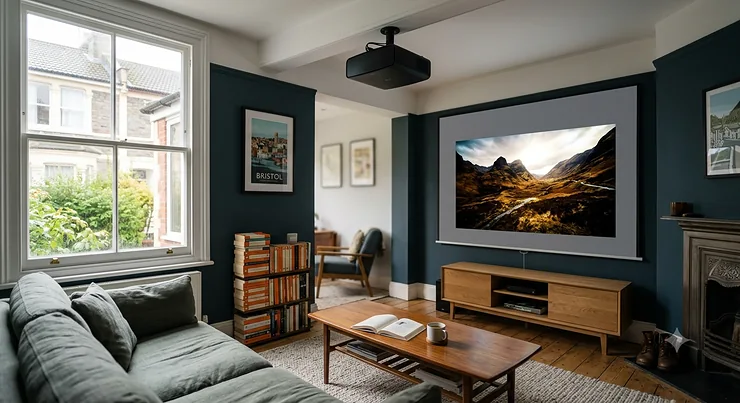
There’s a moment — usually about twenty minutes into a well-mastered film on a quality projector — when you stop watching and start experiencing. Sunsets look genuinely warm. Shadows feel deep. The contrast between a candle flame and the darkness around it looks almost three-dimensional. That moment, more often than not, comes down to one thing: proper HDR performance.
The best HDR projector doesn’t just decode an HDR signal — it actually does something useful with it. And that distinction matters enormously, especially in the UK, where many buyers are discovering that “supports HDR10” printed on a box is not always the same as a projector that handles high dynamic range content with any meaningful skill.
Finding the best HDR projector for a British living room, spare bedroom, or dedicated home cinema involves navigating a surprisingly nuanced market. HDR stands for High Dynamic Range, and in practical terms it means a vastly wider range of brightness levels and colours compared to standard video — think the kind of detail in bright highlights and dark shadows that makes a good film feel immersive rather than flat. The best HDR projectors support formats like HDR10, HDR10+, HLG (common on BBC iPlayer broadcasts), and Dolby Vision, each with slightly different approaches to the same goal: showing you the picture as the director intended.
For UK buyers, there are a few extra considerations worth keeping in mind. First, British rooms tend to be smaller and less easy to black out completely than purpose-built home cinemas — so brightness and contrast matter more than raw resolution alone. Second, the damp British climate means sealed optics and reliable build quality matter more here than they might in sunnier climates. Third, all projectors sold through Amazon.co.uk must be compatible with UK mains voltage (230V/50Hz) and come with a Type G plug — which the models in this guide all are.
We’ve researched and analysed seven of the best HDR projectors currently available on Amazon.co.uk across a wide range of budgets, from smart portable units in the mid-£200s to serious home cinema investments north of £2,500. Read on to find your perfect match.
Quick Comparison: Best HDR Projectors UK 2026
| Projector | HDR Formats | Brightness | Native Res | Price Range | Best For |
|---|---|---|---|---|---|
| WiMiUS G2 | HDR10 | 2500 ANSI | 1080p | £200–£280 | Budget buyers, bedrooms |
| TOPTRO X9 Pro | HDR10 | 2200 ANSI | 1080p (4K decode) | £200–£270 | Affordable smart TV feel |
| Anker Nebula Capsule 3 | Dolby Digital, HDR | 200 ANSI | 1080p | £300–£380 | Portability, travel |
| BenQ GP520 | HDR10+, HLG | 2600 ANSI | 4K | £850–£1,000 | Living rooms, casual use |
| Hisense M2 Pro (M2TUK) | Dolby Vision, HDR10, HLG | 1300 ISO | 4K | £1,000–£1,300 | Serious cinephiles, versatility |
| BenQ W2720i | HDR10+, HDR10, HLG | 2500 ANSI | 4K LED | £1,200–£1,500 | Mid-premium home cinema |
| XGIMI Horizon 20 Max | Dolby Vision, HDR10+, HLG | 5700 ISO | 4K Triple Laser | £2,500–£2,700 | Premium, bright rooms |
The table above shows a clear pattern: as budget increases, so does HDR format support and brightness — two factors that are closely linked to real-world HDR performance. The BenQ GP520 represents a significant leap over the budget models in terms of actual 4K output, while the Hisense M2 Pro and BenQ W2720i both hit a sweet spot where HDR tone mapping genuinely impresses. For those who want the absolute best and can stretch the budget, the XGIMI Horizon 20 Max’s 5,700 ISO lumens makes it the only projector here that handles HDR convincingly even with some ambient light.
✨ Don’t Miss These Exclusive Deals!
🔍 Take your home cinema to the next level with these carefully selected HDR projectors. Click on any highlighted product name to check current pricing and availability on Amazon.co.uk. These picks will help you find exactly what you need!
Top 7 HDR Projectors UK 2026: Expert Analysis
1. WiMiUS G2 — Best Budget HDR Smart Projector
The WiMiUS G2 is what happens when Chinese manufacturers genuinely listen to their audience. This isn’t your average cheap projector with inflated lumen claims and a mediocre picture — it runs Google TV 14.0, outputs 2,500 ANSI lumens, and includes MEMC motion processing, all for a price that sits firmly in the “impulse buy” category.
In practical terms, the native 1080p output is sharp and, with 4K content decoded via HDMI 2.1, there’s noticeably more depth and texture than you’d expect at this price. The HDR10 support works best in a properly darkened room — and in a typical British semi-detached with blackout curtains drawn, the difference between HDR and SDR content is genuinely visible. The MEMC motion handling deserves a special mention: instead of the dreaded “soap opera effect” that plagues cheap projectors, the G2 preserves a cinematic motion blur that feels natural. A UK reviewer who works professionally in live event projection described it as “a properly polished, modern home cinema system rather than a typical budget projector” — and that’s high praise from someone who’s handled serious kit.
The 40W Dolby Audio output is surprisingly room-filling, meaning you can genuinely get away without external speakers for casual viewing — useful in a smaller flat where wires and extra kit are impractical. AI auto-focus and keystone correction handle themselves competently, making setup effortless.
✅ Google TV 14.0 with all UK streaming apps
✅ MEMC motion processing — rare at this price
✅ 40W Dolby Audio avoids the need for external speakers
❌ HDR performance drops significantly in anything other than a darkened room
❌ Native 1080p only — not true 4K output
In the £200–£280 range, the WiMiUS G2 is a strong choice for anyone furnishing a bedroom or rented flat where spending £1,000+ on a projector isn’t realistic. Check current price on Amazon.co.uk.
2. TOPTRO X9 Pro — Best for Smart Streaming on a Budget
The TOPTRO X9 Pro takes a slightly different approach to the budget market by partnering with VIDAA, Hisense’s smart TV operating system, which gives it a considerably more polished smart platform than most rivals at this price. Dolby Digital audio, voice control, and fast app loading make it feel closer to a £500 product than one in the £200–£270 range.
The 2,200 ANSI lumens rating is honest — not the wildly inflated “20,000 lumen” marketing nonsense that plagues this market — and in a typical British living room with the curtains drawn on a grey autumn afternoon, images are bright enough for comfortable viewing. HDR10 support delivers decent dynamic range in dark scenes, though highlight detail in very bright areas (fireworks, sunsets) does compress slightly due to the limited peak brightness. The 40W dual speaker system is a genuine asset and produces warm, surprisingly full sound.
What TOPTRO gets right that many rivals miss is reliability. The X9 Pro runs quietly, stays cool, and the VIDAA platform is stable and responsive. For a British family in a terraced house looking to set up a casual home cinema without a complicated installation or a dedicated dark room, this delivers solid value.
✅ VIDAA OS — stable and well-supported with Netflix, YouTube, Disney+
✅ 40W dual speakers provide genuine room-filling sound
✅ Honest brightness rating and quiet operation
❌ HDR highlight detail is average — limited by peak brightness ceiling
❌ No Dolby Vision or HDR10+ support
At around £200–£270 on Amazon.co.uk, the TOPTRO X9 Pro is the budget pick for buyers who prioritise smart TV usability over raw picture quality.
3. Anker Nebula Capsule 3 — Best Portable HDR Projector
The Anker Nebula Capsule 3 is genuinely clever engineering compressed into a can-shaped package the size of a large drinks bottle. Don’t let the diminutive dimensions fool you — this earns its place in a best HDR projector guide because it does something no other projector here can: it goes wherever you do.
At 200 ANSI lumens, the Capsule 3 is the least bright projector on this list by a considerable margin, and in a brightly lit room it’ll struggle. But dim the lights, pull the curtains, and project onto a wall or portable screen, and it produces a genuinely watchable 1080p image with Dolby Digital audio and proper HDR support. The Google TV operating system includes all UK catch-up apps — BBC iPlayer, ITVX, Channel 4, Netflix, Prime Video, Disney+ — which makes it more useful in the UK context than many rivals that omit crucial British services. The built-in battery provides around 2.5 hours of playback, which comfortably covers most films.
For UK buyers, the IPX3 water resistance rating and 30,000-hour LED lifespan are quietly reassuring — this is a product built to last, not to be discarded after a summer of garden screenings. The 120-inch maximum picture size is achievable from a sensible throw distance, making outdoor use in a modest British garden perfectly viable on warmer evenings.
✅ Genuinely portable with 2.5-hour battery
✅ Google TV with all major UK streaming apps including catch-up
✅ IPX3 water resistance — reassuring for UK outdoor use
❌ 200 ANSI lumens limits use to dark environments
❌ No 4K output — 1080p only
At around £300–£380 on Amazon.co.uk, this is the only sensible choice for buyers who need genuine portability alongside decent HDR performance.
4. BenQ GP520 — Best 4K HDR Projector for Living Rooms
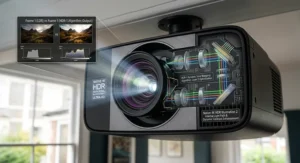
The BenQ GP520 represents a significant step up in capability. Where the budget models above decode HDR10 and display it with varying degrees of competence, the GP520 is a genuine 4K projector with HDR10+ support, meaning it can apply dynamic tone mapping that adjusts scene by scene — a substantially more sophisticated approach to HDR than the static HDR10 used by cheaper options.
Powered by a 4LED light source delivering 2,600 ANSI lumens, the GP520 produces bright, well-saturated images with 98% Rec.709 colour accuracy. In practical terms, this means skin tones look natural rather than waxy, reds don’t bloom excessively, and dark scenes retain detail rather than crushing to black. Google TV is baked in, with HDMI 2.1 support enabling smooth 4K streaming from a Chromecast, Fire TV Stick, or directly via built-in apps. The eARC support means it integrates neatly into a living room soundbar setup — valuable for UK buyers who may not want the cabling complexity of a separate AV receiver.
BenQ’s Auto Cinema Mode is a thoughtful feature that automatically adjusts colour temperature and brightness based on ambient light — useful for typical British living rooms where controlling every lumen of incoming light isn’t always practical.
✅ True 4K output with HDR10+ dynamic tone mapping
✅ 2600 ANSI lumens — bright enough for some ambient light
✅ Auto Cinema Mode adapts to UK living room conditions
❌ 4LED light source lacks the contrast depth of laser alternatives
❌ No Dolby Vision support
In the £850–£1,000 range, the BenQ GP520 is the sensible entry point into proper 4K HDR home cinema for UK buyers who don’t want to spend four figures on a projector.
5. Hisense M2 Pro (M2TUK Pro) — Best Mid-Range HDR Projector
The Hisense M2 Pro — sold on Amazon.co.uk as the M2TUK Pro — is, without question, the most complete package in the mid-range bracket, and possibly one of the most impressive home cinema products available at any price that doesn’t require permanent installation.
What makes it remarkable is the combination: a triple-laser Trichroma light source (covering 110% of BT.2020 colour space), full Dolby Vision support, IMAX Enhanced certification, and VIDAA smart TV software — in a compact 3.9kg unit that sits on its own adjustable stand and doesn’t need ceiling mounting. The triple-laser output delivers genuinely vivid, accurately coloured HDR images that the budget alternatives simply cannot match. What Hi-Fi?, testing the unit in a professional viewing room, noted that watching Civil War, “the flames have a wonderful hue of red and an intensity that makes them suitably distinct from the silhouette of the background forest” — that’s the kind of commentary that signals real HDR performance.
For UK buyers, the M2 Pro hits a particular sweet spot. It’s compact enough to store in a cupboard in a smaller British home, quick to set up on a coffee table or bookshelf, and the 200-inch maximum image size is more than enough for most rooms. The VIDAA platform includes Netflix, Disney+, YouTube, and Prime Video natively. DTS Virtual:X audio is impressively room-filling for built-in speakers, though we’d still recommend adding a soundbar for serious film nights. One caveat: as a short-throw model without optical zoom, placement flexibility is more limited than traditional projectors — worth checking your room dimensions before buying.
✅ Triple-laser Trichroma with Dolby Vision and IMAX Enhanced
✅ Compact and storage-friendly — ideal for smaller UK homes
✅ 5-star award from What Hi-Fi? for performance per pound
❌ Short-throw placement limits flexibility
❌ Built-in audio, while capable, benefits from a soundbar addition
Priced in the £1,000–£1,300 range on Amazon.co.uk, the Hisense M2 Pro is exceptional value for a serious cinephile who wants genuine HDR performance without a permanent installation.
6. BenQ W2720i — Best Mid-Premium HDR Home Cinema Projector
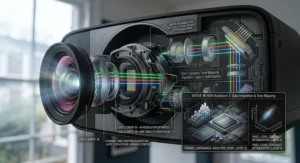
The BenQ W2720i arrives with one of the more impressive specification sheets in this bracket, and — unusually for a projector — it largely lives up to them. The AI Cinema Mode is not mere marketing: it genuinely analyses scenes and adjusts brightness and tone mapping in real time, which translates to HDR content that looks consistently balanced rather than occasionally washed out and occasionally over-processed.
Factory-calibrated to Delta E <3 — a level of colour accuracy that professional displays aim for — the W2720i produces images where the colour is simply right from the moment you turn it on. The 4K LED light source, covering 90% of the wider DCI-P3 colour space, gives HDR content a richness that LED-lit projectors rarely achieve. HDR10+ dynamic tone mapping and HLG support make it compatible with everything you’re likely to encounter: HDR10 streaming content, HDR10+ discs, and HLG broadcasts from the BBC. The 7.1-channel audio pass-through via eARC makes integration into an existing home cinema setup seamless.
For a UK buyer in a semi-detached or detached home with a dedicated viewing room or a lounge that can be reasonably controlled for light, the W2720i delivers a picture quality that genuinely rivals much more expensive options. The ±5% vertical lens shift is genuinely useful for flexible placement in British rooms where ceiling heights and furniture positions don’t always cooperate with ideal projector placement.
✅ Factory-calibrated colour accuracy — impressive out of the box
✅ AI Cinema Mode with HDR10+ dynamic tone mapping
✅ Lens shift for flexible placement in varied room types
❌ LED light source means slightly lower contrast depth than laser alternatives at this price
❌ Premium price point requires a dedicated or controlled viewing environment to justify
At £1,200–£1,500 on Amazon.co.uk, the BenQ W2720i is the choice for buyers who want serious, calibrated HDR performance and won’t settle for average.
7. XGIMI Horizon 20 Max — Best Premium HDR Projector
The XGIMI Horizon 20 Max is, frankly, in a different league. With 5,700 ISO lumens from a triple-laser RGB light source, Dolby Vision support, optical zoom with genuine lens shift, and Google TV with licensed Netflix — this is the projector that changes the conversation about what’s possible without a dedicated installation.
The 5,700-lumen output is the number that matters most here, because it’s what makes HDR actually work in a room with some ambient light. High dynamic range requires genuine brightness headroom to show the difference between a bright highlight and a mid-tone. At the brightness levels of budget and mid-range projectors, HDR tone mapping is a compromise. At 5,700 ISO lumens, it isn’t. The result is HDR imagery — particularly Dolby Vision content from Netflix or Apple TV+ — that carries the kind of perceptual depth and subtlety that you previously needed a dedicated darkened room and a £5,000 projector to achieve.
The hinged gimbal stand allows pointing adjustments without moving the entire unit — a practical feature for British living rooms where the projector might need to sit on a coffee table pointing slightly upward, or on a shelf pointing slightly downward. The 240Hz refresh rate and 1ms input lag make it an exceptional gaming projector too — relevant for PS5 and Xbox Series X owners who want their HDR gaming to match the scale of their displays.
Expert Reviews UK rated the Horizon 20 Max among the best portable projectors tested, noting its “super-bright picture quality” and particularly its handling of animated content with “bold colors, powerful contrast, and great detail.”
✅ 5700 ISO lumens — HDR performance in ambient light conditions
✅ Dolby Vision, HDR10+, HLG — comprehensive format support
✅ 240Hz/1ms gaming performance with Dolby Vision
❌ Premium price — around £2,500–£2,700 on Amazon.co.uk
❌ Size and weight (similar to a small cube) rules out ultra-portable use
How to Set Up Your HDR Projector for the Best Results in a UK Home
Getting the most from your HDR projector requires a few setup steps that the instruction manual rarely covers adequately. Follow these and you’ll notice an immediate improvement.
Choose the right picture mode first. Almost every projector ships with a default mode set to maximum brightness — which typically looks vivid but inaccurate, with oversaturated colours and poor HDR tone mapping. Switch to “Cinema,” “Filmmaker,” or “Calibrated” mode immediately. It’ll look dimmer at first, but the colours will be correct and HDR content will look substantially more natural.
Control your ambient light. In the UK, we deal with variable daylight — long summer evenings can cause problems even with decent projectors. Blackout blinds or heavy curtains are worth the investment. If you’re projecting in a room that can’t be fully darkened, prioritise a projector with at least 2,000 ANSI lumens (not the inflated “lumen” figures many budget models advertise — those numbers refer to LED brightness, not ANSI standard measurement).
Calibrate your screen or wall. A grey or cream wall reflects light unevenly and adds a colour cast to the image. A proper projector screen — even a relatively affordable pull-down model — makes a noticeable difference to contrast and HDR performance. In a compact British flat where wall mounting isn’t an option, a portable tensioned screen is a reasonable alternative.
Check your HDMI cable. HDR10+ and Dolby Vision at 4K resolution require an HDMI 2.1 cable, or at minimum a Premium HDMI 2.0 cable certified for 18Gbps bandwidth. The cable bundled with budget projectors often isn’t up to the task — worth spending a few pounds on a certified cable.
Allow 30 minutes warm-up. Laser projectors maintain consistent brightness from cold, but LED-based models can vary slightly in their first 20–30 minutes of use. For critical viewing, give the projector time to reach operating temperature before judging the picture quality.
Real-World Scenarios: Which HDR Projector Suits You?
Choosing a projector is easier when you can see yourself in the purchase. Here are three typical British buyers and the model that best fits their situation.
The London flat-dweller: Sophie rents a one-bedroom flat in Hackney. She wants a big-screen experience without permanently mounting anything or annoying her downstairs neighbours with excessive bass. Her lounge is small — about 4 metres long — and she can draw the blinds but can’t fully black it out. Budget: up to around £300. Best pick: WiMiUS G2. The Google TV integration, 40W built-in audio, and 2,500 ANSI lumens deliver a genuinely impressive living room cinema without requiring a separate sound system or complicated setup.
The suburban family in Manchester: The Patels have a semi-detached in Didsbury with a spare reception room they occasionally use for movie nights. They want something that handles HDR Blu-ray rips and Netflix 4K content with real quality, can be tucked away in a cupboard between uses, and doesn’t require a permanent black-out setup. Budget: £1,000–£1,300. Best pick: Hisense M2 Pro (M2TUK Pro). The portable form factor, triple-laser picture quality, and Dolby Vision support give them a genuine cinema-quality experience that’s genuinely stored-away-after-use practical.
The home cinema enthusiast in Edinburgh: David has a dedicated room in his detached home in Morningside, runs a 120-inch fixed screen, and wants the best HDR projector that doesn’t require a £5,000 ceiling-mounted installation. He games on a PS5 and watches a lot of Dolby Vision content on Apple TV+. Budget: £1,200–£1,600. Best pick: BenQ W2720i. The factory-calibrated colour accuracy, AI Cinema Mode, HDR10+ dynamic tone mapping, and eARC integration give him picture quality that rivals native 4K TVs at a fraction of the price.
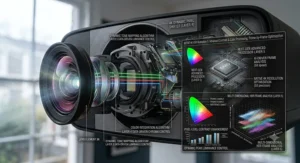
What to Expect: Real-World HDR Performance in British Conditions
One of the most common disappointments among first-time projector buyers in the UK is the gap between HDR performance claimed on the box and HDR performance experienced in a typical British living room. Let’s close that gap with some honest commentary.
Brightness is the limiting factor. Genuine HDR requires high peak brightness to show the “pop” in highlights — the specular gleam on a wet road in the rain, the flare of a candle, the bright sky above a dark building. Most consumer projectors, even those claiming “HDR10 support,” have insufficient peak brightness to render these highlights with the same impact as a good OLED or QLED TV. The more you spend on a projector, the brighter its HDR highlights become. Below around 1,000 ANSI lumens, HDR content is being significantly tone-mapped downward, and the HDR benefit is largely theoretical.
Contrast is the other key. Deep black levels allow the range between dark and bright parts of the image to look genuinely dramatic. Laser projectors generally produce deeper blacks than LED alternatives at the same price. The Hisense M2 Pro’s triple-laser light source produces a measured contrast ratio of around 1,685:1 — which translates to genuinely dramatic HDR imagery with convincing shadow detail.
UK broadcast HDR: The BBC broadcasts HDR content via iPlayer in HLG format — a format specifically designed for broadcast rather than streaming services. HLG support is present on all seven projectors in this guide, but performance varies. On the BenQ W2720i and XGIMI Horizon 20 Max, HLG content from BBC iPlayer looks genuinely impressive. On budget models, the improvement over SDR is more modest.
Cold weather considerations: Projector performance in cold environments is worth noting. Laser light sources are more affected by cold temperatures than LED — most manufacturers recommend operating above 5°C. In a well-heated British home this isn’t usually a concern, but an unheated garage cinema may need a brief warm-up period in winter months.
HDR Projector vs HDR TV: Which Is Right for You?
This is a question worth addressing directly, because for many UK buyers the honest answer might be “a good TV.”
A premium 65-inch OLED TV typically outperforms a projector costing twice as much in terms of absolute HDR performance — peak brightness, contrast, and colour accuracy. If you want the best possible HDR picture quality in an average-sized room, a television is a more efficient use of money.
Where projectors win, and win convincingly, is in screen size. A 120-inch projected image at 4K HDR creates a sense of immersion and scale that no TV can match outside of absurdly expensive commercial displays. Watching sport, films, or gaming on a 120-inch screen in your own home is categorically different from watching on a 65-inch TV — and that experience is available for less than £1,500 with the right projector.
The practical advice: if your primary concern is picture quality per pound and your room maxes out at a 65-75-inch display size, a good OLED TV (particularly LG or Sony’s current ranges) will likely satisfy more than a projector. If you want a screen larger than 80 inches and the immersive experience that comes with it, a well-chosen HDR projector is the right call. You can read more about choosing between TV and projector options via the BBC’s technology coverage and Which? projector reviews, both excellent resources for UK consumers.
For a broader understanding of how HDR formats work — particularly HLG, which is relevant to UK broadcast viewers — the Wikipedia article on High Dynamic Range television is worth reading before making a decision.
Common Mistakes When Buying an HDR Projector in the UK
Avoid these pitfalls and your projector purchase is far less likely to end in buyer’s remorse.
Trusting lumen numbers uncritically. “20,000 lumens” on a £150 projector is almost certainly an LED brightness figure, not an ANSI lumen measurement. ANSI lumens are the industry standard and typically run at around 10-15% of the inflated figures used by budget brands. The WiMiUS G2’s 2,500 ANSI lumens and the BenQ GP520’s 2,600 ANSI lumens are honest figures that you can actually compare meaningfully.
Buying a US-voltage model from a third-party seller. Some Amazon.co.uk marketplace sellers list projectors designed for North American 110V/60Hz power. While most modern projectors use switching power supplies that accept 100-240V, it’s worth confirming the voltage compatibility before buying — and ensuring the model comes with a UK Type G plug or a proper adaptor, not a flimsy travel plug converter. All seven projectors in this guide are sold through Amazon.co.uk with full UK compatibility.
Ignoring throw ratio. The throw ratio determines how far back you need to place the projector to achieve a given screen size. A projector with a throw ratio of 1.5:1 placed 3 metres from the screen produces a 2-metre-wide image — roughly 90 inches diagonal. A short-throw model at the same distance might achieve 150 inches. In compact British rooms where you can’t always place the projector far back, short-throw ratios are genuinely important.
Overlooking streaming app availability. Some projectors run Android TV or VIDAA OS with full UK streaming support; others have limited app selections that omit BBC iPlayer, ITVX, or Channel 4. For UK buyers, the catch-up app situation is particularly important. Check what’s available before buying, and if in doubt, factor in the cost of a £40–£50 streaming stick such as the Amazon Fire TV Stick 4K Max.
Assuming HDR support means HDR performance. As discussed above, “supports HDR10” means the projector accepts the HDR signal — not that it displays it with any particular quality. Look for models with dynamic tone mapping (HDR10+ or Dolby Vision) and sufficient peak brightness to make that tone mapping meaningful.
Long-Term Value: Cost of Ownership in the UK
Projectors have evolved dramatically in terms of running costs over the past decade. The shift from lamp-based technology to LED and laser light sources has transformed the economics.
Lamp projectors (increasingly rare in new models) typically need their lamp replacing every 3,000–5,000 hours. Replacement lamps for quality brands like Epson or Sony cost £80–£200 on Amazon.co.uk. If you watch four hours of content per day, that’s a lamp replacement roughly every two to three years — a non-trivial ongoing cost.
LED and laser projectors — which include all seven models in this guide — are rated for 25,000–30,000 hours of use. At four hours per day, that’s roughly 17–20 years of viewing. The ongoing cost is essentially zero beyond electricity. At UK electricity rates (currently around 24p per kWh), a projector consuming 200W costs roughly 5p per hour to run — negligible compared to the upfront investment.
Screen costs: A decent 100-inch motorised projector screen costs around £100–£200 on Amazon.co.uk and dramatically improves image quality over projecting onto a painted wall. Factor this into your budget if you haven’t already.
Warranty: Most projectors sold via Amazon.co.uk come with a minimum one-year UK warranty, with some brands offering two or three years. Under the UK Consumer Rights Act 2015, goods must be of satisfactory quality, and you have up to six years to make a claim if a fault develops that isn’t fair wear and tear. Additionally, the 14-day cooling-off period under the Consumer Contracts Regulations means you can return any online purchase within 14 days, no questions asked — stronger consumer protection than most countries offer.
For more on UK consumer rights when purchasing electronics, the Citizens Advice guide to your consumer rights is an excellent starting point.
FAQ: Best HDR Projectors in the UK
❓ What does HDR mean on a projector?
❓ Is Dolby Vision worth the extra cost in a projector?
❓ Can I use an HDR projector during the day in a UK living room?
❓ Do HDR projectors on Amazon.co.uk come with UK plugs?
❓ What screen size do I need for proper HDR viewing in a typical UK room?
Conclusion: Finding the Best HDR Projector for Your UK Home
The best HDR projector for you depends almost entirely on how you intend to use it and how much control you have over your viewing environment. For most buyers, the sweet spot sits between the WiMiUS G2 at the budget end and the Hisense M2 Pro at the mid-range — both deliver genuinely satisfying HDR performance in a darkened British room, at prices that don’t require a lengthy budgeting conversation.
If your budget stretches to the BenQ W2720i, the quality jump is significant and the factory calibration means you’re getting professional-grade colour accuracy without needing to spend additional money on professional calibration. And if the XGIMI Horizon 20 Max’s price tag is within reach, you’re buying the most capable portable HDR projector currently available on Amazon.co.uk — one that handles HDR even with ambient light, plays games at 240Hz with 1ms lag, and genuinely transforms any room into a home cinema.
Whatever you choose, a few principles will serve you well: prioritise brightness and contrast over resolution for HDR performance, invest in at least a basic projector screen, and use the 14-day Consumer Contracts Regulations cooling-off period to your advantage — test the projector in your actual environment before committing.
✨ Don’t Miss These Exclusive Deals!
🔍 Click on any highlighted projector name in this article to check current pricing and availability on Amazon.co.uk. Prime members enjoy free next-day delivery on eligible items — so your home cinema upgrade could be set up by tomorrow evening!
Recommended for You
- Best 1080p Projector for Gaming UK 2026: 7 Top Picks Tested
- Best 1080p Projector Under £300 UK 2026: 7 Top Picks Tested
- Best 1080p Projector UK 2026: 7 Full HD Picks Reviewed
Disclaimer: This article contains affiliate links. As an Amazon Associate, I earn from qualifying purchases. If you purchase products through these links, we may earn a small commission at no additional cost to you.
✨ Found this helpful? Share it with your mates! 💬🤗
