
In This Article
A 4K projector screen is a purpose-made surface that reflects a 3840 x 2160 projected image back towards your seating position. The “4K” label is mostly a promise about flatness, surface texture and uniformity, not a different technology. A good one preserves detail, colour and contrast, and a poor one quietly wastes all three.
Picture the classic British mistake. You spend a tidy sum on a 4K projector, then beam it onto a magnolia wall with a light switch in the middle of Gandalf’s face. The picture is bright enough, but the blacks go milky and the fine detail you paid for dissolves into the paint. The cure is a proper 4K projector screen, and the brightness, contrast and viewing angle you get from it are governed largely by screen gain, a spec that is often misunderstood.
Think of this as a 4K projector screen review built on manufacturer specifications, UK editorial roundups and straightforward reasoning. It does not rest on claims of owning or testing each model. We cover seven real options from budget to premium, then the things spec sheets skip: ultra HD projector screen material, pixel density, screen weave, and the viewing distance for 4K that makes the extra resolution worth having. Where I couldn’t verify something, such as UK review volumes or exact current prices, I say so.
Quick Comparison: Seven 4K Projector Screen Options at a Glance
| Screen | Type | Listed gain / angle | Best for | Price (indicative) |
|---|---|---|---|---|
| Elite Screens Aeon CineGrey 5D | Fixed frame, ALR (standard throw) | 1.5 gain, 80° | Bright living rooms | £600-£1,200 range |
| Elite Screens Sable Frame B2 | Fixed frame, matte white | 1.1-1.3 gain (varies by listing) | Dedicated dark rooms | £250-£500 range |
| AWOL Vision Cinematic ALR | Fixed frame, ALR (UST only) | Up to 170° | Ultra short throw in living rooms | £450-£900 range |
| Celexon Electric Expert | Motorised, wall or ceiling | 1.25 gain, 150° | Shared rooms, hidden screen | £400-£900 range |
| Duronic FFPS100 | Fixed frame, 100 inch | “+1” gain per UK review | Budget first screen | £130-£150 range |
| Luxburg 100-inch Portable | Freestanding pull-up | Not clearly stated | Flexible or rented spaces | £170-£200 range |
| Vamvo 120-inch Outdoor/Indoor | Foldable with stand | Not clearly stated | Gardens and parties | £100-£150 range |
Looking at the comparison above, the Sable Frame B2 is the sensible default for anyone with a dim room and a standard-throw projector. The Aeon CineGrey 5D earns its premium only when daylight or ceiling lights are the real enemy, and the AWOL Vision Cinematic ALR is essentially mandatory for ultra short throw setups. Budget buyers should note that the Duronic FFPS100 and Vamvo 120-inch trade polish for price, so check current price and size before committing.
💬 Just one click — help others make better buying decisions too!😊
Top 7 4K Projector Screen Picks: Expert Review and Analysis
Each pick below follows the same logic: what the spec means in practice, who it suits, what the aggregated evidence says, and whether the price makes sense. Prices are indicative ranges at the time of research, so check current price before buying.
1. Elite Screens Aeon CineGrey 5D — ambient-light rejection for bright rooms
If your lounge has a big window and a pale ceiling, this is the screen that fights back against both.
Elite’s material sheet lists a 1.5 gain angular-reflective grey surface with an 80° viewing cone. In practice, the picture is boosted for people sitting broadly in front, and light arriving from above is rejected. That matters in UK homes, where overhead lights and daylight are the usual culprits. The slim “edge free” frame also turns more of the wall into picture. It is designed for standard-throw projectors, with a listed minimum projector distance of about 1.5 times the image width.
Because gain rises as viewing angle narrows, the end seats on a wide sofa will see slight fading, while centre seats get the best image. It can also rescue a modest-brightness 4K projector, though it can’t invent contrast the projector lacks. It will not work with ultra short throw projectors.
I couldn’t verify a meaningful pool of amazon.co.uk reviews at the time of research. The editorial signal is stronger: a 2026 roundup names the Aeon CineGrey 5D range its best ALR fixed-frame screen.
Pros:
- ✅ Rejects overhead light for punchier contrast
- ✅ 1.5 gain helps modest projectors
- ✅ Slim edge-free frame looks tidy
Cons:
- ❌ Narrower viewing cone than matte white
- ❌ Standard-throw projectors only
Price: premium, roughly £600-£1,200 depending on size. Verdict: worth it only if ambient light is a genuine, daily problem.
2. Elite Screens Sable Frame B2 — the dependable matte white all-rounder
Sometimes the unglamorous option is the right one, and this is it.
The Sable Frame B2 uses a tensioned matte white surface in a velvet-wrapped aluminium frame. Listings quote either 1.1 or 1.3 gain depending on version and retailer, so confirm which you’re buying. The velvet border soaks up light spill beyond the picture edges, which makes contrast feel higher. Elite lists sizes from roughly 92 to 150 inches and compatibility with standard, short and ultra short throw projectors. A neutral white surface also leaves colour calibration alone, so the projector’s settings are what you see.
For a dark living room or dedicated cinema, this is hard to fault. In a bright room it lacks the light rejection of an ALR surface, and a 1.3 gain version will show a gentle brightness roll-off to the sides.
For sentiment, US outlet Popular Science named the 120-inch Sable Frame B2 its pick for movie buffs, which is editorial praise rather than a UK review count. I couldn’t verify amazon.co.uk review volumes for this model.
Pros:
- ✅ Neutral surface keeps colours honest
- ✅ Tensioned frame stays flat
- ✅ Wide range of sizes available
Cons:
- ❌ No ambient-light rejection
- ❌ Gain figures vary between listings
Price: roughly £250-£500 depending on size and version. Verdict: the best value for dim rooms.
3. AWOL Vision Cinematic ALR — built specifically for ultra short throw projectors
Ultra short throw projectors beam upwards at a steep angle, and an ordinary screen handles that badly.
The AWOL Vision Cinematic ALR is a fixed, wall-mounted lenticular screen sold in sizes from 100 to 150 inches. It lists a 170° viewing angle and is designed to bounce light from the projector below towards your eyes while rejecting light from the ceiling. The manufacturer claims strong ambient light rejection, but treat that as a marketing figure, not a lab result. A UK retailer, Richer Sounds, stocks the 100-inch model.
The key insight is compatibility. This screen only makes sense with a UST projector, and AWOL says so itself. Used with a conventional projector, the picture would be a mess. If you own a UST projector, though, a matching ALR surface typically beats a white wall or generic screen in a lit room.
I found no verified UK review pool for this screen at the time of research. The retailer listing is promotional rather than independent.
Pros:
- ✅ Engineered for UST geometry
- ✅ Wide 170° listed viewing angle
- ✅ Slim frame blends into the wall
Cons:
- ❌ Useless with standard-throw projectors
- ❌ Larger sizes can be pricey and heavy
Price: roughly £450-£900 depending on size. Verdict: essential for UST owners, irrelevant for everyone else.
4. Celexon Electric Expert — motorised screen that disappears when you’re done
Not everyone wants a giant rectangle on the wall during the day.
The Celexon Electric Expert is a motorised screen with a fibreglass fabric, 1.25 gain and a 150° viewing angle, driven by a Somfy motor and operated from a wall switch. The fibreglass backing helps keep the surface flat, which matters for sharpness. There’s no black masking on the fabric, so any format displays, though you’ll need your own black borders if you care about contrast. Celexon’s UK site lists a range of sizes, so you can match the screen to your wall.
This suits shared rooms where the screen has to retract after movie night. Motorised screens can show slight rippling at the bottom edge compared with tensioned frames, which is a general trade-off, so installation matters. Some of Celexon’s newer ranges use a finer-textured fabric aimed at 4K, so verify which fabric your chosen variant has.
I couldn’t verify amazon.co.uk review volumes for this model, so judge it on the manufacturer’s specifications and your tolerance for motor noise.
Pros:
- ✅ Retracts out of sight when unused
- ✅ Fibreglass fabric aids flatness
- ✅ Quiet branded motor
Cons:
- ❌ Dearer than fixed-frame equivalents
- ❌ No black masking borders
Price: roughly £400-£900 depending on size. Verdict: worth it when wall space has to double as living space.
5. Duronic FFPS100 — the sensible budget fixed frame
A tensioned frame under £150 is a rarer thing than it should be.
The Duronic FFPS100 is a 100-inch, 16:9 fixed-frame screen with a matte white surface (quoted at “+1” gain), black backing and a black velvet border, measuring about 233 x 136 x 3 cm. The black backing stops light bleeding through, and the velvet border adds contrast. It’s light enough for a standard wall fixing.
Expert Reviews, a UK publication, named it the best fixed-frame screen in its 2024 roundup. The product is pitched as an HD screen, and a plain matte white surface doesn’t limit 4K detail by itself. The risk with budget fabric is texture, tension and consistency rather than the label, so check how flat it looks once hung.
I couldn’t verify a large current pool of amazon.co.uk reviews, so the editorial endorsement is the main signal.
Pros:
- ✅ Genuine fixed frame at a low price
- ✅ Black backing and velvet border
- ✅ Simple assembly
Cons:
- ❌ Only one size on offer
- ❌ Not specifically marketed for 4K
Price: around £130-£150 at the time of research. Verdict: the best entry point for a first 4K projector screen.
6. Luxburg 100-inch Portable — a freestanding screen for flexible spaces
If you rent, or the projector lives in a cupboard, a permanent frame is a non-starter.
The Luxburg 100-inch Portable is a freestanding pull-up screen, about 221 x 125 cm, with matte white fabric, black borders and black backing. A built-in carry case with a handle helps with storage. The amazon.co.uk title describes it as 4K UHD, though a portable screen’s real limit is usually flatness rather than the label.
Expert Reviews notes the main trade-off: a freestanding screen is harder to line up perfectly than a wall-mounted one, and it takes patience to get framing right. In practice, that means checking the base is level and the projector is square on. Pull-up fabric can also show waves if tension isn’t even.
Aside from that editorial note, I couldn’t verify a robust amazon.co.uk review pool at the time of research.
Pros:
- ✅ Quick to set up and pack away
- ✅ Black borders and backing for contrast
- ✅ Built-in carry case
Cons:
- ❌ Harder to align than wall-mounted
- ❌ Fabric may show ripples over time
Price: around £170-£200 at the time of research. Verdict: good for renters, poor for permanent cinemas.
7. Vamvo 120-inch Outdoor/Indoor — garden cinema without the faff
Garden movie nights are the one scenario where a fixed frame is simply wrong.
The Vamvo 120-inch Outdoor/Indoor is a foldable 120-inch screen with a stand and storage bag, marketed as wrinkle-free. Expert Reviews says the side ropes help keep it steady in rough weather and that it takes minutes to set up. At 120 inches it gives a big picture, though a bigger image is dimmer for the same projector, so you’ll want a bright model.
Even so, any lightweight outdoor screen is at the mercy of wind. Peg it down, and bring it in when the weather turns. Also, ambient light outdoors at dusk is far lower than in a living room, so a plain white surface does fine.
Aside from the Expert Reviews recommendation, I couldn’t verify a meaningful amazon.co.uk review pool for this model.
Pros:
- ✅ Large 120-inch picture for the money
- ✅ Folds into a storage bag
- ✅ Works indoors and outdoors
Cons:
- ❌ Struggles in breezy weather
- ❌ Fabric thinner than frame screens
Price: around £100-£150 at the time of research. Verdict: unbeatable for parties, unsuitable as a permanent screen.
Spec Snapshot
| Screen | Mounting | Projector compatibility | Sizes noted | Best for |
|---|---|---|---|---|
| Aeon CineGrey 5D | Wall or ceiling fixed | Standard throw | 92-165 inch | Bright rooms |
| Sable Frame B2 | Wall fixed | Standard, short, UST | 92-150 inch | Dark rooms |
| AWOL Vision Cinematic ALR | Wall fixed | UST only | 100-150 inch | UST living rooms |
| Celexon Electric Expert | Wall or ceiling motorised | Standard throw (UST not advertised) | Multiple sizes | Shared spaces |
| Duronic FFPS100 | Wall fixed | Standard throw | 100 inch | Budget buyers |
| Luxburg 100-inch Portable | Freestanding | Standard throw | 100 inch | Rentals |
| Vamvo 120-inch | Freestanding foldable | Standard throw | 120 inch | Outdoor use |
The table makes the compatibility split obvious: only the Sable Frame B2 is advertised for all three throw types, while the AWOL Vision Cinematic ALR and Aeon CineGrey 5D are specialists. Match the screen to your projector first and room second. The price gap between the Duronic FFPS100 and the Aeon CineGrey 5D is large, but the premium buys light rejection rather than extra resolution.
Setting Up Your 4K Projector Screen: A Practical Guide
A good screen can still disappoint if it’s hung badly. Work through this order.
- Measure before you buy. Width matters more than diagonal. A 100-inch 16:9 screen is about 221 cm wide and 125 cm tall.
- Check your throw distance. Throw distance equals the projector’s throw ratio multiplied by the screen width. A 1.2 ratio on a 2.2 m wide image needs roughly 2.6 m.
- Set the height. Aim to have the centre of the picture near seated eye level. A frame mounted too high gives you neck ache within an hour.
- Square the projector. Use lens shift or physical positioning rather than digital keystone correction, which resamples the image and softens fine detail.
- Tame the borders. If your screen has no black border, a thin matte black surround or masking tape on the wall sharpens perceived contrast.
- Calibrate. Pick a cinema or calibrated picture mode and check brightness and colour on a familiar film.
For upkeep, Elite’s materials guidance suggests cleaning surfaces gently with a microfibre cloth. Avoid touching the surface, dust fixed frames monthly, and let motorised screens retract fully. In your first 30 days, the common mistakes are over-tightening tension, leaving a portable screen out in damp air, and blaming the screen for what is actually a focus problem.
Real-World Scenarios: Which 4K Projector Screen Fits Which Home?
These are hypothetical profiles, designed to show how the reasoning works.
The renter in a one-bed flat. Budget is around £250 for everything screen-related, and movie nights happen two or three times a week. A Luxburg 100-inch Portable gives flexibility without drilling, while the Duronic FFPS100 is better if the landlord tolerates a wall fixing. The room is small, so 100 inches is plenty.
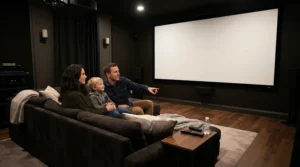
The sunlit family lounge. The family owns a UST projector, the room has big windows, and viewing happens most afternoons. A UST-specific ALR such as the AWOL Vision Cinematic ALR is the logical match, with the budget set aside to match. Wide seating suits the 170° listed angle better than a narrow-cone screen would.
The garden host. Summer weekends, a bright portable projector, and a lawn. The Vamvo 120-inch wins on price and scale, and pegging it down matters more than any spec. A fixed frame outdoors would be wasted money.
The dedicated cinema room. Dark walls, controlled lighting, and a standard-throw projector. The Sable Frame B2 delivers a neutral, flat surface, and you can spend the saved money on a better projector.
How to Choose a 4K Projector Screen
- Start with throw type. A UST projector needs a UST-specific screen, while a standard projector needs a conventional one. Get this wrong and nothing else matters.
- Size for your seats. Measure the distance from your sofa to the wall, then use the viewing distance for 4K guidance below.
- Judge your light. Dark room: matte white. Bright room: consider an ALR surface, accepting the narrower viewing cone.
- Match gain to your projector and seating. Low brightness projectors benefit from higher gain; wide sofas prefer lower gain.
- Pick the format. Fixed frames are flattest, motorised screens hide away, and portable screens trade flatness for flexibility.
- Check the surface. Look for smooth, fine, uniform texture. Only choose a perforated or woven surface if you want speakers behind it.
4K Screen vs Standard Projector Screen
The 4K screen vs standard projector screen debate is partly marketing. No screen adds resolution, so the question is what a screen might subtract. A 4K image packs four times the pixels into the same area, so surface roughness, uneven tension or visible texture can mask fine detail that a 1080p image would hide. Celexon, for example, describes a finer-textured fabric aimed at 4K.
| Feature | 4K-ready screen | Standard/budget screen | Best for |
|---|---|---|---|
| Surface texture | Fine, uniform | Variable | Close seating |
| Flatness | Tensioned frame, often | May ripple | Dark rooms |
| Gain consistency | Specified | Often vague | Critical viewing |
| Price | £250+ (e.g. Sable Frame B2) | £100-£150 (e.g. Duronic FFPS100) | Budget buyers |
| Best for | Dedicated cinemas | Casual viewing | N/A |
The practical gap between a decent budget screen and a premium one is smaller than the labels suggest. A flat, matte white Duronic FFPS100 will likely beat a rippling, expensive screen, so tension and surface quality matter more than a “4K” sticker. Spend extra only when you need something a basic screen can’t do, such as light rejection or motorised retraction.
Ultra HD Projector Screen Material: Gain, Fabric and Coatings
Ultra HD projector screen material comes down to three things: gain, surface structure and backing. Gain is a brightness ratio against a reference surface, and no light is actually added. A 1.1 gain screen reflects about 10% more light than a 1.0 reference, but higher gain generally narrows the viewing angle.
Matte white diffuse surfaces typically sit between 1.0 and 1.3 gain with wide viewing angles, which is why they suit dark rooms and wide seating. Grey and angular-reflective materials, like the one on the Aeon CineGrey 5D, trade viewing angle for better black levels under ambient light. Surfaces are commonly vinyl or fibreglass, with fibreglass favoured for flatness, as on the Celexon Electric Expert.
Backing also matters. A black back stops light passing through the fabric and bouncing around, which helps contrast. When shopping for ultra HD projector screen material, ask four questions: what is the gain, what is the viewing cone, is the texture fine enough for close seating, and does it suit your throw type?
Pixel Density: Why Screen Size Changes What You See
Pixel density on a projection screen is simply 3,840 pixels divided by the screen’s width, and it falls as the screen grows. A 4K image has about 8.3 million pixels. Spread across a 100-inch screen (about 87 inches wide), that works out to roughly 44 pixels per inch. At 120 inches it drops to about 37, and at 150 inches to about 29. A 65-inch 4K television, by contrast, manages roughly 68.
That sounds alarming, but it’s about distance. A pixel on a 100-inch screen is roughly 0.58 mm across, and for typical 20/20 vision it blends into its neighbours at about 2 metres. At 120 inches that distance is about 2.4 m, and at 150 inches about 3 m. Sit nearer, and you may see the grid; sit further back, and it disappears.
Why does the screen matter here? If its own surface texture approaches the size of a pixel, it softens the image. That’s why finer, flatter surfaces are worth choosing as you go bigger.
Screen Weave: When Texture Becomes a Problem
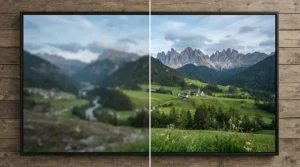
Screen weave matters mainly if you want speakers hidden behind the screen. Acoustically transparent screens fall into two types, woven or perforated. According to Stewart Filmscreen, moiré is an interference pattern that appears when the projector’s pixel grid lines up with the screen’s holes or weave gaps, and it can be managed through analysis of pixel spacing.
For 4K, that analysis matters more because pixels are smaller and closer together. Tighter weaves, such as Elite’s AcousticPro-4K material and Snap AV’s Ultra AcoustiWeave, are marketed as moiré-free for this reason. Woven surfaces can also produce a slight “sparkle” where raised fibres reflect unevenly, and perforated vinyl avoids that but can have its own anomalies.
None of the seven picks above relies on an acoustically transparent surface. If you don’t need speakers behind the screen, a solid surface sidesteps screen weave problems entirely. If you do, budget for a premium material and keep your seats a little further back.
Viewing Distance for 4K: Where to Sit
The viewing distance for 4K depends on screen size and the viewing angle you want. THX recommends a 40° field of view, and a handy rule from Sound & Vision is to divide the diagonal by 0.84. SMPTE suggests 30°, roughly the diagonal divided by 0.6. As Kaleidescape’s guide puts it in essence, 4K is most worthwhile at the closer THX angle, while 30° suits mixed viewing.
| Screen size | THX 40° (immersive) | SMPTE 30° (relaxed) | Best for |
|---|---|---|---|
| 100 inch | about 3.0 m | about 4.2 m | Small lounges |
| 120 inch | about 3.6 m | about 5.1 m | Medium rooms |
| 135 inch | about 4.1 m | about 5.7 m | Larger rooms |
| 150 inch | about 4.5 m | about 6.4 m | Dedicated cinemas |
If your sofa sits around 3 metres from the wall, 100 inches is the immersive sweet spot, and 120 inches suits a 3.5-4 metre seat. Sit closer than the THX distance and you’ll see the pixel grid on bigger screens, as the pixel density figures above suggest. Sit beyond the SMPTE distance and you’ve paid for resolution you can’t resolve, so pick the distance first and the screen second.
Common Mistakes When Buying a 4K Projector Screen
- Buying by diagonal alone. Width and height decide whether it fits your wall.
- Ignoring throw type. A UST projector and a standard screen is a recipe for disappointment.
- Chasing gain. Higher gain can mean hot spots and a narrow viewing cone.
- Paying for the “4K” label. Flatness and surface quality matter more.
- Forgetting ambient light. A bright room needs light rejection, not just a bigger screen.
- Skipping the borders. Black edges noticeably improve perceived contrast.
Long-Term Cost and Maintenance
Screens are one of the few cinema components that rarely depreciate in usefulness. Say you watch two films a week for five years: that is roughly 520 sessions. A screen costing around £130 works out at about 25p a session, and one costing around £900 comes to about £1.75. Neither figure is ruinous.
The real ongoing costs are small: a microfibre cloth, occasional tension checks on frames, and keeping portable screens dry. Motorised screens add a motor that could fail eventually, so check the warranty length. Spending more on a screen that outlasts two projectors is often better value than replacing a cheap one.

FAQ
❓ Can a white wall replace a 4K projector screen?
❓ How much should I spend on a 4K projector screen in the UK?
❓ Is a fixed frame or motorised 4K projector screen better?
❓ Will any 4K projector screen work with an ultra short throw projector?
❓ How do I stop my 4K projector screen rippling?
Conclusion
The best 4K projector screen is the one that suits your projector, your room and your seats, not the one with the biggest gain figure. For dark rooms, the Sable Frame B2 is the sensible mid-range choice. For bright lounges, the Aeon CineGrey 5D fights ambient light, while the AWOL Vision Cinematic ALR is the natural partner for ultra short throw projectors. The Celexon Electric Expert hides away when you need your wall back, and the Duronic FFPS100, Luxburg 100-inch Portable and Vamvo 120-inch cover budget, flexible and garden use.
Remember the bigger lessons from this 4K projector screen review: pixel density falls as screens grow, screen weave only matters if you want hidden speakers, and the viewing distance for 4K decides whether your extra pixels are visible. Measure first, check your throw type, and treat the “4K” label as a starting point. Verify current prices and specifications before buying, because listings change.
✨ Don’t Miss These Exclusive Deals!
🔍 Take your home cinema to the next level with these carefully selected screens. Click on any highlighted item to check current pricing and availability. The right surface will help you create authentic movie nights your family will love!
Recommended for You
- Curved Projector Screen For Gaming: 7 Best Picks UK (2026)
- Curved Screen For Ultra Wide Projection: 7 Best Picks (2026)
- Curved Projector Screen: 7 Best Picks, Honestly Compared (2026)
Disclaimer: This article contains affiliate links. As an Amazon Associate, I earn from qualifying purchases. If you purchase products through these links, we may earn a small commission at no additional cost to you.
✨ Found this helpful? Share it with your friends! 💬🤗
