
In This Article
Here’s an uncomfortable truth about home cinema. You can spend four figures on a triple-laser projector and then throw its image onto a patch of magnolia emulsion. The result looks like a Ferrari stuck in a car park queue.
A good 8K projector screen fixes that mismatch. Strictly speaking, no screen is “8K”. A screen is a passive surface and has no pixels. But an 8K-ready surface has a texture fine enough to stay out of the way of 8K resolution, which is 7,680 × 4,320 pixels. It also handles laser speckle and tames the lights you can’t switch off. Pick wrongly and you get a shimmering, grainy picture that wastes the projector’s money. Pick well and the image looks as if it’s floating on the wall.
This guide covers seven real, currently listed screens. It pairs them with the right projector types and explains what the spec sheets leave out. It also covers our secondary topics: the 8K gain screen for home cinema, the 4K screen for laser projectors, laser projector pairing, ultra-fine screen texture and future-proofing. Nothing here is lifted from retailer blurb. It’s analysis built on published specs and the review material that could genuinely be verified.
Quick Comparison: The 7 Best 8K Projector Screen Options at a Glance
Before the detail, here’s the lay of the land. Price bands are indicative and loosely converted from international listings, so check current prices before buying.
| Product | Screen type | Projector pairing | Indicative price band (120″) | Best For |
|---|---|---|---|---|
| AWOL Valerion PureVision Fixed Frame | PET matte, fixed frame | Long-throw RGB laser | £500–£900 | Speckle-sensitive purists |
| Valerion PureVision Motorized | PET matte, motorised drop | Long-throw RGB laser | £800–£1,300 | Living rooms with hidden storage |
| Elite Screens Aeon CineGrey 5D | Angular-reflective ALR, 1.5 gain | Standard long-throw | £1,200–£1,900 | Bright rooms, lower-output projectors |
| Elite Screens Aeon CineGrey 3D | ALR, 1.2 gain | Standard long-throw | £900–£1,400 | Balanced colour in mixed light |
| Valerion Fresnel ALR Fixed Frame | Fresnel ALR | UST laser | £800–£1,500 | UST owners wanting a premium surface |
| AWOL Vision Motorized ALR Floor Rising | ALR, floor-rising | UST laser | £1,200–£2,200 | Tidy, auto-syncing UST setups |
| NothingProjector Black Series ALR | Black-grid ALR, fixed frame | UST laser | £500–£900 | Value-minded UST buyers |
Read the table by projector type first and brand second. The Elite Screens Aeon CineGrey 5D and Elite Screens Aeon CineGrey 3D are built for conventional long-throw projectors only, and Elite states they are not for short-throw or UST use. The Valerion Fresnel ALR Fixed Frame, AWOL Vision Motorized ALR Floor Rising and NothingProjector Black Series ALR are the opposite: UST-optimised. Buying across that divide is the single costliest mistake in this category.
Budget buyers will find the NothingProjector Black Series ALR and AWOL Valerion PureVision Fixed Frame are the cheapest ways into either camp. Those wanting convenience will pay a premium for the motorised pair.
💬 Just one click — help others make better buying decisions too!😊
What Is an 8K Projector Screen?
An 8K projector screen is a projection surface engineered to stay visually transparent at 7,680 × 4,320 pixels. Its material texture is fine enough not to interfere with the image. It typically also reduces laser speckle and, in many models, rejects ambient light. The “8K” label is a compatibility promise rather than a measurable screen property.
Does that matter in practice? Do the sums for a 120-inch 16:9 screen, which is roughly 2.66 metres wide. At 8K, each pixel is about 0.35 mm across. At 4K, it’s about 0.69 mm. A coarse or sparkly material, or an aggressive lens-like ALR structure, can be larger than that. It then adds its own grain on top of the picture. A good 8K projector screen keeps its surface structure finer than the detail you’re trying to see.
My back-of-envelope reading of those numbers: with normal eyesight, you’d need to sit within about 2.4 metres of a 120-inch screen to resolve individual 4K pixels. For 8K, you’d need to be within roughly 1.2 metres. Few sofas sit there. So the benefit of an 8K-rated surface today is mostly cleanliness (no sparkle, no moiré, less speckle) rather than visible extra sharpness.
Top 7 8K Projector Screen Picks: Expert Analysis
1. AWOL Valerion PureVision Fixed Frame — best for taming laser speckle
Where most screens chase brightness, the AWOL Valerion PureVision Fixed Frame chases calm. Its PET matte surface is designed to reduce the shimmering “static” that coherent laser light produces.
It’s sold in sizes from 100 to 150 inches and is marketed for 4K/8K RGB laser use. Listings quote a gain around 1.1, and that modest figure is a feature. Low gain keeps the surface from amplifying speckle or hotspotting, so a bright laser projector doesn’t need extra help. It’s a long-throw design, so UST owners should look elsewhere.
On paper, this is the logical match for triple-laser projectors that deliver plenty of lumens but a noticeably grainy shimmer on bright, flat colours like skies or ice rinks. Don’t expect ambient-light rejection, though. It’s a matte surface, so room control still matters.
On reviews: I couldn’t find a meaningful pool of independent long-term reviews, so I won’t characterise buyer sentiment. Manufacturer speckle-reduction claims remain unverified by third-party measurement.
Pros:
- ✅ Surface designed specifically for laser speckle reduction
- ✅ Low gain keeps colours natural and hotspot-free
- ✅ Sizes from 100 to 150 inches
Cons:
- ❌ Long-throw only; no UST compatibility
- ❌ No ambient-light rejection for bright rooms
Expect roughly £500–£900 for 120 inches (check current price). The value is strong if your room is dim and your projector is laser.
2. Valerion PureVision Motorized — best for hide-away living rooms
The Valerion PureVision Motorized takes the same speckle-fighting philosophy and adds a retractable drop. The screen disappears into a case when not in use.
Manufacturer claims include an optical coating that cuts over 90% of laser speckle and a 20-inch adjustable drop. The latter matters more than it sounds: it lets you drop the screen to eye level instead of being locked to the ceiling line. The motor is quoted at under 40 dB and the case includes a black backing to boost contrast. Like its fixed sibling, it’s for long-throw projectors only.
My analysis: the motorised version suits shared rooms where a permanent black rectangle would dominate. The trade-off is flatness. Roller screens can’t match the rigid, taut surface of a fixed frame, and the manufacturer’s assertion that it boosts sharpness by up to 80% compared with a plain wall is marketing, not a measurement you can reproduce.
Buyer sentiment: the listings I accessed showed “reviews coming soon,” so I can’t summarise real-world feedback honestly.
Pros:
- ✅ Retracts neatly out of sight
- ✅ 20-inch drop for eye-level placement
- ✅ Quiet motor, quoted under 40 dB
Cons:
- ❌ Roller design can’t match fixed-frame flatness
- ❌ Not suitable for UST projectors
Indicative cost is £800–£1,300 for 120 inches (check current price). It’s good value if hiding the screen matters to you, and poor value if it doesn’t.
3. Elite Screens Aeon CineGrey 5D — best for bright rooms and modest projectors
The Elite Screens Aeon CineGrey 5D is the screen you buy when the room fights back. Its angular-reflective surface pushes light toward the viewers and shrugs off ceiling light.
Elite quotes a 1.5 gain and up to 75% ambient-light rejection, plus an EDGE FREE frame that makes the screen look like a giant television. Viewing angle varies between retailers (roughly 70° to 80°), so sit reasonably central. Critically, it’s for standard long-throw projectors only; Elite recommends its separate CLR range for UST projectors.
The point most buyers miss: a 1.5 gain means this screen is mainly a brightness-multiplier. For lower-output projectors in a lounge with big windows, that’s transformative. For very bright laser projectors, however, higher gain can accentuate speckle and hotspots, so the pairing deserves care.
Buyer sentiment: I couldn’t verify review volume for this exact model, but trade coverage notes that the material carries GREENGUARD Gold certification for indoor air quality emissions.
Pros:
- ✅ Strong ambient-light rejection for lounges
- ✅ Gain of 1.5 helps weaker projectors
- ✅ Slim, television-like EDGE FREE frame
Cons:
- ❌ Long-throw only; incompatible with UST
- ❌ Higher gain may exaggerate laser speckle
Expect around £1,200–£1,900 for 120 inches (check current price). It’s worth the premium if daylight is your enemy, but less so in a blacked-out room.
4. Elite Screens Aeon CineGrey 3D — best balanced all-rounder for mixed light
If the 5D is a sports car, the Elite Screens Aeon CineGrey 3D is the grand tourer. It’s calmer, more neutral and kinder to colour.
Elite lists it with 65% ambient-light rejection, 1.2 gain and a 1.5:1 minimum throw ratio. That gentler gain suits RGB laser projectors better than the 5D’s punchier 1.5, because less amplification means less speckle emphasis. It’s also listed for 4K/8K and 3D use. Again, it is explicitly not for short-throw or UST projectors.
My analysis: for most British living rooms with normal evening lamps and a long-throw projector, this is the sensible compromise. It handles stray light without turning whites cold or sparkly, and the frame hardware appears sturdy.
Buyer sentiment: comments on retailer listings I accessed praised frame durability and value against pricier rivals. A professional installer reviewer said they recommend Elite for budget-controlled installs. One reviewer noted the screen attaches via Velcro rather than eyelets, which some prefer and others dislike.
Pros:
- ✅ Balanced 1.2 gain suits laser projectors
- ✅ Frame durability praised by buyers
- ✅ Strong value versus premium ALR brands
Cons:
- ❌ Only 65% light rejection; not for sunny rooms
- ❌ Incompatible with UST projectors
Typical cost is £900–£1,400 for 120 inches (check current price). The verdict: excellent value for mixed-light lounges.
5. Valerion Fresnel ALR Fixed Frame — best premium UST surface
The Valerion Fresnel ALR Fixed Frame targets UST owners who want the refined end of the ALR spectrum.
One review roundup lists it as 85% ALR and “8K ready” in a 120-inch fixed frame, and names it that site’s editor’s choice. Treat these specs as indicative: they come from a single roundup rather than a lab, and I’d verify them with the seller.
Fresnel-style ALR surfaces use fine concentric structures to bounce light from a low-mounted UST projector toward the viewer while rejecting overhead light. That’s why ultra-fine screen texture matters so much here: coarse rings can produce visible patterns at 8K.
My take: if you’ve bought a UST laser projector and live in a room with a bright ceiling spotlight array, a Fresnel-type surface is the textbook solution. The roundup author reports using it paired with a triple-laser UST projector for daytime sport.
Pros:
- ✅ UST-optimised light path
- ✅ Strong ceiling-light rejection
- ✅ Reported as 8K-ready
Cons:
- ❌ Specs rely on limited published sources
- ❌ Perfectly level installation is essential
Expect roughly £800–£1,500 for 120 inches (check current price). It’s strong value if verified specs hold up.
6. AWOL Vision Motorized ALR Floor Rising — best auto-syncing UST setup
The AWOL Vision Motorized ALR Floor Rising solves a real annoyance: wrestling with a fixed screen that dominates the room when the cinema is off.
A USB trigger cable plugs into the UST projector’s power port, so the screen rises when the projector fires up. Little touches like that make daily use feel luxurious. The same roundup notes mild laser speckle on some content but “no worse” than other ALR screens at similar gain. That’s a fair assessment of a hard physical problem.
My reading: floor-rising screens trade a little flatness for convenience, and the UST light path means the projector sits low beneath the screen, so the cabinet and screen can form one tidy unit. Cable routing matters more than you’d think.
Buyer sentiment: the single review I could verify praised convenience and noted mild speckle; broader reviewer data wasn’t available.
Pros:
- ✅ USB sync raises the screen automatically
- ✅ Hides away when not in use
- ✅ Designed for UST laser projectors
Cons:
- ❌ Pricier than comparable fixed frames
- ❌ Mild speckle reported on some content
Budget roughly £1,200–£2,200 for 120 inches (check current price). It’s high value for people who’ll use the convenience daily.
7. NothingProjector Black Series ALR — best value for UST owners
Not every UST owner wants to spend like a cinema installer. The NothingProjector Black Series ALR is the sensible, mid-priced answer.
The 120-inch fixed-frame 16:9 model is listed with 95% ambient ceiling-light rejection, a black-grid structure, 4K/8K compatibility and Active 3D. One roundup crowns it “best value” among fixed-frame UST screens. Listings also mention a slim 0.4-inch bezel.
Here’s the catch: “95% rejection” is a manufacturer claim and there’s no standard test behind it. Treat it as “very good in ceiling-lit rooms” rather than a precise number.
My analysis: for a typical UST owner with downlights, a value-focused black-grid surface delivers most of the benefit of costlier ALR options. Check texture visibility at your viewing distance, because lower-priced structures can show grain up close.
Pros:
- ✅ Strong ceiling-light rejection claimed
- ✅ Value-oriented price for 120 inches
- ✅ Slim bezel for a clean look
Cons:
- ❌ Claimed specs lack independent verification
- ❌ Texture may show on very close viewing
Expect roughly £500–£900 (check current price). A very good value pick if you verify texture.
Side-by-Side Specs: Top 7 8K Projector Screen Models
| Product | Format | Claimed ALR / gain | Throw type | Resolution claim | Best For |
|---|---|---|---|---|---|
| AWOL Valerion PureVision Fixed Frame | Fixed | Matte, gain ~1.1 | Long-throw | 4K/8K | Speckle-sensitive purists |
| Valerion PureVision Motorized | Motorised | Matte, speckle coating | Long-throw | 4K/8K | Shared living rooms |
| Elite Screens Aeon CineGrey 5D | Fixed | Up to 75%, gain 1.5 | Long-throw | 4K-ready | Bright rooms |
| Elite Screens Aeon CineGrey 3D | Fixed | 65%, gain 1.2 | Long-throw | 4K/8K | Mixed light |
| Valerion Fresnel ALR Fixed Frame | Fixed | ~85% | UST | 8K-ready | Premium UST |
| AWOL Vision Motorized ALR Floor Rising | Floor-rising | ALR | UST | 4K/8K | Tidy UST |
| NothingProjector Black Series ALR | Fixed | ~95% claimed | UST | 4K/8K | Budget UST |
The table makes the throw-type divide obvious: four long-throw-friendly options against three UST specialists. If you’ve already bought a projector, that single column eliminates half the field. The matte PureVision screens target speckle, whereas the ALR contenders target room light; they solve different problems, so rank your own problem first.
How to Choose an 8K Projector Screen
Here’s a simple, ordered decision path. Follow it top to bottom and you’ll avoid most expensive mistakes. For further neutral buying context, Popular Science’s projector screen roundup is a useful sanity check.
- Start with your projector’s throw type. UST projectors need UST-specific ALR; long-throw projectors need long-throw materials. Mixing them produces ugly, uneven pictures.
- Measure your ambient light. A blackout room wants matte; a lounge with downlights wants ALR. Don’t buy ALR “just in case”; it adds cost and constraints.
- Match gain to projector brightness. Bright lasers want lower gain; dim projectors want more.
- Check the surface texture. Finer is safer for 8K; ask about sparkle and moiré.
- Pick fixed or motorised honestly. Fixed is flatter; motorised is neater.
- Size to your seat. At 3 metres, a 120-inch screen already fills most of your vision.
- Confirm mounting and ceiling or wall strength. Large frames can be heavy.
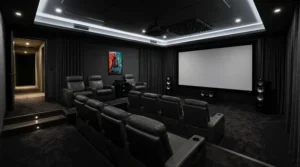
8K Gain Screen for Home Cinema: Getting Brightness Right
An 8K gain screen for home cinema is a trade-off, not a gift. Gain is simply how much light the surface reflects toward you compared with a reference white. A gain of 1.5 looks brighter, but it does so by narrowing the viewing cone and increasing the risk of hotspots.
For an RGB laser projector, brightness is rarely the problem. Speckle and ambient contrast are. That’s why low-to-moderate gain suits most laser setups, and why the Elite Screens Aeon CineGrey 3D sits more comfortably with laser projectors than the Elite Screens Aeon CineGrey 5D in a dim room.
One commentator on a triple-laser projector forum-style article recommends a grey-based ALR with gain around 0.8–1.0 for these projectors, because high-gain surfaces can accentuate sparkle. Treat that as one informed opinion rather than a rule, but it matches the physics.
Rule of thumb: dim projector plus bright room equals higher gain; bright projector plus controlled room equals lower gain.
4K Screen for Laser Projectors: Do You Really Need 8K?
A 4K screen for laser projectors is often all you need today. Most content you’ll actually play is 4K or below, and the screen doesn’t care about resolution anyway. The question is texture and speckle, not pixel count.
That said, several screens above advertise 4K/8K support, and the premium over a 4K-only equivalent is often small. Paying a little more makes sense if you plan to keep the screen for a decade. Paying a lot more does not.
Here’s the practical approach. If your projector is 4K and your screen is a well-made matte or ALR surface, you’re fine. If you’ve found speckle intrusive, a speckle-focused surface like the AWOL Valerion PureVision Fixed Frame is a better spend than chasing an “8K” badge. For an ALR option, the Elite Screens Aeon CineGrey 3D is listed for 4K/8K and is a sensible midpoint.
Laser Projector Pairing: Matching Screen to Light Source
Laser projector pairing is the most overlooked step. A laser projector creates coherent light, and when it bounces off a micro-textured surface it can interfere with itself. That interference is the shimmering grain called speckle.
Triple-laser (RGB) projectors typically show more speckle than single-laser phosphor designs, and some screens suppress it better than others. Surface structure, gain and viewing angle all influence the effect.
A safe pairing logic:
- RGB laser, dark room, long-throw: AWOL Valerion PureVision Fixed Frame or Valerion PureVision Motorized.
- RGB laser, bright lounge, long-throw: Elite Screens Aeon CineGrey 3D first, Elite Screens Aeon CineGrey 5D if brightness is short.
- UST laser, ceiling lights: Valerion Fresnel ALR Fixed Frame, NothingProjector Black Series ALR or AWOL Vision Motorized ALR Floor Rising.
One manufacturer blog even suggests a non-UST short-throw laser projector can work with a UST ALR screen if placed below the screen and angled upward, avoiding ceiling mounts. That’s a vendor claim, so test before committing, but it’s an interesting hack.
Ultra-Fine Screen Texture: Why It Matters at 8K
Ultra-fine screen texture is what separates an 8K-ready surface from a merely large one. If the screen’s microstructure is coarser than the picture’s smallest detail, you see the screen instead of the film.
Matte PET surfaces like the AWOL Valerion PureVision Fixed Frame are smooth and low-structure, which is why they’re pitched for laser speckle. ALR surfaces rely on engineered microstructures such as Fresnel rings or black grids to reject overhead light. Those structures need to be extremely fine, or they can add faint patterns known as moiré when they interact with the projector’s pixel grid.
Here’s how to test texture without a lab. View a bright, flat-colour scene such as a clear sky from your actual seat. Look for sparkle, banding or a faint “screen door”. Then repeat from closer than usual. If you can’t see it, you’re fine.
The rule: the more engineered the ALR structure, the more it’s worth checking the texture in person or buying from a seller with a generous returns policy.
Future-Proofing Your Home Cinema Screen
Future-proofing is the best argument for buying an 8K projector screen today. Projectors change every two years; screens last a decade. The surface you buy now will almost certainly outlive your first projector.
That logic suggests prioritising three things: a fine texture that won’t limit future resolution, a sensible gain that suits both current and next-generation light sources, and a size you won’t outgrow. Don’t pay extra for gimmicks; do pay for a flat, durable frame.
A caution: future-proofing isn’t permanent. Throw type is the one thing you can’t change. If you might swap a long-throw projector for a UST later, a screen designed for the wrong geometry becomes useless. Think carefully, or choose a surface you can sell on.
My view: the Elite Screens Aeon CineGrey 3D is the sturdiest long-term bet for long-throw owners because of its balanced gain and sturdy frame. UST households might lean toward the Valerion Fresnel ALR Fixed Frame.
✨ Don’t Miss These Exclusive Deals!
🔍 Take your home cinema to the next level with these carefully selected screens. Click on any highlighted product to check current pricing and availability. These picks will help you create the cinema-quality evenings your family will love!
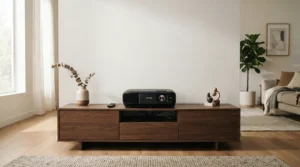
Practical Setup Guide: Your First 30 Days
A good screen can be ruined by a sloppy install. This is where you add value Amazon listings never provide.
Week one: install carefully. Use a spirit level and a stud finder; 120-inch frames are heavy. Keep the UST projector perfectly square to the screen, since a few millimetres of tilt becomes visible keystone distortion. Avoid digital keystone where possible, because it softens the image.
Check the cabling. Use certified high-bandwidth HDMI cables for 4K/8K signals. A weak cable can force a downsample or cause dropouts that people wrongly blame on the screen.
Mind the mains. Motorised models need power and often a 12V trigger. Check whether the supplied plug suits UK sockets, and use a surge-protected extension.
Laser safety. Laser projectors carry a photobiological risk group, usually printed on the unit. Never stare into the lens, and be mindful of children around UST projectors, because the beam travels upward from a low cabinet.
Weeks two to four: dial it in. Calibrate with the projector’s built-in patterns, then adjust black level, colour temperature and brightness. Add black velvet borders if light spills past the edges. Clean with a soft, dry microfibre cloth rather than harsh chemicals.
Real-World Scenarios: Matching Screens to Households
Scenario 1: the south-facing lounge. A family watches football on Saturday afternoons with the curtains half open. Budget is around £1,500. A long-throw projector sits on a shelf. The Elite Screens Aeon CineGrey 5D is the strongest match, since it rejects ceiling light and boosts a modest projector.
Scenario 2: the dedicated, dim cinema room. A film enthusiast with a triple-laser projector wants the cleanest picture. Light is fully controlled. The AWOL Valerion PureVision Fixed Frame makes the most sense, because speckle, not ambient light, is the enemy.
Scenario 3: the UST living room. A couple has a UST projector on a low unit under a 120-inch screen, with downlights overhead. They watch daily. The AWOL Vision Motorized ALR Floor Rising adds convenience, whereas the NothingProjector Black Series ALR saves several hundred pounds if budget is tight.
Scenario 4: the shared flat. The screen has to disappear after movie night. The Valerion PureVision Motorized is the sensible pick for long-throw projectors.
8K Projector Screen vs Plain Wall (and Standard White Screens)
Is a purpose-built screen really worth it compared with a painted wall? Almost always, yes. A wall’s texture is uneven, its colour isn’t neutral and its reflectivity varies. A screen is flat, calibrated and designed for projection.
| Factor | Plain wall | Standard matte white screen | 8K-ready purpose-built screen |
|---|---|---|---|
| Flatness | Poor | Good | Excellent (fixed frame) |
| Colour neutrality | Variable | Good | Good to excellent |
| Speckle control | None | Limited | Can be designed in |
| Ambient-light handling | Poor | Poor | Strong (ALR models) |
| Texture at 8K | Uncontrolled | Usually fine | Designed fine |
| Best For | Temporary use | Dark rooms, tight budgets | Serious laser setups |
The pattern is clear: a wall is a compromise you tolerate, while a screen is a component you choose. A basic matte white screen is acceptable for dark rooms, but if you’ve invested in a laser projector, a surface engineered for it protects that investment. Budget buyers should still note that an ordinary high-quality matte screen is better than a wall, even without the 8K marketing.
Common Mistakes When Buying an 8K Projector Screen
Most regret in this category comes from a handful of avoidable errors.
Buying the wrong throw type. It’s the number-one mistake. Long-throw ALR screens like the Elite Screens Aeon CineGrey 3D won’t work with UST projectors, and vice versa.
Chasing gain. Higher is not better. High gain narrows viewing angles and can worsen speckle.
Trusting percentage claims. “95% ambient light rejection” has no universal test. Treat it as marketing shorthand.
Ignoring texture. Ultra-fine screen texture matters more than a resolution badge. Test it in a real room if you can.
Skipping room prep. A bright white ceiling and pale walls bounce light onto the screen. Even the best ALR can’t fix that entirely.
Oversizing. A 150-inch screen in a small lounge forces you to sit too close, which is when pixels, texture and fatigue become obvious.
Long-Term Cost and Maintenance
A screen’s cost isn’t just the purchase price. Fixed-frame screens like the AWOL Valerion PureVision Fixed Frame have almost no running costs: no motor, no moving parts, only occasional dusting. Motorised models like the Valerion PureVision Motorized add mechanical wear and, eventually, potential repair.
Think about cost per year. A £1,200 screen kept for ten years costs about £120 annually, which is trivial next to the projector’s lifetime lamp and electricity cost. Laser light sources typically last tens of thousands of hours, so your screen may need to outlast two or three projectors. That’s another argument for durability and neutral surface design. For a deeper background on screen types, the Wikipedia article on the projection screen is a handy reference.
Maintenance is simple. Dust with a dry microfibre cloth, avoid pressing the surface, and keep it out of direct sun. Never use solvents. If a screen has a replaceable fabric, replace it rather than the whole frame.
FAQ: 8K Projector Screen Questions
❓ Do I need an 8K projector screen for a 4K projector?
❓ Is an ALR screen worth it with a laser projector?
❓ What size 8K projector screen suits a lounge?
❓ Can a UST ALR screen work with a long-throw projector?
❓ How do I reduce laser speckle on my screen?
Conclusion
The best 8K projector screen isn’t the one with the biggest badge; it’s the one that matches your projector, your room and your patience. If you own a long-throw laser projector in a dim room, the AWOL Valerion PureVision Fixed Frame is a smart, speckle-conscious choice. If you want a hidden screen, the Valerion PureVision Motorized adds convenience. For brighter lounges, the Elite Screens Aeon CineGrey 3D offers the most balanced compromise, while the Elite Screens Aeon CineGrey 5D adds punch for weaker projectors.
UST owners have three solid directions: the Valerion Fresnel ALR Fixed Frame for refinement, the AWOL Vision Motorized ALR Floor Rising for convenience, and the NothingProjector Black Series ALR for value. Whatever you pick, check throw type first, texture second and price third.
Future-proofing is real but limited: buy a screen that outlasts your projector, but don’t expect it to outlast a change of throw type. Choose carefully, install properly and enjoy the picture you paid for.
✨ Ready to upgrade?
🔍 Click any highlighted product above to check current pricing and availability, and give your projector the screen it deserves. 🎬
Recommended for You
- High Gain Screen For HDR Projectors: 7 Best Picks Compared (2026)
- 4K Projector Screen: 7 Best Picks For UK Homes (2026)
- Curved Projector Screen For Gaming: 7 Best Picks UK (2026)
Disclaimer: This article contains affiliate links. As an Amazon Associate, I earn from qualifying purchases. If you purchase products through these links, we may earn a small commission at no additional cost to you.
✨ Found this helpful? Share it with your friends! 💬🤗
