
In This Article
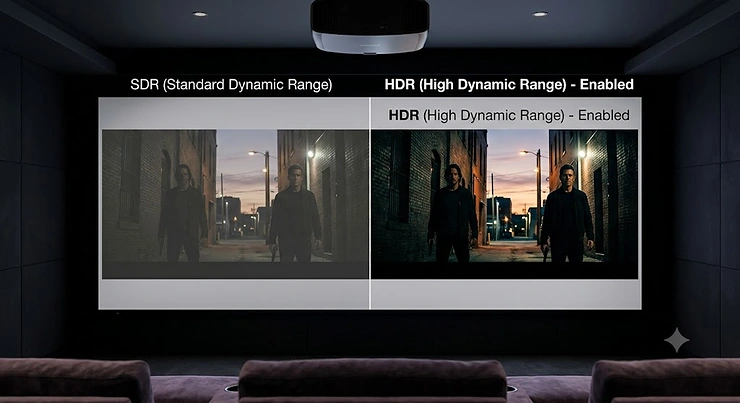
Ask a projector salesperson whether HDR matters on a projector and you’ll get an enthusiastic yes. Ask a cynical AV engineer and you’ll get a slightly pained expression followed by a technical lecture about peak brightness. The truth, as is usually the case, sits somewhere in the middle — and understanding that middle ground is genuinely useful before you spend anywhere between £800 and £2,000 on a home cinema projector.
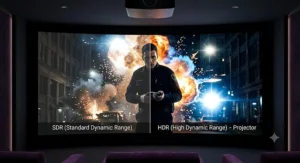
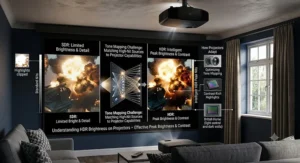
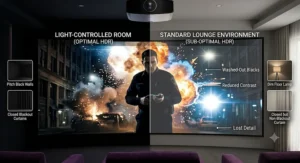
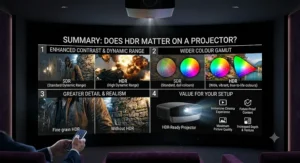
So does HDR matter on a projector? The honest answer for 2026 is: yes, but with important conditions that most product listings conveniently omit. HDR (High Dynamic Range) is a technology designed to expand the range between the brightest highlights and darkest shadows in a displayed image, delivering greater perceived contrast, richer colours, and more lifelike detail — particularly in scenes involving sunlight, fire, or bright artificial light against dark backgrounds. On a television with 1,000+ nits of peak brightness, HDR is spectacular. The problem is that most projectors — even good ones — produce 150 to 300 nits on a 100-inch screen. HDR is specified for displays achieving 400 to 10,000 nits. The gap is significant.
But here’s where it gets more interesting. Modern projectors handle this gap through tone mapping — intelligently redistributing the HDR signal’s brightness information into the projector’s available range. Done well, the result is genuinely better than SDR (Standard Dynamic Range): richer colours, more nuanced shadow detail, and highlights that feel punchy rather than washed out. Done poorly — or on a projector too dim to work with — HDR can actually look worse than SDR: flat, undersaturated, and oddly grey.
This guide explains exactly what to look for, separates the genuine HDR performers from the badge-slapping pretenders, and reviews seven real HDR projectors currently available on Amazon.co.uk — all UK-compatible (230V, UK type G plug), all available for Prime delivery. Because the best HDR projector for your British sitting room is the one that handles tone mapping intelligently and has enough brightness to make it count.
According to Wikipedia’s HDR overview, HDR standards include HDR10, HDR10+, HLG, and Dolby Vision — each with different brightness targets and metadata handling. Understanding which standard your projector supports is the first step to knowing what you’re actually buying.
Quick Comparison: 7 Best HDR Projectors UK 2026
| Model | Technology | Brightness | HDR Support | Price Range | Best For |
|---|---|---|---|---|---|
| BenQ W2700 | DLP, 4K | 2,000 ANSI lm | HDR10, HLG | £900–£1,200 | Colour accuracy, dark rooms |
| Epson EH-TW7100 | 3LCD, 4K | 3,000 ANSI lm | HDR10, HLG | £1,100–£1,300 | Bright rooms, flexibility |
| Hisense C2TUK Ultra | Triple Laser, 4K | 3,000 ANSI lm | Dolby Vision, HDR10 | £1,100–£1,400 | All-round smart projector |
| Nebula Cosmos 4K SE | Laser+LED, 4K | 1,800 ANSI lm | Dolby Vision, HDR10 | £750–£900 | Portable premium |
| BenQ TK710STi | Laser, 4K | 3,200 ANSI lm | HDR10, HLG | £1,200–£1,500 | Gaming + cinema |
| XGIMI Horizon Ultra | Laser, 4K | 2,300 ISO lm | Dolby Vision, HDR10 | £1,000–£1,300 | Smart lifestyle use |
| Valerion VisionMaster Pro2 | RGB Triple Laser, 4K | 3,000 ISO lm | HDR10+, Dolby Vision | £1,700–£2,200 | Dedicated cinema room |
The brightness column is arguably the most important thing to understand in this table. At 1,800 ANSI lumens (Nebula Cosmos), HDR tone mapping works but requires a reasonably dark room — ambient light from a British afternoon will challenge it noticeably. At 3,000–3,200 lumens (Hisense, BenQ TK710STi, Epson), HDR content remains watchable with the curtains partially closed, which for most UK living rooms is the realistic scenario. The Valerion’s triple-laser RGB light source changes the equation further still, producing colour depth that dramatically enhances the perceived impact of HDR content.
💬 Just one click — help others make better buying decisions too! 😊
Top 7 HDR Projectors for UK Home Cinema: Expert Analysis
1. BenQ W2700 — The Colour-Accuracy HDR Benchmark That Set the Standard
The BenQ W2700 is the projector that convinced many UK AV enthusiasts that affordable 4K HDR was actually possible. While newer models have since matched or exceeded it in brightness, the W2700’s HDR-PRO technology and near-complete DCI-P3 colour coverage (95%) remain genuinely impressive at its price point — and as a result, it continues to appear on recommended lists years after launch.
HDR-PRO is BenQ’s proprietary tone mapping approach. Rather than applying a single, static tone curve to HDR content, it analyses the signal and redistributes brightness information dynamically to suit the projector’s actual output range. In practice, with the W2700’s 2,000 ANSI lumens, this means highlights in HDR content feel meaningfully punchy — not flat, not blown out. The 95% DCI-P3 colour gamut (achieved via an RGBRGB colour wheel) means wide-gamut HDR content actually displays with the rich, accurate hues the content creator intended. This is notably better than projectors with RGBW colour wheels, which sacrifice colour accuracy for brightness.
What most UK buyers overlook about this model is the lens shift — both vertical and horizontal. In British homes where the projector needs to sit on a coffee table or shelf rather than ceiling-mounted directly behind the seating position, lens shift provides the placement flexibility that keystone correction alone cannot offer. Keystone correction distorts pixels; lens shift moves the optical image without degrading quality.
The W2700’s 2,000-lumen output requires a properly darkened room for HDR to perform at its best — which in a UK sitting room with patio doors means evening viewing primarily. For a dedicated media room or loft conversion with blackout blinds, it’s exceptional.
UK reviews describe it as delivering “the most enjoyable 4K HDR pictures I’ve seen on any sub-£2,000 projector.”
✅ 95% DCI-P3 — genuine wide-gamut HDR colour
✅ HDR-PRO dynamic tone mapping — well-implemented
✅ Lens shift — flexibility for non-ideal room layouts
❌ 2,000 lumens — requires a dark room for best HDR results
❌ No built-in smart platform — needs external streaming device
Price range: £900–£1,200 | Verdict: The colour-first HDR choice. Outstanding in a dark room.
2. Epson EH-TW7100 — The 3LCD All-Rounder That Handles Bright British Living Rooms
The Epson EH-TW7100 is the projector that frequently wins UK AV awards — and given what it offers, this is not particularly surprising. At 3,000 ANSI lumens of actual light output (using 3LCD technology rather than DLP), it’s one of the brightest projectors in its price bracket, and brightness matters enormously for HDR performance in real-world British rooms.
3LCD technology has a meaningful advantage for HDR specifically: it produces 100% colour brightness, meaning the measured lumen output is delivered in full colour, not just white light. Many DLP projectors quote their white lumens but produce significantly lower colour lumens — which directly affects how HDR’s wide colour gamut appears on screen. The EH-TW7100’s 3,000 lumens is usable colour light, which is why HDR content looks properly vivid rather than washed-out on this projector even in rooms with some ambient light.
The PRO-UHD 4K resolution uses Epson’s dual pixel-shift technology, producing a 4K output from native 1080p panels. At normal viewing distances of 3–5 metres in a typical British sitting room, the result is indistinguishable from native 4K in practice. HDR10 and HLG are both supported, with the EH-TW7100 applying competent tone mapping that keeps highlight detail without sacrificing shadow depth.
Wide lens shift — both vertical and horizontal — is the installation feature that distinguishes the EH-TW7100 from most competitors at this price. For UK semi-detached houses where the projector shelf isn’t precisely where the throw distance demands, this flexibility is a genuine practical benefit.
UK reviewers consistently highlight ease of calibration and the ability to use it in partially lit rooms without significant HDR degradation.
✅ 3,000 ANSI lumens — best brightness for HDR in ambient light
✅ Wide horizontal and vertical lens shift — installation flexibility
✅ 3LCD colour brightness — no colour wheel compromise
❌ Pixel-shift 4K rather than native — marginal but worth noting
❌ No smart platform — external streaming device required
Price range: £1,100–£1,300 | Verdict: The practical British living room HDR choice. Genuinely versatile.
3. Hisense C2TUK Ultra — The Triple-Laser All-In-One That Changes the Conversation 🔥
The Hisense C2TUK Ultra is where the projector market gets genuinely exciting. This is not a conventional home cinema projector — it’s a 4K Trichroma Triple Laser smart projector with Dolby Vision, JBL speakers with a subwoofer, VIDAA smart operating system with Netflix, Prime Video and Disney+ built in, and 3,000 ANSI lumens of output. It comes with a gimbal stand, supports HDMI 2.1, and produces 110% BT.2020 colour coverage.
Dolby Vision on a projector is worth pausing on. Unlike standard HDR10, Dolby Vision is a dynamic format — it adjusts metadata frame by frame, allowing the projector to tone-map each scene individually rather than applying a single static curve to the whole film. On a projector with appropriate brightness (the C2TUK Ultra’s 3,000 lumens qualifies), the result is HDR that actually looks like the premium format it’s marketed as: highlight detail preserved, shadow depth maintained, colours vivid without appearing oversaturated.
The Trichroma triple-laser light source — using separate red, green, and blue lasers rather than a single white light — is the technological foundation that makes the 110% BT.2020 coverage possible. This is substantially wider than any standard projector colour wheel can achieve, and in practice means that HDR content with genuinely demanding colour requirements (lush greens, deep reds, sky gradients) displays with a naturalness that’s visually striking.
For UK buyers in particular, the built-in smart platform eliminates the need for a streaming stick — the C2TUK Ultra connects directly to your WiFi and handles Netflix HDR content natively. One UK Amazon reviewer described upgrading from a BenQ W2700 and finding it “so bright, ideal for a living room where you can’t control ambient light well.”
✅ Dolby Vision — dynamic, frame-by-frame HDR tone mapping
✅ 110% BT.2020 colour — exceptional wide gamut
✅ Built-in smart OS — no streaming stick needed
❌ Higher price than traditional projectors at this brightness
❌ Pricier to ceiling-mount than conventional rectangular designs
Price range: £1,100–£1,400 | Verdict: The premium smart projector. Best Dolby Vision HDR under £1,500.
4. Nebula Cosmos 4K SE — Portable Dolby Vision HDR That Actually Works ⚡
The Nebula Cosmos 4K SE answers a question that previously had no satisfying answer: can you get a genuinely portable, compact projector that handles HDR content properly? At 1,800 ANSI lumens with Dolby Vision and a Laser+LED hybrid light source (Anker’s HybridBeam technology), the Cosmos 4K SE is the most capable portable HDR projector currently available on Amazon.co.uk.
1,800 ANSI lumens sounds modest, but the Laser+LED light source produces consistent, stable brightness without the colour temperature drift that lamp-based projectors suffer from as they age. The Dolby Vision support means dynamic tone mapping is applied to HDR content, which is genuinely more effective at 1,800 lumens than static HDR10 tone mapping — because Dolby Vision can be calibrated to work within the projector’s actual brightness ceiling rather than assuming output levels the hardware can’t achieve.
The Google TV integration means Netflix, Prime Video, Disney+, and Apple TV+ are all accessible natively, with HDR streams available on supported services. For UK viewers, this includes Netflix 4K HDR content without needing an additional streaming device. The built-in Dolby Audio produces reasonable sound for a compact device, though any serious home cinema application will benefit from connecting to a soundbar or AV receiver.
For UK flat-dwellers with limited permanent space — which covers a significant proportion of British households — the Cosmos 4K SE’s ability to be stowed in a cupboard between uses and deployed for a film night is a genuine lifestyle advantage that a ceiling-mounted traditional projector cannot offer.
The 200-inch maximum screen size is achievable in practice, though at that size the 1,800-lumen output requires genuinely dark conditions.
UK Amazon reviews are strongly positive, highlighting the Dolby Vision quality and portability combination.
✅ Dolby Vision — dynamic HDR at a compact price
✅ Google TV built-in — Netflix HDR natively
✅ Portable — storable in a British flat or terraced house
❌ 1,800 lumens — needs a dark room for full HDR impact
❌ Built-in speakers adequate but not cinema-quality
Price range: £750–£900 | Verdict: The portable HDR projector. Outstanding flexibility for its price.
5. BenQ TK710STi — 4K Laser HDR for Gamers Who Also Watch Films 🎮
The BenQ TK710STi is what happens when a manufacturer takes a serious laser-based light source, combines it with proper HDR tone mapping, adds Android TV with Netflix and Chromecast, includes AirPlay, then tunes the whole package for both gaming and cinematic content. At 3,200 ANSI lumens with HDR10 and HLG support, it’s one of the brightest HDR projectors at this price point on Amazon.co.uk.
The laser light source is significant for HDR performance specifically. Laser light produces deeper, more controllable black levels than LED or traditional lamp sources, which directly improves the perceived contrast that makes HDR effective. The TK710STi’s 500,000:1 contrast ratio (enhanced dynamic) means that HDR’s light-to-dark transitions carry genuine visual weight rather than collapsing into murky grey.
The 4ms response time at 4K and 240Hz refresh rate are gaming specifications, but they benefit HDR film content too — particularly for action sequences where fast motion combined with HDR highlights would otherwise produce blurring or judder artefacts. For UK buyers with a PS5 or Xbox Series X connected to the projector, the TK710STi handles 4K HDR gaming as cleanly as any projector currently available at this price.
A detail worth noting for UK buyers: the TK710STi supports 3D Keystone correction, which significantly eases setup in British rooms where a precise throw angle is rarely achievable. Combined with the laser light source’s 30,000-hour rated lifespan — meaning you won’t be purchasing replacement lamps for the foreseeable future — the total cost of ownership is genuinely attractive.
UK reviewers praise the gaming mode’s effect on picture clarity in darker scenes and the smart platform’s responsiveness.
✅ 3,200 ANSI lumens — powerful enough for partial ambient light
✅ Laser light source — improved blacks, 30,000-hour lifespan
✅ 4ms / 240Hz — serious gaming HDR capability
❌ No Dolby Vision — HDR10 and HLG only
❌ Higher price bracket for gaming-primary buyers
Price range: £1,200–£1,500 | Verdict: The gamer-cinema hybrid. Laser HDR at its most practical.
6. XGIMI Horizon Ultra — Lifestyle Smart Projector With Dolby Vision Ambitions 🎯
The XGIMI Horizon Ultra occupies the smart-lifestyle projector category — the growing segment of projectors designed to look good in a modern living room, set up easily, and connect intelligently. With 2,300 ISO lumens, a laser light source, Dolby Vision, Android TV 11, and dual 12W Harman Kardon speakers, it offers a self-contained cinematic experience without requiring a separate AV rack of equipment.
The ISO lumen measurement is worth understanding. ISO lumens measure actual projected light on a screen across multiple points (eliminating the centre-brightness cherry-picking that plagues some lumen claims). XGIMI’s 2,300 ISO lumens is an honest figure, which puts it comfortably above lamp-based projectors claiming equivalent ANSI output. Dolby Vision at this brightness level works well in the evenings and in rooms where window light can be managed — which, given the UK’s generally overcast skies for most of the year, is a broad category of British living rooms.
XGIMI’s ISA (Intelligent Screen Adaptation) technology is the practical feature that makes this projector genuinely easy to live with: it auto-detects screen boundaries, corrects keystone distortion, avoids obstacles projected onto walls, and adjusts for ambient light levels. For UK households where projector setup is a weekend activity rather than a professional installation, this intelligence reduces friction significantly.
The Harman Kardon audio is genuinely capable — better than the average projector speaker — which reduces (though doesn’t eliminate) the case for a separate soundbar. For casual film viewing in a British sitting room, it’s more than adequate.
UK reviewers cite the setup simplicity and Dolby Vision picture quality as particular strengths.
✅ Dolby Vision — dynamic HDR, same standard as Hisense C2TUK
✅ ISA intelligent setup — auto-adjusts for British room realities
✅ Harman Kardon audio — less need for a separate soundbar
❌ 2,300 ISO lumens — limited in bright conditions
❌ No lens shift — positioning less flexible than Epson or BenQ
Price range: £1,000–£1,300 | Verdict: The smart living room choice. Beautiful HDR without the faff.
✨ Don’t Miss These Deals!
🔍 All 7 projectors are available on Amazon.co.uk — click any highlighted model name to check current pricing. Prime members get free next-day delivery on most items.
7. Valerion VisionMaster Pro2 — The Triple-Laser Reference Standard for Serious Enthusiasts
The Valerion VisionMaster Pro2 is the projector that makes HDR on a projector debate almost irrelevant — because with RGB triple laser producing 107% Rec. 2020 colour coverage at 3,000 ISO lumens and a 15,000:1 native contrast ratio, it implements HDR with a competence that most sub-£2,000 projectors simply cannot match. This is the projector for buyers who want dedicated home cinema performance without spending £5,000+.
RGB triple laser — using 28 individual laser chips across three colour channels — is fundamentally different from single-blue laser systems. It produces every colour independently rather than filtering a single white beam, which means the colour gamut is genuinely wider, more accurate, and more stable across brightness levels. For HDR specifically, this means highlights retain colour saturation rather than shifting towards white as the image gets brighter — the precise limitation that makes HDR on lesser projectors look flat.
The HDR10+ support is the most advanced HDR format available outside of Dolby Vision, applying dynamic metadata scene by scene (like Dolby Vision) but without the licensing fees that some manufacturers absorb and others pass to consumers. IMAX Enhanced certification means IMAX-certified content (available on Netflix and other services for UK subscribers) displays with the additional colour and audio headroom the format provides.
The HDMI 2.1 ports with eARC mean modern AV receivers and soundbars connect cleanly, and the 0.9–1.5x optical zoom with motorised operation allows precise screen filling without leaving the couch. For a UK media room setup — a converted garage, a loft conversion, or a dedicated downstairs space — this is the projector that makes HDR on projection genuinely comparable to OLED television HDR performance.
UK pricing is at the premium end of this list, but the technology gap between the VisionMaster Pro2 and any projector under £1,500 is substantial and visible.
✅ RGB Triple Laser — widest colour gamut on this list
✅ HDR10+ with dynamic metadata — best HDR format outside Dolby Vision
✅ 15,000:1 native contrast — deep blacks, genuine HDR punch
❌ £1,700–£2,200 — significant investment
❌ Best in a dedicated room — less suited to casual use
Price range: £1,700–£2,200 | Verdict: The reference-grade choice. HDR as it was intended to look.
Setting Up Your HDR Projector in a British Home: A Practical Guide
Getting HDR right on a projector involves more than plugging it in and pressing play. Here’s a practical guide built around the realities of British home cinema setups.
Step one: Control the light. This is the single most important factor for HDR performance. A projector producing 2,000 lumens in a room with afternoon sunlight streaming through patio doors is fighting a battle it will lose. The UK’s frequently overcast skies actually help — but motorised blackout blinds or heavy curtains make a material difference. In genuinely dark conditions, a 2,000-lumen projector like the BenQ W2700 delivers HDR that rivals much brighter competitors in ambient light.
Step two: Choose the right screen. A white screen with 1.0 gain reflects all light evenly and suits most UK rooms. A grey screen (0.8–0.9 gain) improves perceived contrast and suits projectors in rooms where some ambient light is unavoidable — which is most British living rooms. Acoustically transparent screens allow speakers to be placed behind the screen for a proper cinema soundstage, which matters if you’re investing at the Valerion price level.
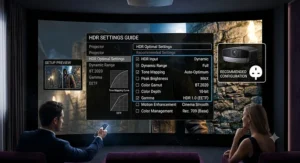
Step three: Enable HDR in picture settings, not just in the source device. Many buyers enable 4K HDR output from their streaming stick or Blu-ray player but leave the projector in SDR mode. Verify HDR is enabled in both the source device’s display settings and the projector’s picture mode simultaneously.
Step four: Select the appropriate HDR mode. Most projectors offer Bright, Standard, Cinema, and HDR/Film presets. The HDR or Cinema preset typically applies the most accurate tone mapping. Bright modes prioritise luminance over colour accuracy and often degrade HDR significantly — the picture looks punchier momentarily but loses the nuanced highlight detail that makes HDR worthwhile.
UK power note: All projectors on this list operate at 230V with a UK type G plug as standard. No voltage adaptor is needed. Ensure the projector’s power cable reaches comfortably to a wall socket — most projectors ship with a 1.5–2-metre cable, which in a UK media room may require an extension lead.
Does HDR Matter on a Projector? Real UK Usage Scenarios
The semi-detached sitting room in Manchester. You have a 3.5-metre throw distance, standard curtains that reduce but don’t eliminate afternoon light, and a wall-mounted screen. You want to watch Netflix 4K HDR and play on the PS5. The Hisense C2TUK Ultra handles this scenario better than anything else on this list — 3,000 lumens with Dolby Vision means HDR content still looks excellent with the curtains drawn, and the built-in smart OS handles Netflix natively.
The purpose-built media room in a converted garage, Bristol. You have full light control, a proper 100-inch screen, and a budget that reflects the investment you’ve made in the space. HDR matters enormously here because you have the conditions for it to perform properly. The Valerion VisionMaster Pro2 is the call — its triple-laser colour accuracy and HDR10+ support deliver genuinely cinema-grade results.
The flat in East London, second bedroom. You need something portable enough to move between rooms, usable without a permanent installation, and capable of producing decent HDR when you close the roller blind. The Nebula Cosmos 4K SE is made for exactly this scenario — compact, self-contained, Dolby Vision capable, and stowable between uses.
The family living room in Edinburgh, primary screen. You want 4K HDR, Netflix built in, minimal setup faff, good audio, and something that works whether it’s dark or just dim. The XGIMI Horizon Ultra covers this profile well — intelligent setup, Dolby Vision, Harman Kardon audio, and 2,300 ISO lumens that handle typical Scottish sitting room light levels sensibly.
HDR Projector vs SDR Projector: The Honest Comparison
| Feature | HDR Projector | SDR Projector |
|---|---|---|
| Colour gamut | Wide (DCI-P3 or BT.2020) | Rec. 709 standard |
| Highlight detail | Preserved with tone mapping | Can be lost in bright scenes |
| Streaming content | Full HDR on Netflix, Disney+ etc | Downscaled to SDR |
| Price premium | £200–£500 more typically | Lower entry cost |
| Room requirements | Darker conditions help significantly | Less light-sensitive |
| Future-proofing | Yes — all premium content is HDR | Limited as HDR becomes standard |
The comparison makes the case clearly. HDR projectors do cost more, but all premium streaming content — the 4K libraries on Netflix, Disney+, Prime Video — is delivered in HDR by default. A projector without HDR support simply cannot access the full quality of that content. Given that most UK households streaming 4K content now encounter HDR automatically, buying a projector that doesn’t handle it properly is knowingly leaving quality on the table.
The caveat — and it bears repeating — is room conditions. An SDR projector with 3,500 lumens in a bright room may produce more satisfying images than an HDR projector with 2,000 lumens fighting ambient light. Know your room before selecting your specification.
How to Choose an HDR Projector in the UK: 5 Key Criteria
1. Brightness first. The rule of thumb for HDR projectors: for a completely dark, dedicated room, 2,000 ANSI lumens is adequate. For a partially lit room (curtains drawn, some light creep), aim for 2,500–3,000 ANSI lumens. For a living room with standard curtains and daylight viewing, 3,000+ lumens with laser light source is the minimum for HDR to look convincing. UK homes rarely have perfect light control; plan accordingly.
2. HDR format support. At minimum, look for HDR10 — the most widely used format, supported on essentially all HDR content. HLG (Hybrid Log-Gamma) is important for UK broadcast content (BBC iPlayer, Channel 4 on demand use HLG for their HDR streams). Dolby Vision adds dynamic tone mapping and is the premium standard. HDR10+ is the Samsung/Amazon alternative to Dolby Vision with similar dynamic metadata benefits.
3. Colour gamut coverage. HDR content is mastered in wide colour spaces (DCI-P3 or BT.2020). A projector covering 95%+ DCI-P3 (BenQ W2700, Valerion Pro2, Hisense C2TUK) displays HDR colour as intended. Models covering only Rec. 709 display HDR brightness metadata but cannot reproduce the colour information — you get the contrast benefit of HDR without the colour benefit.
4. Tone mapping quality. This is the hardest specification to assess from a spec sheet. Look for independent reviews that assess HDR performance specifically — publications like What Hi-Fi?, Expert Reviews, and Home Cinema Choice regularly test UK-available projectors in controlled conditions. Good tone mapping preserves both highlight detail and shadow depth simultaneously.
5. Laser vs lamp light source. Laser projectors cost more but produce more consistent brightness over time, deeper black levels (better for HDR contrast), and don’t require lamp replacement (typically £100–£200 every 3,000–5,000 hours for lamp models). For a projector used 3–4 hours per day, a 30,000-hour laser source rated life represents 27+ years of use. For UK buyers intending to keep their projector for a decade, laser is often better value overall.
Features That Actually Matter for HDR — and Those That Don’t
Matters significantly:
Peak brightness specification matched to room conditions. The single most important HDR variable.
Dynamic tone mapping (Dolby Vision or HDR10+). Scene-by-scene metadata handling consistently outperforms static HDR10 tone curves on diverse content.
Wide colour gamut coverage (DCI-P3 95%+). Without it, you’re getting HDR contrast without HDR colour.
Laser light source. Deeper blacks, more consistent brightness, better long-term value.
Matters less than marketing suggests:
HDR-compatible HDMI specifications alone. An HDMI port that accepts an HDR signal doesn’t guarantee the projector can display it properly. The display technology matters more than the input standard.
Peak brightness measured in “dynamic contrast” ratios. A 1,000,000:1 dynamic contrast ratio on a spec sheet is a marketing measurement involving the lamp dimming to near-off in dark scenes. Native contrast — the contrast achievable with the lamp at fixed output — is the meaningful number.
4K native vs pixel-shift. At normal viewing distances in UK rooms (3–5 metres), the difference between native 4K (Valerion Pro2) and well-implemented pixel-shift 4K (Epson EH-TW7100, BenQ W2700) is genuinely imperceptible to most viewers.
Frequently Asked Questions: HDR on Projectors in the UK
❓ Does HDR make a visible difference on a projector or is it marketing?
❓ Which HDR format is best for a home cinema projector in the UK?
❓ Is 2,000 ANSI lumens enough for HDR on a projector in a UK home?
❓ Can I watch Netflix and Disney+ in HDR on a projector in the UK?
❓ Do HDR projectors bought on Amazon.co.uk come with UK plugs?
Conclusion: Does HDR Matter on a Projector? Yes — If You Choose the Right One
The answer is unequivocally yes, provided you make the right choices around brightness, colour gamut, and tone mapping quality. HDR on the wrong projector — too dim, too narrow a colour gamut, poor tone mapping — can look worse than good SDR. HDR on the right projector, in appropriate room conditions, is a genuinely transformative viewing experience that justifies every pound of the price premium.
For most UK buyers, the Hisense C2TUK Ultra represents the most complete HDR projector package: Dolby Vision, triple-laser colour, 3,000 lumens, and smart OS built in. The Epson EH-TW7100 is the practical alternative for buyers who need maximum brightness flexibility with strong installation options. The BenQ W2700 remains the colour-accuracy champion for dedicated dark rooms. And the Valerion VisionMaster Pro2 is the reference-grade choice for those who have the budget and the room to let it perform at its best.
Don’t buy HDR certification. Buy brightness, buy colour gamut, buy a quality light source. The rest follows.
✨ Ready for Big-Screen HDR?
🔍 Check current pricing on any projector highlighted above at Amazon.co.uk. All prices include 20% UK VAT, and Prime members enjoy free next-day delivery on most items.
Recommended for You 📽️
- Best HDR Projector UK 2026: 7 Top Picks Tested & Reviewed
- Best 1080p Projector for Gaming UK 2026: 7 Top Picks Tested
- Best 1080p Projector Under £300 UK 2026: 7 Top Picks Tested
Disclaimer: This article contains affiliate links. As an Amazon Associate, I earn from qualifying purchases. If you purchase products through these links, we may earn a small commission at no additional cost to you.
✨ Found this helpful? Share it with your mates! 💬🤗
