
In This Article
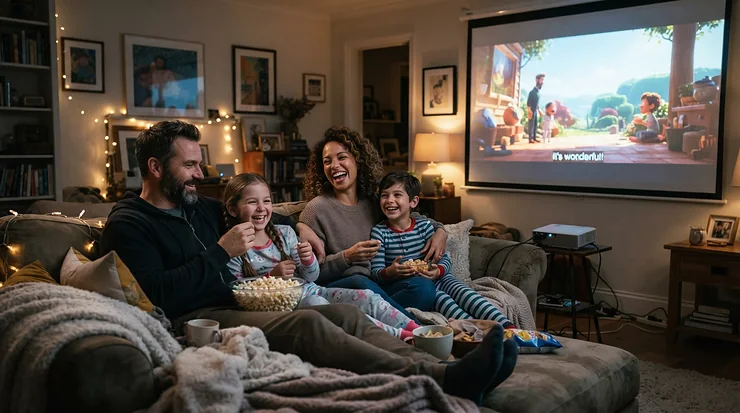
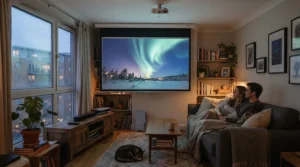
A pull down screen for living room use is a retractable projection surface that rolls into a slim case fixed to your wall or ceiling and drops only when the film starts. Unlike a permanent projection screen, it vanishes between sessions, so the room goes back to being a room.

Here is the British living-room dilemma in one sentence: you want a 100-inch picture, but you also want somewhere to put the Christmas tree. A projector solves the first half. A bare painted wall solves nothing, because paint was never designed to bounce light evenly towards your eyes. Tucking the screen away solves the second half.
This guide covers seven real models, from budget manual rollers to a motorised, ambient-light-rejecting screen. I haven’t tested them in my own front room, so you won’t find invented anecdotes here. What you will find is spec-sheet analysis, what each spec means for everyday use, and a clear look at the pull down vs fixed frame projector screen trade-off. I’ve also flagged where reviews can and can’t be verified.
Whether you’re planning a pull down screen for home cinema nights or a multi-purpose room setup that doubles as dining area and home office, there’s a pick below for you. Prices are ranges only and change often, so check current price and availability before you buy.
Quick Comparison: Best Pull Down Screen for Living Room Picks at a Glance
| Screen | Type | Picture size | Best For |
|---|---|---|---|
| Pyle 72-inch Manual Pull Down | Manual, auto-lock | 72″ (4:3) | Tiny budgets and small rooms |
| VonHaus 90-inch Soft-Close | Manual, soft-close | 90″ (16:9) | Quiet everyday use on a budget |
| Elite Screens Manual B 100-inch | Manual, slow-retract | 100″ (16:9) | Best all-round manual value |
| celexon Manual Economy 99-inch | Manual, adjustable drop | 99″ (16:9) | Film fans wanting a wider 21:9 option |
| Elite Screens M100XWH-E24 | Manual, 24″ extra drop | 100″ (16:9) | Tall rooms needing a lower picture |
| Elite Screens Spectrum2 SPM100H-E12 | Motorised | 100″ (16:9) | One-touch convenience |
| Elite Saker CineGrey 5D | Motorised, tab-tension, ALR | 100″+ (16:9) | Bright rooms and serious home cinema |
Looking at the comparison above, the sensible centre of gravity is the 100-inch manual group: Elite Screens Manual B, celexon Manual Economy and Elite Screens M100XWH-E24 all deliver a large 16:9 picture without a motor’s price tag. The Pyle and VonHaus screens trade size or refinement for a lower entry cost.
The two motorised models sit in a different league. Elite Screens Spectrum2 buys convenience, while Elite Saker buys daylight performance. Which one is right depends less on the room’s size and more on how often the screen will be used and how much light you can’t control.
💬 Just one click — help others make better buying decisions too!😊
Top 7 Pull Down Screen for Living Room Picks: Expert Analysis
Specifications below come from manufacturer and retailer listings. Review sentiment is summarised only where I could verify it, and where I couldn’t, I say so. Prices are indicative ranges, not quotes.
1. Pyle 72-inch Manual Pull Down — cheapest way to try a screen
Its whole pitch is price: this is the screen you buy to find out whether a pull down screen for living room life suits you before spending real money.
The surface is a 72-inch, 4:3 matte white fabric (roughly 42.5 × 56.6 inches) with a black border and an auto-lock pull mechanism, built for wall or ceiling mounting. That 4:3 shape means a widescreen film fills only about a 65-inch 16:9 picture, with spare cloth above and below. It’s fine for a compact projector in a box room, but cramped if your sofa sits much more than two or three metres back.
On paper, this is a starter screen for a student bedroom, a children’s den or a rented flat where you want proof of concept. Based on the spec comparison, it’s the weakest fit for anyone with pull down screen for home cinema ambitions, simply because of the picture shape and size.
I couldn’t verify a sizeable body of UK-specific reviews for the Pyle. Read the latest verified-purchase feedback on the listing, paying attention to comments about the cloth hanging flat and the lock holding.
Pros:
- ✅ Very low cost of entry
- ✅ Compact case suits smaller walls
- ✅ Designed for wall or ceiling mounting
Cons:
- ❌ 4:3 shape wastes cloth on widescreen films
- ❌ Too small for larger living rooms
Expect under £100 at the time of research, and check current price. That’s fair value only if you accept the size limits.
2. VonHaus 90-inch Soft-Close — gentle retraction for daily use
The headline here is the soft-close mechanism, which rolls the screen away slowly instead of letting it snap home.
The VonHaus is a 90-inch 16:9 screen (about 199 × 112 cm) with a 1.1 gain surface, a stainless steel casing and a pull cord, and it mounts on a wall or ceiling. That 16:9 shape matches almost everything you’ll watch. The 1.1 gain gives a modest brightness lift over a plain 1.0 matte surface, which helps when a standard lamp is on. The soft-close matters more than it sounds, because a roller that slams into its case every evening is noisy and wears the mechanism over time.
My analytical take: this is the screen for households where it goes up and down daily, such as children’s TV in the afternoon and a film after bedtime. It suits everyday use better than its price suggests. It’s not for people chasing deep blacks, since 1.1 gain is still essentially a plain white surface.
The listing I found sits on The Range’s marketplace, sold by VonHaus’s parent company. I couldn’t verify a large aggregated review pool across retailers, so skim recent comments for casing dents and how the soft-close behaves on longer drops.
Pros:
- ✅ Soft-close retracts gently and quietly
- ✅ Proper 16:9 shape for widescreen content
- ✅ Wall or ceiling installation options
Cons:
- ❌ Manual cord means getting up each time
- ❌ Plain surface struggles with strong daylight
Prices typically sit under £120 at the time of research, so check current price. It’s strong value for budget-conscious everyday use.
3. Elite Screens Manual B 100-inch — precise two-inch auto-lock steps
Elite’s Manual B takes a solid 100-inch frame and adds slow retraction plus a two-inch ratchet for setting the picture height.
The view area is 49.0 × 87.0 inches in 16:9, on black-backed, mildew-resistant, easy-clean MaxWhite B fabric with 1.0 gain and a quoted 180° viewing angle. A pull lanyard and a mounting kit are included. The case is roughly 93.8 inches (about 2.4 metres) wide, so measure your wall before you fall in love. Those two-inch locking steps mean you can set the picture height precisely, and 1.0 gain keeps colours neutral for viewers sitting off to the side.
For most households this is the sensible default. It makes the fewest compromises, and the slow retract protects both fabric and case. What the spec sheet won’t tell you is that 1.0 gain does nothing to fight daylight, so pair it with curtains.
One roundup’s reviewer reports being able to stop the screen at exactly the right height, which they called rare for a manual model at this price. That’s one reviewer, so treat it as indicative and check UK buyer feedback too.
Pros:
- ✅ Two-inch auto-lock gives precise height
- ✅ Slow retract protects fabric and case
- ✅ Neutral 1.0 gain with wide viewing angle
Cons:
- ❌ Case needs roughly 2.4 metres of wall
- ❌ Plain matte surface can’t beat strong daylight
Expect around £100–£160. That’s excellent value for a 100-inch picture, and check current price first.
4. celexon Manual Economy 99-inch — adjustable drop for 21:9 films
The standout is flexibility: stop the celexon at different heights and you can switch between 16:9 and a wider cinema shape.
The viewing area is 220 × 124 cm on matt white polyester with 1.0 gain and a black back. It has 5 cm black borders at the sides, a 5 cm drop at the bottom and a generous 40 cm black drop at the top. The housing measures about 241 × 7 × 7 cm, and wall or ceiling fixings are included. The long top drop means the image starts lower on the wall, closer to eye level. Pulling the screen down less gives a wider-than-16:9 image, provided your projector can zoom and shift to match.
This is a neat pick for film fans who like their widescreen epics at proper proportions. For a pull down screen for home cinema nights without a motor, the masking and slim case do real work. celexon also runs a UK site, which should help with support, and lists optional wall spacers.
I couldn’t find an aggregated UK review sample for this exact model, so lean on the manufacturer’s UK pages and recent buyer comments.
Pros:
- ✅ Adjustable height enables a wider 21:9 image
- ✅ Generous 40 cm black top drop
- ✅ Wall and ceiling fixings included
Cons:
- ❌ Plain 1.0 gain offers no daylight help
- ❌ Less widely reviewed than Elite’s range
Indicatively, around £170–£230. Prices may vary, so check current price.
5. Elite Screens M100XWH-E24 — extra 24-inch drop for tall rooms
The standout is that 24-inch black drop, which hangs the picture lower than a standard 100-inch roller.
The M100XWH-E24 has a 49.1 × 87.2-inch view area, 1.1 gain MaxWhite fabric with a black back, a lock-anywhere pull cord, and a lanyard so you can reach the handle from high up. Its fabric is non-tensioned. Elite’s brochure puts the case at about 2,374 mm wide and the hanging height with the drop at about 2,009 mm, against 1,513 mm for the standard model. By my arithmetic, in a room with a 2.4–2.5 m ceiling the picture’s bottom edge lands roughly 55–65 cm above the floor, which is sofa-back territory, so check your sightlines.
This suits high-ceilinged rooms and anyone who wants the picture nearer eye level without lowering the case. It’s a smart multi-purpose room setup choice, because the case tucks up high and out of the way.
A reviewer on a retailer listing said the extra drop was a real help. It’s a single review, so treat it as a pointer.
Pros:
- ✅ 24-inch drop lowers picture towards eye level
- ✅ Locks at any height via pull cord
- ✅ Black-backed 1.1 gain MaxWhite surface
Cons:
- ❌ Non-tensioned fabric is less flat than frames
- ❌ Two-metre hanging height won’t suit low ceilings
Indicatively, around £180–£260. Check current price. It’s good value if your ceiling is high.
6. Elite Screens Spectrum2 SPM100H-E12 — motorised convenience with floating brackets
One button instead of a trip across the carpet: that’s the real selling point of this motorised 100-inch screen.
The Spectrum2 pairs a MaxWhite FG fabric (1.1 gain, fibreglass-backed, black-backed, 180° quoted viewing angle) with a 12-inch drop and an aluminium case with a white enamel finish. The floating brackets let you install first and align later. One retailer lists the remote kit (IR remote, 3-way wall switch and 12V trigger) as sold separately, so check exactly what’s in the box. A 12V trigger can raise and lower the screen with the projector’s power, as Digital Trends explains for retractable screens in general.
Screens go unused when using them feels like effort. For a multi-purpose room setup where the screen drops on weeknights, removing that friction is the whole value. The motor needs power at the case, so factor in an electrician if there’s no socket nearby, and look for UKCA or CE marking.
I couldn’t verify a UK-specific review sample. Look for comments on motor noise and the stopping accuracy.
Pros:
- ✅ One-touch operation with optional remote or trigger
- ✅ Floating brackets simplify levelling and alignment
- ✅ Fibreglass-backed 1.1 gain surface
Cons:
- ❌ Needs power at the wall or ceiling
- ❌ Remote kit may cost extra
Expect roughly £400–£550, so check current price. It’s worth it if you’ll use it most evenings.
7. Elite Saker CineGrey 5D — daylight-fighting ALR in a tab-tension roller
The standout is the combination of a 1.5 gain ambient-light-rejecting surface with tab-tension, which is rare in a roll-away screen.
Elite ProAV describes the Saker as a motorised roll-up with CineGrey 5D ambient and ceiling light rejecting material, ISF-certified for D65 colour neutrality, with an IR/RF control package, a 12V trigger and flush hidden mounts that slide for centring. The 100-inch version is 87.2 × 49.1 inches. Tab-tension tugs the cloth taut from the sides, tackling the ripples basic rollers can show. The ALR surface favours the viewer sitting centrally, because higher gain generally narrows the viewing angle, as Wikipedia’s projection screen entry explains.
If your living room can’t go dark, this is the only screen here designed for that problem. If you watch only in the evening, it’s overkill. Check projector compatibility too, since Elite’s notes on its fixed-frame CineGrey 5D say it isn’t suited to ultra short throw projectors.
I couldn’t verify independent UK reviews, and UK availability may be limited, so check the listing carefully.
Pros:
- ✅ Ambient light rejection lifts daytime contrast
- ✅ Tab-tension keeps surface flatter than basic rollers
- ✅ IR/RF control and 12V trigger included
Cons:
- ❌ Price is far above the other six
- ❌ Narrower sweet spot than matte white
Expect four-figure territory at the time of research, so check current price. It’s good value only if daylight is your real problem.
Top 7 Compared: Specs, Price Ranges and Best Uses
| Screen | Gain | Control / drop | Indicative price | Best For |
|---|---|---|---|---|
| Pyle 72-inch Manual Pull Down | Not stated | Manual, auto-lock | Under £100 | Trying a screen cheaply |
| VonHaus 90-inch Soft-Close | 1.1 | Manual, soft-close | Under £120 | Quiet daily use |
| Elite Screens Manual B 100-inch | 1.0 | Manual, 2″ steps | £100–£160 | Best all-round value |
| celexon Manual Economy 99-inch | 1.0 | Manual, 40 cm top drop | £170–£230 | 21:9 film fans |
| Elite Screens M100XWH-E24 | 1.1 | Manual, 24″ drop | £180–£260 | Tall rooms |
| Elite Screens Spectrum2 SPM100H-E12 | 1.1 | Motorised, 12″ drop | £400–£550 | One-touch convenience |
| Elite Saker CineGrey 5D | 1.5 | Motorised, tab-tension | Four figures | Bright rooms |
I’ve left out star ratings because they shift constantly and I couldn’t verify them across UK sellers. The price gap between the Manual B and the Spectrum2 is roughly the cost of a motor, remote kit and mounting convenience, so ask yourself honestly how often you’d use it. The Saker isn’t really comparable on price, but it’s the only screen here that changes how the picture looks when the curtains are open.
Setting Up Your Pull Down Screen for Living Room Walls: A First-30-Days Guide
Most disappointment with a pull down screen for living room walls comes from installation, not the screen itself. Spend an hour on setup and you’ll save weeks of grumbling.
Week one: install carefully. Measure the case width against your wall and mark brackets with a level (Elite’s motorised model ships with a bubble level for a reason). Use a detector to find joists, pipes and cables before drilling. For ceilings, fix into solid timber rather than plasterboard alone. Leave a small gap between screen and wall, because celexon lists wall spacers as an optional accessory. Fitting one stops the fabric brushing skirting-board or picture-rail clutter.
Week two: find your drop. Pull the screen to the picture height that matches your projector’s image. With a lock like the Manual B‘s two-inch steps, mark the sweet-spot notch with a tiny dab of tape on the lanyard. On a celexon, note the shorter drop that suits 21:9 films.
Week three onwards: build habits. Always guide the roller up by hand rather than letting go. Dust with a soft dry cloth, and use mild soap and water only where the maker says the fabric is washable. Manufacturer literature describes MaxWhite surfaces as easy to clean.
Common first-month mistakes: yanking the cord at an angle, leaving it half-down for weeks (so the cloth sags), and forgetting that motorised cases need mains power. These small habits make everyday use smooth rather than fiddly.
Real-World Scenarios: Matching a Pull Down Screen for Living Room Budgets
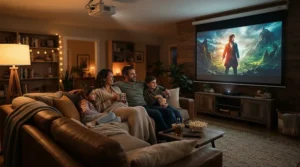
Here are three household profiles, each matched to a pick with reasoning. They’re illustrative scenarios built from the specs, not real customer stories.
The renter with a small front room. Budget: about £100. Environment: curtained room, 2.5 m sofa distance. Frequency: weekly film nights. The VonHaus or Pyle fits here. The VonHaus wins if your wall is wide enough for 90 inches, because the soft-close and 16:9 shape suit the sofa distance. The Pyle is for the tightest budgets.
The family with an open-plan living and dining room. Budget: £200–£300. Environment: light-filled with a high ceiling. Frequency: daily kids’ TV plus weekend films. The Elite Screens M100XWH-E24 brings the picture lower on a tall wall, and the black-backed 1.1 surface tolerates a lamp or two. Add blackout curtains for daytime viewing, because no plain white fabric under this budget fights sunlight.
The home-working couple. Budget: £500 or more. Environment: bright south-facing multi-purpose room setup. Frequency: five or six evenings a week. The Spectrum2 removes friction at a mid-range price. If daytime viewing matters, stretch to the Saker.
In each case, matching how often you’ll use it to the mechanism matters more than chasing the biggest number on the box.
Problem → Solution: Fixing the Five Most Common Pull Down Screen Annoyances
1. The picture looks washed out in daylight. A plain matte surface like the Manual B can’t reject stray light. Solutions: close curtains, move the projector brightness up, or step up to an ALR surface like the Saker.
2. The fabric ripples. Non-tensioned rollers, such as the M100XWH-E24, can’t match a frame’s flatness. Pull the screen fully down, let it settle, and avoid draughty spots. A tab-tension model is the real fix.
3. Colours look off. Walls matter: Sound & Vision’s screen roundup notes that light bouncing off painted walls and ceilings can drift back onto the screen and that coloured walls reflect their tint into the picture. Matte neutral surroundings help.
4. The screen slams home. That’s what the VonHaus soft-close and the Manual B slow retract exist to prevent.
5. The picture sits too high. Choose a longer drop like the M100XWH-E24‘s, or a celexon with its 40 cm top drop.
How to Choose a Pull Down Screen for Living Room Use
- Measure first. Check wall or ceiling width against the case. A 100-inch case is roughly 2.4 metres wide, and the case is wider than the picture.
- Match the aspect ratio. Choose 16:9 for modern content and your projector’s native shape, as 4:3 wastes cloth on widescreen films.
- Size to your distance. Bigger isn’t always better. How large a picture your projector can drive depends on its brightness, as TechRadar’s home cinema guide points out, so don’t oversize a dim projector.
- Pick the surface for your light. Matte white at 1.0–1.1 gain suits dark rooms. ALR suits bright ones.
- Decide manual or motorised. Think about how often you’ll use it, not how tidy the idea sounds.
- Check the drop. A black top drop sets how low the image starts.
- Confirm projector compatibility. Short and long throw are usually fine, but ultra short throw needs specific checking.
Pull Down vs Fixed Frame Projector Screen: Which Suits a Living Room?
The pull down vs fixed frame projector screen debate is really a debate about flatness versus flexibility. A fixed frame holds fabric under constant tension, so the surface stays flat and the picture stays crisp. A pull down screen disappears when you’re done, so the room stays flexible.
| Option | Flatness | When idle | Cost | Best For |
|---|---|---|---|---|
| Pull down screen | Good, best with tab-tension | Rolled out of sight | Low to high | Shared living spaces |
| Fixed frame screen | Excellent | Always on the wall | Mid to high | Dedicated cinema rooms |
| Bare wall | Poor | Invisible | Free | Casual, temporary viewing |
As the table shows, the pull down vs fixed frame projector screen choice depends on whether you can dedicate a wall. In a shared room, flexibility usually wins. Digital Trends calls a fixed screen a great choice for a dedicated theatre, while noting that retractable screens cost more and may not be quite as flat. Elite makes the same trade in its own range: the CineGrey 5D is offered in both a fixed-frame and a tab-tension roll-up version.
If you’re reading this because your lounge is also the dining room, the pull down vs fixed frame projector screen answer is almost always a pull down.
✨ Don’t Miss These Carefully Chosen Picks!
🔍 Take your film nights to the next level with the screens above. Click any highlighted product name to check current pricing and availability. These screens will help you create a proper cinema atmosphere your family will love!
Pull Down Screen for Home Cinema: Can a Roll-Away Surface Really Compete?
Short answer: yes, if you pick the right one. A pull down screen for home cinema is a compromise, but the gap is narrower than it was a few years ago.
Three things separate a convincing roll-away from a mediocre one. First is the flatness. A basic roller can show ripples, while tab-tension designs like the Saker pull the fabric taut. Second is the masking. Black borders and a generous top drop, as on the celexon, frame the image and sharpen the sense of contrast. Third is the surface. A matte white 1.0–1.1 screen is lovely in a dark room, but ALR material is the only fix for a lounge you can’t darken.
Wikipedia notes that screen gain generally falls between about 0.8 for light grey matte and up to 2.5 for glass bead surfaces. A higher gain brightens the picture but usually narrows the viewing angle.
For a pull down screen for home cinema in a controlled, dark lounge, the Manual B or Spectrum2 will serve you well. For a bright room, the Saker is the honest answer. Don’t expect a £100 roller to match a £1,000 ALR roller, but don’t pay for what your room can’t use either.
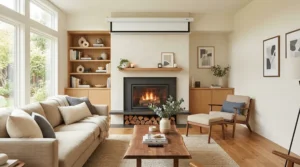
Multi-Purpose Room Setup: Making a Pull Down Screen Work Around Real Life
A multi-purpose room setup changes the rules. The screen must coexist with sofas, a dining table, perhaps a desk, and a family who won’t thank you for cables across the carpet.
Start with position. Place the case where it won’t clash with curtains, shelves or picture rails. A M100XWH-E24, hung high, keeps the case out of the eyeline. Next, plan the projector’s home: ceiling mount, shelf behind the sofa, or a low cabinet. Keep power and HDMI cables out of walkways. Then decide how the screen is operated. In a multi-purpose room setup, a motorised Spectrum2 with a wall switch or trigger means anyone in the household can use it, not just the person who knows the trick with the cord.
Finally, think about daylight at every hour. A room that’s perfect at 8pm may be washed out at 3pm. If the room serves as a home office, you may want the screen up all day, so check the roll-up height doesn’t block a window or shelf. The best multi-purpose room setup is the one your household actually uses.
Long-Term Cost, Maintenance and Everyday Use
A good screen is a decade purchase, so everyday use matters more than the headline price. Manual models have almost nothing to go wrong beyond the spring and lock. Motorised models add a motor, a power feed and a control kit, which are more things to maintain.
| Tier | Typical range | Mechanism | Value verdict |
|---|---|---|---|
| Entry manual | Under £120 | Basic or soft-close | Great for trials and tight budgets |
| Mid manual | £100–£260 | Auto-lock, slow retract | Best value for most homes |
| Motorised mid | £400–£550 | Motor, optional remote | Worth it for daily use |
| Motorised ALR | Four figures | Tab-tension motor | Only if daylight is your problem |
Spread over five years of weekly use, a £150 manual screen costs pennies per film. The honest value question is whether you’d use a motorised screen enough to justify roughly triple the spend. If you’d use it nightly, probably yes. If you’d use it monthly, no. Prices change, so check current price before deciding.
Maintenance for everyday use is light. Dust gently, keep the cloth rolled when not in use, and don’t leave it half-extended. Following those steps is what keeps a budget screen looking sharp for years.
Features That Actually Matter (And Those That Don’t)
What matters: the drop length, because it controls where the picture sits on the wall. The black backing, because it stops light leaking through and washing the image. The locking or soft-close mechanism, because you’ll touch it every session. And the aspect ratio, because a mismatch wastes picture.
What doesn’t matter as much as the box suggests: “4K and 8K ready” labels. A passive projection fabric doesn’t process pixels, so these are mostly reassurance rather than a spec that decides the picture. Likewise, a glossy “3D ready” tag is largely irrelevant if you never watch 3D.
What matters only sometimes: gain. In a dark room, 1.0 versus 1.1 is barely visible. In a bright room, you need a different material altogether, not a fractionally higher number.
Common Mistakes When Buying a Pull Down Screen for Living Room Use
Buying too big. A 120-inch screen on a modest projector looks dim, and the case may not fit your wall. Match the screen to the projector, not your ambitions.
Ignoring the case width. The case is wider than the picture. Measure the wall, not the diagonal.
Skipping the joist check. Ceiling-mounting into plasterboard alone is asking for trouble, especially with a motorised case.
Forgetting daylight. A plain matte surface in a sun-drenched room will disappoint, however good the projector.
Mismatching shape. A 4:3 screen like the Pyle wastes cloth on widescreen films.
Overlooking projector compatibility. Ultra short throw projectors need specific screens, and Elite’s own listings say its manual series isn’t compatible.
Assuming resolution labels decide quality. Surface, flatness and light control matter more.
Frequently Asked Questions
❓ How big a pull down screen do I need for a small living room?
❓ Can I use a pull down screen with a short throw projector?
❓ Is a motorised pull down screen worth the extra money?
❓ How much does a pull down screen for living room use cost in the UK?
❓ Can a pull down screen be mounted on the ceiling?
Conclusion
The best pull down screen for living room use is the one that matches how you actually live. If you want the lowest-risk, best-value starting point, the Elite Screens Manual B is the sensible default, offering 100 inches, slow retract and precise two-inch locking. For quiet everyday use on a tighter budget, the VonHaus soft-close is a considerate choice. Film fans who like a wider picture should look at the celexon, while the M100XWH-E24 suits tall rooms.
If one-touch convenience is the priority, the Spectrum2 removes friction in a multi-purpose room setup. And if daylight is your genuine enemy, the Saker is the only screen here built to fight it, though at a price that demands honest self-assessment. The Pyle earns its place as a cheap way to find out whether a screen suits you at all.
Whatever you choose, measure your wall, check your projector’s throw and plan for the light. Get those right and even a modest screen will transform your everyday use. The pull down vs fixed frame projector screen question mostly answers itself in a shared room, and a pull down screen for home cinema nights can genuinely deliver when matched to a dark-ish room.
✨ Ready to Transform Movie Night?
🔍 Take your living room to the next level with these carefully selected screens. Click any highlighted product name to check current pricing and availability. Your family will love the big-screen magic!
Recommended for You
- Pull Down Projector Screen: 7 Best Picks For UK Homes (2026)
- 8K Projector Screen: 7 Best Proven Picks For UK Cinemas (2026)
- High Gain Screen For HDR Projectors: 7 Best Picks Compared (2026)
Disclaimer: This article contains affiliate links. As an Amazon Associate, I earn from qualifying purchases. If you purchase products through these links, we may earn a small commission at no additional cost to you.
✨ Found this helpful? Share it with your friends! 💬🤗
