
In This Article
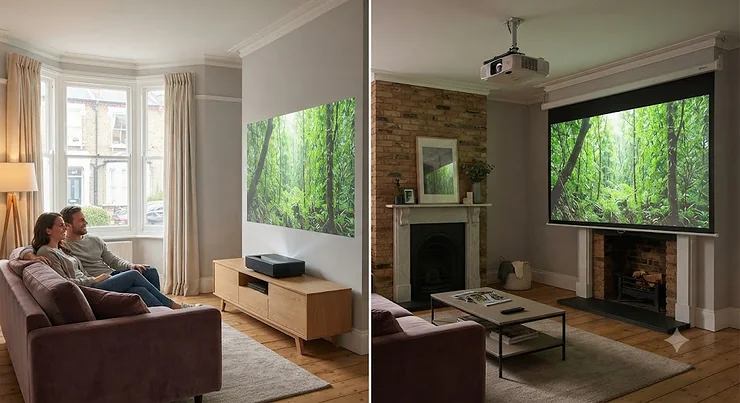
Somewhere in the last decade, “just get a projector” stopped being simple advice. Walk into any UK living room discussion online and you’ll find someone insisting a short throw projector is the only sane option for a terraced house, while someone else swears their long throw model has served them faithfully for a decade from a shelf at the back of the lounge. Both can be right, because short throw vs long throw projector isn’t really a fight between good and bad technology — it’s a fight between two different relationships with your room.
The short version: a short throw projector sits close to the wall and still fills it with picture, while a long throw (or standard throw) model needs more distance behind it to do the same job. Neither is objectively superior; each solves a different spatial problem. Get the match wrong and you’ll spend more time fighting keystone correction and shadow-casting housemates than actually watching anything.
This guide skips the marketing fluff and gets into real numbers — throw ratios, verified specs, and honest analysis of seven projectors you can actually buy on amazon.co.uk right now, spanning budget standard throw units through to premium ultra short throw laser TVs. Whether you’re squeezed into a small flat or planning a proper home cinema conversion, by the end you’ll know exactly which throw distance category your room actually calls for, and which real model fits your budget within it.
Quick Comparison Table
Before diving into full reviews, here’s a snapshot of how these seven models stack up on the metric that matters most for this guide: throw ratio, and what it means for real UK rooms.
| Projector | Throw Type | Throw Ratio | 100″ Image From | Best For |
|---|---|---|---|---|
| Epson EH-TW650 | Standard/Long | 1.02–1.23:1 | ~3.4–4.1m | Budget long-throw home cinema |
| Optoma UHZ35 | Long Throw | 1.4–2.24:1 | ~4.7–7.5m | Larger rooms, flexible zoom |
| BenQ TH671ST | Short Throw | 0.69–0.83:1 | ~1.5m | Small-room gaming on a budget |
| Optoma UHZ35ST | Short Throw | 0.496:1 | ~1.3m | 4K gaming in tight spaces |
| ViewSonic PS502X | Short Throw | 0.616:1 | ~1.3m | Bright rooms, multi-use spaces |
| Hisense PX3-PRO TriChroma | Ultra Short Throw | 0.22:1 | ~0.3m | TV-replacement living rooms |
| LG CineBeam HU715Q | Ultra Short Throw | ~0.19:1 | ~0.25m | Premium near-wall cinema |
Reading this table, the pattern that jumps out is how throw ratio compresses as price climbs into ultra short throw territory. The Epson EH-TW650 and Optoma UHZ35 both need several metres of clear floor to fill a 100-inch wall, which rules them out for cramped UK box rooms but suits anyone with a proper lounge or loft conversion. At the other end, the Hisense PX3-PRO TriChroma and LG CineBeam HU715Q can sit on a low cabinet almost touching the wall, trading that convenience for a noticeably higher price tag. The three short throw models in the middle — BenQ TH671ST, Optoma UHZ35ST and ViewSonic PS502X — occupy the sensible middle ground most UK flats and terraced houses will actually need.
💬 Just one click — help others make better buying decisions too!😊
Top 7 Short Throw and Long Throw Projectors: Expert Analysis
We’ve grouped these seven real, currently-listed models by throw category so you can see exactly how the throw distance changes the buying decision, not just the spec sheet.
1. Epson EH-TW650 — best budget long-throw home cinema pick
The Epson EH-TW650 opens our list as the standard-throw baseline every other projector here gets compared against. Its 1.02–1.23:1 throw ratio means it needs proper distance from the wall, but that distance buys you a genuinely mature, well-reviewed picture for not much money.
At 3,100 ANSI lumens and a 15,000:1 contrast ratio, this Full HD 3LCD projector can throw an image up to 300 inches, though most UK lounges will realistically land somewhere around 100–120 inches. What that brightness figure means in practice is a picture that stays watchable with curtains open on a grey afternoon — a genuinely useful trait most budget projectors fudge on their spec sheets. Based on the spec comparison with rivals in this price band, the EH-TW650 punches above its weight mainly because Epson’s 3LCD engine avoids the “rainbow effect” that some cheaper single-chip DLP projectors show under fast motion.
Independent reviewers who tested the EH-TW650 at full retail price described the picture as close to faultless, praising crisp detail, strong brightness and natural colour reproduction — reasonably high praise for a projector that regularly appears at deep discounts through the year. What most buyers overlook about this model is that its throw ratio actually works against small-room buyers; if your sofa sits less than three metres from the wall, you simply won’t get a big enough image, no matter how good the picture quality is.
Pros:
- ✅ Bright, natural-looking image even in daylight-ish rooms
- ✅ 3LCD tech avoids rainbow artefacts seen on some DLP rivals
- ✅ Frequently available well under its original RRP
Cons:
- ❌ Long throw distance rules out small flats and box rooms
- ❌ Full HD only, no native 4K support
Typically found in the £400–£550 range depending on retailer promotions, the EH-TW650 remains solid value for anyone with the room depth to use it properly — but check current price before assuming it fits your space.
2. Optoma UHZ35 — best long-throw 4K laser for bigger rooms
The Optoma UHZ35 is essentially the long-throw sibling of a short throw model further down this list, and comparing the two side by side is genuinely one of the clearest ways to understand what throw ratio actually buys you. Where its short-throw twin uses a fixed 0.496:1 lens, the UHZ35 swaps in a 1.6x manual zoom lens rated at 1.4–2.24:1, trading proximity for flexibility.
Here’s what to weigh: that zoom range lets you place the UHZ35 anywhere from roughly 4.7 to 7.5 metres from a 100-inch screen, which suits larger lounges, converted garages, or dedicated home cinema rooms where a short throw unit’s fixed lens would be too restrictive. It shares the same DuraCore laser engine rated for 30,000 hours, 4K UHD resolution via pixel-shifting, and a genuinely competitive 4.4ms input lag at 1080p/240Hz for gaming.
Because this is a newer long-throw variant, aggregated review volume is thinner than for its short throw sibling, and Amazon UK listings show relatively few verified customer reviews at the time of research — so treat brightness claims with the same scepticism reviewers applied to the ST version, where measured output came in noticeably below the advertised lumen figure.
Pros:
- ✅ Genuine 1.6x zoom gives real placement flexibility
- ✅ 30,000-hour laser light source, minimal maintenance
- ✅ Strong gaming credentials with low input lag
Cons:
- ❌ Needs a genuinely large room to make sense
- ❌ Limited independent UK review data so far
Expect a price in the mid-£1,300s to upper-£1,600s range at the time of research, positioning it as a serious step up from entry-level long throw units.
3. BenQ TH671ST — best budget short throw for gaming rooms
The BenQ TH671ST is the short throw workhorse of this list, and its 0.69–0.83:1 throw ratio is exactly the kind of number that solves the classic UK small-room problem: it can fill a 100-inch wall from around 1.5 metres away, meaning it’ll comfortably sit on a low unit in front of a sofa that’s barely two metres from the screen.
The 3,000-lumen output and 92% Rec. 709 colour accuracy translate into a picture bright enough for early-evening gaming sessions without blackout curtains, while the 16.67ms input lag at 1080p keeps competitive gamers happy without feeling laggy against a modern TV. On paper this means the TH671ST trades ultimate picture refinement for responsiveness and placement flexibility — a sensible compromise for anyone buying primarily for console gaming rather than cinema-grade movie nights.
Reviewers and marketplace listings consistently flag the same strengths: punchy native 1080p resolution, dependable brightness, and genuinely versatile connectivity for the price. The backing 3-year warranty is also worth flagging, since it’s noticeably longer than many rivals in this bracket offer.
Pros:
- ✅ Fills 100 inches from just 1.5 metres away
- ✅ Low input lag suits fast-paced console gaming
- ✅ Backed by a 3-year parts-and-labour warranty
Cons:
- ❌ 1080p only, no native 4K
- ❌ Lamp-based light source needs eventual replacement
Typically priced in the £500–£650 range, this is arguably the most sensible entry point into short throw ownership for anyone converting a small bedroom or box room into a gaming den.
4. Optoma UHZ35ST — best 4K short throw for tight gaming spaces
Where the TH671ST covers the budget end, the Optoma UHZ35ST pushes short throw into genuine 4K territory. Its 0.496:1 throw ratio is meaningfully tighter than the BenQ’s, letting it project a 120-inch image from around 4.3 feet — practically wall-hugging by long-throw standards, and useful for buyers who want a big screen without sacrificing much floor space.
The DuraCore laser engine is rated for 30,000 maintenance-free hours, and the 4K UHD resolution via XPR pixel-shifting delivers genuinely sharp detail for the price bracket. Gamers get an enhanced mode with input lag as low as 4.4ms at 1080p/240Hz, which is competitive-grade responsiveness rarely seen at this price outside dedicated gaming monitors. What the spec sheet won’t tell you, but independent lab testing found, is that the advertised 3,500-lumen brightness measured closer to 2,536 ANSI lumens under real testing conditions — still respectable, but worth knowing before you assume you’ll match the marketing number in a bright room.
That brightness shortfall is the main honest criticism reviewers levelled at this model, alongside a fixed lens with no zoom, meaning your screen size is dictated entirely by how far you can physically place the unit from the wall.
Pros:
- ✅ Genuine 4K UHD detail from a compact short throw body
- ✅ Class-leading input lag for a laser projector
- ✅ 30,000-hour laser life, no bulb replacements
Cons:
- ❌ Measured brightness fell short of the advertised spec
- ❌ Fixed lens offers no zoom flexibility
Expect pricing in the upper-£1,700s to low-£2,000s range, making this a considered upgrade rather than an impulse buy, best suited to buyers who specifically need both 4K and a short footprint.
5. ViewSonic PS502X — best bright-room short throw for multi-use spaces
The ViewSonic PS502X is included here partly for honesty: it’s marketed primarily as a business and education projector, but its 0.616:1 throw ratio and blistering 4,000 ANSI lumens make it a genuinely useful short throw option for UK households that use one room for both movie nights and home-working presentations.
That brightness figure matters in practice more than most spec sheets let on — 4,000 lumens means this projector stays perfectly watchable with the lights on, which is rare at this end of the market and genuinely useful for family rooms where blackout evenings aren’t always practical. It projects a 100-inch image from roughly 1.3 metres, and its XGA resolution, while lower than the Full HD or 4K rivals on this list, is honestly plenty for presentations, sports, and casual viewing rather than critical film-watching.
Because this model sits in the business/education category rather than dedicated home cinema, verified home-use customer reviews are genuinely harder to find than for the more cinema-focused entries here — so it’s fair to say the strongest evidence for this projector is its spec sheet and its brand’s education/business track record, rather than a large body of living-room review sentiment.
Pros:
- ✅ Exceptionally bright even with lights on
- ✅ Compact short throw footprint for small rooms
- ✅ Dual HDMI plus flexible mounting options
Cons:
- ❌ XGA resolution trails behind Full HD/4K rivals
- ❌ Thin pool of dedicated home-cinema reviews
Typically available in the £550–£750 range, this suits buyers who genuinely need a dual-purpose short throw projector rather than a dedicated home cinema unit.
6. Hisense PX3-PRO TriChroma — best premium ultra short throw for TV replacement
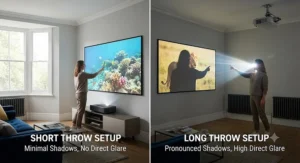
Stepping into ultra short throw territory, the Hisense PX3-PRO TriChroma is designed to sit almost flush against the wall it projects onto. Its 0.22 throw ratio means a genuinely enormous image from barely any distance at all — this is the category built specifically for buyers who want to replace a TV entirely rather than build a dedicated cinema room.
A triple-laser light source delivering 3,000 ANSI lumens gives it both the brightness and the colour volume to compete credibly with a large flatscreen, and the adjustable 80–150 inch image range means it scales from a modest bedroom setup to a genuine cinema-sized wall. Based on the spec comparison against standard-throw laser rivals, triple-laser engines like this typically deliver noticeably wider colour coverage than single or dual-laser designs, which is exactly what reviewers flagged as this model’s standout strength.
Aggregated review commentary from UK retailers and tech press consistently praises punchy colour reproduction and strong gaming credentials, while positioning it a notch below its more expensive Pro sibling on outright picture refinement — reviewers awarded it four stars rather than five, largely on value-for-money grounds rather than any single glaring flaw.
Pros:
- ✅ Triple-laser engine gives genuinely wide colour coverage
- ✅ Near-wall placement suits TV-replacement setups
- ✅ Scales comfortably from 80 to 150 inches
Cons:
- ❌ Noticeably pricier than short throw alternatives
- ❌ Needs a genuinely flat, uninterrupted wall surface
Prices have been seen anywhere from around £1,400 up to the £2,500 range depending on ongoing retailer promotions, so it’s worth comparing current deals before committing.
7. LG CineBeam HU715Q — best premium UST for a true cinema-at-home feel
Closing the list, the LG CineBeam HU715Q represents the most convincing ultra short throw argument for genuinely retiring a TV. Sitting within centimetres of the wall, it produces a vastly larger and more cinematic picture than even a large OLED television could manage in the same footprint.
It won’t match a top-tier OLED for inky blacks or contrast, and that’s an honest trade-off worth stating plainly rather than glossing over — UST laser projectors generally concede some black-level performance in exchange for scale. What the HU715Q does deliver is a genuinely big, bright, colour-rich image alongside smart platform integration, making day-to-day use closer to owning a giant smart TV than a traditional home cinema rig that needs a separate streaming box.
Reviewers who tested it against its price point called it one of the strongest cases yet for choosing a UST projector over a large-screen TV, specifically citing the gap between price and screen size as the deciding factor for anyone torn between the two. That said, this is still a considered purchase rather than a casual one, and buyers should weigh ambient light control carefully, since UST laser projectors are more light-sensitive than direct-view TVs regardless of brand.
Pros:
- ✅ Genuinely TV-replacing scale and brightness
- ✅ Near-wall placement, minimal shadow-casting
- ✅ Strong smart platform integration out of the box
Cons:
- ❌ Black levels trail behind premium OLED TVs
- ❌ Performance is sensitive to ambient room lighting
Deal pricing has recently put this model anywhere from the mid-£1,700s up toward £3,000 at full RRP, so timing your purchase around a promotional window makes a real difference here.
Projector Throw Distance Guide: What Throw Ratio Actually Means
What is throw ratio? Throw ratio is the relationship between how far a projector sits from the screen and how wide the image it produces is, expressed as distance divided by width. A throw ratio of 1.5:1 means the projector needs to sit 1.5 metres away for every metre of image width it’s asked to fill — the lower the number, the closer the projector can sit.
This single figure is arguably the most important spec on any projector’s data sheet, and it’s the one most casually skipped by first-time buyers dazzled by lumens and resolution instead. As the Wikipedia entry on projector throw explains, the formula is straightforward: divide the distance to the screen by the screen’s width, and you get the throw ratio the lens needs to match. Most manufacturers publish this as a single value for fixed lenses, or a range for projectors with zoom capability, exactly as we’ve listed for each of the seven products above.
Throw distance categories generally break down into three bands. Long throw (or “standard throw”) projectors typically carry ratios above 1.0:1 and need several metres of clear space — think ceiling-mounted units in school halls or a shelf at the back of a proper lounge. Short throw projectors sit roughly between 0.4:1 and 1.0:1, designed to work from a low cabinet a metre or two from the wall. Ultra short throw (UST) projectors drop below 0.4:1, sometimes as low as 0.2:1, letting the unit sit almost flush against the wall it’s projecting onto. Getting this one number right before you buy avoids the single most common projector-buying mistake: purchasing a projector that physically cannot produce the screen size you want in the room you actually have.
Which Projector Throw Distance Do I Need?
Working out your ideal throw distance doesn’t require an engineering degree — follow these steps in order and you’ll land on the right category before you even start comparing individual models.
- Measure your available distance. Stand where you’d place the projector and measure to the wall or screen in metres. This single number rules out entire categories immediately.
- Decide your target screen width, not diagonal. Manufacturers quote throw ratio against image width, not the diagonal inch figure used in marketing, so convert first — a 100-inch 16:9 screen is roughly 2.2 metres wide.
- Divide distance by width to get your required ratio. If you have 3 metres of clear space and want a 2.2-metre-wide image, you need a throw ratio around 1.36:1 — solidly standard/long throw territory.
- Match that ratio against the three bands. Above roughly 1.0:1 points you toward long throw models like the Epson EH-TW650 or Optoma UHZ35; between 0.4:1 and 1.0:1 suggests short throw units like the BenQ TH671ST; below 0.4:1 means you’re in UST territory with models like the Hisense PX3-PRO.
- Check for a zoom range, not just a single figure. Projectors like the Optoma UHZ35 quote a throw ratio range rather than a fixed number, giving you flexibility to fine-tune image size without moving furniture.
- Cross-reference against ceiling height and mounting plans. A wide throw ratio range is only useful if your ceiling or shelf position can accommodate the resulting distance — measure twice before buying.
- Leave a margin for keystone correction, don’t rely on it. Every projector on this list includes some keystone adjustment, but using it heavily degrades image sharpness, so aim to nail the physical placement first and treat correction as a fine-tuning tool, not a fix for a fundamentally wrong throw ratio.
Short Throw or Standard Throw Projector: Which Type Fits Your Room?
This is the genuine heart of the short throw vs long throw projector decision, and it deserves more than a table can offer. A standard (long) throw projector, like the Epson EH-TW650 on this list, needs meaningful distance behind it — typically 3 metres or more for a 100-inch image — which suits larger lounges, loft conversions, or any room where the projector can live on a shelf, cabinet, or ceiling mount well back from the screen.
A short throw or standard throw projector decision really comes down to a blunt question: how much floor space do you actually have between your seating and the wall you want to project onto? Short throw models like the BenQ TH671ST and Optoma UHZ35ST solve the classic UK problem of narrow terraced-house lounges and box-room conversions, where three metres of clear floor simply doesn’t exist. Positioning the projector close to the screen also reduces the chance of anyone walking through the beam and casting a shadow across the picture — a genuinely practical benefit in busy households with children or pets.
The trade-off worth being honest about: short throw lenses are optically more complex to manufacture without distortion, which is part of why short throw and ultra short throw models tend to cost more than a long throw projector with comparable brightness and resolution. Reviewers consistently note that long throw projectors, freed from that optical complexity, often deliver more picture quality per pound spent — so if your room genuinely has the distance to spare, a long throw model like the EH-TW650 or UHZ35 can outperform a short throw rival at the same price point. The right choice isn’t about which technology is “better” in the abstract; it’s about which one your specific room can physically accommodate without compromise.
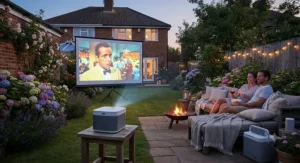
Short Throw Projector Pros and Cons
Pulling together everything covered across the seven reviews above, here’s the honest short throw projector pros and cons picture, stripped of marketing spin.
Pros:
- ✅ Fits small UK rooms where long throw models simply can’t work
- ✅ Reduces shadow-casting from people walking near the screen
- ✅ Often includes a lower fire/trip hazard footprint near the wall
Cons:
- ❌ Generally costs more than an equivalent-spec long throw model
- ❌ Fixed-lens short throw units offer little zoom flexibility
Beyond that headline list, there’s a genuine installation trade-off worth flagging: short throw projectors are considerably less forgiving of an uneven or non-flat wall, since the extreme projection angle magnifies any surface irregularity into visible distortion. Reviewers evaluating ultra short throw models in particular flag that a proper flat wall or dedicated ALR (ambient light rejecting) screen makes a genuinely noticeable difference to image quality — something long throw projectors are considerably more forgiving about given their gentler projection angle.
Throw Ratio Calculator Projector: Do the Maths Without a Headache
You don’t need a dedicated throw ratio calculator projector tool to work this out, though plenty exist online and most manufacturers, including Epson and BenQ, publish their own on official product pages. Here’s the practical, do-it-yourself version for setting up any of the seven models above.
Step one: convert your target screen size to width. Diagonal inches are what’s advertised, but throw ratio math uses width. For a standard 16:9 screen, multiply the diagonal by roughly 0.87 to get the width in the same units, then convert to metres if needed.
Step two: multiply width by the throw ratio. If you want a 2.2-metre-wide image (roughly 100 inches diagonal) and you’re considering the ViewSonic PS502X at its 0.616:1 ratio, multiply 2.2 by 0.616 to get approximately 1.36 metres of required distance — comfortably achievable in most small UK rooms.
Step three: repeat for the maximum figure if your projector has a zoom lens. The Optoma UHZ35 ranges from 1.4:1 to 2.24:1, so for that same 2.2-metre-wide image, you’d need somewhere between roughly 3.1 and 4.9 metres of clear distance — a completely different room requirement to the PS502X above, despite both technically being “projectors for a 100-inch screen.”
Step four: sanity-check against your ceiling height for mounted installs. Ceiling-mounting typically requires the beam to clear furniture and heads, so factor in the offset most manufacturers quote separately from throw distance, usually found in the same datasheet as the throw ratio itself.
Running through this maths before you buy — rather than after unboxing — is genuinely the single biggest predictor of whether you’ll be happy with your purchase in six months’ time.
Projector Distance to Screen Size: Quick Reference
Because the same throw ratio produces wildly different results depending on screen size, here’s a quick projector distance to screen size reference across our three throw categories, using round figures for easy mental maths.
| Screen Size (16:9) | Long Throw (1.2:1) | Short Throw (0.6:1) | UST (0.22:1) |
|---|---|---|---|
| 80 inches | ~2.1m | ~1.06m | ~0.39m |
| 100 inches | ~2.66m | ~1.33m | ~0.49m |
| 120 inches | ~3.19m | ~1.6m | ~0.59m |
| 150 inches | ~3.98m | ~1.99m | ~0.73m |
Reading across this table, the practical difference becomes obvious fast: to fill a 120-inch wall, a long throw projector needs well over three metres of clear floor, while a UST model like the Hisense PX3-PRO TriChroma can do the same job from barely half a metre away. This is precisely why UST projectors command a price premium — that compressed distance requires considerably more complex lens engineering to avoid distortion at the edges of the image, and manufacturers pass that engineering cost on to buyers.
Projector Placement Flexibility for UK Homes
Real UK housing stock rarely matches the spacious American living rooms shown in most projector marketing photography, so let’s ground this in genuine scenarios drawn from typical room dimensions.
The terraced-house lounge. A typical UK terrace lounge runs somewhere around 3.5 to 4.5 metres in length once you account for a sofa, coffee table, and walking space. That’s workable for a long throw projector like the EH-TW650 if the screen sits on the far wall, but tight enough that a short throw model like the TH671ST or UHZ35ST gives considerably more breathing room for furniture rearrangement, since it only needs a metre or so from the screen itself.
The box-room home cinema. Converting a small bedroom, often barely 2.5 to 3 metres across, into a dedicated viewing space genuinely requires short throw or UST projection. A long throw projector simply cannot physically produce a satisfying image size in that footprint without sitting practically on top of the viewer’s head — this is exactly the scenario UST models like the LG CineBeam HU715Q were designed to solve.
The open-plan living/dining space. Larger open-plan conversions, increasingly common in UK new-builds, often have the 4–6 metres of clear distance a long throw model like the Optoma UHZ35 needs to really shine, letting its zoom lens fine-tune image size against a longer wall without needing to hunt for the exact right shelf position.
Projector placement flexibility ultimately comes down to matching lens type to available distance rather than chasing whichever category currently has the most marketing buzz — ultra short throw is genuinely the right answer for some rooms and genuinely the wrong, overpriced answer for others with distance to spare.
✨ Don’t Miss These Exclusive Deals!
🔍 Take your home cinema setup to the next level with these carefully selected short throw and long throw projectors. Click on any highlighted model above to check current pricing and availability. These picks will help you create a genuinely big-screen experience your household will love, whatever your room size!
Common Mistakes When Buying a Short Throw or Long Throw Projector
Even careful buyers trip over a handful of recurring errors, and most are entirely avoidable once you know to look for them.
Buying the screen size before measuring the room. It’s tempting to chase the biggest inch figure a projector advertises, but every product on this list has a maximum image size that assumes a specific, often impractical, distance — check the achievable size at your actual room dimensions, not the marketing maximum.
Ignoring ambient light in the buying decision. A projector rated at 1,500 lumens will disappoint badly in a bright south-facing room regardless of its throw ratio; the ViewSonic PS502X‘s 4,000-lumen output specifically exists to solve this problem, and it’s worth paying attention to brightness figures alongside throw ratio rather than treating them as separate decisions.
Assuming keystone correction fixes a bad throw ratio match. Digital keystone correction can straighten a slightly off-angle image, but it does so by discarding pixels and softening detail — it’s a fine-tuning tool, not a substitute for correct placement.
Overlooking wall quality for short throw and UST models. As covered earlier, the extreme projection angles of short throw and UST projectors magnify wall imperfections considerably more than a long throw model would, so a genuinely flat surface or dedicated screen matters more than buyers expect.
Forgetting that fixed-lens short throw units offer no zoom. Models like the Optoma UHZ35ST have no optical zoom at all — your image size is dictated entirely by exact placement distance, unlike zoom-equipped long throw siblings such as the UHZ35.
Long-Term Cost & Maintenance: Laser vs Lamp Across Throw Types
Throw category and light source technology are separate decisions, but they’re worth weighing together for genuine total cost of ownership. Lamp-based projectors like the BenQ TH671ST typically rate their light source for 4,000 to 15,000 hours depending on power mode, after which a replacement lamp — often £80–£150 — becomes necessary. Laser-based models, including the Optoma UHZ35ST, Optoma UHZ35, Hisense PX3-PRO TriChroma, and LG CineBeam HU715Q, rate their light engines for around 20,000 to 30,000 hours, which at typical viewing habits translates to well over a decade of use without a light-source replacement.
Here’s what to weigh in practice: laser projectors cost more upfront, but that premium is partially offset over years of ownership by avoiding lamp replacement costs entirely, plus laser engines generally reach full brightness instantly rather than needing a warm-up period. For a household watching a couple of hours nightly, a lamp-based projector like the TH671ST at roughly 4,000-hour lamp life in normal mode might need its light source replaced within three to four years — worth factoring into the genuine cost comparison against a pricier laser alternative that could outlast it by a decade.
Maintenance beyond the light source is broadly similar across throw types: dust filters (where fitted) benefit from occasional cleaning, and short throw or UST models sat low near a wall may accumulate more household dust than a ceiling-mounted long throw unit positioned away from foot traffic.
Safety and Regulations: Laser Class and UK Compliance
Anything sold on amazon.co.uk to UK consumers needs to meet UK product safety requirements, and this matters more for laser-based projectors than most buyers realise. Laser light sources used in home projectors, including several models covered here, are typically certified as Class 1 or Class 3R devices under the relevant IEC laser safety standard, meaning they’re designed to be safe under normal viewing use but still carry manufacturer warnings against staring directly into the lens at close range.
The Health and Safety Executive’s guidance on laser safety explains that higher-powered laser classes require active risk control measures, which is precisely why consumer laser projectors are engineered to sit well within lower-risk classifications rather than the higher-power categories used in industrial or entertainment laser displays. In practice, this means treating the advice on any projector’s warning label seriously — avoid staring directly into the lens during operation, and keep young children from doing so, even though the risk from a compliant consumer laser projector is considerably lower than from a handheld laser pointer of comparable class.
On the regulatory side, electronic products sold in Great Britain, including projectors, need to demonstrate compliance through either the UKCA marking or the continued-recognition CE marking system, as outlined in official UK government guidance on UKCA marking. Checking that a listing shows recognised UK or EU conformity marking is a sensible due-diligence step before buying any electrical device, projectors included, particularly from lesser-known third-party marketplace sellers.
Buyer’s Decision Framework
If you’d rather skip straight to a decision, here’s a simple priority checklist matched against everything covered above.
If your room offers less than 2 metres of clear distance to the wall, choose an ultra short throw model like the Hisense PX3-PRO TriChroma or LG CineBeam HU715Q, because nothing else in this category will physically produce a usable image size.
If you have 1.5 to 3 metres available and want to stay budget-conscious, choose a short throw projector like the BenQ TH671ST or ViewSonic PS502X, because they’ll comfortably fill a wall without the ultra short throw price premium.
If you specifically need genuine 4K and a compact footprint, choose the Optoma UHZ35ST, accepting its fixed-lens limitation in exchange for sharper detail than the 1080p short throw alternatives.
If your room has 3 metres or more of usable distance and budget matters, choose a long throw model like the Epson EH-TW650, because you’ll get more picture quality per pound spent than any short throw equivalent.
If you want long throw flexibility with 4K and gaming credentials, choose the Optoma UHZ35, whose zoom range accommodates rooms of genuinely variable size.
Frequently Asked Questions
❓ Is a short throw projector better than a long throw projector?
❓ How close can a short throw projector be to the wall?
❓ What throw ratio do I need for a 100-inch screen in a small room?
❓ Do short throw projectors cost more than long throw projectors?
❓ Can I convert a long throw projector into a short throw setup?
Conclusion
The short throw vs long throw projector debate isn’t really a debate once you measure your own room properly. A long throw model like the Epson EH-TW650 or Optoma UHZ35 rewards buyers with distance to spare, typically delivering stronger picture quality per pound spent. A short throw projector like the BenQ TH671ST, Optoma UHZ35ST, or ViewSonic PS502X solves the genuine UK housing problem of compact rooms without proper projection distance. And at the premium end, ultra short throw models like the Hisense PX3-PRO TriChroma and LG CineBeam HU715Q exist specifically for buyers who want to replace a television entirely with something dramatically larger, from a footprint barely bigger than a soundbar.
None of these seven models is a wrong choice in the abstract — each is the right choice for a specific room, budget, and use case, and the whole point of running through throw ratio maths before buying is landing confidently in the category that actually fits your space. Measure first, match your throw ratio requirement against the categories above, then shop within that band rather than chasing whichever projector happens to be trending.
Recommended for You
- Short Throw Projector for Gaming: 7 Best Picks for 2026
- Best Short Throw Projector 2026: 7 Top UK Picks Ranked
- Projector For Small Room 2026: 7 Brilliant Picks That Fit
Disclaimer: This article contains affiliate links. As an Amazon Associate, I earn from qualifying purchases. If you purchase products through these links, we may earn a small commission at no additional cost to you.
✨ Found this helpful? Share it with your friends! 💬🤗
