
In This Article
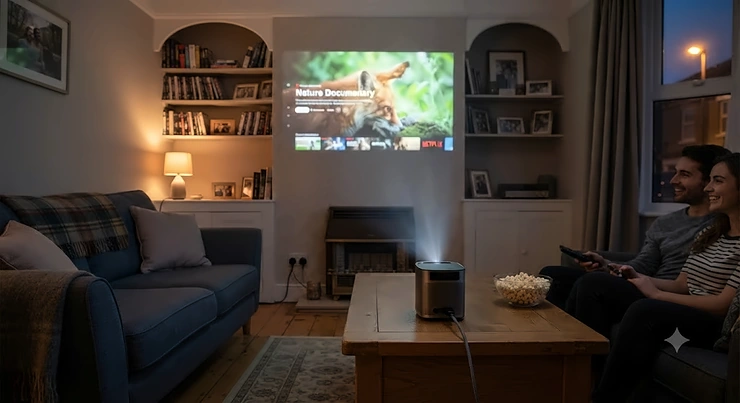
A projector for small room living is one of those ideas that sounds like a contradiction until you actually try it. Big cinema screen, tiny flat — surely those two things don’t belong in the same sentence? And yet, walk into thousands of British box-rooms, studio flats and boxy new-builds right now, and you’ll find exactly that: a beam of light turning a blank wall into something that makes the telly look positively parochial. In short, a projector for small room use is any model engineered to sit close to the screen, throw a large image without needing a cavernous lounge, and cope sensibly with the ambient light that floods most compact British homes.
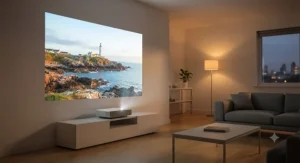
Here’s the thing nobody tells you when you start browsing: “small room” doesn’t mean one product category, it means several. A student in a shoebox bedroom has completely different needs from a couple squeezing a home cinema into a narrow lounge with an eight-foot ceiling. Throw distance, brightness, and how forgiving the optics are with wonky placement all matter more than the marketing blurb ever admits. This piece cuts through that — real products, real specs interpreted honestly, and a proper look at what each one is genuinely good for, rather than a rehash of the Amazon listing you’ve already scrolled past twice.
We’ve dug into ultra short throw models that sit centimetres from the wall, portable units small enough to live in a drawer, and everything sensible in between, always with the compact British room in mind — narrow depth, low ceilings, and a landlord who probably isn’t thrilled about drilling holes. According to Which?’s independent projector testing, picture quality and ease of use vary wildly even among similarly priced models, which is exactly why spec-sheet shopping alone won’t cut it here.
Quick Comparison Table
Before the deep dive, here’s the shortcut version — seven real projectors, sorted roughly from pocket-friendly to properly premium, so you can see at a glance which one fits your room and your budget.
| Projector | Best For | Throw Type | Price Range |
|---|---|---|---|
| Samsung The Freestyle 2nd Gen | Renters & no-drill flats | Standard, adjustable | under £400 |
| Anker Nebula Capsule 3 Laser | Small bedrooms | Standard, compact | £420-£480 range |
| XGIMI Halo+ | All-rounder small living rooms | Standard, portable | £650-£750 range |
| Epson EF-12 | Tight fixed-position rooms | 1:1 minimum throw | £850-£950 range |
| Optoma UHD35STx | 4K gaming in a small room | Short throw (0.5:1) | £1,300-£1,500 range |
| XGIMI Horizon Ultra | Small space home cinema | Standard, bright | £1,400-£1,700 range |
| Hisense PX3-PRO TriChroma | UST projector 2 metres from wall | Ultra short throw (0.22:1) | £1,600-£2,300 range |
Look closely and a pattern emerges: as throw ratio shrinks, price tends to climb, because squeezing a distortion-free image out of a lens sitting inches from the wall is genuinely difficult optical engineering. The Samsung The Freestyle 2nd Gen and Anker Nebula Capsule 3 Laser trade ultimate brightness for portability and a forgiving price tag, while the Hisense PX3-PRO TriChroma sits at the other extreme, built specifically to replace a TV in a room where you can’t sit a projector six metres back. Whichever budget you’re working with, treat throw distance as the first filter, not an afterthought — it decides whether you can even fit the picture on your wall in the first place.
💬 Found a model that’s already caught your eye? Compare current prices and availability before they change!
Top 7 Projectors for Small Rooms: Expert Analysis
1. Samsung The Freestyle 2nd Gen — tiny footprint, tilts anywhere
Weighing under a kilogram and roughly the size of a large mug, the Samsung The Freestyle 2nd Gen was built around the idea that not everyone owns a dedicated cinema room. Its 230 ANSI lumen LED engine won’t blow the doors off a bright lounge, but its cradle stand rotates a full 180 degrees, meaning it can point at a wall, a ceiling, or an angled surface without any bracket at all. Auto keystone and auto-focus mean it corrects itself the moment you switch it on, which matters enormously in a small room where you rarely get a perfectly perpendicular wall to aim at. Based on the spec comparison with rival portables, this is the projector that best suits someone who genuinely cannot drill into a rented wall.
Reviewers consistently note that picture quality is more than acceptable for casual viewing but struggles once curtains are open or a lamp is left on, so it rewards a room that can dim easily. It’s a strong pick for students, first flats, or anyone who wants a projector for small room use that can move between rooms in seconds rather than staying bolted in place.
Pros:
- ✅ Rotates 180° — no ceiling mount needed
- ✅ Auto keystone and autofocus on power-up
- ✅ Genuinely portable at under 1kg
Cons:
- ❌ Brightness struggles in daylight rooms
- ❌ No built-in battery on this generation
Prices sit consistently under £400, occasionally dipping lower during sales events — solid value for a first small-space projector.
2. Anker Nebula Capsule 3 Laser — laser brightness in a soft-drink-can body
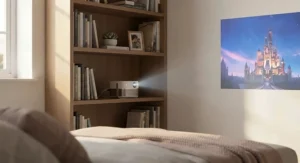
If the Samsung The Freestyle 2nd Gen is the flexible generalist, the Anker Nebula Capsule 3 Laser is the specialist for anyone furnishing a genuinely tiny bedroom. At roughly the size of a large tin of drink and weighing under a kilogram, it’s one of the few laser-lit projectors this small, delivering 300 ANSI lumens with noticeably punchier colour than LED rivals of similar size. What most buyers overlook about this model is that its built-in Google TV smart platform removes the need for a separate streaming stick — plug in power, and you’re browsing Netflix within seconds, which is exactly the kind of convenience a cramped bedside table demands.
The integrated 2.5-hour battery is genuinely useful for reading in bed with a film playing on the ceiling, though reviewers consistently flag that input lag makes it a poor gaming companion. Aggregated review sentiment describes the 8W speaker as surprisingly full-bodied for something this pocketable, even if it can’t fill a large room on its own.
Pros:
- ✅ Laser brightness beats LED rivals its size
- ✅ Built-in Google TV, no streaming stick needed
- ✅ 2.5-hour battery for cordless bedroom use
Cons:
- ❌ Noticeable input lag rules out serious gaming
- ❌ Battery drains faster on max brightness
Expect to pay in the £420-£480 range, making it one of the more premium “pocket” projectors, but the laser light source is the reason.
3. XGIMI Halo+ — the sensible all-rounder for a cramped lounge
The XGIMI Halo+ occupies a comfortable middle ground: bigger and brighter than the pocket-sized options above, but still light enough to carry from the shelf to the coffee table without a second thought. Its LED engine pushes out roughly 900 ISO lumens with genuine 1080p resolution, which in practice means it holds up far better with the curtains half-open than either the Samsung The Freestyle 2nd Gen or the Anker Nebula Capsule 3 Laser. Here’s what to weigh: the Halo+ trades laser punch for raw lumen output and a built-in Harman Kardon-tuned speaker system that genuinely fills a small lounge without a soundbar.
The spec sheet won’t tell you this, but reviewers note the autofocus camera occasionally hunts for a second or two when the unit is moved, though it settles reliably. For anyone furnishing their first proper small space home cinema without a dedicated screen, this is a strong middle step.
Pros:
- ✅ 900 ISO lumens copes with some ambient light
- ✅ Harman Kardon speakers fill a small lounge alone
- ✅ Full battery-free operation for stable brightness
Cons:
- ❌ Heavier and larger than pocket rivals
- ❌ Autofocus occasionally needs a second attempt
Sitting in the £650-£750 range, it’s the natural upgrade path once a Freestyle-style unit starts to feel underpowered.
4. Epson EF-12 — fixed 1:1 throw, built for a tight footprint
The Epson EF-12 solves a very specific small-room problem: a fixed lens with a 1:1 throw ratio, meaning a metre away from the wall gets you a genuinely usable image without any zoom to fiddle with. Based on the spec comparison, its 1,000-lumen 3LCD laser engine and true three-chip design avoid the faint “rainbow” colour fringing some cheaper single-chip DLP projectors suffer, which reviewers consistently praise for skin tones during film-heavy sessions.
What most buyers overlook is that Epson partnered with Yamaha on the audio, and the resulting built-in sound system genuinely outperforms most all-in-one projectors in this price bracket, arguably removing the need for a soundbar altogether in a compact room. The trade-off is that, unlike the Halo+, there’s no battery and no zoom lens, so placement is far less flexible once you’ve found your spot.
Pros:
- ✅ True 3-chip 3LCD avoids DLP rainbow artefacts
- ✅ Yamaha-tuned sound needs no extra speaker
- ✅ Compact footprint suits a shelf or worktop
Cons:
- ❌ Fixed 1:1 lens means no zoom flexibility
- ❌ Mains power only, no battery option
Typically found in the £850-£950 range, it sits just above the Halo+ for buyers who prioritise picture purity over portability.
5. Optoma UHD35STx — short throw with genuine 4K gaming chops
Where the previous models are largely about lifestyle convenience, the Optoma UHD35STx is a dedicated performance projector that happens to suit a small room brilliantly thanks to its 0.5:1 short throw lens. In practice, that means a 100-inch image from just over a metre away — a genuinely useful spec for anyone whose lounge depth is measured in single-digit feet. Its 3,600-lumen DLP engine and true 4K UHD resolution (3840×2160) push it well past the lifestyle projectors above in outright sharpness and daytime usability.
Reviewers consistently highlight the 4.2ms input lag and 240Hz refresh mode as genuinely competitive for console and PC gaming, a rarity at this size and price. On paper this means a small room can double as a proper gaming den without sacrificing 4K detail for movies. The trade-off, honestly, is a bulkier chassis and a noticeably brighter fan than the portable models further up this list.
Pros:
- ✅ True 4K UHD resolution at 3,600 lumens
- ✅ 4.2ms input lag and 240Hz for serious gaming
- ✅ 100-inch image from just over a metre away
Cons:
- ❌ Larger, less portable than lifestyle rivals
- ❌ Fan noise more noticeable in a quiet room
Pricing generally sits in the £1,300-£1,500 range, positioning it as an entry point into genuinely premium 4K performance.
6. XGIMI Horizon Ultra — brightest small space home cinema pick
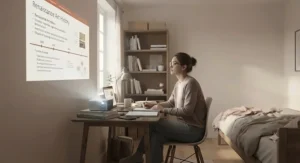
The XGIMI Horizon Ultra is arguably the standout for anyone chasing a genuine small space home cinema experience without stepping into ultra short throw pricing. Its Dual-Light engine — combining an RGBB LED with a supplementary red laser — claims up to 2,300 ISO lumens, a figure XGIMI states makes it the brand’s brightest model to date. Based on the spec comparison, that brightness is precisely what separates a projector that only shines after dark from one that copes with a lounge lit by a single lamp.
What most buyers overlook is the reasoning behind Dual-Light technology in the first place: pure laser projectors often struggle with colour accuracy at high brightness, while pure LED units struggle with brightness at all. Blending the two, on paper, is intended to sidestep both weaknesses simultaneously. Aggregated review sentiment praises the resulting HDR performance and colour depth as genuinely close to dedicated home cinema projectors costing considerably more.
Pros:
- ✅ Up to 2,300 ISO lumens, XGIMI’s brightest yet
- ✅ Dual-Light tech balances brightness and colour
- ✅ Strong HDR handling for a lifestyle projector
Cons:
- ❌ Standard throw needs more back-wall distance
- ❌ Premium price compared with earlier XGIMI models
Expect a £1,400-£1,700 range at full price, though it has appeared meaningfully discounted during major UK sales events.
7. Hisense PX3-PRO TriChroma — the UST projector 2 metres from wall solution
For anyone whose search really started with “UST projector 2 metres from wall,” the Hisense PX3-PRO TriChroma is the model built precisely for that brief. Its 0.22 throw ratio means it can sit on a low media unit right against the skirting board and still throw a genuinely large image — do the maths and roughly two metres of placement distance yields a screen comfortably over 120 inches, all without a single shadow being cast by anyone walking past. Reviewers consistently rank it among the best ultra short throw projectors currently available, and its TriChroma laser engine — pure red, green and blue lasers rather than a single laser-phosphor source — is the reason its colour reproduction is frequently singled out.
Here’s what to weigh: this is a gaming-certified UST with HDMI 2.1 inputs supporting 4K at 120Hz, so it doubles brilliantly as a console gaming screen, not just a film projector. What the spec sheet won’t tell you, but aggregated reviews suggest, is that black levels can look slightly grey compared with a genuinely dark-room dedicated cinema projector — an inherent UST trade-off rather than a flaw specific to this model.
Pros:
- ✅ 0.22 throw ratio suits a UST projector for small room use
- ✅ TriChroma RGB laser gives standout colour accuracy
- ✅ HDMI 2.1 with 4K/120Hz for serious console gaming
Cons:
- ❌ Blacks slightly greyer than dark-room projectors
- ❌ Premium pricing versus standard-throw rivals
Discounts are common, with prices frequently found in the £1,600-£2,300 range against a considerably higher RRP.
Top 7 Projectors: Spec Comparison
| Projector | Resolution | Brightness | Best For |
|---|---|---|---|
| Samsung The Freestyle 2nd Gen | Full HD | 230 lumens | Renters, no-drill flats |
| Anker Nebula Capsule 3 Laser | Full HD | 300 lumens (laser) | Small bedrooms |
| XGIMI Halo+ | Full HD | ~900 lumens | Casual lounge viewing |
| Epson EF-12 | Full HD | 1,000 lumens | Fixed tight footprints |
| Optoma UHD35STx | 4K UHD | 3,600 lumens | Gaming and daylight rooms |
| XGIMI Horizon Ultra | 4K UHD | ~2,300 lumens | Small space home cinema |
| Hisense PX3-PRO TriChroma | 4K UHD | ~3,000 lumens | UST living room replacement |
The clearest takeaway from this table is that brightness climbs sharply once you move from lifestyle-focused portables to dedicated home cinema and gaming projectors — a jump that also brings 4K resolution along for the ride. If your small room has decent blackout curtains, the XGIMI Halo+ or Epson EF-12 will likely feel entirely adequate; if it’s flooded with daylight most afternoons, the extra spend on the Optoma UHD35STx or Hisense PX3-PRO TriChroma earns its keep.
Practical Usage Guide: Setting Up a Projector in a Small Room
Getting a projector for small room use looking its best isn’t complicated, but a handful of early decisions save weeks of squinting at a wonky image. Start by measuring your actual throw distance before buying anything — stand where the projector would sit and measure to the wall in centimetres, then check that figure against the model’s minimum throw distance projector spec, not just its maximum image size claim. Most manufacturers publish an online throw calculator; use it religiously.
Once the unit arrives, resist the urge to eyeball the levelling. A projector even five degrees off-axis forces keystone correction to kick in, which softens image sharpness at the edges — genuinely noticeable on text-heavy content like subtitles. Instead, use a spirit level app on your phone to get the base flat before switching on autofocus. In the first month, dust the lens with a proper microfibre cloth rather than a sleeve or tissue, since grit can permanently scratch a coating that’s expensive to replace.
A common beginner mistake is leaving a projector running in “vivid” or “dynamic” picture mode out of the box; almost every model reviewed here looks noticeably more natural switched to “cinema” or “filmmaker” mode, particularly for skin tones. Finally, if you’re using an ultra short throw model like the Hisense PX3-PRO TriChroma, keep the area directly in front of the lens completely clear — even a stray phone charger cable can cast a distracting shadow across the bottom of the image.
💬 Struggling to picture the setup? Compare current pricing on a model that fits your exact throw distance.
Real-World Scenarios: Which Projector Suits Your Space?
Picture three genuinely different households, because “small room” covers a lot of ground. First, a university student in a single bedroom with a shared kitchen — budget is tight, the room doubles as a study space, and nobody wants a permanent screen bolted to a rental wall. Here, the Samsung The Freestyle 2nd Gen or Anker Nebula Capsule 3 Laser make obvious sense: no drilling, portable enough to tuck in a drawer between films, and priced so a scratched lens isn’t a financial disaster.
Second, a couple in a new-build flat with an eight-foot ceiling and a narrow but bright lounge, wanting something that replaces the telly properly. Ambient light rules out the cheapest portables, and standard throw distance rules out anything needing six metres of back wall. This is squarely XGIMI Horizon Ultra or Optoma UHD35STx territory — enough brightness for daytime football, enough throw flexibility for a genuinely compact space home cinema setup.
Third, a small-space renovator who’s committed to going all-in on a permanent media wall despite limited depth. For this household, the Hisense PX3-PRO TriChroma earns its premium price precisely because a UST projector 2 metres from wall placement is often the only geometry that actually works in a room too narrow for standard throw. Matching the scenario to the throw ratio, rather than the marketing headline, is genuinely the single most useful thing you can do before spending anything.
Problem → Solution: Fixing Common Small-Room Projector Headaches
Small rooms create a fairly predictable set of frustrations, so here’s the honest fix for each. Problem one: the image is bigger than the wall. Solution — measure your actual usable wall space first, then check the projector’s minimum image size at your intended throw distance; models like the Epson EF-12 with fixed lenses are especially unforgiving here, so double-check before buying rather than after.
Problem two: daylight washes out the picture completely. Solution — either invest in genuine blackout curtains, which cost far less than upgrading to a brighter projector, or step up to a model like the Optoma UHD35STx with 3,600-plus lumens that’s genuinely designed for some ambient light. Problem three: the image looks soft or slightly blurred at the edges. This is usually excessive keystone correction fighting an off-axis placement — reposition the unit squarely to the wall rather than relying entirely on digital correction, which degrades sharpness the more it’s used.
Problem four: sound is thin and tinny in a small, hard-surfaced room. A bare projector speaker in a room full of bare walls and laminate flooring will always sound worse than in a furnished lounge full of soft furnishings to absorb reflections; a compact soundbar solves this more cheaply than most people assume. Problem five: heat build-up in a genuinely cramped alcove. Ensure at least ten centimetres of clearance around the vents on any model, since restricted airflow shortens laser and LED engine lifespan over time.
How to Choose a Projector for a Small Room
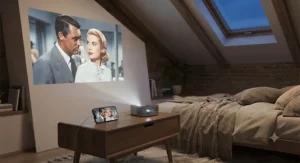
Picking the right projector for small room living comes down to a short, sensible checklist rather than chasing the highest spec on paper.
- Measure your throw distance first. Stand where the unit will live and measure to the wall — this single number rules out more models than any other spec.
- Be honest about ambient light. A north-facing bedroom with heavy curtains needs far less brightness than a south-facing lounge with bay windows.
- Decide if portability matters. If the projector moves between rooms or gets packed away, prioritise weight and battery life over raw lumens.
- Check native resolution, not just “supports 4K.” Many budget models accept a 4K signal but downscale it internally — true native 4K DLP or LCD panels look noticeably sharper.
- Factor in the sound system honestly. Built-in speakers vary enormously; if yours sounds thin, budget for a small soundbar from day one rather than as an afterthought.
- Think about keystone and lens shift. Auto-correction is convenient but slightly softens the image versus a projector placed perfectly square to the wall.
- Confirm smart platform support. A built-in Google TV or Android TV system, as found on the XGIMI Halo+ and Anker Nebula Capsule 3 Laser, removes the clutter of an extra streaming stick in a room where every cable matters.
Ultra Short Throw vs Standard Throw Projectors for Small Rooms
The single biggest decision in a compact room is throw type, and it deserves its own honest comparison rather than a footnote.
| Factor | Ultra Short Throw (UST) | Standard Throw |
|---|---|---|
| Placement | Sits against the wall, no shadows | Needs 1-4m+ of back distance |
| Example model | Hisense PX3-PRO TriChroma | XGIMI Horizon Ultra |
| Price | Generally higher for equivalent brightness | More affordable at same brightness |
| Best For | Narrow rooms, media-wall setups | Rooms with usable depth |
An ultra short throw projector small room setup solves a genuine geometry problem — you simply cannot fit a standard throw projector’s required distance into some box rooms — but that convenience comes at a real cost premium, since UST optics are considerably harder to engineer without distortion. Standard throw models like the XGIMI Horizon Ultra, by contrast, deliver more lumens and resolution per pound spent, provided your room has even a modest two to three metres of usable depth. The honest advice: measure first, then decide which category you’re even shopping in, because comparing a UST price tag against a standard throw one without accounting for the placement flexibility is comparing apples with oranges.
Common Mistakes When Buying a Projector for a Small Room
The most frequent mistake, by a wide margin, is buying based on maximum image size rather than the size achievable at your actual throw distance — a 300-inch claim is meaningless if your wall only allows 100 inches at your available distance. A close second is ignoring ambient light honestly; buyers routinely underestimate how much daylight floods a room at 3pm versus how dark it looks during an evening viewing at the shop or in a review video.
Another common misstep is assuming a fixed-lens model like the Epson EF-12 offers the same placement flexibility as a zoom-lens projector — it doesn’t, and returns due to “wrong size image” are a genuinely common complaint in aggregated customer feedback for fixed-throw units. Buyers also frequently skip checking input lag entirely, only to discover their new “cinema” projector is unplayable for gaming because of a 60ms-plus delay, a spec that rarely appears prominently on the box. Finally, many people underestimate running noise in a genuinely small room, where a projector’s fan is proportionally louder simply because there’s less air volume to disperse it into.
What to Expect: Real-World Performance in a Small Room
Specs on paper rarely match the lived experience, so here’s what actually happens once these projectors are running in a compact space. In a fully blacked-out bedroom, even a modest 300-lumen unit like the Anker Nebula Capsule 3 Laser produces a genuinely cinematic, punchy image — darkness does more heavy lifting than raw brightness ever will. The moment even dim ambient light enters, though, that gap widens fast; a 3,600-lumen model like the Optoma UHD35STx will still look vibrant with a lamp on, while sub-1,000-lumen units start to look distinctly washed out and pastel.
Close-range placement, as with UST models, also changes perceived sharpness — sitting nearer the wall means you notice pixel structure less at typical seating distances in a small room, which is one of the reasons UST projectors feel so “TV-like” despite lower relative resolution advantages over some standard throw rivals. Audio, meanwhile, consistently underwhelms across the board in real-world small-room use, since hard walls and limited furnishing give sound less to work with than a fully furnished lounge would.
Projectors for Small Bedrooms vs Small Living Rooms
A projector for small bedroom use and one for a compact living room are rarely the same purchase, even though both fall under the small-room umbrella. Bedroom viewing is typically solo or for two, often at night with curtains drawn, and frequently from a bed rather than a sofa at a fixed height — which is precisely why the rotating cradle on the Samsung The Freestyle 2nd Gen and the battery-powered Anker Nebula Capsule 3 Laser suit bedrooms so well; both can point at a ceiling or an awkward angle without a mount. Noise matters more here too, since a whirring fan six feet from a pillow is far more noticeable than one across a larger lounge.
Living rooms, by contrast, tend to host groups, daytime viewing, and gaming sessions, all of which push the requirement bar higher on brightness and input lag. This is where the Optoma UHD35STx, XGIMI Horizon Ultra, and Hisense PX3-PRO TriChroma genuinely earn their higher prices — a living room projector needs to survive a Sunday afternoon with curtains only half-drawn, something no 300-lumen bedroom unit is built for. If you’re kitting out both spaces, it’s entirely reasonable to buy differently for each rather than forcing one projector to do both jobs badly.
Long-Term Cost & Maintenance
The upfront price tag is only part of the real cost of a projector for small room use. Laser and LED light sources, used in every model featured here, typically rate for 20,000-30,000 hours of use — at even three hours a night, that’s decades of viewing without a bulb replacement, a genuine advantage over older lamp-based projectors that needed a £150-plus bulb every 1,500-3,000 hours. That said, dust filters on models with active cooling, such as the Optoma UHD35STx, do need occasional cleaning to maintain both brightness and fan-noise levels over time.
Electricity running costs are modest across the board; even the brightest model here, the Optoma UHD35STx, draws considerably less power than a large flat-panel TV of equivalent screen size during typical film-length use. The most significant “hidden” cost tends to be a screen or paint upgrade — a proper ambient-light-rejecting screen genuinely transforms UST performance, though it’s an optional rather than mandatory purchase for casual viewers happy with a plain white wall.
Features That Actually Matter (And Those That Don’t)
Marketing copy loves to bury the genuinely useful specs under flashier ones, so here’s an honest filter. Native resolution and real ANSI lumens matter enormously — these determine sharpness and daytime usability far more than any headline “supports 4K” claim, which often just means the projector accepts a 4K signal and downscales it. Throw ratio matters just as much, since it’s the number that decides whether the projector physically fits your room at all.
What matters less than the marketing suggests: maximum claimed image size, which is almost always measured at an unrealistic distance most small rooms simply don’t have; and headline contrast ratio figures, which are calculated differently by every manufacturer and rarely comparable across brands. 3D support, still listed on some spec sheets, is a feature aggregated reviews suggest almost nobody actually uses in 2026. Built-in “AI” picture enhancement modes are also worth treating with scepticism — reviewers consistently note that a manually selected cinema or filmmaker mode frequently looks more natural than an automatic scene-detection setting.
Safety, Regulations & Compliance for Small-Room Projectors
Every laser-lit projector featured here, including the Anker Nebula Capsule 3 Laser, Epson EF-12, XGIMI Horizon Ultra and Hisense PX3-PRO TriChroma, is classified under the international laser safety framework as a Class 1 laser product, meaning it’s designed to be incapable of producing damaging radiation levels during normal use. As one UK-based photonics safety resource explains, Class 1 laser products are governed by the IEC 60825-1 standard, adopted in the UK as BS EN 60825-1:2014, which sets strict exposure limits manufacturers must meet before selling into the UK market.
In practical terms for a small room, this means normal viewing distances are entirely safe, though manufacturers universally advise against staring directly into the lens at close range, particularly for children and pets who might wander in front of an ultra short throw unit’s upward-angled beam. Electrically, any projector sold in the UK should carry a UKCA or CE mark confirming compliance with relevant safety standards — worth a quick check on the box before plugging anything in, especially with imported or grey-market listings.
Minimum Throw Distance Explained: UST Projectors 2 Metres From the Wall
Throw ratio is simply the distance from the lens to the screen divided by the resulting image width, and it’s the single most useful number for anyone shopping for a minimum throw distance projector in a genuinely small room. A standard throw projector with a 1.5:1 ratio needs 1.5 metres of distance for every metre of image width — quickly ruling it out of a tight box room. An ultra short throw model like the Hisense PX3-PRO TriChroma, with its 0.22:1 ratio, needs only 0.22 metres of distance per metre of width, which is precisely why a UST projector 2 metres from wall placement can realistically produce a screen well over 120 inches diagonally.
According to TechRadar’s testing of ultra short throw models, this near-wall placement is also what eliminates shadows entirely, since the beam travels almost vertically up the wall rather than horizontally across the room where people walk. Fixed 1:1 models like the Epson EF-12 sit between these extremes — not a true UST, but still considerably more forgiving of a shallow room than a traditional 1.5:1 or 2:1 lens.
Best Projector for a Flat: Renters, Low Ceilings and No-Drill Setups
Anyone hunting for the best projector for flat living usually shares three specific constraints: no permission to drill for a ceiling mount, an eight-foot ceiling that leaves little clearance for a bulky bracket, and a need to reposition the unit if furniture or flatmates change. This is precisely the scenario the Samsung The Freestyle 2nd Gen was designed around — its 180-degree rotating cradle means it can sit on a shelf, sideboard, or even the floor and still throw an image onto a wall or an eight foot ceiling without a single screw.
For flat-dwellers who want a genuinely no-fuss weekend movie setup, the XGIMI Halo+ and Anker Nebula Capsule 3 Laser are similarly strong choices, since both are light enough to move between a living room and a bedroom depending on who’s watching what. Avoid committing to a fixed-lens ultra short throw model in rented accommodation unless you’re genuinely settled, since repositioning a UST projector after finding its ideal spot against one particular wall is far more disruptive than simply picking up a lightweight standard-throw unit and carrying it somewhere else.
FAQ
❓ What is the best projector for a small room on a budget?
❓ How close can a projector be to the wall?
❓ Do small rooms need a special projector screen?
❓ Is a projector or a TV better for a small room?
❓ What ceiling height do I need for a small room projector?
Conclusion
Choosing a projector for small room use ultimately comes down to being honest about three things: how much natural light your room gets, how much real depth you have between the likely projector position and the wall, and whether portability matters more to you than raw brightness. Budget-conscious renters and bedroom viewers are well served by the Samsung The Freestyle 2nd Gen and Anker Nebula Capsule 3 Laser, both of which sidestep permanent installation entirely. Anyone chasing a proper small space home cinema with daytime usability should look toward the XGIMI Horizon Ultra or Optoma UHD35STx, while a genuinely space-starved room is where a UST projector 2 metres from wall setup like the Hisense PX3-PRO TriChroma earns every penny of its premium price tag.
None of these seven models is universally “best” — that’s precisely the point of treating throw distance, brightness, and portability as filters rather than afterthoughts. Measure your room properly, be realistic about the light it gets at different times of day, and the right match becomes obvious fairly quickly. Whichever direction you go, current prices and availability are always worth checking before you commit, since projector pricing shifts frequently across UK retailers.
Recommended for You
- Laser Ultra Short Throw Projector: 7 Best Picks for 2026
- 4K UST Projector Under £2000: 7 Brilliant Picks (2026)
- 4K Ultra Short Throw Projector: 7 Brilliant 2026 Picks
Disclaimer: This article contains affiliate links. As an Amazon Associate, I earn from qualifying purchases. If you purchase products through these links, we may earn a small commission at no additional cost to you.
✨ Found this helpful? Share it with your friends! 💬🤗
