
In This Article
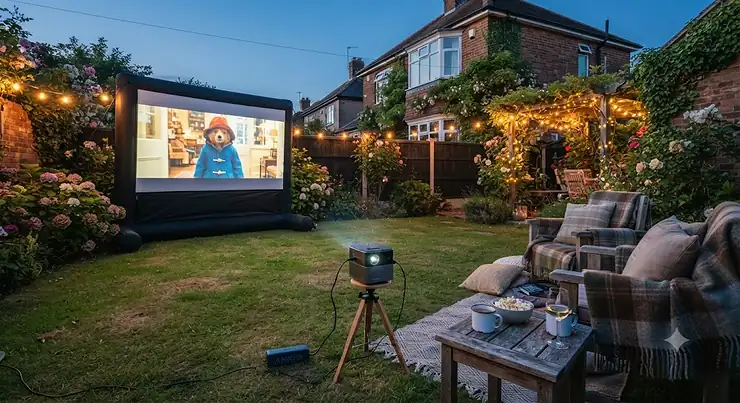
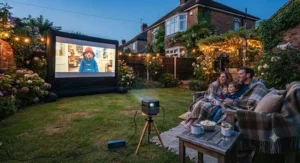
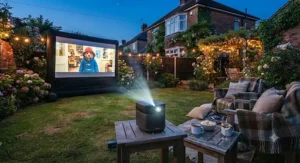
There’s a particular kind of magic to watching a film with the fence as your cinema wall and a blanket over your knees, and it’s why the garden cinema projector has quietly become one of the most-searched purchases of the British summer. You don’t need a converted loft or a five-figure home cinema budget — you need a decent projector, something to bounce the picture off, and a plan for when the midges show up. That’s genuinely most of it.
What trips people up isn’t the concept, it’s the shopping. Search “garden cinema projector” and you’ll wade through a swamp of near-identical mini projectors with wildly inflated lumen claims, most of which were clearly never tested outside a living room, let alone a British garden at 9pm in July with the neighbour’s security light doing its best impression of a searchlight. This guide cuts through that: seven real, currently available products across budget, mid-range and premium, tested claims cross-checked against independent reviewers, and the unglamorous bits — batteries, brightness, weatherproofing — explained in terms of what they actually mean once you’re stood on the lawn trying to get a straight image onto a bedsheet.
We’ll cover how to choose a garden cinema projector, what separates a projector built for outdoor use from one that just happens to be portable, how to think about audio when there’s no ceiling to bounce sound off, and where an inflatable screen earns its keep over a plain white wall. Prices are given as ranges rather than fixed figures, because retail pricing shifts by the week — always check the current price before buying.
Quick Comparison Table
| Product | Best For | Price Range | Standout Spec |
|---|---|---|---|
| Anker Nebula Mars 3 | Best overall / off-grid power | £900–£1,100 | 1,000 ANSI lumens, 185Wh battery |
| XGIMI Halo+ | Best all-rounder for the money | £650–£750 | 900 ANSI lumens, Harman Kardon sound |
| Anker Nebula Capsule 3 Laser | Most portable laser projector | £450–£500 | Laser engine, fits in a bag |
| Samsung The Freestyle 2nd Gen | Most flexible smart interface | £350–£500 | 180° adjustable cradle, Gaming Hub |
| Aldi Outdoor Cinema Projector | Cheapest way in | Around £50 | Full bundle available under £120 |
| celexon INF200 Inflatable Screen | Serious dedicated screen | £250–£340 | 140-inch self-inflating PVC screen |
| Anker Soundcore Motion Boom Plus | Best audio upgrade | £150–£190 | 80W, IP67 waterproof |
Looking at the spread, there’s a genuine gap between the sub-£500 portables and the £650-plus tier, which is really a brightness gap as much as a price one — the XGIMI Halo+ and Anker Nebula Mars 3 both clear 900 ANSI lumens, while most of the budget options sit closer to 200-400. For most back-garden setups after dusk, that gap matters less than the marketing suggests, but it becomes the deciding factor the moment you want to start before the sun’s fully down. Anyone building a full garden cinema projector bundle rather than buying piecemeal should note that a screen and a decent speaker often add up to nearly as much as the projector itself, so budget for the whole system, not just the box with the lens.
💬 Found a projector you like the look of? Bookmark this table before you keep reading — you’ll want to compare back to it.
Top 7 Garden Cinema Projectors: Expert Analysis
1. Anker Nebula Mars 3 — best for true off-grid garden cinema
The standout here is the 185Wh built-in battery, which is less a convenience feature and more the entire point of the product. Anker built the Mars 3 specifically for people who don’t want to run an extension lead across a wet lawn, and it shows: it carries IPX3 water resistance along with 0.5-metre drop resistance and dust resistance rated to particles as small as 0.7mm, so a light shower mid-film won’t end the evening. At 1,000 ANSI lumens with genuine 1080p resolution, this is bright enough to start a film before the sky’s gone properly dark, which is the single biggest quality-of-life upgrade over cheaper portables.
On battery power alone it manages up to five hours of eco-mode viewing, and Android TV 11 gives direct access to the major streaming apps without needing a dongle. Based on the spec comparison with the rest of this list, the Mars 3 is the only projector here genuinely designed to survive being left out for an entire garden party rather than carried out for one film and back inside straight after. Reviewers consistently note the automated calibration and AI brightness adjustment make setup fast even for first-timers, though a few flag that the built-in speakers, while loud, aren’t a substitute for a dedicated Bluetooth speaker on a full-size lawn.
Pros:
- ✅ Genuinely weatherproofed for outdoor use, not just “portable”
- ✅ Five-hour battery removes the extension lead problem entirely
- ✅ Brightest projector on this list, works closer to dusk
Cons:
- ❌ Heaviest and priciest option here by some margin
- ❌ Built-in speakers still benefit from an external speaker outdoors
Typically found in the £900–£1,100 range, though it’s regularly discounted by £150-£200 during summer sales. For anyone who hosts garden movie nights more than a handful of times a year, the durability alone makes this a reasonable long-term investment; casual users will likely get better value further down this list.
2. XGIMI Halo+ — best all-rounder for the money
The standout feature is XGIMI’s Intelligent Screen Adaption system, which handles autofocus, keystone correction and obstacle avoidance automatically the moment you switch it on. The Halo+ peaks at 900 ANSI Lumens, a full 100 lumens brighter than the original Halo, and outputs true 1080p from a 0.33-inch DMD chip with a 1.2:1 throw ratio. In practice, that brightness figure is what separates a genuinely usable garden projector from one that only works once it’s pitch black.
The built-in 59Wh battery, dual 5W Harman Kardon speakers, HDMI 2.0 and USB-A ports round out a spec sheet that punches well above its price point. What most buyers overlook about this model is that the Harman Kardon-tuned audio is a genuine differentiator versus rivals in this bracket — for a garden party of eight to ten people, you can often skip the extra speaker entirely, which isn’t true of most competitors at this price. Aggregated review sentiment across major outlets consistently praises the picture quality and setup speed, with the main recurring criticism being battery life, which tops out around 2.5 hours in standard mode — plenty for one film, tight for a double bill.
Pros:
- ✅ Best-in-class autofocus and keystone correction for quick setup
- ✅ Harman Kardon speakers strong enough to skip external audio
- ✅ 900 ANSI lumens is genuinely bright for this price bracket
Cons:
- ❌ Battery caps out around 2.5 hours on a single charge
- ❌ Android TV 10 is a generation behind newer rivals
Retailing around £739 at launch, expect a working range of roughly £650-£750, with occasional dips lower during sales events. As a value proposition for a genuine garden cinema projector, this is arguably the sweet spot on this entire list.
3. Anker Nebula Capsule 3 Laser — most portable laser projector
The standout feature is squeezing a genuine laser light engine into something the size of a soft drinks can. At just 2lb (900g) and roughly 90% smaller than rivals offering similar brightness, the Capsule 3 Laser still delivers 300 ANSI lumens in full 1080p and projects up to a 120-inch image, with a 2.5-hour battery for video and up to eight hours in Bluetooth speaker mode.
300 ANSI lumens sounds modest against the Mars 3’s 1,000, and on paper it is — but here’s what the spec sheet won’t tell you: because it’s a laser rather than LED source, the colour accuracy and contrast at that lower brightness figure often look more vivid than an LED projector rated higher, especially once full darkness sets in. Google TV, Netflix certification and 8W Dolby Digital speakers round out a feature set that’s unusually complete for something this small. Reviewers who’ve compared it directly against pricier rivals note it’s genuinely hard to fault for the size, with the main criticism being that £499 feels steep next to bulkier but similarly bright competitors.
Pros:
- ✅ Laser engine gives punchy colour despite modest lumen rating
- ✅ Small enough to genuinely carry in one hand to the garden
- ✅ Doubles as a capable Bluetooth speaker for eight hours
Cons:
- ❌ Premium price for its brightness class
- ❌ 120-inch max image is smaller than rivals on this list
Expect to pay in the £450-£500 range at full price, though this model does see periodic discounts. This is the pick for anyone whose “garden” is really a balcony or courtyard and portability outranks raw brightness.
4. Samsung The Freestyle 2nd Gen — most flexible smart interface
The standout feature is the 180-degree adjustable cradle that lets you point the image at literally any flat surface without fiddling with a tripod. The compact design delivers a projected image up to 100 inches, supports Full HD and produces 360-degree audio, which for casual garden use is a genuinely clever bit of engineering — prop it on a table, angle it up at a wall or even a garage door, and it self-corrects.
Crucially for outdoor use, The Freestyle needs a compatible external battery pack (USB-PD, 50W/20V or above) since it has no built-in battery of its own, and a weatherproof case is recommended for genuinely outdoor sessions. Based on the spec comparison, this is the projector that rewards buyers who already own or don’t mind buying a decent power bank — without one, it’s really an indoor projector you occasionally carry outside on an extension lead. Samsung’s own UK customer reviews describe it as excellent for casual home cinema, outdoor movies and gaming, though a minority of reviewers flag reliability concerns after 6-12 months of use, which is worth factoring into any warranty decision.
Pros:
- ✅ 180-degree cradle makes aiming the image effortless
- ✅ Samsung Smart TV interface and Gaming Hub built in
- ✅ 360-degree speaker delivers surprisingly wide sound
Cons:
- ❌ No built-in battery — needs a separate power bank for outdoor use
- ❌ At 230 lumens, best used after full darkness
Official RRP sits around £649, but real-world UK pricing is regularly found in the £350-£450 range, making it considerably better value than list price suggests once you check current price at the time of buying.
5. Aldi Outdoor Cinema Projector — cheapest way into garden cinema
The standout feature is simply the price: a full outdoor cinema starter kit for less than most rivals charge for the projector alone. Aldi’s projector and matching inflatable movie screen launched as a Special Buy, priced separately at around £50 for the projector and £60 for the screen, aimed squarely at first-time buyers dipping a toe into garden cinema.
The projector fits a screen size from 40 to 130 inches, runs on Android 11 to stream directly from apps, includes a built-in speaker and a simple adjustable stand, though focus needs to be set manually rather than auto-adjusting. Here’s what the spec sheet won’t tell you: at this price, image brightness and contrast simply can’t compete with the £650-plus tier, so this is a projector for full-dark viewing only, and don’t expect crisp text or sharp detail on a large screen. What most buyers overlook is that this makes an ideal “try before you commit” purchase — if garden movie nights become a regular fixture in your household, you’ll likely upgrade within a year or two, but you won’t have wasted much finding that out.
Pros:
- ✅ Full bundle (projector plus screen) available under £120 total
- ✅ Android 11 streaming built in, no extra dongle required
- ✅ Genuinely low-risk way to try garden cinema before investing more
Cons:
- ❌ Manual focus adjustment, no auto-keystone correction
- ❌ Brightness only suitable for full darkness
Around £50 for the projector alone, or roughly £110-£120 with the matching inflatable screen when both are in stock. As a genuine garden cinema projector bundle, it’s hard to beat for a one-off event or a family testing the waters.
6. celexon INF200 Inflatable Outdoor Screen — best inflatable screen for serious garden cinema
The standout feature is a proper 140-inch, self-inflating cinema screen that goes up in minutes without a frame to assemble. The screen presents an impressive picture diagonal of over 350cm, using a PVC front projection cloth with a black, light-blocking back so that light sources behind it barely disturb the projected image.
Velcro strips around the frame let one person tension the fabric individually, countering the temperature-related expansion that plagues cheaper screens, and the finely structured surface is rated to handle 4K UHD content without visible loss of detail. On paper this means it out-performs a bedsheet or garage door in every measurable way: proper gain, genuine black-level backing and a taut, wrinkle-free surface that a painted wall simply can’t offer. At 15kg with a 4.2m x 1.8m footprint once inflated, this isn’t something you’ll set up on a whim, but for anyone hosting garden cinema nights regularly, or scaling up toward beer-garden-style public viewing, it’s a genuine step up in production value. Reviewers on retailer sites consistently rate the ease of setup highly, with the main caveat being that a continuous air pump (sold separately on some bundles) is required to keep the screen taut throughout a long evening.
Pros:
- ✅ 140-inch self-inflating screen sets up in minutes
- ✅ Light-blocking PVC backing genuinely improves contrast outdoors
- ✅ 4K-optimised surface future-proofs against a projector upgrade
Cons:
- ❌ Bulky at 15kg — not something you’ll set up spontaneously
- ❌ Needs a continuous air pump running throughout use
Typically priced in the £250-£340 range depending on retailer. For anyone whose search started at “inflatable projector screen garden,” this is the product that search is really pointing toward.
7. Anker Soundcore Motion Boom Plus — best audio upgrade for garden movie nights
The standout feature is 80W of genuinely garden-filling sound from a speaker that’s still light enough to carry out in one hand. It delivers booming 80W stereo sound with enhanced bass from dual 30W woofers and a 10W tweeter, built around a waterproof, portable design with a 20-hour playtime.
A 13,400mAh battery doubles as a power bank for topping up a phone or streaming stick mid-film, and Bluetooth 5.3 keeps the connection stable across a typical garden’s width. Reviewers consistently note that this level of bass and clarity at this price undercuts the closest rival by a meaningful margin — one detailed comparison found it holds up credibly against speakers costing nearly twice as much. Based on the spec comparison, this is the single most cost-effective upgrade on this entire list: pairing any of the sub-£500 projectors above with this speaker solves their biggest shared weakness (thin built-in audio) for well under £200.
Pros:
- ✅ 80W output genuinely fills a mid-size garden with sound
- ✅ IP67 rating means rain or a knocked-over drink won’t end it
- ✅ 20-hour battery comfortably outlasts any projector’s playtime
Cons:
- ❌ Large and heavy compared to pocket-sized Bluetooth speakers
- ❌ No aptX support, so audiophiles may notice compression on Bluetooth
Usually found in the £150-£190 range. If your garden cinema audio setup currently relies on a projector’s built-in speaker, this is the first accessory worth buying.
Top 7 at a Glance: Specs Compared
| Product | Resolution | Brightness | Power | Price Range |
|---|---|---|---|---|
| Anker Nebula Mars 3 | 1080p | 1,000 ANSI lumens | Built-in battery, ~5hrs | £900–£1,100 |
| XGIMI Halo+ | 1080p | 900 ANSI lumens | Built-in battery, ~2.5hrs | £650–£750 |
| Anker Nebula Capsule 3 Laser | 1080p | 300 ANSI lumens (laser) | Built-in battery, ~2.5hrs | £450–£500 |
| Samsung The Freestyle 2nd Gen | 1080p | 230 ANSI lumens | External battery required | £350–£500 |
| Aldi Outdoor Cinema Projector | HD | Entry-level | Mains powered | Around £50 |
| celexon INF200 Screen | N/A (screen) | N/A | Air pump required | £250–£340 |
| Anker Soundcore Motion Boom Plus | N/A (speaker) | N/A | Built-in battery, 20hrs | £150–£190 |
The clearest pattern here is that brightness and battery life scale together with price almost perfectly, right up until the Samsung The Freestyle 2nd Gen, which bucks the trend by charging mid-range money for entry-level brightness in exchange for its flexible mounting and smart interface. If raw picture quality after dusk is your only concern, the XGIMI Halo+ offers the best lumens-per-pound of any projector here, while the celexon INF200 and Anker Soundcore Motion Boom Plus aren’t competing on this table at all — they’re the accessories that make whichever projector you choose actually feel like a cinema rather than a laptop pointed at a wall.
How to Set Up Your Garden Cinema
Getting a garden cinema projector bundle from box to first film is genuinely a 30-minute job once you know the order to do things in. Start with positioning before anything else gets unpacked: measure the throw distance your chosen projector needs for the screen size you want, then work backwards to find a stable, level surface — a garden table works better than grass, which shifts underfoot and throws off keystone correction. If you’re projecting after 8pm in a UK summer, you’ve usually got enough natural darkness by 9:30pm to start without the image washing out, though this varies significantly by latitude and month.
Run a full cable and power check before guests arrive, not after: outdoor-rated extension leads are non-negotiable if you’re not running on battery, and route them away from walkways. For audio, pair your Bluetooth speaker before the projector’s even switched on — most connection hiccups happen because people try to pair mid-film with music already queued up elsewhere. A common first-30-days mistake is skipping the auto-keystone or auto-focus calibration step because “it looks fine,” only to notice a soft, slightly trapezoidal image once the film starts; always run the full calibration cycle, even on projectors that claim instant setup. Finally, have a backup plan for dew: covering seating and keeping the projector under some form of shelter (even a large umbrella) protects electronics from condensation as temperatures drop through the evening.
Garden Movie Night Scenarios: Matching the Projector to You
Not every garden cinema setup needs the same kit, and matching the product to the actual use case saves money and disappointment in equal measure. Consider three common profiles.
The first-timer testing the waters, hosting one or two family film nights a summer on a modest budget, is well served by the Aldi Outdoor Cinema Projector paired with nothing more than a white sheet or the side of the shed — spending more before you know you’ll use it regularly doesn’t make sense. The regular host, running a garden cinema most weekends through summer for family and friends, benefits far more from the XGIMI Halo+ or Anker Nebula Mars 3 paired with the Anker Soundcore Motion Boom Plus, since both the brightness and the battery life get real, repeated use that justifies the higher outlay. Finally, the event organiser planning something closer to a public viewing — a street party, a work social, a football screening for a crowd — is the one buyer for whom the celexon INF200 Inflatable Outdoor Screen genuinely earns its price, since a bedsheet simply won’t hold up visually or physically to that scale of audience.
Problem → Solution: Fixing the Most Common Garden Cinema Headaches
Even the right projector runs into a handful of recurring problems once it’s outside, and most have straightforward fixes. Washed-out image in twilight: this is almost always a brightness mismatch, not a faulty unit — either wait for full darkness or upgrade toward the 900+ ANSI lumen tier like the XGIMI Halo+. Sound getting lost across the garden: built-in speakers on every projector here are designed for a living room, not open air; a dedicated speaker such as the Anker Soundcore Motion Boom Plus solves this in one purchase rather than fiddling with volume settings. Wobbly or wrinkled screen surface: a bedsheet pinned to a washing line will always ripple in the slightest breeze — a taut, purpose-built screen like the celexon INF200 removes the problem entirely.
Wi-Fi dropping out mid-film: gardens sit at the edge of most home routers’ range, so either use a mesh extender near the back door or download content in advance rather than relying on live streaming. Condensation on the lens after dark: as temperatures fall, cool projector glass can mist over in humid evening air; a short pause with the projector angled slightly to air out usually clears it, and positioning away from direct grass (where moisture rises fastest) helps prevent it recurring.
✨ Don’t Miss These Exclusive Deals!
🔍 Take Your Garden Movie Nights to the Next Level
Ready to build your own garden cinema setup? Click through on any of the picks above to check current pricing and availability, and start planning the perfect summer of garden movie nights with the whole family. 🍿🌙
How to Choose a Garden Cinema Projector
Working through the decision methodically saves both money and buyer’s remorse. Here’s the order that actually matters:
- Set a brightness floor first. Anything under 300 ANSI lumens genuinely needs full darkness to look good; if you want to start before sunset, aim for 700+.
- Decide on power source before anything else. Mains-only projectors like the entry-level Aldi model are fine near the house, but a built-in battery is essential for anywhere further from a socket.
- Match resolution to screen size, not the other way round. 1080p is genuinely sufficient up to around 150 inches for garden viewing distances; 4K only pays off on larger dedicated screens.
- Budget for audio separately. Every projector on this list has usable but limited built-in sound; treat a speaker as part of the core budget, not an optional extra.
- Check the weatherproofing rating, not just the marketing copy. An IPX3 or better rating means genuine protection from light rain; anything unrated should be treated as fair-weather-only.
- Factor in setup speed for your actual habits. Auto-keystone and autofocus genuinely matter if you’re setting up weekly; less so for a single annual event.
- Leave room in the budget for a screen. A projector alone rarely delivers the full “cinema” feeling that a taut, purpose-built surface adds.
Features That Actually Matter (And Those That Don’t)
Marketing copy on garden cinema projectors leans heavily on numbers that sound impressive but rarely translate into real-world difference. Raw “lumens” figures (as opposed to ANSI lumens) are the worst offender — manufacturers routinely quote inflated non-standardised figures that bear little relation to actual brightness, so always look specifically for the ANSI-rated number when comparing models. Similarly, headline max screen sizes (200-inch, 300-inch) are almost always theoretical maximums that look dim and soft well before you reach them; treat any stated maximum as roughly double the size you’d actually want to watch a film at.
What genuinely does matter: auto-keystone correction (saves real setup time every single use), a battery rating stated in hours rather than percentage, and a clearly stated ANSI lumen figure from an independent source rather than the manufacturer alone. 4K resolution, by contrast, matters far less outdoors than indoors — ambient light and typical garden viewing distances mean most people can’t reliably tell 1080p from 4K on anything under 150 inches, making it one of the more overrated specs for this specific use case.
Garden Cinema Projector vs Outdoor TV
For anyone torn between a projector and a weatherproof outdoor TV, the comparison usually comes down to flexibility versus permanence.
| Factor | Garden Cinema Projector | Outdoor TV |
|---|---|---|
| Best For | Flexible, movable garden cinema setups | Fixed, permanent outdoor viewing spot |
| Upfront cost | £50–£1,100 | Typically £800–£3,000+ |
| Screen size | Up to 150+ inches | Fixed at purchase, usually 55–75 inches |
| Weather resilience | Portable, store indoors between uses | Built to remain outside year-round |
| Daytime viewing | Poor without very high brightness | Excellent, designed for direct sunlight |
The projector route wins decisively on flexibility and upfront cost — you can pack the whole system away after summer and reclaim the garden, and even the premium Anker Nebula Mars 3 costs a fraction of a genuine outdoor TV installation. Outdoor TVs win comfortably on daytime and installed permanence, since they’re built to survive being rained on for months at a time and remain watchable in bright sunlight, which no projector on this list can genuinely match. For most UK households wanting an occasional garden cinema rather than a permanent outdoor living room, the projector route remains the more sensible and considerably cheaper starting point.
Common Mistakes When Buying a Garden Cinema Projector
The most frequent mistake is buying on raw lumen figures alone without checking whether they’re ANSI-rated, which routinely leads to a projector that looks noticeably dimmer in person than the listing implied. A close second is underestimating cable and power needs — many first-time buyers discover on the night that their chosen spot is further from a socket than any lead they own, only to find the projector they bought has no battery option at all. Ignoring audio until after the projector arrives is another common trap; retrofitting a decent speaker afterward tends to cost more in a rushed, unresearched purchase than budgeting for one from the start would have.
Buyers also frequently skip checking the throw ratio against their intended screen size, ending up with a projector that either can’t fill a screen from the available distance or overshoots it entirely. Finally, plenty of first-time buyers assume any projector will “do outdoors” simply because it’s small and battery-powered — portability and genuine weather resistance are not the same thing, and only a rating like IPX3 or higher confirms the latter.
Garden Cinema Audio Setup: Built-In Speakers vs External Systems
Every projector on this list ships with some form of built-in speaker, and for a small, intimate garden cinema night with two or three people huddled close, that’s often genuinely enough — particularly on the XGIMI Halo+, whose Harman Kardon-tuned pair punches well above its size. Where built-in audio consistently falls short is scale: open-air sound dissipates far faster than indoor sound reflecting off walls and ceilings, so what feels adequate for four people quickly becomes strained for a garden full of ten or more.
The practical threshold is roughly six to eight guests: beyond that, a dedicated external speaker like the Anker Soundcore Motion Boom Plus stops being a luxury and becomes the difference between an enjoyable evening and one where half the audience keeps asking “what did they say?” Bluetooth pairing is now near-universal across projectors in this category, so compatibility is rarely the blocker — budget and forward planning are. For anyone building a genuine garden cinema audio setup rather than relying on whatever ships in the box, pairing a projector from the mid-range tier with a dedicated IP-rated speaker is consistently the better use of a fixed budget than spending the entire amount chasing a brighter projector alone.
What to Expect: Real-World Performance in a British Garden
Spec sheets are written in controlled test conditions that rarely resemble an actual British garden in July. In practice, ambient light is the dominant factor: even a well-lit street lamp or a neighbour’s security light spilling over the fence can noticeably wash out anything under around 500 ANSI lumens, which is why the budget tier of this list performs best in genuinely dark, rural-adjacent gardens rather than well-lit suburban streets. Wind is the second underrated variable — a loose bedsheet screen will visibly ripple in anything more than a gentle breeze, which is precisely the problem a taut, weighted screen like the celexon INF200 is engineered to solve.
Temperature drop through the evening also affects battery-powered projectors more than most buyers expect; battery performance in cooler air trends slightly lower than the manufacturer’s stated figures, so treat quoted playtimes as a best-case scenario rather than a guarantee. On the upside, once full darkness sets in — reliably from around 9:30-10pm through a UK summer — even mid-range projectors in this list perform close to their spec sheet, delivering the kind of crisp, genuinely cinematic image that makes the whole exercise worthwhile.
Safety, Weatherproofing & UK Regulations for Garden Cinema Projectors
Any electrical product sold in Great Britain, projectors included, must meet UK product safety requirements — in practice this means checking for the UKCA or CE conformity mark on the product before buying, which confirms it has been assessed against the relevant electrical safety standards. As GOV.UK explains in its guidance on product marking, businesses currently have flexibility to use either the UKCA or CE mark on electrical goods sold in Great Britain, so seeing either on a projector or speaker is a reasonable indicator of compliance rather than a red flag.
Beyond the mark itself, the practical safety checklist for outdoor use is short but important: never run mains-powered equipment on standard indoor extension leads in damp grass — use outdoor-rated cable and connectors only; keep any mains connection point covered and off the ground; and treat stated IP ratings as the genuine limit of what a product can handle, not a suggestion. A projector rated IPX3, for instance, tolerates light spray but not submersion or heavy, sustained rain, so packing away promptly if weather turns remains the safest habit regardless of what the rating suggests.
One more UK-specific consideration worth planning around: noise carries much further outdoors than most hosts expect, and guidance from nidirect on noise nuisance and neighbours confirms that councils can investigate and act on noise from gardens just as they would from inside a house. Keeping garden movie nights to reasonable hours and moderate volume isn’t just considerate — it genuinely avoids the small but real risk of a noise complaint escalating into formal council involvement.
Frequently Asked Questions
❓ What's the best projector for a garden party with a lot of guests?
❓ Do I need a special screen, or can I just use a wall?
❓ How bright does a garden cinema projector need to be?
❓ Can I run a garden cinema projector without power outside?
❓ Will a garden cinema projector work during the day?
Conclusion
A genuinely good garden cinema projector isn’t the one with the biggest headline lumen number — it’s the one that matches how often you’ll actually use it, how far you are from a power socket, and how many people you’re realistically hosting. For most UK households dipping a toe in for the first time, the Aldi Outdoor Cinema Projector removes the financial risk entirely; for anyone who already knows garden movie nights are becoming a summer fixture, the XGIMI Halo+ offers the strongest all-round balance of brightness, sound and battery life on this list, while the Anker Nebula Mars 3 remains the pick for genuinely off-grid, weatherproof use.
Don’t underestimate the accessories, either. A dedicated screen like the celexon INF200 and a proper outdoor speaker like the Anker Soundcore Motion Boom Plus routinely do more for the overall experience than upgrading the projector itself once you’re past the entry-level tier. Whichever combination you land on, the same basic rules apply across every price point covered here: check the ANSI lumen rating rather than the marketing headline, budget for audio from day one, and always check current pricing before buying, since this category sees frequent, meaningful discounts throughout the year.
✨ Ready to Plan Your First Garden Movie Night?
🎬 Pick your projector, grab a screen if you’re going all-in, and check the forecast — everything else in this guide is designed to help that first garden cinema evening go off without a hitch. Enjoy the show! 🍿
Recommended for You
- 7 Best Portable Outdoor Projectors UK 2026
- Best Weatherproof Projector 2026: 7 Rain-Ready Picks Tested
- Outdoor Cinema Projector Setup 2026: 7 Picks & Full Buying Guide
Disclaimer: This article contains affiliate links. As an Amazon Associate, I earn from qualifying purchases. If you purchase products through these links, we may earn a small commission at no additional cost to you.
✨ Found this helpful? Share it with your friends! 💬🤗
