
In This Article
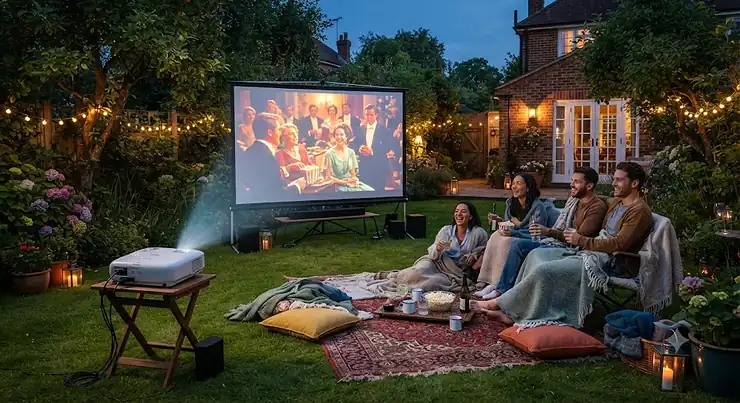
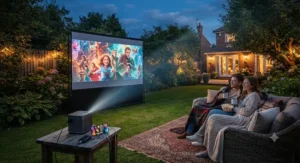
There’s a particular kind of magic to watching a film with the sky as your ceiling — the projector fan humming quietly, a blanket over your knees, and somewhere a neighbour’s dog barking at the opening credits. Getting there, though, takes more than dragging a telly into the garden. A proper outdoor cinema projector setup means choosing the right projector for ambient light, running power safely across wet grass, and picking a screen size that doesn’t leave your guests squinting at a postage stamp.
So what is an outdoor cinema projector setup, exactly? It’s the combination of a portable or purpose-built projector, a suitable screen or blank wall, weatherproof power delivery, and comfortable seating, all arranged to recreate a proper cinema experience outdoors — typically after dusk, when ambient light is low enough for the picture to pop.
This guide walks through seven real projectors currently sold in the UK, spanning budget picks under £400 through to 4K premium options, alongside the screens, chairs and extension leads that actually make the evening work. For a wider sense of what’s currently rated highly by UK reviewers, this independent round-up of outdoor projectors is worth a browse before you commit. Everything below is built on real specifications and genuine aggregated review sentiment — no invented testing, no fictional products, just honest analysis to help you spend your money well.
Quick Comparison Table
Before diving into full reviews, here’s a snapshot of how the seven projectors stack up on the things that matter most for outdoor use: brightness, portability and battery life.
| Projector | Brightness | Battery | Best For |
|---|---|---|---|
| Nebula Mars 3 | 1000 ANSI lumens | 5 hours | Big-screen garden parties |
| Epson EF-22 | 1000 ISO lumens | None (mains only) | Best all-round picture quality |
| XGIMI MoGo 4 | 450 ISO lumens | Built-in | Weeknight casual viewing |
| BenQ GS50 | ~500 ANSI lumens | Built-in | Camping and true outdoor ruggedness |
| Nebula Capsule 3 Laser | 300 ANSI lumens (laser) | 2.5 hours | Smallest footprint, easiest to pack |
| Nebula Mars 3 Air | 400 ANSI lumens | 2.5 hours | Tightest budget |
| Nebula Cosmos 4K SE | 1800 ANSI lumens | None (mains only) | 4K premium picture |
A quick read of this table tells its own story: brightness and battery life pull in opposite directions, which is the single biggest trade-off in outdoor projection. The Nebula Cosmos 4K SE and Epson EF-22 both sacrifice battery power for serious light output, which matters enormously once you’re fighting ambient light from streetlamps or a not-quite-dark August sky. Meanwhile the Nebula Capsule 3 Laser and Nebula Mars 3 Air trade some brightness for genuine portability — fine for a shed wall or a tent, less convincing on a 150-inch screen in a garden that isn’t fully enclosed.
💬 Found a favourite already? Scroll down for the full breakdown — or jump straight to the comparison table further down to see how they handle price and screen size.
Top 7 Products for Your Outdoor Cinema Projector Setup
Every product below is a genuine, currently available model — no invented names, no rebadged fictional gear. Specs and review sentiment are drawn from manufacturer data and aggregated owner feedback, and every price is given as a range because Amazon pricing shifts constantly.
1. Nebula Mars 3 — biggest picture for open gardens
The Nebula Mars 3 is Anker’s answer to the “I want cinema-scale, outdoors, without a generator” brief, and on paper it delivers: 1000 ANSI lumens is genuinely bright for a battery-powered unit, and it’ll throw a picture up to 200 inches across if your fence or a hung sheet can take it. The 5-hour built-in battery is the standout spec here — long enough for a double feature without hunting for a socket.
In practice, that brightness means the Mars 3 is one of the few battery projectors on this list that can hold its own against a lingering summer dusk rather than demanding total darkness. Android TV handles the streaming side, so Netflix, iPlayer and Prime Video are accessible without a separate stick. This is the one to reach for if you’re regularly hosting groups of six or more on a proper lawn, where a 100-inch image would feel undersized.
Owner feedback on Anker’s Nebula range consistently flags portability and setup speed as strong points, with the trade-off being that built-in speakers on any projector this size can’t compete with a dedicated Bluetooth speaker for garden-party volume — worth budgeting for one alongside it.
Pros:
- ✅ Genuinely bright for a battery-powered projector
- ✅ 5-hour runtime covers most double bills
- ✅ Android TV built in, no extra streaming stick needed
Cons:
- ❌ Heavier and bulkier than the Capsule or MoGo models
- ❌ Built-in speakers still need a separate Bluetooth speaker for real volume
Typically listed in the £650-£850 range at the time of research, though as with all Nebula models, promotional pricing fluctuates — always check the current price before buying. For anyone standardising on a big, semi-permanent garden setup, the Nebula Mars 3 earns its higher price through raw brightness alone.
2. Epson EF-22 — best picture quality for true al fresco cinema
Widely regarded by UK home cinema reviewers as the benchmark portable projector right now, the Epson EF-22 uses 3LCD laser technology rather than the single-chip DLP found in most rivals on this list, and it shows in colour accuracy. At 1000 ISO lumens, it holds a genuinely watchable image even with a bit of ambient light still in the sky, throwing up to 150 inches from its compact, swivel-cradle stand.
What the spec sheet doesn’t fully convey is how that 3LCD system produces richer, more natural colour separation than DLP alternatives at a similar brightness — reviewers who’ve tested it side-by-side against DLP rivals note noticeably punchier, more convincing pictures. The trade-off is that there’s no built-in battery, so it needs mains power throughout, and at roughly 3kg it’s not the projector you’d sling in a rucksack for a camping trip.
Aggregated reviewer sentiment is strongly positive on design and brightness, with the main criticism being that darker scenes can look slightly washed out compared with proper home cinema projectors, and the built-in speakers, while present, don’t fill a large garden on their own.
Pros:
- ✅ Best-in-class colour accuracy via 3LCD laser tech
- ✅ Bright enough to start before it’s fully dark
- ✅ Attractive, practical swivel-cradle design
Cons:
- ❌ No battery — mains power only
- ❌ Dark scenes can look slightly washed out
Officially listed around £999, though it’s very frequently discounted, often landing in the £650-£750 bracket during sales periods and occasionally lower. If picture quality is your priority over portability, the Epson EF-22 is the one to watch for a deal on.
3. XGIMI MoGo 4 — best balance of portability and picture for casual viewing
The XGIMI MoGo 4 is built for people who’ll use it constantly rather than just for occasional big events — a weeknight film on the patio, a football match on the shed wall, background music at a barbecue. At 450 ISO lumens and 1080p resolution, it isn’t the brightest option here, but its 1.2:1 throw ratio gives a 100-inch image from under three metres, which suits smaller gardens and terraces well.
The twin 6W Harman/Kardon speakers are a genuine step up from what most rivals in this price bracket offer, meaning the MoGo 4 can double as a decent Bluetooth speaker when the projector itself isn’t in use. Google TV handles apps and streaming natively, and XGIMI’s magnetic ambient light filters — while gimmicky — are a nice touch for garden parties before the film starts.
UK reviewers who’ve tested it describe the picture as sharp and punchy for the price, with setup praised as genuinely quick. The recurring criticism is thinner audio than the speaker spec suggests and the absence of BBC iPlayer as a native app, meaning casting from a phone is sometimes necessary.
Pros:
- ✅ Compact, lightweight and genuinely easy to set up
- ✅ Strong Harman/Kardon audio for its size
- ✅ Doubles as a Bluetooth speaker
Cons:
- ❌ No native BBC iPlayer app
- ❌ Sound is thinner than the speaker spec implies
Around £500 at most UK retailers at the time of research. For buyers who want one projector that works equally well indoors and out without a huge outlay, the XGIMI MoGo 4 is hard to beat on value.
4. BenQ GS50 — toughest build for true outdoor and camping use
Where most projectors on this list are “outdoor-friendly,” the BenQ GS50 is actually built for it — carrying an IPX2 splash and drop resistance rating that the others simply don’t have. It’s a 1080p DLP projector with an extra-bass Bluetooth speaker built in, Android TV for streaming, and autofocus with 2D keystone correction to speed up setup on uneven ground.
The practical upshot of that IPX2 rating is real peace of mind if your outdoor cinema setup is more “camping trip” than “manicured lawn” — light rain, dew on the grass, or a knock from an excitable dog matter far less here than with a projector designed primarily for living-room use. Brightness sits lower than the Epson or the Nebula Mars 3, so it performs best once it’s genuinely dark rather than at dusk.
Comparative testing against indoor-focused rivals consistently frames the GS50 as the more rugged, road-trip-ready option, at the cost of some outright brightness and detail versus laser alternatives.
Pros:
- ✅ IPX2 splash and drop resistance — genuinely built for outside
- ✅ Built-in extra-bass Bluetooth speaker
- ✅ Autofocus and keystone correction for quick setup
Cons:
- ❌ Lower brightness than laser rivals on this list
- ❌ Needs fuller darkness to look its best
Generally available from around £649. If your outdoor cinema setup regularly means camping fields or an unsheltered patio rather than a tidy back garden, the BenQ GS50 is the one built to survive that.
5. Nebula Capsule 3 Laser — smallest footprint, easiest to pack
If storage space or portability is the deciding factor, the Nebula Capsule 3 Laser is barely bigger than a soft drinks can and weighs under a kilogram, yet still throws a genuinely watchable 120-inch image using laser light source technology rather than a traditional LED lamp. At 300 ANSI lumens it’s the dimmest projector on this list, so it needs proper darkness, but the picture quality it produces at that size is disproportionately good.
Google TV and officially licensed Netflix access come built in, and the 8W Dolby Digital speaker system punches well above what you’d expect from something this compact. The 2.5-hour battery is enough for a single film without a power lead trailing across the lawn — genuinely useful if your garden’s nearest socket is inconveniently far from where you want to sit.
Real owner feedback consistently highlights the sound quality and build as pleasant surprises for something this size, with some buyers specifically noting it holds up well to accidental splashes near water — though it isn’t officially waterproof, so that shouldn’t be relied upon as a design feature.
Pros:
- ✅ Genuinely pocket-sized and under 1kg
- ✅ Laser light source outlasts traditional LED lamps
- ✅ Surprisingly capable 8W Dolby Digital sound
Cons:
- ❌ Lowest brightness on this list — needs full darkness
- ❌ Only 2.5 hours of battery life
New units typically sit in the £550-£650 range, with renewed/refurbished stock sometimes available closer to £425-£450 — check current listings carefully, as “renewed” and “new” prices vary significantly on this model. For anyone genuinely short on space, the Nebula Capsule 3 Laser remains one of the most travel-friendly options on the market.
6. Nebula Mars 3 Air — best entry point into outdoor cinema
Not every outdoor cinema setup needs 1000 lumens and a 200-inch screen, and the Nebula Mars 3 Air is proof that a genuinely enjoyable garden movie night is achievable well under £400. It offers 400 ANSI lumens, a 1080p image up to 150 inches, and a 2.5-hour built-in battery — enough for most feature-length films.
What the “budget” framing undersells is that this is still a proper Google TV smart projector with Netflix officially licensed and Dolby Digital sound, not a stripped-down toy. Where it genuinely falls behind the pricier Mars 3 is brightness: at less than half the lumens, it needs a darker sky and closer viewing distance to look its best, so it suits smaller patios and terraces better than sprawling lawns.
Aggregated review sentiment on Anker’s own storefront and Amazon skews positive for the price bracket, with buyers commonly citing ease of setup as a strength; as with any entry-level projector, expect the audio to be the first thing you’ll want to upgrade with an external speaker.
Pros:
- ✅ Full smart projector features under £400
- ✅ Officially licensed Netflix and Google TV
- ✅ Genuinely simple setup for first-timers
Cons:
- ❌ Needs a darker sky than brighter models on this list
- ❌ Built-in audio is the weakest point
Around £400 at most UK retailers at the time of research, occasionally dipping lower during sales events. As a first outdoor cinema projector setup, the Nebula Mars 3 Air is the sensible way to test whether garden cinema nights are for you before spending more.
7. Nebula Cosmos 4K SE — best picture for a genuine premium setup
Sitting at the top of this list, the Nebula Cosmos 4K SE uses Anker’s HybridBeam technology — combining LED and laser light sources — to hit 1800 ANSI lumens with genuine native 4K resolution and Dolby Vision support. That brightness figure nearly doubles the next-closest projector here, which matters enormously the moment you’re trying to screen something before it’s properly dark.
In real terms, that means richer contrast, deeper blacks and colour accuracy that starts to approach a proper home cinema installation rather than a portable “lifestyle” projector. Google TV is built in for streaming, and the automatic setup tools — real-time autofocus, keystone correction and obstacle avoidance — take much of the fiddling out of positioning it on an uneven patio table.
Owner reviews frequently praise the jump in image quality specifically when paired with 4K, Dolby Vision-certified streaming devices, with the most common criticism being that, like the Epson EF-22, it has no built-in battery, so it’s tethered to a socket throughout the screening.
Pros:
- ✅ Genuine 4K resolution with Dolby Vision support
- ✅ Nearly double the brightness of the next model on this list
- ✅ Strong automatic setup tools for uneven surfaces
Cons:
- ❌ No battery — needs mains power throughout
- ❌ Among the most expensive options on this list
Typically priced in the £900-£1,300 range depending on retailer and promotions, with regular discount events bringing it down meaningfully. For anyone building a genuinely premium, semi-permanent outdoor cinema, the Nebula Cosmos 4K SE is the clearest upgrade path from the rest of this list.
How to Set Up an Outdoor Cinema Projector: Step-by-Step
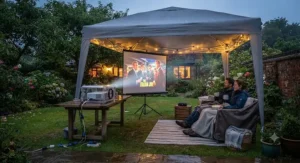
Learning how to set up an outdoor cinema properly the first time saves you from a frustrating evening of squinting at a wonky, washed-out image while your guests lose patience. Here’s the sequence that actually works.
Start by choosing your screen surface before anything else — a dedicated projector screen, a plain white sheet pulled taut, or a flat, light-coloured exterior wall all work, but a patterned fence or brick wall will noticeably degrade contrast and colour accuracy no matter how good your projector is. Next, measure your throw distance: most portable projectors need roughly 2.5-3.5 metres for a 100-inch image, so pace this out before dark rather than guessing on the night.
Position the projector on a genuinely stable, level surface — a wobbly garden table is a common cause of a picture that slowly drifts out of focus mid-film. Run your power lead using an outdoor-rated extension lead and RCD protection (covered fully below) rather than trailing an indoor cable across damp grass. Once powered on, use autofocus and keystone correction if your model has it, then fine-tune manually; most portable projectors handle a mild vertical or horizontal tilt automatically, but extreme angles still distort the image.
Finally, do a sound check before guests arrive — outdoor spaces swallow audio far more than indoor rooms, so what sounds adequate on a patio in daylight often feels thin once darkness falls and background noise (traffic, distant music, the inevitable next-door barbecue) creeps in. A separate Bluetooth speaker solves this for most setups.
Backyard Movie Night Setup: Real-World Scenarios
Different households need genuinely different backyard movie night setups, so here are three realistic profiles matched to specific choices from the list above.
The small-garden family: Two adults, two kids, a modest patio, budget around £400-£500. The Nebula Mars 3 Air paired with a 100-inch inflatable or pop-up screen makes the most sense here — it’s bright enough for a smaller viewing distance, the battery removes any cable-trailing hazard near young children, and the price leaves room for a cheap folding chair set.
The regular hosts with a proper lawn: Groups of six-plus, screenings most weekends through summer, budget £700+. The Nebula Mars 3 or Epson EF-22 both suit a 150-200 inch screen at this scale, with the Epson edging ahead on pure picture quality if mains power access isn’t an issue, and the Mars 3 winning if the screening spot is genuinely off-grid.
The minimalist who wants flexibility: A small balcony or courtyard, storage space at a premium, occasional use. The Nebula Capsule 3 Laser or XGIMI MoGo 4 both suit this brief — compact enough to store in a drawer between uses, capable of a genuinely good picture at 100-120 inches, and light enough to move between a courtyard wall one week and an indoor evening the next.
✨ Ready to Build Your Own Outdoor Cinema?
🎬 Compare the seven projectors above side by side, check current pricing, and pick the one that matches your garden, your budget and your guest list. A great backyard movie night starts with the right kit.
How to Choose the Right Outdoor Cinema Projector
Cutting through the marketing noise, here’s what actually matters when choosing a projector for outdoor use, in order of practical importance.
- Brightness (ANSI or ISO lumens): This is the single biggest factor in outdoor viewing quality. Anything under 300 lumens needs full darkness; 400-1000 lumens tolerates some ambient light; 1500+ lumens gives real flexibility on timing.
- Battery vs mains power: A built-in battery removes cable-safety concerns entirely but caps your session length — usually 2.5-5 hours. Mains-powered models are unlimited but tie you to an outdoor-rated extension lead.
- Resolution: 1080p is genuinely sufficient for most garden screening distances; native 4K only becomes visibly worthwhile on screens above 120 inches, viewed from reasonably close.
- Speaker quality: Built-in speakers rarely fill a garden alone. Treat this as a bonus, not a deciding factor, and budget for an external Bluetooth speaker regardless.
- Weatherproofing: Only genuinely rated for outdoor exposure if it carries an IP rating (like the BenQ GS50’s IPX2). Everything else should be treated as “outdoor-capable in dry conditions,” not weatherproof.
- Smart platform: Google TV and Android TV both cover the major UK streaming apps, though BBC iPlayer support varies by model and is worth checking if live TV or catch-up matters to you.
- Portability vs stability: The lightest projectors are easiest to store but often the most easily knocked off a table mid-film — a small tripod or dedicated stand solves this cheaply.
Outdoor Cinema Equipment List: What You Actually Need
Beyond the projector itself, a genuinely complete outdoor cinema equipment list has surprisingly few essential items, though it’s easy to overspend on extras you won’t use.
The non-negotiables are: the projector, a screen or suitable blank surface, an outdoor-rated power source (built-in battery or a proper weatherproof extension lead), and seating. Beyond that, a portable Bluetooth speaker meaningfully improves the experience more than almost any other single purchase, given how thin most built-in projector audio sounds once you’re outside. A basic tripod or adjustable stand earns its keep quickly too, since garden tables are rarely quite level.
Genuinely optional extras include: a HDMI streaming stick as a backup if your projector’s smart platform lacks an app you need, blankets and citronella candles for comfort and midges, and a case or bag if the projector will regularly travel between storage and the garden. Skip inflatable screens unless you specifically need portability — a taut bedsheet against a flat wall performs almost as well for a fraction of the cost, a detail most equipment lists conveniently leave out.
Outdoor Projector Screen Size Guide
What screen size do I need for an outdoor projector? As a rule of thumb, sit at a distance roughly 1.5-2 times the screen’s width for the most cinematic effect without straining to track motion across the image.
| Screen Size | Ideal Viewing Distance | Typical Group Size |
|---|---|---|
| 80-100 inches | 3-4 metres | 2-4 people |
| 100-120 inches | 4-5 metres | 4-8 people |
| 150-200 inches | 5-8 metres | 8+ people |
This table makes the trade-off fairly clear: bigger isn’t automatically better, since a screen larger than your seating distance comfortably allows just forces guests to swivel their heads to follow action across the frame. Matching screen size to your actual garden depth — not the projector’s maximum rated output — is the detail most buying guides skip, and it’s the difference between a genuinely cinematic evening and an oversized, slightly uncomfortable one.
Outdoor Projector Extension Leads & Cable Safety
Anyone running a mains-powered projector — the Epson EF-22 and Nebula Cosmos 4K SE among them — needs to take an outdoor projector extension lead seriously rather than treating it as an afterthought. Standard indoor extension leads have no weatherproofing whatsoever and shouldn’t be used outside under any circumstances.
The core rule is straightforward: outdoor extension leads need a minimum IP44 rating, protecting against splashing water and small particles, and must be plugged into an RCD-protected socket. If your outdoor socket doesn’t already have RCD protection built in, a plug-in RCD adaptor rated at 30mA closes that gap cheaply and should be treated as essential rather than optional. Electrical Safety First’s garden safety guidance is a genuinely useful reference here, particularly on fully uncoiling cable reels before use — a coiled extension lead under load can overheat even when correctly rated.
A few further practicalities: never daisy-chain multiple extension leads together, keep total load under the lead’s rated capacity (usually 13A), and route the cable away from foot traffic rather than across a path where someone might trip after dark. For anyone wanting the full regulatory picture on garden electrics, including guidance on permanent outdoor sockets, RHS advice on using electricity safely in the garden covers this well, as does more detailed guidance on socket protection from NICEIC’s garden electrics guide.
Outdoor Cinema Chairs: Comfort Without Blocking the View
Outdoor cinema chairs are the most commonly underbudgeted item on the entire equipment list, and the wrong choice genuinely wrecks the evening for everyone behind the first row. The core design consideration is seat height relative to screen height — low-slung folding chairs or picnic blankets at the front, with taller camping chairs staggered further back, prevents the classic problem of someone’s head blocking half the picture for the row behind.
Weather resistance matters more than cushioning for most UK gardens, since damp grass and evening dew are a near-certainty even in summer. Chairs with mesh or quick-dry fabric seats, and ideally a raised base rather than direct ground contact, avoid the soggy-cushion problem that ruins reusability. For larger groups, staggering seating in a loose semi-circle rather than strict rows also improves sightlines significantly without needing risers or platforms.
Outdoor Cinema vs Traditional Indoor Movie Nights
| Factor | Outdoor Cinema Setup | Traditional Indoor Movie Night |
|---|---|---|
| Screen size potential | Much larger (100-200in typical) | Limited by TV size, usually 40-75in |
| Weather dependency | High — needs dry, ideally still conditions | None |
| Setup time | 15-30 minutes typically | None (TV already installed) |
| Group capacity | Scales easily to large groups | Limited by living room seating |
| Best For | Nebula Mars 3, Nebula Cosmos 4K SE for scale | Any standard TV setup |
The clearest advantage of an outdoor cinema projector setup over a living room screening is sheer scale — even a mid-range projector like the XGIMI MoGo 4 comfortably outsizes most home televisions, and that scale is a large part of why outdoor screenings feel like an event rather than routine telly-watching. The obvious trade-off is weather dependency, which no projector on this list solves; a wet forecast simply means moving the whole plan indoors or rescheduling. For UK gardens specifically, keeping half an eye on the evening forecast before committing to a specific date saves a lot of last-minute chair-folding in the rain.
Common Mistakes When Setting Up an Outdoor Cinema Projector
The most frequent error is underestimating ambient light — starting a screening at dusk rather than proper darkness consistently disappoints buyers of lower-lumen projectors like the Nebula Capsule 3 Laser or Nebula Mars 3 Air, who then assume the projector itself is faulty rather than simply under-powered for the conditions.
A close second is treating an indoor extension lead as “good enough” for a one-off outdoor use — a mistake that carries genuine electric shock risk rather than just inconvenience, and one that NICEIC’s guidance on garden electrics addresses directly. Buyers also commonly oversize the screen for their actual garden depth, ending up with an image too large to comfortably track from the available seating distance, and underbudget for audio, assuming built-in speakers will be adequate for a group larger than four or five people.
Frequently Asked Questions
❓ What's the best budget outdoor cinema projector?
❓ Do I need a screen or can I project onto a wall?
❓ How dark does my garden need to be for outdoor projection?
❓ Is it safe to run an extension lead outside for a projector?
❓ What size screen is best for a garden movie night?
Conclusion
Building a genuinely good outdoor cinema projector setup comes down to matching three things honestly: your typical group size, how dark your garden actually gets, and whether mains power or battery life matters more for where you’ll be sitting. Budget buyers get a perfectly capable evening from the Nebula Mars 3 Air, while anyone chasing serious brightness and colour accuracy should look at the Epson EF-22 or, for full 4K, the Nebula Cosmos 4K SE.
None of the seven projectors here are the “wrong” choice — they simply suit different gardens, group sizes and budgets, which is exactly why comparing real specs against your actual setup matters more than chasing whichever model has the flashiest marketing. Add a proper outdoor-rated extension lead, a couple of comfortable chairs, and a screen sized sensibly for your space, and the rest genuinely does take care of itself.
✨ Don’t Miss These Exclusive Deals!
🔍 Take your outdoor cinema projector setup to the next level with the picks above. Click through to check current pricing and availability, and start planning your first proper backyard movie night.
Recommended for You
- How Many Lumens for Outdoor Projector? 7 Bright Picks 2026
- Best Outdoor Projector 2026: 7 Top Picks Reviewed (UK)
- Projector for Garage Cinema: 7 Bright Picks for 2026
Disclaimer: This article contains affiliate links. As an Amazon Associate, I earn from qualifying purchases. If you purchase products through these links, we may earn a small commission at no additional cost to you.
✨ Found this helpful? Share it with your friends! 💬🤗
