
In This Article
There’s a specific kind of magic in dragging a duvet outside, plugging in a projector, and watching a film flicker across your own back garden while the sky goes navy behind it. A garden cinema projector screen is the one piece of kit that turns “projecting onto a bedsheet pegged to the washing line” into something that actually looks like cinema. Not a white wall with wonky perspective and a crease running through everyone’s face — an actual flat, bright, properly sized canvas.
The tricky part is that “garden cinema projector screen” covers an enormous spread of products, from a £40 tripod screen the size of a tea tray to a motorised, weatherproof unit that costs more than the projector itself. Get the wrong one and you’ll spend more time wrestling guy ropes in the wind than watching Wimbledon or Bond night with the neighbours. Get the right one and it becomes the centrepiece of every warm evening from May to September.
This guide walks through seven real, currently available screens spanning budget tripod models, inflatable showstoppers, and premium fixed-frame installs, with honest analysis of who each one actually suits — not just a spec sheet. As UK tech title What Hi-Fi? notes in its outdoor projector coverage, a decent screen is just as important to the final picture as the projector driving it, so it’s worth treating the two as a matched pair rather than an afterthought. We’ll also cover sizing, gain, wind resistance and how to pair a screen with a projector, because a screen is only as good as the thinking that goes into choosing it.
Quick Comparison Table
| Screen | Type | Size | Price Range | Best For |
|---|---|---|---|---|
| Duronic TPS60 | Tripod (portable) | 60″ (4:3) | Under £70 | Small patios, first-timers |
| VEVOR 120″ Tripod Screen | Tripod (portable) | 120″ (16:9) | £70–£110 | Budget-friendly big-screen nights |
| GYUEM 21ft Inflatable | Inflatable | ~21ft class | £150–£220 | Parties, big groups, wow factor |
| Elite Screens Yard Master 2 | Fast-fold frame + stand | 110–120″ (16:9) | £180–£260 | Regular garden cinema use |
| Silver Ticket STO Sliding Snap | Portable frame + stand | 125″ (16:9) | £300–£420 | Sharper, flatter image outdoors |
| Silver Ticket STR Fixed Frame | Fixed frame | 120″ (16:9) | £280–£380 | Permanent covered patio setup |
| Elite Screens Yard Master Electric | Motorised roll-up | 120″ (16:9) | Around £700–£900 | Serious, semi-permanent garden cinemas |
Looking at the spread above, there’s roughly a tenfold price gap between the cheapest and most expensive screens here, and that gap buys you three things: rigidity (how flat and wrinkle-free the surface stays), convenience (how fast it goes up and down), and weatherproofing (how confidently it survives being left semi-outdoors). If you’re testing the waters with garden cinema nights, the Duronic TPS60 or VEVOR 120″ Tripod Screen let you do that without much financial risk. If you already know you’ll be doing this every summer weekend, the Elite Screens Yard Master 2 or Silver Ticket STR Fixed Frame earn their higher price through durability you’ll actually feel after a dozen uses.
✨ Fancy seeing exactly how these stack up against each other before you commit? Scroll down to the full breakdown — every screen gets the honest treatment. ✨
Top 7 Garden Cinema Projector Screens: Expert Analysis
Here’s the thing about garden cinema screens that most quick “top 10” listicles skip: the “best” one depends entirely on how often you’ll use it, how big your garden is, and whether you’re storing it in a shed or leaving it half-assembled behind the greenhouse all summer. What follows isn’t a ranked countdown — it’s seven genuinely different tools for seven genuinely different gardens.
1. Duronic TPS60 — smallest footprint, easiest first purchase
If your idea of a garden cinema projector screen is “something I can set up in ten minutes on a small patio without a second pair of hands,” this is where to start. The Duronic TPS60 is a 60-inch, 4:3 tripod screen — modest by modern film standards, but genuinely fast to deploy.
The 122cm x 91cm matte white viewing surface sits on a lightweight tripod stand rather than a peg-down frame, which in practice means you can set it up on decking, gravel, or a patio without driving anything into the ground. Duronic is a British-run brand founded in 2005, and this model is squarely aimed at classrooms and small presentations as much as movie nights — which shows in its compact scale and no-fuss design.
Based on the spec comparison with the larger frame screens on this list, the trade-off is obvious: 60 inches is fine for four or five people huddled around a small patio table, but it starts to feel thin once you’ve got eight friends spread across garden chairs. What most buyers overlook about this model is that its 4:3 aspect ratio doesn’t match widescreen films perfectly, so you’ll see black bars unless your projector crops the image. Reviewers consistently note that the tripod is genuinely portable — several mention using it in campervans as much as gardens — and that setup takes only a couple of minutes once you’ve done it once.
Pros:
- ✅ Fastest, easiest setup of any screen on this list
- ✅ Genuinely portable — fits in most car boots
- ✅ Trusted British brand with UK-based support
Cons:
- ❌ 4:3 ratio means black bars on most modern films
- ❌ Too small for larger garden gatherings
At under £70, the Duronic TPS60 is best viewed as a low-commitment way to try garden cinema before investing in something bigger — value that comes from removing risk, not from raw screen size.
2. VEVOR 120″ Tripod Screen — best value for a genuine big-screen feel
Once you want the “wow, that’s actually a proper cinema screen” reaction from guests, 120 inches diagonally is roughly where it starts. The VEVOR 120″ Tripod Screen (model ZG-LJ120) gets you there without the price tag of a fast-fold or fixed-frame system.
The polyester oxford cloth surface measures 2,780 x 1,620mm and sits within a horizontal-and-vertical bar frame supported by two tripod legs, giving a 160° viewing angle — wide enough that side-seated guests aren’t squinting at a dimmed, off-axis image. On paper, this means a group spread across a wide garden table gets a genuinely usable picture, not just the people sitting dead centre. The wrinkle-resistant polyester is a real practical upgrade over the thin PVC sheeting used on some ultra-budget alternatives, since wrinkles show up brutally under a bright projector beam.
Here’s what the spec sheet won’t tell you, but user reports suggest: at roughly 5kg for the screen fabric plus a tripod frame, this isn’t a screen you casually reposition mid-evening — plan your layout before the sun goes down. It ships with ground nails and ropes for extra stability, which matters more than it sounds; a loose 120-inch screen catches wind like a small sail.
Pros:
- ✅ Big 120-inch size at a genuinely budget price
- ✅ 160° viewing angle suits wide garden seating
- ✅ Wrinkle-resistant polyester holds a flatter image than PVC rivals
Cons:
- ❌ Setup takes real effort for one person alone
- ❌ Ground nails needed for stability in any breeze
Priced in the £70–£110 range, this is arguably the sweet spot for anyone who wants a proper outdoor projector screen experience without paying fast-fold or fixed-frame money.
3. GYUEM 21ft Inflatable Outdoor Projector Movie Screen — best inflatable screen for garden parties
If you want your garden to look like it’s hosting a genuine outdoor cinema event rather than a family film night, an inflatable is the answer, and the GYUEM 21ft Inflatable Outdoor Projector Movie Screen is one of the most established names in the category on Amazon.
This is a completely different animal from the tripod screens above — a self-supporting air-filled frame with the screen fabric stretched taut across the front, inflated in around two minutes by the included quiet electric blower. Because it’s freestanding once inflated, there’s no scaffolding, no tripod legs to level on uneven lawn, and — genuinely useful for garden layouts — the screen supports both front and rear projection, so you can hide the projector and cabling behind it rather than in the middle of your seating area. The included rope, tent stakes, and carry bag round out what is honestly a fairly complete package for the price.
What most buyers overlook about inflatables is the running noise and power draw of the blower — most models, GYUEM included, need continuous or near-continuous power to stay firm through the evening, so you’ll want that in mind if you’re on an extension lead. Aggregated review sentiment across major inflatable screen listings consistently flags two things: buyers are often surprised by just how large these screens feel once inflated (bigger than the box suggests), and a small number report the blower struggling in gustier gardens. If verified ratings for this exact listing weren’t available at the time of research, it’s worth reading the most recent reviews on the product page directly, since blower reliability can vary between manufacturing batches.
Pros:
- ✅ Huge screen size for genuine party atmosphere
- ✅ Freestanding — no levelling or scaffolding needed
- ✅ Supports front and rear projection for flexible setup
Cons:
- ❌ Needs continuous power to stay firm
- ❌ Bulkier to store than folding frame screens
In the £150–£220 range, this is the pick for anyone hosting World Cup nights, birthday screenings, or anything where “biggest screen on the road” is part of the appeal.
4. Elite Screens Yard Master 2 — best all-rounder for regular garden cinema use
Elite Screens has built its reputation on being the brand projector enthusiasts actually trust, and the Elite Screens Yard Master 2 is its purpose-built answer to outdoor movie nights — a fast-fold frame screen with legs rather than a tripod-and-fabric setup.
Available around the 110–120 inch mark, the CineWhite material offers a 1.1 gain rating and a wide 180° viewing angle, with a black-backed design that keeps the image bright even when light bleeds through from behind. The fast-fold, easy-snap frame assembles noticeably quicker than bolt-together tripod systems — reviewers consistently describe setup in the region of a few minutes once you know the sequence — and it packs down into a duffel bag for storage, which matters if you don’t have a shed to spare. Elite Screens backs it with a two-year manufacturer warranty and lifetime product support, a genuinely useful detail for buyers who plan to use a screen dozens of times a season rather than twice.
Based on the spec comparison with the budget tripod options, what you’re really paying for here is flatness and frame rigidity — the snap-frame system pulls the fabric taut in a way loose tripod bars can’t quite match, and it shows in reduced wrinkling under bright projection. One honest caveat from Elite Screens’ own guidance: this screen is designed for light breeze conditions only, not sustained wind, so it’s not the pick for an exposed, hilltop garden.
Pros:
- ✅ Fast-fold frame sets up faster than tripod rivals
- ✅ 1.1 gain CineWhite material stays bright with wide viewing angles
- ✅ Two-year warranty and lifetime support from an established brand
Cons:
- ❌ Rated for light breeze only, not strong wind
- ❌ Priced above basic tripod screens
At around £180–£260, the Yard Master 2 suits anyone treating garden cinema as a regular summer hobby rather than a once-a-year novelty.
5. Silver Ticket STO Series Sliding Snap Frame with Stand — sharpest image for the price bracket
Where the Yard Master 2 focuses on portability, the Silver Ticket STO Series Sliding Snap Frame with Stand (125-inch) leans into image quality — Silver Ticket built its name on fixed-frame indoor screens, and this outdoor-rated version borrows that DNA.
The screen uses a white front-projection material with a black backing to prevent light bleed-through, mounted via a sliding snap frame system onto an included stand — a middle ground between the flat rigidity of a true fixed frame and the portability of a fold-up unit. On paper this means a noticeably flatter surface than tripod-and-fabric screens, since the snap-frame tensioning removes the sagging that causes visible ripples in the projected image, particularly around the edges. Reviewers of Silver Ticket’s broader fixed-frame range consistently praise the quick assembly relative to how taut the final surface feels — the tension-rod system slots material into a pocket rather than requiring you to stretch and clip fabric by hand.
What the spec sheet won’t tell you, but the wider Silver Ticket review base makes clear, is that this brand’s screens reward projectors with decent brightness output, since the material doesn’t have an unusually high gain to compensate for a dim source. Pair it with a genuinely bright outdoor-rated projector and the difference over a basic tripod screen becomes obvious within the first ten minutes of a film.
Pros:
- ✅ Noticeably flatter, sharper image than fold-up alternatives
- ✅ Sliding snap frame assembles faster than bolt-together fixed frames
- ✅ Black-backed material reduces light bleed-through
Cons:
- ❌ Needs a genuinely bright projector to look its best
- ❌ Bulkier to transport than a fast-fold or tripod screen
At £300–£420, this is the choice for anyone who’s outgrown “good enough” screens and wants their outdoor picture to rival an indoor home cinema setup.
6. Silver Ticket STR Series Fixed Frame — best for a permanent covered-patio cinema
If your garden has a covered patio, pergola, or outbuilding wall that’s sheltered from the worst of the weather, a genuinely fixed-frame screen changes the equation entirely. The Silver Ticket STR Series Fixed Frame (120-inch, 16:9) is built to be wall-mounted and left in place, not folded away after every screening.
The extruded aluminium frame — 4 inches wide and wrapped, not just flocked, in light-absorbing black velvet — mounts to a wall at four points, and the Tension Rod System threads through pockets sewn into the screen material to pull it drum-tight with zero wrinkles. This is the closest thing on this list to an actual home cinema screen, just installed outdoors. The 1.1 gain matte white vinyl is rated for 4K and Active 3D content, which is arguably overkill for casual movie nights but genuinely useful if you’re running a proper short-throw or laser projector setup.
Here’s what most buyers overlook: because this is a genuinely fixed installation, it’s not something you take down for winter without real effort, so it only makes sense for gardens with some weather protection — direct exposure to UK winters will shorten the material’s lifespan considerably. Aggregated reviewer sentiment across Silver Ticket’s fixed-frame range is strongly positive on build quality and ease of assembly relative to competing fixed-frame brands, with occasional notes about the six-piece frame requiring a careful read of instructions before starting.
Pros:
- ✅ Genuinely wrinkle-free, drum-tight surface
- ✅ Rated for 4K and Active 3D content
- ✅ Built to stay in place as a permanent fixture
Cons:
- ❌ Not practical to take down and store regularly
- ❌ Needs a sheltered spot, not open lawn
Priced around £280–£380, this suits anyone building a genuine “outdoor room” cinema setup rather than a portable movie-night kit.
7. Elite Screens Yard Master Electric — the premium, motorised choice
At the top of this list sits the Elite Screens Yard Master Electric, a 120-inch motorised screen that rolls up and down via a radio-frequency remote control — the closest thing to a proper home cinema experience you’ll get outdoors.
Rather than folding frames or tripod legs, this screen mounts via floating aluminium anti-rust brackets and retracts into its housing when not in use, meaning it can realistically live outside on a covered patio or pergola year-round rather than being packed away after each film. Elite Screens rates the housing IP33 for rain and water protection, and the tubular motor is built with enough weight tolerance for repeated raising and lowering without strain. The MaxWhite material offers a 1.1 gain rating and 180° viewing angle, with black masking borders that noticeably improve perceived contrast — genuinely useful once the sky isn’t fully dark yet, which is often the reality of British summer evenings.
Based on the spec comparison with every other screen here, the honest trade-off is compatibility: Elite Screens is explicit that this model isn’t designed to work with short-throw or ultra-short-throw projectors, so it needs a standard-throw setup positioned further back in the garden. Reviewers of the Yard Master Electric line consistently mention that installation is a two-person job and genuinely benefits from being treated as a semi-permanent fixture rather than a one-off purchase.
Pros:
- ✅ Motorised remote operation feels genuinely premium
- ✅ IP33-rated housing suits semi-permanent outdoor installation
- ✅ Rust-proof aluminium components built for repeated outdoor use
Cons:
- ❌ Not compatible with short-throw projectors
- ❌ Significant price jump over every other screen on this list
At around £700–£900, this is squarely for buyers who see their garden cinema as a long-term investment in the property, not a summer novelty.
Setting Up Your Garden Cinema: A Practical Guide
Getting a garden cinema projector screen up correctly the first time saves you from a wobbling, wrinkled picture and an evening spent fiddling instead of watching. Start by picking your spot in daylight, not at dusk — walk the garden and check for a flat, level patch with roughly the same distance available in front of it as your projector’s throw distance requires (most standard-throw projectors need 3–5 metres for a 120-inch image). Face the screen away from any streetlights or security lights that might wash out the image once darkness properly falls.
For frame and tripod screens, always peg or stake the base even on a still evening — British weather is famously unpredictable, and a sudden gust mid-film is far more disruptive than five extra minutes of anchoring beforehand. If you’re running an inflatable screen, position the blower’s power lead along a route that avoids trip hazards and standing water, and never leave it plugged into an indoor extension lead exposed to evening dew — Electrical Safety First’s garden guidance is clear that outdoor electrical equipment should always run through an RCD-protected socket and a lead genuinely rated for outdoor use (more on that below). Once assembled, do a quick focus and keystone check before guests arrive, and dim any porch lighting that spills onto the screen surface.
Maintenance is straightforward but easy to skip: wipe fabric screens down with a soft, dry cloth after each use rather than letting garden debris sit on the material overnight, and store folding screens fully dry to avoid mildew developing in the storage bag. Common first-30-days mistakes include over-tightening frame poles (which can bow lightweight aluminium), storing a screen while still slightly damp from evening dew, and skipping the ground stakes because “it’s not that windy” — the single most common cause of a mid-film screen collapse.
Which Garden Cinema Screen Suits Your Space? Real Scenarios
The small-garden couple: if you’ve got a compact patio and mainly watch films as a pair or with one other couple, a 60–100 inch tripod screen like the Duronic TPS60 makes far more sense than a 120-inch giant — you’ll get a crisper, more filled frame at a viewing distance your garden can actually accommodate, and setup and storage stay genuinely quick.
The regular weekend host: for anyone running garden cinema nights most weekends through summer, durability starts to matter more than upfront cost. The Elite Screens Yard Master 2 or Silver Ticket STO Sliding Snap Frame earn their higher price through frames that hold their tension screening after screening, rather than sagging by week four the way budget tripod fabric sometimes does.
The occasional big-event host: if garden cinema for you means the World Cup final, a milestone birthday, or one big neighbourhood screening a year, the GYUEM Inflatable delivers the biggest visual impact per pound spent, and its freestanding design means no levelling headaches on a lawn that’s rarely perfectly flat.
The homeowner building an outdoor room: where the garden already has a covered patio or pergola, the Silver Ticket STR Fixed Frame or Elite Screens Yard Master Electric turn “occasional projector screen” into “permanent feature,” and the extra spend reflects that shift from event kit to home improvement.
Garden Cinema Screen Problems—And How to Solve Them
Problem: the screen won’t stay flat and shows visible wrinkles. This is almost always a tensioning issue rather than a faulty product — tripod and fabric screens need the frame bars pulled to full extension before the fabric is clipped on, and fast-fold or fixed-frame options like the Elite Screens Yard Master 2 or Silver Ticket STR Fixed Frame solve this structurally by design.
Problem: the image looks washed out even after dark. This is usually a projector brightness issue rather than a screen issue, but pairing a higher-gain screen with a modest projector — as with the Silver Ticket STO Sliding Snap Frame — can meaningfully compensate, since more of the available light reflects straight back at your seating area rather than scattering.
Problem: the screen wobbles or shifts during the film. Nine times out of ten this comes down to skipped ground stakes or ropes, which every portable screen on this list ships with — use them even on a calm evening, since British gardens rarely stay still for a full two-hour film.
Problem: the inflatable screen loses firmness partway through the evening. Check the blower’s power connection first — most inflatables, including the GYUEM 21ft Inflatable, rely on continuous or near-continuous airflow, so a loose extension lead connection is the most common culprit, not a puncture.
Problem: storage space at home is limited. Tripod screens like the VEVOR 120″ Tripod Screen and fast-fold options like the Elite Screens Yard Master 2 pack into carry bags that fit most understair cupboards or shed shelving, whereas fixed-frame and inflatable screens genuinely need dedicated storage — worth checking before you buy the largest option available.
What Is a Garden Cinema Projector Screen?
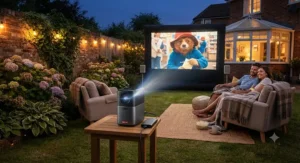
A garden cinema projector screen is a portable or fixed surface, typically made from PVC, polyester, or vinyl, designed to reflect a projector’s image outdoors more evenly and brightly than a wall or bedsheet. Unlike indoor screens, garden models are built or adapted to handle damp grass, wind, and repeated setup and takedown, ranging from lightweight tripod frames to motorised, weatherproofed installations.
Garden Projector Screen Size Guide: How to Choose
Picking the right size comes down to viewing distance and seating layout more than “bigger is always better.” Follow these steps:
- Measure your realistic viewing distance. As a rule of thumb, sit roughly 1.5–2.5 times the screen’s width away for a comfortable, cinema-like experience — closer for a punchier feel, further back for a gentler one.
- Match the size to your group. A 60–80 inch screen comfortably serves two to four people at close range; 100–120 inches suits six to ten spread across garden seating; anything above 120 inches is really built for parties.
- Check your projector’s throw distance. Every projector needs a specific distance between lens and screen to fill a given size — a 120-inch image typically needs several metres of clear space, so measure your garden before falling for a huge screen.
- Account for aspect ratio. Most modern films and streaming content are 16:9 widescreen; a 4:3 screen like the Duronic TPS60 will show black bars unless your projector’s zoom or crop settings compensate.
- Consider storage constraints alongside viewing size. A 150-inch inflatable delivers spectacle, but only if you have somewhere realistic to store it between uses.
- Factor in ambient light. Larger screens dilute a projector’s brightness across more surface area, so bigger screens generally need brighter projectors to avoid a dim, washed-out picture once dusk properly sets in.
- Think about permanence. If size is a one-off “biggest possible” decision for a single event, an inflatable makes sense; if it’s a recurring choice, right-sizing for your regular audience matters more than maximum scale.
Projection Screen Gain Outdoor: What It Means and Why It Matters
Screen “gain” describes how much light a screen reflects back compared with a standard white reference surface — a gain of 1.0 reflects roughly what a plain white board would, while anything above that concentrates more light back towards the audience rather than scattering it evenly. Most of the screens on this list, including the Elite Screens Yard Master 2 and Silver Ticket ranges, sit around 1.1 gain, which strikes a sensible balance: bright enough to counter fading ambient light at dusk, without narrowing the viewing angle so much that side-seated guests lose brightness.
Here’s what most buyers overlook when comparing gain figures: higher gain isn’t automatically better outdoors. A higher-gain surface reflects light more directionally, which can actually work against you in a garden setting where guests are seated in a wide arc rather than a straight cinema row. For most garden layouts, a moderate 1.1–1.3 gain screen paired with a genuinely bright projector — rather than chasing the highest gain number available — delivers a more consistent picture across every seat.
Inflatable Screen vs Frame Screen for the Garden
The choice between an inflatable like the GYUEM 21ft Inflatable and a frame-based screen like the Elite Screens Yard Master 2 or VEVOR 120″ Tripod Screen really comes down to how you use your garden, not which is objectively “better.”
Inflatables win decisively on visual spectacle and freestanding convenience — no levelling, no ground anchoring beyond stability ropes, and a genuinely enormous presence that suits parties and big-group events. Their weakness is storage bulk, power dependency for the blower, and generally a less taut, slightly less rigid surface than a properly tensioned frame, which can show as subtle rippling under close inspection. Frame screens, by contrast, deliver a flatter, more consistent surface and — in fast-fold or fixed-frame form — noticeably better wrinkle resistance, at the cost of needing more careful assembly and, in the case of fixed frames, essentially permanent placement.
Reviewers consistently note that inflatables feel more like an “event,” while frame screens feel more like a genuine piece of home cinema equipment. If your garden cinema nights are occasional and social, lean inflatable; if they’re a regular fixture of your week, a frame screen’s image quality tends to matter more the more often you use it.
Outdoor Screen Wind Resistance: Safety & Set-Up Advice
Wind is the single biggest practical enemy of a garden cinema screen, and manufacturer guidance is consistent across brands: Elite Screens explicitly states its Yard Master range should only be used in light breeze conditions, not sustained wind, and that guidance is a sensible baseline for every screen on this list. For context on what “light breeze” actually means in measurable terms, the Met Office’s Beaufort scale defines a light breeze as roughly 4–7mph, with leaves and small twigs starting to move constantly once you reach a “gentle breeze” around 8–12mph — useful reference points before you commit to an evening’s screening.
Practically, that means always using the supplied ground stakes and guy ropes even when the evening feels still, positioning frame and tripod screens with their broadest face away from any garden corridor that channels wind (between a house and a fence, for instance), and bringing an inflatable screen down promptly if wind noticeably picks up rather than waiting to see if it settles. Fixed-frame installations like the Silver Ticket STR Fixed Frame sidestep much of this risk by being permanently secured to a wall, but they still benefit from a sheltered position rather than open exposure to prevailing wind.
It’s also worth thinking about the power side of an outdoor setup alongside the screen itself. Any electrical equipment used outdoors — projectors, inflatable blowers, string lighting — should run through an RCD-protected socket and a lead genuinely rated for outdoor use, not an ordinary indoor extension cable trailed through a window, since damp grass combined with unprotected mains power is a genuinely serious hazard, not just an inconvenience.
🎬 Ready to build your own back-garden cinema? Compare current prices on the screens above before the good weather slips away! 🎬
Best Inflatable Screen for Garden: What to Look For
Not every inflatable screen is built equally, and a few specific features separate a genuinely good garden option from a flimsy party-shop equivalent. First, check blower noise levels — a loud pump running throughout the film undermines the whole point of a quiet evening outdoors, and better models like the GYUEM 21ft Inflatable are specifically marketed around low-noise continuous operation. Second, look for double-sided or front/rear projection support, which gives you flexibility to hide the projector and its cabling behind the screen rather than in your seating area — genuinely useful in a smaller garden.
Third, check the base and anchoring system rather than assuming “inflatable means stable” — the best garden-suited inflatables ship with tent stakes and rope specifically because a large air-filled surface catches wind more than a flat frame does. Finally, weigh screen size against realistic storage: a 21-foot inflatable is spectacular, but only if you have a garage, shed, or loft space that can accommodate the folded bag between uses. Reviewers of large-format inflatables consistently mention being pleasantly surprised by just how big these screens feel once inflated — a useful reminder to measure your garden’s realistic clear space before ordering the largest option available.
Garden Cinema Screen and Projector Bundle: Buy Together or Separately?
It’s tempting to look for a single garden cinema screen and projector bundle rather than researching each piece separately, and for absolute beginners there’s a genuine case for it — bundles remove the guesswork of matching throw distance, brightness, and screen size correctly. The trade-off is compromise: bundled projectors are rarely the strongest performer in their price bracket, since bundle pricing tends to prioritise a complete package over best-in-class components.
Based on the spec comparison across the screens featured here, a smarter approach for most buyers is to select the screen based on garden size and intended group size first, then choose a projector rated with enough ANSI lumens brightness to suit that screen size and your garden’s typical ambient light at screening time — a projector that looks perfectly bright in a dark room can still struggle against a 120-inch screen at dusk. If you already own a projector, check its throw-distance specification against your garden’s available depth before choosing screen size, rather than the other way round. Buying separately generally gives better long-term value, since you can upgrade one component — say, swapping a budget tripod screen for a fixed frame — without needing to replace the whole system.
Common Mistakes When Buying an Outdoor Projector Screen
The single most common mistake is buying on size alone without checking projector throw distance, leaving buyers with a screen too large for their available garden depth to fill properly. A close second is underestimating wind — choosing a screen based purely on size and price, then discovering it’s rated for light breeze only once it’s already been assembled on an exposed lawn. Buyers also frequently overlook aspect ratio, ending up with a 4:3 screen like older tripod models that shows black bars on modern 16:9 content, or they skip checking gain and viewing angle entirely, resulting in a picture that looks great dead-centre but fades badly for guests seated off to the side. Finally, storage is routinely an afterthought — a spectacular 21-foot inflatable or six-piece fixed frame is only a good purchase if there’s genuinely somewhere practical to keep it during the ten months of the year it isn’t in use.
Long-Term Cost & Maintenance
Judged purely on upfront price, budget tripod screens like the Duronic TPS60 and VEVOR 120″ Tripod Screen look like the obvious value pick. Judged on cost-per-use over several summers, the picture shifts. A £70–£110 tripod screen used weekly through a British summer sees real wear on its fabric and frame joints within a couple of seasons, while a fast-fold frame like the Elite Screens Yard Master 2, backed by a genuine two-year warranty, spreads its higher upfront cost across noticeably more screenings before anything needs replacing.
Fixed-frame and motorised options push this logic furthest. The Silver Ticket STR Fixed Frame and Elite Screens Yard Master Electric cost several times more than a tripod screen initially, but neither needs repeated assembly and disassembly — the single biggest source of wear and tear on portable screens — so their effective cost-per-screening over five years can end up genuinely competitive with cheaper models that need replacing twice in the same period. The practical takeaway: if garden cinema is a lasting habit rather than a single-summer experiment, weighting your decision towards durability rather than the lowest sticker price tends to pay off — a point echoed in ProjectorCentral’s guidance on outdoor movie setups, which notes that portability, sturdy anchoring and price all deserve equal weight against raw screen size when planning for repeated use.
FAQ
❓ What size projector screen do I need for my garden?
❓ Can projector screens be left outside permanently?
❓ Do I need a special projector for outdoor use?
❓ How windy is too windy for an outdoor projector screen?
❓ Is an inflatable screen better than a frame screen for garden movie nights?
Conclusion
A garden cinema projector screen isn’t a single product so much as a category with genuinely different tools for genuinely different gardens — and that’s exactly why picking blind off a bestseller list tends to disappoint. If you’re testing the waters, the Duronic TPS60 or VEVOR 120″ Tripod Screen let you find out whether garden cinema nights become a habit without much financial risk. If they already are a habit, the Elite Screens Yard Master 2 and Silver Ticket ranges reward the extra spend through flatness, brightness consistency, and — frankly — fewer wrinkles ruining your favourite scenes. And if your garden already has a sheltered spot begging for a permanent screen, the Silver Ticket STR Fixed Frame or Elite Screens Yard Master Electric turn an occasional novelty into a genuine outdoor room.
Whichever you choose, the details covered here — sizing against your real viewing distance, understanding gain, respecting wind limits, and running power safely — matter more to how good your evenings actually look than any single spec on a product page. Get those right, and the screen you pick becomes background to the real point: good films, good company, and a garden that earns its keep long after the barbecue’s put away.
Recommended for You
- Garden Cinema Projector: 7 Best Picks for UK Gardens (2026)
- 7 Best Portable Outdoor Projectors UK 2026
- Best Weatherproof Projector 2026: 7 Rain-Ready Picks Tested
Disclaimer: This article contains affiliate links. As an Amazon Associate, I earn from qualifying purchases. If you purchase products through these links, we may earn a small commission at no additional cost to you.
✨ Found this helpful? Share it with your friends! 💬🤗
