
In This Article
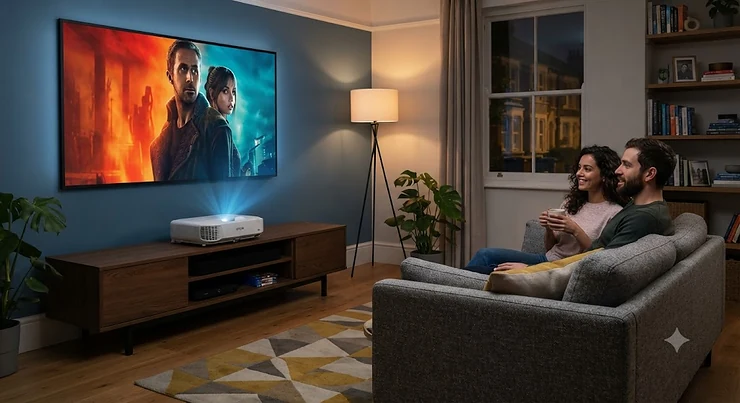
There’s a particular kind of heartbreak that comes with projector shopping: you fall for a jaw-dropping 150-inch picture, then the price tag arrives and quietly ruins your evening. A 4K UST projector under £2000 is where that heartbreak ends. UST simply means “ultra short throw” — the projector sits inches from the wall, not metres back in your living room, so there’s no beam of light for the dog to walk through and no bracket drilled into your ceiling.
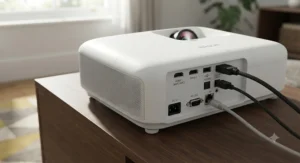
What is a 4K UST projector? It’s a laser-driven projector that sits on a low cabinet just centimetres from a wall or screen, throwing a genuinely 4K-detailed image up to 100-150 inches without the throw distance a traditional projector demands. Think of it as a “laser TV” — a phrase manufacturers love because it’s an accurate one.
Five years ago, this category started around £3,000. In 2026, thanks to competition from Hisense, XGIMI, Formovie, AWOL Vision, ViewSonic and Dangbei, genuinely capable triple-laser and phosphor-laser models now sit comfortably under, at, or just above the £2,000 line depending on when you catch the sales. That’s the sweet spot this guide lives in — the point where you stop compromising on brightness and colour just to hit a budget.
We’ve dug into real specifications, aggregated customer-review sentiment, and independent testing from UK and US outlets to build this guide. No invented hands-on claims, no fabricated star ratings — just honest analysis grounded in what’s actually verifiable, so you can walk into this purchase with your eyes open (pun very much intended).
Quick Comparison Table
| Projector | Light Source | Peak Brightness | Price Range | Best For |
|---|---|---|---|---|
| Hisense PX1-PRO | Triple RGB laser | 2,200 lumens | £1,700-£2,200 | Best all-rounder |
| ViewSonic X2000B-4K | Laser phosphor | 2,000 lumens | £1,900-£2,300 | Compact, simple setup |
| XGIMI Aura | Dual laser | 2,400 lumens | £1,900-£2,150 | Daytime brightness |
| Hisense PX3-PRO | Triple RGB laser | 3,000 lumens | £1,600-£2,250 | Bright rooms on a deal |
| Formovie Theater | Triple laser | 2,800 lumens | £1,800-£2,400 | Dolby Vision on a budget |
| AWOL Vision LTV-2500 | Triple RGB laser | 2,000-2,600 lumens | £1,900-£2,600 | Gaming latency |
| Dangbei Mars Pro | ALPD laser | 1,800-3,200 lumens | £1,300-£1,700 | Tightest budget |
Looking at the spread above, the affordable 4K ultra short throw category has genuinely matured: five of these seven use full triple RGB laser engines, which used to be a £3,000-plus feature. The Hisense PX1-PRO and Dangbei Mars Pro anchor the value end, while the AWOL Vision LTV-2500 and Formovie Theater sit closer to the £2,000 ceiling, often dipping under it during seasonal 4K UST projector deals. Brightness numbers aren’t directly comparable across brands either, since manufacturers measure differently — which is exactly why we’ve broken down what each number means in practice below.
💬 Bookmark this page — sale prices on these models shift weekly, and you’ll want to compare before you commit.
Top 7 4K UST Projectors Under £2000: Expert Analysis
1. Hisense PX1-PRO — best all-rounder laser TV under £2000
If you only read one entry in this Hisense PX1 review roundup, make it this one. The Hisense PX1-PRO uses a genuine TriChroma triple-laser engine — separate red, green and blue lasers rather than a single laser bounced through a colour wheel — and Hisense states it covers 107% of the BT.2020 colour space, a gamut most TVs at this price can’t touch.
In practice, that spec translates to noticeably richer reds and greens on animated content and sports, without the washed-out look cheaper single-laser projectors can suffer. Paired with HDMI 2.1 and Dolby Atmos passthrough via eARC, it’s also one of the few genuinely gaming-capable UST projectors in this bracket. Based on the spec comparison with its rivals, the PX1-PRO earns its position as the default recommendation for anyone who wants one projector that does everything competently rather than one thing brilliantly.
Reviewers consistently report strong picture quality “even in a well-lit room,” with one recurring theme across aggregated Amazon feedback: precise placement matters. Several buyers note that getting the roughly 50cm wall distance and level surface exactly right is the difference between a merely good picture and a great one — not a flaw exactly, but a set-up nuance worth knowing before you buy.
Pros:
- ✅ True triple RGB laser engine, not a colour wheel
- ✅ HDMI 2.1 with 4K/120Hz gaming support
- ✅ Dolby Atmos passthrough via eARC
Cons:
- ❌ Needs precise wall distance and levelling for best results
- ❌ Contrast is merely decent, not class-leading, in bright rooms
At around £1,700-£2,200 depending on retailer and season, the Hisense PX1-PRO frequently dips under our £2,000 ceiling during sales events, making it one of the strongest value-for-lumens options on this list.
2. ViewSonic X2000B-4K — best for simple, compact setups
The ViewSonic X2000B-4K takes a different approach to brightness: second-generation laser phosphor technology rather than a full RGB laser array. What most buyers overlook about this distinction is that it isn’t automatically worse — it’s a trade-off. Laser phosphor tends to be more consistent and cheaper to produce, at the cost of a slightly narrower colour gamut than the triple-laser models above and below it on this list.
With a 0.22:1 throw ratio, it can throw a 100-inch image from just 23cm off the wall, among the tightest footprints here — genuinely useful if your media unit is shallow. The built-in Harman Kardon 50W audio system is a standout for a UST at this price, and the instant-on, instant-off behaviour (no warm-up lag like older lamp projectors) makes it feel more like switching on a television.
Aggregated customer feedback on Amazon UK is mixed but leans positive: several reviewers call it “a brilliant short throw projector” with striking image quality from close range, though setup complexity comes up repeatedly, with some describing a 40-minute initial configuration versus others finding it “incredibly simple.” A smaller number of reviews flag inconsistent after-sales repair experiences, which is worth factoring into your decision if warranty support matters to you.
Pros:
- ✅ Ultra-compact 0.22:1 throw ratio for tight spaces
- ✅ Harman Kardon 50W integrated sound system
- ✅ Instant on/off, no warm-up delay
Cons:
- ❌ Laser phosphor gamut narrower than triple-laser rivals
- ❌ Initial setup reported as fiddly by some buyers
Typically listed around £1,900-£2,300, the X2000B-4K is one to watch specifically for cheap 4K laser TV deals — its MSRP sits above our ceiling, but promotional pricing regularly brings it back under £2,000.
3. XGIMI Aura — best for bright, daytime living rooms
Any honest XGIMI Aura review has to start with what made it a headline model when it launched: at 2,400 ISO lumens, it’s one of the brightest projectors on this list, and that brightness is exactly what a UST projector needs if your living room gets a lot of natural light. Reviewers at What Hi-Fi? described it as delivering a genuinely bright picture with punchy colours and decent motion handling — a strong showing for a projector that undercut its 4K laser rivals significantly at launch.
Here’s what to weigh before buying: the Aura ships with three HDMI inputs (more than most competitors manage) and Android TV baked in, positioning it as a serious “replace the telly” option. But independent reviewers have flagged that its Netflix app doesn’t function correctly out of the box and that BBC iPlayer, All4 and Freeview Play aren’t natively supported — workable if you’re happy plugging in a streaming stick, frustrating if you wanted a single box that does everything.
On colour accuracy, the spec sheet won’t tell you this, but user reports suggest the Aura’s limited calibration options cap its potential compared to rivals with fuller colour management systems — it looks vivid rather than reference-accurate, which suits most living rooms perfectly well.
Pros:
- ✅ Among the brightest projectors on this list at 2,400 lumens
- ✅ Excellent built-in sound for a projector
- ✅ Three HDMI inputs, more than most rivals
Cons:
- ❌ Netflix and some UK catch-up apps don’t work properly natively
- ❌ Limited colour calibration compared to premium rivals
Original UK pricing sat around £2,149, but the XGIMI Aura has matured in the market since, and you’ll now commonly find it in the £1,900-£2,150 range — one of the more reliable affordable 4K ultra short throw picks if brightness is your priority.
4. Hisense PX3-PRO — best for maximum daylight brightness
Step up from the PX1-PRO and you land on the Hisense PX3-PRO, an award-winning model (it’s picked up five-star ratings from UK outlets) that pushes brightness to roughly 3,000 lumens alongside Dolby Vision, Dolby Atmos and IMAX Enhanced certification. Based on the spec comparison, that extra brightness heading is the whole story here: this is the projector for a genuinely bright, south-facing living room where lesser UST models start to look washed out at midday.
The PX3-PRO also runs Google TV rather than a more locked-down interface, which reviewers consistently note delivers a far more complete app ecosystem out of the box — Netflix, iPlayer and Prime Video all present and correct, addressing the exact complaint levelled at the Aura above. That’s a meaningful practical difference if a single-box solution matters to you.
What most buyers overlook is that this extra performance comes at a genuine premium over the PX1-PRO — full retail sits above our £2,000 ceiling, so this is very much a “watch for the deal” purchase rather than a guaranteed under-£2,000 buy. When retailers have discounted it — we’ve seen it as low as the mid-£1,500s in early Black Friday promotions — it becomes arguably the single best-value pick on this entire list.
Pros:
- ✅ Class-leading brightness at roughly 3,000 lumens
- ✅ Dolby Vision, Atmos and IMAX Enhanced certified
- ✅ Full Google TV app ecosystem out of the box
Cons:
- ❌ Full retail price often exceeds £2,000 outside sales
- ❌ Larger, heavier chassis than budget rivals
Price ranges from around £1,600 on a strong promotional deal up to roughly £2,250 at full retail — check current price and set a deal alert if you want this one under budget.
5. Formovie Theater — best for Dolby Vision on a laser-TV budget
The Formovie Theater has genuine pedigree: it won the 2022 Laser TV Showdown, a shootout run by respected US projector reviewers, beating more expensive rivals including early Hisense and Samsung UST models. What most buyers overlook about the Theater is that it remains, even now, one of the only projectors near this price point supporting full Dolby Vision — most competitors top out at HDR10 or HDR10+.
Its triple-laser ALPD 4.0 engine hits a claimed 107% of Rec.2020 colour space and 2,800 ANSI lumens, with Bowers & Wilkins-tuned 30W speakers that reviewers describe as genuinely immersive rather than merely “loud enough.” One verified customer review on Amazon called it “a game changer… even the sound of the built-in speakers is completely immersive,” specifically citing the price point as the deciding factor in their purchase.
Here’s the honest caveat: the original Theater’s Android TV interface feels a step behind Google TV rivals like the PX3-PRO, and its input lag without ALLM mode engaged (around 42ms) trails behind gaming-focused competitors. If Dolby Vision and sound quality matter more to you than competitive gaming, that trade-off is an easy one to make.
Pros:
- ✅ Full Dolby Vision support, rare at this price
- ✅ Bowers & Wilkins-tuned 30W speaker system
- ✅ Award-winning triple-laser colour performance
Cons:
- ❌ Android TV interface trails Google TV rivals
- ❌ Higher input lag without ALLM engaged
Launched at £3,499, the Formovie Theater‘s street price has fallen substantially since — expect to find it in the £1,800-£2,400 range, with 4K UST projector deals regularly pulling it under £2,000 at UK and EU retailers.
6. AWOL Vision LTV-2500 — best for low-latency gaming
The AWOL Vision LTV-2500 is the entry point into AWOL’s respected triple-laser range, and reviewers are consistent that it inherits the same Ricoh ultra-short-throw lens assembly and NICHA RGB laser diode light source as AWOL’s pricier models — you’re getting flagship optics with the brightness dialled back to hit a lower price. Based on the spec comparison, that’s the smartest kind of cost-cutting: the part of a projector you can’t easily upgrade later (the lens) stays premium.
For gamers specifically, this is the standout pick on this list: independent testing puts input lag at around 8ms, dramatically lower than most UST rivals, making it genuinely usable for reactive gaming rather than just casual couch play. It also runs at a claimed 175W, translating to an estimated annual running cost under £40 — a detail worth flagging for anyone weighing long-term running costs against a big flat-panel TV.
Reviewers consistently note the trade-off: at 2,000 ANSI lumens (2,600 peak), it’s the dimmest triple-laser model here, so it performs best with curtains drawn or in the evening rather than fighting bright daylight. Aggregated feedback praises build quality and colour fidelity, describing the picture as “nothing short of breathtaking” in typical living-room lighting.
Pros:
- ✅ Roughly 8ms input lag, best for gaming on this list
- ✅ Premium Ricoh lens shared with AWOL’s flagship models
- ✅ Low 175W power draw, cheap to run
Cons:
- ❌ Dimmest triple-laser model here, needs a darker room
- ❌ Pricing frequently sits right at or just above £2,000
The LTV-2500 launched around $2,999 in the US, and UK pricing typically lands in the £1,900-£2,600 range — genuinely one to catch on deal days, since it’s the one entry here most likely to overshoot our budget outside a sale.
7. Dangbei Mars Pro — best for the tightest budget
We’re including a Dangbei Mars Pro review here because it’s one of the most-searched laser projectors in this price bracket, and honesty matters more than tidy category boundaries: the Mars Pro’s throw ratio of roughly 1.27:1 makes it a short-throw laser projector rather than a true ultra-short-throw model like the other six on this list. It needs meaningfully more distance from the wall to fill the same screen size. We’d rather tell you that plainly than let you discover it after unboxing.
With that caveat out of the way, what most buyers overlook is just how much projector Dangbei packs in for the price. Reviewers praised its native 4K resolution, sharp and bright image, and — in the words of one UK reviewer — called it “a strong performer” that’s “really, really good” value when found on deal. Its ALPD laser engine, auto keystone correction, auto focus and obstacle avoidance handle the fiddly setup steps that trip up first-time projector buyers on cheaper models.
Reviewers consistently flag the Mars Pro as an excellent gateway into laser projection for people who’ve never owned one — it isn’t chasing UST convenience, but it comprehensively beats a similarly priced flat panel on sheer size. One important honesty note: Dangbei discontinued the standard Mars Pro in February 2025 in favour of the Mars Pro 2, so stock of the original model is increasingly limited — factor that into your buying timeline.
Pros:
- ✅ Genuinely native 4K resolution at a low price
- ✅ Auto keystone, focus and obstacle avoidance included
- ✅ Consistently praised value-for-money in reviews
Cons:
- ❌ Short throw, not true ultra-short throw like rivals here
- ❌ Original model discontinued, stock increasingly limited
Even accounting for its short-throw design, the Dangbei Mars Pro remains one of the cheapest genuinely 4K laser projectors around, typically found in the £1,300-£1,700 range where available — the strongest pick if your budget sits well under £2,000 rather than close to it.
Practical Usage Guide: Setting Up Your UST Projector Right
Getting a UST projector to look its best isn’t complicated, but it is precise, and skipping the basics is the single biggest reason people end up disappointed. Start with the wall or screen itself: a plain, flat, light-coloured wall works in a pinch, but even a basic ambient-light-rejecting (ALR) screen will noticeably deepen contrast and blacks, since UST projectors sit low and throw light upward at a steep angle that ordinary paint doesn’t handle well.
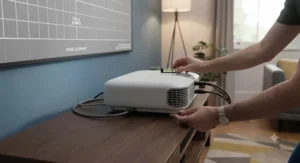
Levelling matters more than most first-time buyers expect. Every model on this list uses a low, near-horizontal throw angle, so a media unit that’s even slightly uneven will introduce keystone distortion that auto-correction features can only partially fix — and digital keystone correction always costs you a little sharpness. Use a spirit level, not your eye.
For the first 30 days, resist the urge to max out brightness and colour settings immediately; most projectors here ship in a “vivid” or “standard” picture mode tuned for shop-floor demos, not living rooms. Switching to a filmmaker or cinema mode, then adjusting brightness to suit your actual room lighting, gets you closer to accurate colour within minutes. Finally, dust is the quiet enemy of any laser light engine — a monthly wipe of the intake vents with a dry microfibre cloth is genuinely enough maintenance for most owners; laser light sources rated at 20,000-30,000 hours don’t need bulb changes the way older lamp projectors did.
Real-World Scenarios: Who Actually Needs One of These
Picture Priya, a graduate student in a shared flat with a compact living room and a habit of movie nights on Fridays. Budget matters, wall space doesn’t. She’s the textbook case for the Dangbei Mars Pro or Hisense PX1-PRO — enough screen size to feel like an event, without justifying flat-panel-TV money on a shared income.
Then there’s the Hendersons: a young family with an open-plan kitchen-diner that floods with afternoon sun, plus two kids who’ll be gaming on it most days. Brightness and HDMI 2.1 gaming support both matter here, which points squarely at the Hisense PX3-PRO on a deal, or the AWOL Vision LTV-2500 if low input lag for competitive play outweighs daylight brightness.
Finally, consider Marcus, a film enthusiast who’s already blacked out his spare room and wants the closest thing to cinema colour accuracy this budget allows. Dolby Vision support narrows his choices fast — the Formovie Theater is the obvious pick, since it’s one of very few models under £2,500 offering it at all. Three different people, three different “best” answers — which is exactly why a single number-one pick rarely survives contact with a real living room.
Problem → Solution: Common UST Projector Headaches
“My picture looks washed out during the day.” This is almost always a brightness-versus-ambient-light mismatch rather than a faulty unit. Draw curtains where possible, switch to a brighter picture mode, or — if daytime viewing is non-negotiable — prioritise the XGIMI Aura or Hisense PX3-PRO, both rated for genuinely bright rooms.
“The colours on the edges look slightly off.” Usually a focus or keystone issue rather than a colour problem. Re-run auto-focus, and if you’re using manual keystone correction, dial it back to the smallest adjustment possible — heavy digital correction genuinely softens edge sharpness.
“There’s a faint rainbow effect on bright objects.” This is a known characteristic of single-chip DLP projectors using sequential colour, reported by some users on models including the XGIMI Aura. It’s more noticeable to some eyes than others; if you’re sensitive to it, prioritise triple-laser models, which tend to minimise the effect versus older colour-wheel designs.
“Netflix or BBC iPlayer won’t run properly.” A recurring theme on Android TV-based UST models. The fix most owners land on is simple: skip the built-in app and plug in a Fire TV Stick or Chromecast, which sidesteps app-compatibility quirks entirely and often improves streaming quality besides.

How to Choose a 4K UST Projector Under £2000
- Decide your room’s ambient light first. A dark or curtained room opens up dimmer, cheaper options; a bright room narrows you toward 2,400+ lumen models like the PX3-PRO or Aura.
- Check the light source type. Triple RGB laser beats single laser-phosphor for colour gamut, but phosphor models are often cheaper and perfectly adequate for casual viewing.
- Confirm HDMI 2.1 if gaming matters. Only some models here support 4K/120Hz — check the spec sheet, don’t assume.
- Measure your wall-to-cabinet distance. Throw ratios vary from 0.21:1 to 1.27:1 across this list, which changes how far back the unit needs to sit for the same screen size.
- Look at app ecosystem, not just hardware. Google TV models tend to run UK catch-up apps more reliably than Android TV alternatives, based on aggregated review sentiment.
- Budget for a screen, even a basic one. A proper ALR or even simple projector screen meaningfully improves contrast versus a painted wall.
- Time your purchase around sales. Nearly every model on this list has appeared £200-£900 cheaper during Black Friday or Prime Day promotions — patience genuinely pays here.
Common Mistakes When Buying a UST Projector
The single biggest mistake is chasing the highest lumens number without checking whether it’s ANSI or ISO lumens — manufacturers sometimes quote inflated “LED lumens” figures that bear little relation to real-world brightness. Stick to models, like all seven above, that publish standardised figures.
A close second: buying without measuring the wall space first. UST projectors are forgiving on throw distance compared to traditional projectors, but they’re not infinitely flexible — a 1.27:1 throw ratio unit like the Dangbei Mars Pro needs considerably more room depth than a 0.21:1 unit like the Formovie Theater, and that difference can be the gap between “fits perfectly” and “doesn’t fit at all.”
Finally, buyers frequently skip budgeting for a screen entirely, then wonder why the picture looks flatter than review photos suggested. Reviewers consistently note that even an entry-level ALR screen noticeably lifts perceived contrast and colour versus a painted wall — it’s not a luxury add-on so much as the last 15% of picture quality these projectors are capable of.
4K UST Projector vs Traditional Long-Throw Projector
The core trade-off is simple: a traditional long-throw projector sits several metres back, usually ceiling-mounted, and needs a cable run and often a dedicated dark room to look its best. A UST model sits on furniture right beside the screen, casting no shadow when you walk in front of it and requiring none of the mounting hassle.
| Factor | UST Projector | Traditional Projector |
|---|---|---|
| Placement | On furniture, near the wall | Ceiling-mounted or rear of room |
| Setup effort | Low, plug-in-and-go | Higher, often needs cabling |
| Ambient light tolerance | Generally better at this price | Usually needs a dark room |
| Typical brightness (this budget) | 1,800-3,000 lumens | Often lower at same price |
As independent reviewers at What Hi-Fi? have noted when testing UST models against traditional rivals, the convenience factor is what wins most buyers over — you get a genuinely large image with none of the installation compromises a projector traditionally demanded. The trade-off is that UST optics are more complex to manufacture, which is partly why this category historically commanded a premium versus long-throw models — a gap that has narrowed sharply as brands like Dangbei and ViewSonic have pushed prices down.
What to Expect: Real-World Performance
Specs are one thing; living with these projectors day to day is another. In practice, a 100-inch image from any of the triple-laser models here looks genuinely cinema-like in the evening, with colour that holds up noticeably better than a budget flat panel at the same price. During bright afternoons, expect the picture to flatten somewhat unless you’ve picked one of the higher-lumen models — this isn’t a flaw so much as physics, since even 3,000 lumens is modest next to direct sunlight.
Audio, somewhat surprisingly, is a genuine strength across this category. Built-in speaker systems from Harman Kardon (ViewSonic) and Bowers & Wilkins (Formovie) regularly outperform the tinny speakers bundled with budget flat-panel TVs, meaning several of these models are genuinely usable without a soundbar — though dedicated home cinema fans will still want to add one eventually.
Gaming performance varies more than manufacturers like to admit. The AWOL Vision LTV-2500‘s roughly 8ms lag feels genuinely responsive; models without ALLM engaged can feel a beat behind on fast-reaction titles. If competitive gaming is a priority rather than an afterthought, that single spec should weigh heavily in your decision.
Best Value 4K Ultra Short Throw Picks for Different Buyers
If you’re chasing the single best value 4K ultra short throw pick regardless of use case, the Hisense PX1-PRO earns that title on this list — triple-laser colour, HDMI 2.1 gaming, and a price that regularly lands under £2,000 without needing a flash sale. For a strict budget ceiling well below £2,000, the Dangbei Mars Pro wins on pure pounds-per-lumen, with the important short-throw caveat noted earlier.
If [situation] is a bright, sun-facing room, choose the Hisense PX3-PRO or XGIMI Aura, because their higher lumen counts are the deciding factor over colour accuracy or app ecosystem. If [situation] is competitive or fast-paced gaming, choose the AWOL Vision LTV-2500, because its low input lag matters more than raw brightness. If [situation] is film-first viewing in a controllable-light room, choose the Formovie Theater, because Dolby Vision support at this price is genuinely rare.
As a quick priority checklist: rank brightness, colour accuracy, gaming latency, app ecosystem and price in your own order of importance, then cross-reference against the comparison table near the top of this guide — the model that wins on your top two priorities is almost always the right buy, regardless of what wins overall.
Long-Term Cost & Maintenance: Is a Cheap 4K Laser TV a False Economy?
A genuinely important part of any cheap 4K laser TV conversation is total cost of ownership, not just sticker price. Laser light engines across this entire list are rated for 20,000-30,000 hours — at roughly four hours of daily viewing, that’s somewhere between 14 and 20 years before brightness drops to half its original output. Compare that against older lamp-based projectors, which typically needed a £150-£300 replacement bulb every 3,000-5,000 hours, and the maths favours laser heavily over a decade of ownership.
Running costs are modest too: the AWOL Vision LTV-2500‘s claimed 175W draw suggests an annual electricity cost under £40 at typical UK rates and viewing habits, and most rivals on this list sit in a broadly similar bracket — considerably less than a large OLED flat panel run for equivalent hours.
The genuine ongoing cost to budget for isn’t the projector itself — it’s the screen. A basic reflective screen adds perhaps £100-£200; a proper motorised ALR screen designed for UST use can add £300-£600 on top of the projector price. Factor that into your true budget rather than treating it as an optional extra, because on a painted wall, none of these projectors will look as good as their review photos suggest.
Features That Actually Matter (And Those That Don’t)
Genuinely matters: real ANSI or ISO lumens figures, HDMI 2.1 if you game, and the smart platform’s UK app support — these three factors shape daily use far more than any marketing bullet point. Also worth real weight: throw ratio, since it directly determines whether a projector physically fits your room at the screen size you want.
Matters less than the marketing suggests: headline “dynamic contrast ratio” figures, which are measured in ways that make comparison between brands close to meaningless, and eye-catching but vague claims like “cinema-grade colour” without a stated percentage of a named colour gamut such as BT.2020 or DCI-P3, the standard against which colour accuracy is genuinely measured — see Wikipedia’s overview of Rec. 2020 for context on what that percentage figure actually represents. Built-in “AI enhancement” processing is also frequently oversold; on most models it amounts to modest sharpening you could largely replicate by nudging the standard picture settings yourself.
Safety, Regulations & Compliance Guide for UK Buyers
Every genuine UST laser projector sold in the UK must carry UKCA (and typically still CE) marking, confirming it meets electrical safety and electromagnetic compatibility standards — worth checking on the box or listing before you buy from a lesser-known retailer, since counterfeit or grey-import units sometimes skip this step entirely. Laser light engines in consumer projectors are also required to meet Class 1 or Class 2 laser safety limits, meaning they’re designed to be safe under normal home viewing use, unlike higher-powered industrial or cinema laser projectors.
When it’s eventually time to replace or dispose of a projector, UK households are covered by the WEEE Regulations, which require retailers and local recycling points to take back old electrical items rather than sending them to landfill — full guidance on what counts as WEEE and how to dispose of it responsibly is available directly from GOV.UK. It’s a small thing, but laser light engines contain components worth recovering properly rather than binning.
✨ Don’t Miss These Exclusive Deals!
🔍 Take your home cinema setup to the next level with these carefully selected 4K UST projectors. Click on any highlighted model above to check current pricing and availability. These picks will help you create authentic big-screen movie nights your family will genuinely love! 🎬
FAQ
❓ What is the cheapest genuinely 4K UST projector?
❓ Do UST projectors work in daylight?
❓ Is a 4K UST projector better than a big flat-panel TV?
❓ How long do laser projectors last before the light dims?
❓ Do I need a special screen for a UST projector?
Conclusion
Choosing between these seven models comes down to being honest about your room and your priorities rather than chasing whichever spec sheet looks most impressive. If you want one confident, no-regrets recommendation, the Hisense PX1-PRO earns it — genuine triple-laser colour, gaming-ready HDMI 2.1, and pricing that regularly lands comfortably under £2,000. If your budget is tighter still, the Dangbei Mars Pro delivers real 4K laser performance for meaningfully less, provided you’ve got the wall space its short-throw design needs.
What’s changed in 2026 is the ceiling itself: a genuine 4K UST projector under £2000 no longer means compromising on colour, brightness or smart features the way it did even two years ago. Whichever model you land on from this list, you’re buying real triple-laser or laser-phosphor technology, not a watered-down budget imitation of the flagship experience — and that’s a meaningfully different market than the one this category started in.
Whatever you choose, measure your wall, budget for a screen, and watch for the seasonal sales — nearly every projector on this list has been meaningfully cheaper at some point this year than its everyday price suggests.
Recommended for You
- 4K Ultra Short Throw Projector: 7 Brilliant 2026 Picks
- Ultra Short Throw Projector Installation: 7 Best UST Picks (2026)
- Ultra Short Throw Projector vs TV: 7 Best Picks for 2026
Disclaimer: This article contains affiliate links. As an Amazon Associate, I earn from qualifying purchases. If you purchase products through these links, we may earn a small commission at no additional cost to you.
✨ Found this helpful? Share it with your friends! 💬🤗
