
In This Article
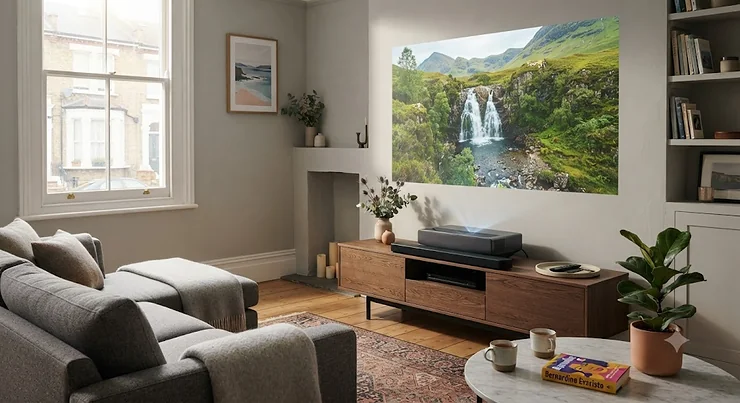
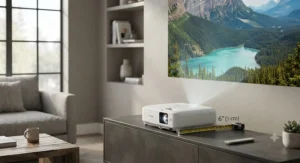
Somewhere in the last three years, the box that used to live in a dusty loft got a serious glow-up. A laser ultra short throw projector now sits on a low console table, inches from the wall, and throws out a picture bigger than most people’s first flat. No ceiling bracket. No trailing HDMI cable snaking across the carpet. Just a box roughly the size of a shoebox that somehow makes a 100-inch cinema screen out of thin air and a lick of paint.
So what actually is a laser ultra short throw projector? In plain terms, it is a projector that sits within a few centimetres of the wall or screen (rather than metres away like a traditional projector) and uses laser diodes instead of a bulb to generate light, giving 20,000+ hours of use, punchier colour, and none of the “the bulb’s gone” panic that plagued the last generation of home cinema kit. If you’re weighing up projectors against other display types more broadly, Currys’ general projector buying guide is a useful primer on the wider category before you narrow things down to laser UST specifically.
We have spent this guide digging through real specification sheets, UK retail listings, and aggregated reviewer sentiment from trusted outlets to work out which models genuinely earn their keep in a British living room, rather than just looking good on a spec sheet. Some of what follows will surprise you — brightness numbers, in particular, rarely tell the whole story. Whether you are chasing a budget-friendly first laser TV projector or eyeing up a flagship triple laser UST, there is a model further down this page built for your room, your budget, and your Sunday-night film habit.
Quick Comparison Table
Before the deep dive, here is the shortest possible version of this whole article.
| Projector | Light Source | Best For | Price Range |
|---|---|---|---|
| Hisense C2 Ultra | Triple laser (mini) | Tight budgets, small rooms | Around £1,800 |
| Hisense PX3-Pro | Triple laser (TriChroma) | Colour accuracy on a budget | £1,800–£2,000 range |
| Epson EH-LS650 | Single laser + phosphor | All-round value | £2,200–£2,300 range |
| XGIMI Aura 2 | Dual Light 2.0 laser | Design-led living rooms | Around £2,450 |
| Epson EH-LS800 | Single laser + phosphor | Bright, light-filled rooms | Around £3,300 |
| Formovie Theater Premium | ALPD 4.0 triple laser | Colour volume and audio | Around £3,500 |
| Samsung The Premiere 9 | RGB triple laser | Flagship home cinema | Around £5,900–£6,000 |
Looking at the spread, there is a clear line in the sand around the £2,000-£2,500 mark: below it you are usually buying a single laser or hybrid engine, and above it, true triple laser and RGB laser designs start to dominate. That matters more than most spec sheets let on, because the number of laser colours behind the lens shapes everything from colour volume to viewing angle tolerance. Budget buyers shouldn’t panic, though — as you’ll see, the Hisense PX3-Pro manages to squeeze genuine triple laser performance into a price bracket that used to be single-laser-only territory.
💬 Found a model that’s already caught your eye? Scroll down to see the full breakdown, or jump straight to checking current pricing and availability.
Top 7 Laser Ultra Short Throw Projectors: Expert Analysis
We shortlisted these seven real, currently available models after cross-referencing UK retail listings, manufacturer spec sheets, and independent testing from outlets including What Hi-Fi?, ProjectorCentral, Expert Reviews and Trusted Reviews. Coverage spans budget mini-USTs through to five-figure flagship laser TVs, so there’s a genuine option here whatever your ceiling — or lack of one.
1. Hisense C2 Ultra — compact triple laser for tight budgets
The standout thing about the Hisense C2 Ultra is that it squeezes a genuine triple laser light engine into a genuinely compact mini-UST chassis, something that was simply unavailable at this size two years ago.
On the spec sheet, it’s built around Hisense’s Trichroma laser system with a 0.9–1.5 optical zoom and support for screen sizes between 65 and 300 inches, alongside Dolby Vision, Dolby Atmos, and built-in JBL-tuned audio running on the VIDAA smart platform. In practice, that zoom range is the quiet hero here — most UST projectors have a fixed lens, meaning you are stuck with whatever image size the throw distance gives you, but the C2 Ultra actually lets you fine-tune the picture without physically moving the unit. Based on the spec comparison with pricier triple laser rivals, this is clearly Hisense’s entry point rather than its flagship, and buyers on a first-projector budget should treat it as such rather than expecting PX3-Pro-level polish.
On Amazon UK, the wider C2 Ultra line carries a strong 4.4-star average across 41 customer reviews, with reviewers consistently reporting satisfaction with picture punch relative to the asking price, though as with any budget-tier model, a handful flag the smart platform as less slick than rivals.
Pros:
- ✅ Genuine triple laser colour at an entry-level price point
- ✅ Rare optical zoom for flexible image sizing
- ✅ JBL-tuned audio built straight into the unit
Cons:
- ❌ Smart platform feels a notch behind flagship rivals
- ❌ Brightness headroom is tighter than step-up Hisense models
At around £1,800, the Hisense C2 Ultra earns its keep as the most accessible genuine triple laser UST on this list — a strong value pick if you want proper colour without flagship money.
2. Hisense PX3-Pro — best colour accuracy out of the box
What most buyers overlook about the Hisense PX3-Pro is that its out-of-the-box colour alignment has been singled out by independent testers as some of the best they’ve seen from any RGB triple laser UST, budget or otherwise.
The numbers back that reputation up: a TriChroma triple laser engine rated at roughly 2,800–3,000 ANSI lumens, a genuinely useful 200,000:1 dynamic contrast ratio (3,000:1 native), 110% coverage of the BT.2020 colour space, and a 240Hz refresh mode at Full HD for smoother sport and gaming. Paired with that is Harman Kardon-tuned 30W audio and support for Dolby Vision, HDR10+ and IMAX Enhanced — a combination that’s genuinely rare below the £2,000 mark. Based on the spec comparison with the far pricier Samsung Premiere 9 later in this guide, the PX3-Pro’s HDR format support is arguably the more complete package, even if Samsung wins on raw brightness.
Reviewers at ProjectorCentral rated the PX3-Pro’s colour alignment as effectively unmatched among RGB laser UST projectors they’d tested, noting only minor fringing visible at close viewing distances. On Amazon UK, it holds a 4.1-star rating from 28 customer reviews, with feedback broadly consistent on picture quality relative to price.
Pros:
- ✅ Colour alignment reviewers rate among the best in its class
- ✅ Dolby Vision, HDR10+ and IMAX Enhanced all included
- ✅ 240Hz motion handling suits sport and gaming alike
Cons:
- ❌ Fixed lens means precise placement matters more than rivals with zoom
- ❌ Some colour fringing visible up close, per reviewer testing
In the £1,800–£2,000 range, the Hisense PX3-Pro is arguably the sharpest value proposition on this entire list — few rivals match its colour credentials for the money.
3. Epson EH-LS650 — best all-round value pick
The Epson EH-LS650’s standout trick is proving that a single laser light engine, done properly, can still comfortably outshine a room full of ambient light — something buyers often assume needs a triple laser system to achieve.
Specification-wise, it’s a 3-chip 3LCD design rated at 3,600 lumens (independently measured closer to 3,485), a laser+phosphor engine rated for 20,000 hours, and support for screen sizes up to 120 inches, all wrapped in Yamaha-designed sound. What that 3LCD architecture buys you in practice is the complete absence of the “rainbow effect” that can bother sensitive eyes on single-chip DLP rivals — a genuinely underrated advantage for anyone who has previously found DLP projectors fatiguing to watch for a full film. On the downside, independent measurement put its colour gamut coverage at roughly 90% of Rec.709 and just 72% of DCI-P3, meaning the wider cinematic colour space that pricier triple laser rivals chase simply isn’t on the table here.
What Hi-Fi?’s testing found the LS650 delivered plenty of brightness and natural colours alongside a genuinely capable Yamaha sound system, while flagging average black levels and a fairly basic Android smart interface as the trade-offs for the price.
Pros:
- ✅ No DLP rainbow effect thanks to 3-chip 3LCD design
- ✅ Long 20,000-hour laser life with strong measured brightness
- ✅ Yamaha-designed sound genuinely holds its own
Cons:
- ❌ Black levels are noticeably average in a dark room
- ❌ Colour gamut coverage trails triple laser rivals
Sitting in the £2,200–£2,300 range, the Epson EH-LS650 is the projector we’d point most first-time buyers toward if outright colour volume isn’t the priority.
4. XGIMI Aura 2 — sleekest design with big built-in sound
The XGIMI Aura 2’s standout feature isn’t really a spec at all — it’s how confidently it doubles as a genuine soundbar replacement, courtesy of four Harman Kardon-tuned 15W speakers built into that sliding-cover chassis.
Underneath the design flourishes sits XGIMI’s second-generation Dual Light engine, rated at 2,300 ISO lumens, capable of throwing images between 90 and 150 inches, and certified for Dolby Vision, IMAX Enhanced and Dolby Atmos, all running on Google TV. Here’s what the spec sheet won’t tell you, but reviewers note: that sliding lens cover isn’t just cosmetic — it genuinely keeps dust and pet hair off the optics, a real-world annoyance that plagues open-lens UST rivals left on a low console table for years at a time. Compared with the single laser Epson models above, the Dual Light system trades some outright brightness for wider colour, a sensible compromise for anyone watching mostly after dark.
What Hi-Fi? praised the Aura 2’s bright, vibrant pictures, strong contrast and genuinely huge image from a short throw distance, while noting a slight rainbow effect, occasional HDR clipping and some frustrations with the Android TV interface.
Pros:
- ✅ Sliding lens cover genuinely protects optics long-term
- ✅ Harman Kardon audio doubles as a capable soundbar
- ✅ Wide 90–150-inch image range from one fixed position
Cons:
- ❌ Slight rainbow effect noted during testing
- ❌ Android TV smart platform can feel clunky day to day
At around £2,450, the XGIMI Aura 2 is the pick for anyone who wants their laser TV projector to look as considered as it performs.
5. Epson EH-LS800 — brightest choice for daylight viewing
The Epson EH-LS800’s standout advantage is raw brightness — at a claimed 4,000 lumens, it’s rated to fight through curtained-but-not-blackout living rooms better than almost anything else on this list.
That brightness comes from a 3-chip 3LCD laser engine, paired with support for image sizes up to 150 inches and a genuinely responsive 120Hz mode for gaming — a detail that matters more than it might seem, since many UST projectors compromise heavily on input lag. Based on the spec comparison with the cheaper LS650 above, the extra £1,000 buys you roughly 400 extra lumens of headroom and a larger maximum screen size, which is a meaningful upgrade if your living room genuinely doesn’t dim easily during the day.
What Hi-Fi?’s testing confirmed it copes well with ambient light and requires no lamp changes over its lifespan, but found dark scenes render somewhat grey rather than truly black, and criticised the smart system as messy to navigate — a common complaint in user reviews that echoes across multiple UST brands, not just Epson.
Pros:
- ✅ Genuinely bright enough for daytime, curtains-open viewing
- ✅ Responsive 120Hz mode suits console and PC gaming
- ✅ No lamp replacements across its rated lifespan
Cons:
- ❌ Dark scenes lean grey rather than deep black
- ❌ Smart system criticised as cluttered in testing
Priced around £3,300, the Epson EH-LS800 earns its place for bright-room households where a triple laser rival’s contrast advantage would go largely unused anyway.
6. Formovie Theater Premium — richest ALPD 4.0 colour volume
The Formovie Theater Premium’s calling card is its ALPD 4.0 RGB+ laser engine — a hybrid design combining a blue laser phosphor with a secondary RGB laser diode, built specifically to widen colour without introducing the speckle artefacts that plague some discrete RGB laser projectors.
On paper, that translates to a claimed 107% coverage of the BT.2020 colour gamut — you can read a fuller technical breakdown of what the Rec. 2020 colour standard actually measures if you want the deeper science — alongside 2,200–2,800 ANSI lumens depending on configuration, and an impressively tight 0.21:1 throw ratio that lets a 150-inch image sit just 40cm from the wall. What most buyers overlook here is the gap between marketing colour claims and measured reality: independent lab testing found real-world BT.2020 coverage closer to 84.5%, still strong for the price bracket but a useful reality check against the headline number. Reviewers at HomeTechnologyReview noted no visible laser speckle during testing, crediting the hybrid ALPD 4.0 design directly, while flagging that it isn’t the brightest UST for daytime use.
Bowers & Wilkins-tuned audio is a genuine differentiator here too, and the Theater Premium was the triple-laser winner of ProjectorCentral’s 2022 Laser TV Showdown, a result that still shapes its reputation among UK home cinema enthusiasts today.
Pros:
- ✅ Hybrid ALPD 4.0 laser virtually eliminates visible speckle
- ✅ Bowers & Wilkins audio is genuinely standalone-capable
- ✅ Compact 0.21:1 throw ratio suits tight British living rooms
Cons:
- ❌ Measured colour gamut falls short of the 107% marketing claim
- ❌ Not the brightest option for daytime, curtains-open viewing
Around the £3,500 mark, the Formovie Theater Premium is the strongest ALPD 4.0 laser projection option for anyone prioritising colour and sound over sheer daytime brightness.
7. Samsung The Premiere 9 — flagship triple laser for home cinema
The Samsung Premiere 9’s standout claim is simple: it’s one of the few consumer laser TV projectors genuinely capable of reaching, or even exceeding, the demanding Rec.2020 colour standard.
That comes courtesy of a true RGB triple laser light source — individual red, green and blue laser diodes rather than a phosphor-converted hybrid — delivering a claimed 3,450 ISO lumens, a 20,000-hour laser lifespan, and a 2,000,000:1 dynamic contrast ratio. A 0.189:1 throw ratio lets it produce a 130-inch image from a genuinely tight footprint, while a 2.2.2-channel, 40-watt Dolby Atmos sound system with Object Tracking Sound aims to make external speakers unnecessary entirely. Here’s what the spec sheet won’t tell you: reviewers at ProjectorCentral noted Samsung has specifically addressed the colour misalignment issues that dogged earlier-generation RGB laser triple-laser projectors industry-wide, resulting in a noticeably cleaner, sharper image than the format’s reputation might suggest.
UK press coverage from Expert Reviews and Trusted Reviews was consistently positive, both outlets calling it one of the most complete lifestyle UST projectors tested, though reviewers were unanimous that the price is steep against rivals — and notably, it lacks Dolby Vision support despite that asking price, a gap the cheaper Hisense PX3-Pro doesn’t share.
Pros:
- ✅ True RGB triple laser reaches near Rec.2020 colour coverage
- ✅ Colour misalignment issues of earlier RGB laser generations resolved
- ✅ Comprehensive Tizen smart platform and Dolby Atmos sound system
Cons:
- ❌ No Dolby Vision support despite the flagship price
- ❌ Considerably more expensive than every other model here
At around £5,900–£6,000, the Samsung The Premiere 9 is for buyers who’ve decided a projector genuinely is replacing their TV, budget be damned — for anyone comparing carefully, it’s worth checking current pricing and availability before committing.
Practical Usage Guide: Setting Up Your Laser UST Projector
Getting a laser ultra short throw projector into a room correctly is less fiddly than a traditional ceiling-mounted projector, but it isn’t quite plug-and-play either, whatever the marketing suggests.
Start with the surface behind the unit: because a UST lens throws light across the wall at a steep angle, any texture, glare, or uneven paint will show up magnified on screen. A dedicated ambient light rejecting (ALR) screen genuinely transforms picture quality in a way a flat-painted wall can’t match, particularly for models like the Epson EH-LS650 or XGIMI Aura 2 that don’t have blistering brightness to spare. Next, get the unit dead level and squared to the wall before you touch any digital keystone correction — every degree of digital correction you apply costs a small amount of sharpness, so mechanical alignment first, software correction only as a last resort.
In the first 30 days, the most common mistake we see is buyers judging picture quality with curtains open in the afternoon, then feeling disappointed. Almost every model on this list, bar the brighter Epson EH-LS800 and Samsung The Premiere 9, is meaningfully better after dusk or with blackout curtains. Give the laser engine a genuine test run at night before deciding it “isn’t bright enough.” For ongoing maintenance, laser light sources need essentially none of the bulb-swapping their lamp-based predecessors demanded, but the intake vents do collect household dust; a monthly wipe with a dry microfibre cloth keeps thermal performance — and therefore fan noise — in check for years.
Real-World Scenarios: Which Laser TV Projector Suits You?
The renter in a one-bedroom flat. Budget is tight, wall space is precious, and the landlord won’t allow ceiling brackets. A UST projector on a low sideboard solves the space problem instantly, and something like the Hisense C2 Ultra keeps the outlay sensible while still delivering genuine triple laser colour for movie nights.
The family replacing an ageing 65-inch TV. Multiple viewers, varied content, and a living room that gets reasonable daylight through a south-facing window. This is squarely the Epson EH-LS800‘s territory — its extra brightness headroom means Saturday morning cartoons don’t have to wait for the curtains to close, while its 120Hz mode keeps the kids’ racing games responsive too.
The dedicated home cinema enthusiast with a light-controllable room. Here, colour accuracy and audio integration matter more than daytime brightness, and budget flexes to match ambition. The Formovie Theater Premium or Samsung The Premiere 9 both make sense depending on how far that budget stretches — the former for colour-per-pound, the latter if a genuinely flagship experience, Dolby Vision gap notwithstanding, is the goal.
How to Choose a Laser Ultra Short Throw Projector
Choosing between these models comes down to weighing five factors in the right order for your specific room, not just chasing the biggest lumens number.
- Room lighting first. If your living room gets strong daylight and you’re rarely watching after dark, brightness matters more than colour volume — favour the Epson EH-LS800 over anything ALPD-based.
- Screen surface next. A UST projector aimed at bare plaster will always underperform; budget for a proper screen or ALR surface alongside the unit itself.
- Laser architecture. Decide whether you need true triple laser colour (see the dedicated comparison below) or whether a well-tuned single laser design like the Epson EH-LS650 will do the job for less.
- Audio ambitions. If this is replacing a soundbar as well as a TV, prioritise models like the XGIMI Aura 2 or Formovie Theater Premium with genuinely capable built-in sound systems.
- Smart platform preference. Google TV, VIDAA, Android TV and Tizen all behave differently day to day; if you already live inside one ecosystem, matching it saves ongoing frustration.
- HDR format support. Dolby Vision support varies wildly across this list — the Hisense PX3-Pro includes it at a fraction of the Samsung Premiere 9‘s price, which is worth knowing before you assume spending more guarantees a fuller feature set.
- Total footprint and throw distance. Measure your actual wall space before falling for a 150-inch marketing shot; the difference between a 0.19:1 and a 0.49:1 throw ratio changes how close the unit needs to sit.
Triple Laser vs Single Laser Projector: What Actually Changes
This is probably the single most consequential spec decision on this whole list, and it’s also the one marketing copy muddies the most.
A single laser design — as used in the Epson EH-LS650 and Epson EH-LS800 — typically fires one blue laser diode through a phosphor wheel to generate the full colour range. It’s a mature, reliable, well-understood approach that delivers strong brightness for the cost, but it inherently compromises colour saturation because red and green are being derived rather than generated directly. A true triple laser design, as found in the Hisense PX3-Pro, Hisense C2 Ultra and Samsung The Premiere 9, fires dedicated red, green and blue laser diodes independently, which is what allows those models to chase — and in Samsung’s case, occasionally exceed — the Rec.2020 colour standard that single laser and lamp-based projectors simply can’t reach.
| Feature | Single Laser (e.g. Epson EH-LS650) | Triple Laser (e.g. Hisense PX3-Pro) | Best For |
|---|---|---|---|
| Colour gamut | ~90% Rec.709 | Up to 110%+ BT.2020 | Hisense PX3-Pro for colour-critical viewing |
| Typical brightness | Often higher (3,600+ lumens) | Slightly lower per £ spent | Epson EH-LS800 for bright rooms |
| Typical price | Lower | Higher | Epson EH-LS650 on tight budgets |
| Speckle/rainbow risk | Low (with 3LCD designs) | Can vary by design | Check per-model reviews |
The trade-off is genuinely rational rather than marketing spin: a single laser unit funnels more of its manufacturing cost into raw lumens output, while a triple laser unit spends it on colour fidelity instead. If your room is naturally dim and you care about how a sunset actually looks on screen, triple laser wins the argument comfortably. If your living room is stubbornly bright and colour nuance will be lost to ambient light regardless, a well-specified single laser model like the Epson EH-LS800 may genuinely deliver the more satisfying real-world picture.
✨ Weighing up triple laser against single laser for your own room? Check current pricing and availability on the models above before deciding — specs alone rarely tell the whole story.
ALPD 4.0 Laser Projection Explained
ALPD stands for Advanced Laser Phosphor Display, a laser projection technology developed by the Chinese optics firm Appotronics — and if you’ve watched a film at a cinema recently, there’s a decent chance ALPD lit the screen, since the technology is used more widely in commercial cinema projection than any other single laser brand.
The 4.0 generation, as used in the Formovie Theater Premium, is a hybrid design: it pairs a conventional blue laser phosphor engine (the same core approach single laser projectors use) with a secondary RGB laser diode array layered on top, specifically to widen colour gamut without reintroducing the speckle artefacts that plague pure discrete RGB laser systems. In practice, this is what lets Formovie claim triple-laser-adjacent colour performance while keeping speckle largely under control — ProjectorCentral’s independent review of the Formovie Theater confirmed no visible speckle during testing, directly crediting the hybrid approach. The trade-off, as covered in the product breakdown above, is that real-world measured colour coverage tends to land noticeably below the marketing figure, so treat ALPD 4.0’s headline gamut claims as a ceiling rather than a guarantee.
Where ALPD 4.0 genuinely earns its keep is longevity and consistency: Formovie rates the laser lifespan at up to 30,000 hours, which, at three hours of viewing a day, comfortably outlasts most household’s patience for the same television.
Laser UST Colour Volume: Why It Matters More Than Lumens
Colour volume is the specification manufacturers talk about least, yet it’s arguably more predictive of how good a picture actually looks than brightness or contrast in isolation.
Put simply, colour volume measures how much of a colour gamut a projector can reproduce at every brightness level, not just at peak white. A projector can claim wide colour gamut coverage on paper while still looking washed out in practice if it can’t sustain that saturation as the image gets brighter or darker — which is precisely the gap between the Formovie Theater Premium‘s marketing claim and its measured real-world performance discussed above. Single laser projectors like the Epson EH-LS650 tend to have lower colour volume specifically because phosphor-converted red and green never quite match the saturation of a directly-lasered primary, particularly in brighter scenes.
This is also why the Samsung The Premiere 9‘s RGB triple laser system commands such a price premium: reviewers specifically praised its ability to sustain vibrant, accurate colour even during bright, highly saturated content — the Paris Olympics coverage was cited by one reviewer as a genuine showcase moment for exactly this trait. If you find yourself torn between two similarly bright projectors on a showroom floor, colour volume, not lumens, is usually the deciding factor for which one you’ll still be happy with a year in.
Best Laser Short Throw Projector for Living Room Use
Living rooms are the hardest environment a projector ever has to work in — mixed lighting, varied seating distances, and an audience that includes people who couldn’t care less about colour gamut and just want the football to look sharp.
For most UK living rooms, we’d point first-time buyers toward the Epson EH-LS650 or Hisense PX3-Pro, both of which balance brightness, colour and price sensibly without demanding a dedicated blackout room to shine. If your living room genuinely floods with light for large parts of the day — south-facing windows, minimal curtain coverage — the extra headroom on the Epson EH-LS800 is worth the premium, since a dimmer projector fighting daylight is a frustration no amount of settings tweaking fully solves. Families who double their living room as a gaming space should also weigh input lag and refresh rate alongside picture quality; both Epson models here support 120Hz+ modes that noticeably improve responsiveness over cheaper rivals.
One genuinely underrated consideration for living room use specifically is noise. UST projectors run their cooling fans more or less continuously, and a projector positioned close to the sofa — as UST design inherently requires — puts that fan noise closer to your ears than a ceiling-mounted alternative ever would. It’s rarely mentioned in spec sheets, but it’s worth listening for in any in-store demo you can get to.
Long-Term Cost & Maintenance
Total cost of ownership for a laser ultra short throw projector looks very different from the halogen and UHP-lamp projectors many buyers grew up replacing bulbs in.
| Cost Factor | Laser UST Projector | Traditional Lamp Projector |
|---|---|---|
| Light source lifespan | 20,000–30,000 hours | 2,000–5,000 hours |
| Replacement cost over 10 years | Typically £0 | £150–£300+ per bulb, multiple times |
| Screen/ALR surface | Often recommended, one-off cost | Often optional |
| Smart platform subscriptions | None required beyond existing streaming | Same |
Run the numbers over a decade of typical use — say, three hours a day — and even the flagship Samsung The Premiere 9 is unlikely to need its laser engine replaced within its practical ownership window, whereas a comparable lamp-based projector from a decade ago would have chewed through several hundred pounds in bulbs alone. That said, the upfront price gap between the cheapest and priciest models on this list — roughly £1,800 to £6,000 — is real money, and it’s worth being honest that a mid-range pick like the XGIMI Aura 2 or Epson EH-LS650 will satisfy the vast majority of households without ever feeling like a compromise. The genuine long-term value case for laser over lamp isn’t really about saving money on bulbs; it’s about never having a film night interrupted by a dead lamp again.
Safety, Regulations & Compliance Guide
Because these projectors use laser diodes rather than LEDs or lamps, it’s worth understanding, briefly, what “laser safe” actually means for a product you’re installing a few feet from where your family sits.
Every model covered in this guide is designed and sold as a Class 1 laser product under the relevant safety standard, which means the laser radiation is fully enclosed within the housing and isn’t accessible during normal use — official UK government guidance on laser radiation safety confirms Class 1 products are considered safe for this kind of everyday household use, in contrast to the much higher-powered laser pointers and party lights that have occasionally been the subject of UK safety recalls. In practice, this means you don’t need any special precautions installing or using any projector on this list, beyond the same common sense you’d apply to any electrical appliance — keep vents unobstructed, and don’t attempt to open the casing yourself, since the enclosed laser classification only holds while the unit remains sealed as designed.
Worth noting separately: because these are imported electronics sold into the UK market, always buy through an authorised retailer or Amazon’s UK marketplace rather than grey-market imports, both for warranty protection and to ensure the specific unit you receive actually carries UK-compliant safety certification and a compatible plug.
Frequently Asked Questions
❓ What is a laser ultra short throw projector?
❓ Is a laser UST projector better than a normal TV?
❓ Do laser projectors need bulb replacements?
❓ What's the difference between triple laser and single laser projectors?
❓ Can I use a laser UST projector in a bright room?
Conclusion
Picking a laser ultra short throw projector genuinely comes down to being honest about your room before you fall for a spec sheet. A south-facing living room that never quite goes dark wants the brightness-first approach of the Epson EH-LS800; a dedicated evening cinema space with control over ambient light gets far more out of the colour-first triple laser engines in the Hisense PX3-Pro, Formovie Theater Premium or Samsung The Premiere 9. Budget-conscious first-timers shouldn’t feel short-changed either — the Hisense C2 Ultra and Epson EH-LS650 both deliver a genuinely satisfying big-screen experience without flagship pricing.
What’s changed in the last couple of years, and what this guide has hopefully made clear, is that “laser projector” no longer means a single compromise-laden category. Triple laser, single laser, and hybrid ALPD 4.0 engines each solve a genuinely different problem, and the right one for your living room depends far more on your windows and your evening routine than on which model has the biggest number on the box.
🔍 Ready to bring the cinema home? Check current pricing and availability on your shortlisted model today, and start planning your first big-screen movie night.
Recommended for You
- 4K UST Projector Under £2000: 7 Brilliant Picks (2026)
- 4K Ultra Short Throw Projector: 7 Brilliant 2026 Picks
- Ultra Short Throw Projector Installation: 7 Best UST Picks (2026)
Disclaimer: This article contains affiliate links. As an Amazon Associate, I earn from qualifying purchases. If you purchase products through these links, we may earn a small commission at no additional cost to you.
✨ Found this helpful? Share it with your friends! 💬🤗
