
In This Article
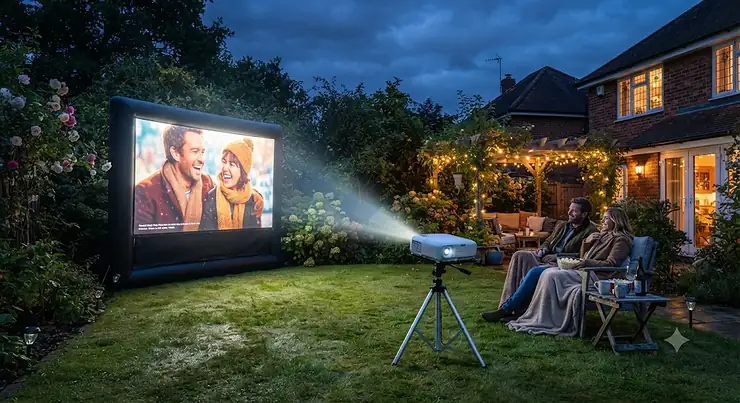
There’s a very specific kind of heartbreak reserved for garden cinema night. You’ve hung the sheet between two fence posts, chilled the drinks, hyped the kids up for two hours — and then you press play and get… a pale grey rectangle that looks like it’s been left out in the rain. This is the single most common question we hear from anyone setting up their first back-garden screening: how many lumens for outdoor projector use is actually enough, and why does the number on the box never seem to match what you see on the sheet? The honest answer is that lumens are only half the story — but they’re the half worth understanding first, because get this number wrong and no amount of clever screen positioning will save your evening.
Outdoor movie nights have become something of a British summer tradition in recent years, and What Hi-Fi’s outdoor projector coverage has tracked that shift closely, testing everything from pocket-sized portables to genuinely daylight-capable units. Lumens measure how much visible light a projector can physically push out, and outdoors, that number has to fight against a genuinely unfair opponent: the sky. Even after “dark,” there’s still ambient light bouncing around from streetlamps, neighbouring windows, and the lingering blue of dusk, all of it working to wash out your picture before it’s even reached the sheet. As a rough starting point, most enthusiasts agree that 1,500–2,000 ANSI lumens is the sweet spot for genuine outdoor use once full darkness has settled, while anything you want to run before the sun has properly gone down needs 3,000 lumens or more to hold its own. We’ll unpack exactly why that range exists, walk through the difference between ANSI and ISO lumens (a distinction that catches almost everyone out), and — because reading specs in the abstract only gets you so far — introduce seven real, currently available projectors spanning budget to premium, each one chosen for a specific kind of outdoor evening.
Quick Comparison Table: 7 Best Outdoor Projectors at a Glance
| Projector | Brightness | Best For | Price Range |
|---|---|---|---|
| Nebula X1 | 3,500 ANSI lumens | Best bright outdoor projector overall | £1,600-£1,900 |
| XGIMI Horizon Pro | 2,200 ANSI lumens (claimed) | Sharpest 4K picture for the money | £1,400-£1,650 |
| Nebula Mars 3 | 1,000 ANSI lumens | Toughest all-round garden and camping unit | £500-£650 |
| Epson EF-22 | 1,000 ISO lumens | Most balanced all-rounder | £600-£750 |
| Optoma PK32 | 1,110 ISO lumens | Best for outdoor gaming nights | £450-£600 |
| BenQ GV31 | 300 ANSI lumens | Most portable twilight-ready pick | £350-£500 |
| VANKYO Leisure 3 | Claimed 2,400 lumens | Cheapest way to try garden cinema | Under £100 |
Look closely at that table and something jumps out immediately: brightness claims range from 300 to 3,500, yet three of these projectors — the Nebula Mars 3, the Epson EF-22, and the Optoma PK32 — sit within touching distance of each other at roughly 1,000-1,100 lumens, despite wildly different price tags. That’s your first clue that lumens alone don’t tell the whole value story; build quality, lens sharpness, and genuine ANSI-standard measurement (rather than marketing lumens) separate these models far more than the raw number suggests. Meanwhile the gap between the VANKYO Leisure 3‘s claimed 2,400 lumens and its sub-£100 price should raise an eyebrow, and we’ll explain exactly why later in this guide.
💬 Found your brightness bracket already? Compare current prices on Amazon UK before the good ones sell out for summer.
Top 7 Outdoor Projectors: Expert Analysis
1. Nebula X1 — best bright outdoor projector overall
The Nebula X1 earns its keep the moment the sun starts dipping but hasn’t fully committed to setting, which is exactly when most outdoor projectors give up. Built around a triple-laser light engine rated at 3,500 ANSI lumens, it’s one of the genuinely brightest units you can point at a garden sheet without renting a cinema-grade rig. Pair that with 4K resolution, Dolby Vision HDR, and a claimed colour accuracy tight enough to make sunset skies in nature documentaries look properly cinematic rather than sickly orange, and you’ve got a projector built for people who refuse to compromise. Reviewers at industry outlets have singled it out as a standout for evening light resistance, and aggregated buyer feedback consistently flags the dual 15W plus dual 5W speaker array as genuinely capable of filling a garden without a separate soundbar — though several users note it’s a mains-only unit, so factor in a decent extension lead or a nearby socket before committing to a spot on the lawn. Based on the spec comparison with rivals in this guide, the Nebula X1 is the projector to buy if brightness is non-negotiable and you’re not fussed about carrying a battery pack; buyers hauling gear to a campsite will find its roughly 6kg body better suited to a fixed garden setup.
Pros:
- ✅ 3,500 ANSI lumens holds up against real evening light
- ✅ 4K with Dolby Vision HDR for genuinely sharp detail
- ✅ Strong built-in audio removes the need for a soundbar
Cons:
- ❌ Mains-powered only, so no cordless flexibility
- ❌ Heavier and bulkier than portable rivals
At around £1,600-£1,900, this sits at the top of our list on price, and the value case rests entirely on how often you’ll actually use that brightness headroom — for weekly summer screenings, it’s arguably the smartest long-term buy here.
2. XGIMI Horizon Pro — sharpest 4K picture for the money
Here’s where things get genuinely interesting, and honestly, a little bit murky. XGIMI markets the Horizon Pro at 2,200 ANSI lumens, and that number appears across most retail listings and its original press materials. Independent lab measurement published by ProjectorCentral, however, puts its real-world output closer to 1,500 ISO lumens — a gap that’s common across the industry but worth flagging upfront, because it’s the clearest teachable moment in this entire article about reading projector specs sceptically. What most buyers overlook about this model is that even at the more conservative measured figure, it’s still a capable performer: true 4K resolution via pixel-shifting DLP, Android TV built in, and auto-focus, auto-keystone, and gyro-correction that mean you can set it on an uneven garden table and still get a straight, sharp rectangle within seconds. Aggregated reviewer sentiment is broadly positive on picture clarity and ease of setup, though a recurring complaint is limited manual picture controls — you get five presets and not much room to fine-tune beyond them. For buyers who prioritise sheer image detail over headline brightness numbers, this is a genuinely strong outdoor performer once dusk has properly settled in.
Pros:
- ✅ True 4K resolution with sharp, detailed image
- ✅ Auto-focus, keystone and gyro-correction save setup time
- ✅ Built-in Android TV means no extra streaming stick needed
Cons:
- ❌ Claimed lumens rating significantly exceeds independently measured brightness
- ❌ Limited manual picture adjustment beyond five presets
Typically retailing in the £1,400-£1,650 range, the XGIMI Horizon Pro competes directly with the Nebula X1 on price — the deciding factor should be whether you value resolution (Horizon Pro) or raw daylight-fighting brightness (Nebula X1) more for your garden.
3. Nebula Mars 3 — toughest all-rounder for garden and camping
If your idea of an outdoor cinema involves more than one location — the garden one week, a campsite the next — the Nebula Mars 3 is built with exactly that flexibility in mind. Rated at 1,000 ANSI lumens with an IPX3 water-resistance rating, it can shrug off a light drizzle that would send most projectors straight back indoors, and its Intelligent Environment Adaptation feature gets you from unpacking to a correctly focused, keystone-adjusted image in around three seconds flat. Here’s what to weigh: 1,000 ANSI lumens is a genuinely bright figure for a battery-capable portable unit, and it throws an image up to 200 inches, but reviewers consistently note that battery life sits around five hours, which is comfortably enough for a feature film but worth checking before an all-night double bill. The 40W Dolby Digital Plus speaker system is another standout — aggregated feedback repeatedly calls out audio quality as punching above its weight for a portable projector, which matters enormously outdoors where you can’t rely on room acoustics to help you.
Pros:
- ✅ IPX3 water resistance handles light outdoor drizzle
- ✅ Roughly 5-hour battery life for cordless viewing
- ✅ 40W Dolby speakers deliver genuinely full sound outside
Cons:
- ❌ Larger and heavier than pocket-sized portable rivals
- ❌ 1,000 lumens fades noticeably before full darkness
Sitting in the £500-£650 range, the Nebula Mars 3 represents strong mid-tier value for anyone who wants one projector to cover both garden nights and camping trips without buying two separate units.
4. Epson EF-22 — most balanced all-rounder
There’s something reassuringly grown-up about the Epson EF-22. It doesn’t chase headline lumens numbers or gimmicky battery packs — it simply does the fundamentals extremely well. Rated at 1,000 ISO lumens through genuine 3LCD technology (rather than the single-chip DLP most rivals use), it produces noticeably richer, more even colour saturation, which matters more outdoors than you’d think, since washed-out DLP colour rainbow artefacts become more visible against a dim garden backdrop. Based on the spec comparison, its 1000 ISO lumens rating is directly comparable — not inflated — against ANSI-rated competitors, meaning what you see on the spec sheet is close to what you’ll actually get on the sheet. Built-in Google TV removes the faff of a separate streaming stick, and reviewers have praised its design as “attractive and practical,” while consistently flagging that dark scenes can look a touch washed out at its brightness ceiling. At 3kg, it’s not the projector you’ll want to lug down the garden every single night, but the fixed cradle base makes positioning genuinely painless once it’s found its spot.
Pros:
- ✅ 3LCD tech gives noticeably richer, more accurate colour
- ✅ Built-in Google TV removes need for a streaming stick
- ✅ Honestly rated brightness that matches real performance
Cons:
- ❌ No battery, so it needs a nearby power source
- ❌ Dark scenes can look washed out at max brightness
At £600-£750, the Epson EF-22 asks a fair price for honesty as much as performance — reviewers consistently rank it among the best-balanced outdoor picks precisely because its spec sheet doesn’t oversell itself.
5. Optoma PK32 — best for outdoor gaming nights
Garden movie night is one thing, but a summer evening of split-screen racing games with mates is a different beast entirely, and the Optoma PK32 is the projector built for exactly that scenario. Rated at 1,110 ISO lumens, it’s bright enough for early-evening outdoor use, but the real headline here is responsiveness: independent testing recorded input lag as low as 4.6ms at 1080p/240Hz and 18.3ms at 4K/60Hz, numbers that comfortably beat most gaming monitors, let alone rival projectors. What most buyers overlook about gaming-focused projectors is that low input lag matters just as much outdoors as it does on a competitive gaming setup indoors — nobody wants their kart to hit the wall a quarter-second after they saw the corner coming. Its gimbal-style design is another genuine advantage, letting you place it at odd angles on uneven garden furniture without wrestling with a tripod, and the included travel case means it survives being tossed in a backpack for a spontaneous evening at a friend’s place. The trade-off, honestly reported, is that it’s not the projector for daytime use — reviewers are consistent that direct sunlight overwhelms its brightness ceiling fast.
Pros:
- ✅ Class-leading input lag for competitive outdoor gaming
- ✅ Gimbal-style design suits placement on uneven surfaces
- ✅ Included travel case supports genuine portability
Cons:
- ❌ Not bright enough for genuine daytime use
- ❌ Battery life shorter than dedicated camping projectors
Priced around £450-£600, the Optoma PK32 is a smart, focused buy for anyone whose outdoor screen time skews towards gaming rather than films — for that use case, it beats far pricier rivals on the metric that actually matters.
6. BenQ GV31 — most portable twilight-ready pick
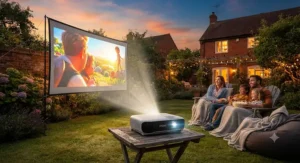
The BenQ GV31 is proof that a modest 300 ANSI lumens rating doesn’t have to mean a modest experience, provided you’re realistic about when you’ll use it. Its rotating lens is a genuinely clever piece of design — tilt it upward and you can project onto a gazebo canopy or an angled garden wall without needing a stand, which opens up seating arrangements a fixed-angle projector simply can’t match. Reviewers consistently flag its 2.1-channel speaker system, built around dual midrange tweeters and a dedicated woofer, as punching well above what you’d expect from something this compact, and its 5,800mAh battery delivers roughly 180 minutes of playback — enough for most feature films without a power lead trailing across the lawn. Here’s the honest trade-off: at 300 ANSI lumens, this is squarely a dusk-and-after projector, not a daytime one, and What Hi-Fi’s testing team has previously called it one of the strongest value outdoor projectors on the market specifically because it doesn’t overpromise on brightness it can’t deliver.
Pros:
- ✅ Rotating lens allows flexible projection angles without a stand
- ✅ Strong 2.1-channel audio for a compact unit
- ✅ Roughly 3-hour battery covers most full-length films
Cons:
- ❌ 300 lumens limits use to dusk or full darkness
- ❌ Rated brightness sits well below its pricier rivals
Now typically found in the £350-£500 range, the BenQ GV31 rewards buyers who plan their screening time around the sunset rather than fighting it — for that audience, it’s excellent value.
7. VANKYO Leisure 3 — cheapest way to try garden cinema
Every category needs an honest entry-level option, and the VANKYO Leisure 3 is exactly that — provided you go in with your eyes open. It’s marketed at up to 2,400 lumens, and on paper that sounds competitive with projectors costing ten times as much. In practice, independent reviewers have been refreshingly blunt about this: as one expert reviewer noted, a projector genuinely producing 2,400 measured lumens would draw upwards of 220 watts, while the Leisure 3 draws only around 50 watts — a power draw more consistent with real output in the low hundreds of lumens, not thousands. That’s not necessarily a dealbreaker, but it reframes what this projector is actually for: casual, after-dark garden viewing on a modest screen size, not a bright summer-evening showpiece. Aggregated customer sentiment is genuinely positive within that narrower expectation — buyers praise its compact size, simple setup, and the fact that it comfortably outperforms a laptop screen for a fraction of the cost of anything else on this list. If you’ve never tried outdoor projection before and want to test the waters without a big financial commitment, this is the low-risk entry point.
Pros:
- ✅ Extremely low price point for first-time buyers
- ✅ Compact and genuinely easy to set up
- ✅ Comfortably outperforms a laptop screen after dark
Cons:
- ❌ Marketed lumens figure significantly overstates real brightness
- ❌ Struggles with anything but full darkness outdoors
At under £100, the VANKYO Leisure 3 isn’t trying to compete with the rest of this list on performance — it’s here as the honest, no-frills way to find out whether outdoor cinema nights are for you before spending serious money.
Practical Usage Guide: Setting Up Your Outdoor Projector for Maximum Brightness
Getting the brightness you paid for onto the sheet — rather than losing half of it to poor setup — comes down to a handful of habits most first-time buyers skip. First, kill every light source you can control: porch lights, kitchen windows facing the garden, even a bright phone screen nearby all steal contrast from your image, and outdoors you don’t get the luxury of blackout curtains. Second, pick your screen surface deliberately rather than defaulting to a bedsheet — a proper matte white projection screen reflects light back far more evenly than fabric, which tends to absorb and scatter it. Third, position the projector as close to perpendicular to the screen as the throw distance allows; even a modest keystone angle forces the lens to stretch the image, which thins out brightness across the frame exactly when you need every lumen working for you. Fourth, in the first 30 days, resist the urge to max out contrast and colour settings hoping for extra “pop” — most projectors ship with a factory-calibrated mode that’s actually closest to accurate, and cranking brightness sliders past their sweet spot introduces washed-out highlights rather than genuine extra light output. Finally, build a simple maintenance habit early: wipe the lens with a proper microfibre cloth (never anything abrasive), and check intake vents for garden debris every few uses, since dust build-up is the single biggest cause of dimming output over a projector’s lifetime.
Real-World Scenarios: Which Setup Matches Your Garden?
Picture three very different buyers, because the “right” lumens answer genuinely depends on who’s asking. First, there’s the young family with a modest suburban garden who mainly wants a wind-down Friday film night after the kids’ bedtime, once it’s properly dark — for them, something like the Nebula Mars 3 or even the budget VANKYO Leisure 3 delivers everything needed, since full darkness removes almost all the ambient-light challenge. Second, imagine the university flat-share hosting a rooftop terrace screening that kicks off at dusk, before the sky has fully surrendered its light — this is the scenario where 1,000+ ANSI lumens genuinely earns its keep, making the Epson EF-22 or XGIMI Horizon Pro the sensible middle ground between price and performance. Third, there’s the household that hosts big garden parties — birthdays, football finals, New Year’s Eve countdowns — where guests are milling about under string lights and nobody’s waiting for total darkness before the big match kicks off; here the Nebula X1‘s 3,500 ANSI lumens genuinely justifies its premium price, because it’s the only projector on this list built to survive a genuinely bright social setting rather than a controlled, darkened evening.
Problem → Solution: Fixing Common Outdoor Projection Issues
Even with the right projector, outdoor setups throw up recurring headaches — thankfully, most have straightforward fixes. If your picture looks washed out despite decent lumens, the culprit is almost always ambient light rather than the projector itself; try angling the screen away from streetlights and neighbouring windows before assuming you need a brighter unit. If the image looks soft or slightly blurred at the edges, check you’re using a genuinely flat, taut screen surface rather than a sheet billowing in the breeze — even a gentle wind introduces enough movement to blur focus across a large thrown image. If sound feels thin or gets lost outdoors, remember that open air offers none of a room’s natural reflection, so pairing your projector (even a model with reasonable built-in speakers, like the Nebula Mars 3) with a dedicated Bluetooth speaker is often the single biggest upgrade for guest experience. If you’re seeing a rainbow-like colour fringe on bright scenes, that’s a known characteristic of single-chip DLP projectors like the XGIMI Horizon Pro or Optoma PK32 under certain lighting — it’s more noticeable to some viewers than others, and largely inherent to the technology rather than a fault. Finally, if your battery-powered projector dies mid-film, a portable power bank rated for at least 65W output (paired with USB-C models like the BenQ GV31) is a cheap insurance policy against an interrupted ending.
What Is “How Many Lumens for Outdoor Projector” Really Asking?
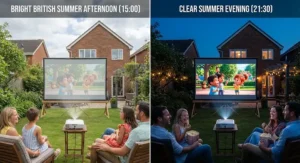
In short: it’s asking how bright a projector needs to be, measured in lumens, to produce a clear, watchable image outside despite ambient light. As a working baseline, 1,500-2,000 ANSI lumens suffices for outdoor viewing in full darkness, while 3,000+ ANSI lumens is recommended for use before or during dusk, when residual daylight is still present.
That definition matters because “outdoors” isn’t one fixed lighting condition — it’s a sliding scale from pitch-black countryside to a suburban garden lit by three neighbours’ security lights, and the lumens figure you need shifts dramatically across that scale.
Outdoor Projector Brightness: How to Choose the Right Lumens Level
Working through this methodically saves a lot of trial and error, so here’s the process we’d recommend to anyone shopping right now:
- Assess your typical viewing time. If you only ever watch after full darkness has set in, you can comfortably shop in the 700-1,200 lumens range; if you routinely start before sunset, aim higher.
- Audit your ambient light sources. Streetlights, porch lights, and even a bright moon add up — each nearby light source effectively raises your minimum brightness requirement by a few hundred lumens.
- Measure your typical screen size. Larger thrown images spread the same total light output over more area, so a 150-inch screen needs noticeably more lumens than a 100-inch one to look equally punchy.
- Decide between ANSI and ISO lumens claims. As we cover in detail below, these aren’t interchangeable — always compare like-for-like where possible.
- Check for a proper screen surface. A dedicated screen with the right gain (more on this shortly) can meaningfully boost perceived brightness without spending a penny more on the projector itself.
- Factor in portability needs. Battery-powered portable units, like the Nebula Mars 3 or BenQ GV31, often trade some raw lumens for cordless flexibility — decide which matters more for your typical setup.
- Read aggregated review sentiment, not just spec sheets. Manufacturer-claimed lumens vary wildly in reliability, so real-world reviewer consensus (as we’ve cited throughout this guide) is often more trustworthy than the number on the box.
Lumens Needed Outside Daytime vs Dusk vs Full Darkness
| Viewing Condition | Recommended ANSI Lumens | Best Matching Pick |
|---|---|---|
| Full darkness (late evening/night) | 700-1,200 | Nebula Mars 3, BenQ GV31 |
| Dusk / early evening light | 1,000-2,000 | Epson EF-22, XGIMI Horizon Pro |
| Daytime / bright ambient light | 3,000+ | Nebula X1 |
The pattern here is straightforward: brightness requirements roughly triple as you move from post-dark viewing to genuine daylight use, which is exactly why a projector that dazzles in a pitch-black garden can look genuinely disappointing at a 4pm summer barbecue. For most UK households, whose outdoor screenings tend to happen once it’s properly dark to maximise contrast for free, the 700-1,200 lumens tier represents the smartest spend rather than chasing daytime-capable brightness you’ll rarely actually need.
✨ Don’t Miss These Exclusive Deals!
🔍 Take Your Garden Cinema to the Next Level
Ready to turn your evenings into a proper outdoor cinema experience? Click through to check current pricing and availability on any of the models above — these picks are chosen to deliver a genuinely bright, crisp picture your family and friends will actually want to watch.
ANSI Lumens vs ISO Lumens Outdoor: What’s the Real Difference?
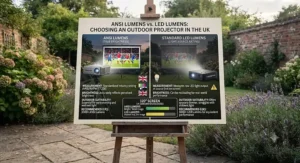
This is the single most misunderstood spec in the entire projector category, and it’s worth getting right before you spend a penny. ANSI lumens is the industry’s most widely accepted brightness measurement, worked out by averaging nine separate light-meter readings taken across different points of a projected image, which makes it a fairly rigorous, standardised figure. ISO lumens is a related but distinct measurement, following its own ISO 21118 testing method, and while the two numbers are often similar, they aren’t strictly interchangeable. It’s worth knowing, too, that the lumen itself is the proper SI unit of luminous flux — a formal measure of how much visible light a source emits — which is why the same word turns up on everything from projectors to household light bulbs.
Here’s what this means in practice, using a real example from this guide: the XGIMI Horizon Pro is marketed at 2,200 ANSI lumens, yet independent lab measurement recorded a figure closer to 1,500 ISO lumens — not because either number is fraudulent, but because ANSI and ISO methodologies simply don’t measure identically, and manufacturers understandably lead with whichever figure looks better in marketing. The practical takeaway: when comparing two projectors, always check which standard each one quotes, because comparing an ANSI figure directly against an ISO figure is comparing two different rulers and expecting the same units.
Ambient Light Outdoor Projection: The Enemy You Can’t Switch Off
Indoors, you can draw the curtains and switch off every lamp in the room. Outdoors, you’re fighting a genuinely uncontrollable variable, and understanding it changes how you shop for brightness. Ambient light — any illumination not produced by your projector — includes everything from a rising moon to a neighbour’s motion-sensor security light, and it works against your image by reducing contrast rather than simply “dimming” it; blacks lift towards grey, and colours lose saturation even if the bright areas of the picture still look reasonably punchy. This is precisely why two gardens with identical projectors can produce wildly different results: a rural garden with genuinely dark surroundings will get noticeably more mileage out of the same lumens count than a well-lit suburban street. Practically speaking, this means auditing your specific garden before you shop — walk out at your typical viewing time and note every light source you can see, because each one effectively raises the brightness floor you need to shop for.
Outdoor Projection Screen Gain: The Free Brightness Upgrade
If there’s one detail buyers consistently underweight, it’s screen gain — and it’s genuinely a free upgrade if you get it right. Screen gain measures how much light a projection surface reflects back to the viewer compared with a standard reference white board, and choosing the right gain rating can meaningfully change perceived brightness without touching the projector’s actual lumens output. As Barco’s projection glossary explains, high-gain screens typically use specialised coatings to boost reflectivity, while ambient light rejecting (ALR) screens go a step further, engineered specifically to bounce the projector’s own light forward while absorbing or deflecting stray light from other sources — which makes them particularly relevant outdoors, where ambient light is unavoidable rather than optional. For most garden setups without dedicated light control, a mid-range gain screen (roughly 1.0-1.3) strikes the best balance: bright enough to help combat ambient light, without the narrower viewing angle that very high-gain surfaces introduce, which can leave guests sitting off to the side squinting at a dimmer image than those seated centrally.
The upshot: pairing even a modest lumens projector, like the BenQ GV31, with a proper gain-rated screen rather than a bedsheet can genuinely close some of the gap against pricier, brighter rivals — it’s the cheapest brightness upgrade available to anyone setting up a garden cinema.
5,000 Lumen Projector Outdoor: Do You Really Need That Much?
It’s tempting to assume more lumens is always better, and retailers certainly aren’t discouraging that instinct — but for the vast majority of UK garden setups, a genuine 5,000 ANSI lumen projector is significant overkill, both in price and practicality. That kind of brightness belongs to large venue and events-grade projectors, designed for enormous screens or genuinely bright daytime conditions like an outdoor festival stage — not a 120-inch sheet in a back garden after sunset. Even our brightest pick here, the Nebula X1 at 3,500 ANSI lumens, comfortably covers the brightest realistic domestic scenario (early evening, ambient light present), and stepping up from there brings diminishing returns for most households while adding significant cost, weight, and power draw. Unless you’re regularly running outdoor screenings in genuine daylight on a very large screen — think garden weddings or community events rather than a normal family movie night — the 1,000-3,500 lumens range covered by the projectors in this guide will comfortably outperform your actual needs.
Common Mistakes When Buying an Outdoor Projector
The single biggest mistake buyers make is trusting a headline lumens number without checking whether it’s ANSI, ISO, or an unspecified “LED lumens” figure — the latter, as covered in our budget pick’s honest review above, can overstate real brightness by a wide margin. A close second is buying based on indoor room-viewing expectations and assuming the same projector will perform identically in a garden; ambient light outdoors is a fundamentally different challenge to a darkened living room, and a projector that looked stunning in a shop demo can disappoint under an open sky. Third, many first-time buyers skip screen gain entirely and project onto a bedsheet, unknowingly sacrificing brightness and sharpness that even a modest dedicated screen would recover for free. Fourth, buyers frequently underestimate audio needs — outdoor spaces swallow sound with none of a room’s helpful reflections, so a projector’s built-in speakers rarely tell the full story of how a garden screening will actually sound. Finally, it’s easy to overlook portability requirements until the third time you’re hauling a 6kg unit down the garden path in the dark — if your setup changes location regularly, weight and battery life deserve just as much weight in your decision as raw brightness.
Long-Term Cost & Maintenance: The Real Total Cost of Ownership
Sticker price is only the opening chapter of what an outdoor projector actually costs over its lifetime, and this is where the value picture can shift dramatically between models. LED and laser light sources — used in most of the projectors on this list, including the Nebula X1 and XGIMI Horizon Pro — typically carry rated lifespans in the 20,000-30,000 hour range, which at a couple of hours of weekly summer use should comfortably outlast a decade of typical ownership without needing a costly bulb replacement, unlike older lamp-based projectors. Battery-powered portables introduce a second consideration: lithium battery packs in units like the Nebula Mars 3 or BenQ GV31 gradually lose capacity over hundreds of charge cycles, so budget-conscious buyers should factor in that a five-year-old portable projector will likely offer noticeably shorter runtime than it did on day one. Screen investment, meanwhile, is genuinely one-off — a decent gain-rated outdoor screen, once purchased, doesn’t degrade the way a bedsheet does after repeated outdoor storage and washing. Add it all up, and the projectors that look pricier at checkout — like the Epson EF-22, with its honestly rated brightness and durable 3LCD engine — often work out cheaper per hour of actual enjoyment than a budget unit you outgrow within a single summer.
Outdoor Projector vs Traditional Home Cinema: A Straight Comparison
| Factor | Outdoor Projector | Traditional Indoor TV/Home Cinema |
|---|---|---|
| Screen size potential | Up to 300 inches | Typically capped around 85 inches |
| Setup flexibility | Portable, works anywhere with power | Fixed room installation |
| Ambient light performance | Requires darkness for best results | Bright, works in any lighting |
| Social/group viewing | Excellent for large gatherings | Limited by room size |
| Weather dependency | Yes — needs dry conditions | None |
The honest read here is that outdoor projectors win decisively on scale and social atmosphere — nothing beats a 150-inch picture under the stars for a group gathering — but they lose outright on convenience and weather independence, which is exactly why most enthusiast households end up owning both rather than choosing one over the other. If your garden screenings are an occasional summer treat rather than a year-round habit, that trade-off tips heavily in the projector’s favour; for genuinely poor-weather regions, it’s worth checking a longer-range forecast before committing an evening (and your guest list) to an outdoor screening.
Buyer’s Decision Framework: A Quick Priority Checklist
If you only ever watch after full darkness, choose a 700-1,200 lumens model like the Nebula Mars 3 or VANKYO Leisure 3, because the extra brightness of pricier options will largely go to waste. If you regularly start screenings at dusk while some daylight lingers, choose a 1,000-2,000 lumens model like the Epson EF-22 or XGIMI Horizon Pro, since this range comfortably bridges the gap without premium-tier pricing. If you host bright, sociable garden parties where guests mill about under string lights, choose the Nebula X1, because 3,500 ANSI lumens is the only figure on this list built to survive genuinely bright social settings. If portability between locations matters more than peak brightness, prioritise battery-powered options like the BenQ GV31 or Nebula Mars 3 over mains-only units. And if you’re simply testing whether outdoor cinema is for you before investing seriously, start with the VANKYO Leisure 3 and upgrade once you know your actual viewing habits.
Frequently Asked Questions
❓ How many lumens do I need for an outdoor projector?
❓ What's the difference between ANSI lumens and ISO lumens?
❓ Is a 5,000 lumen projector overkill for outdoor use?
❓ Does screen gain actually make a difference outdoors?
❓ Can I use any projector outdoors, or do I need a specific 'outdoor' model?
Conclusion
If there’s one thing worth carrying away from this guide, it’s that “how many lumens for outdoor projector” doesn’t have a single universal answer — it has a range, and the right number for your garden depends entirely on when you actually watch, how much ambient light you’re fighting, and how big a screen you’re throwing that light across. For most UK households watching after dark, something in the 700-1,200 ANSI lumens bracket, like the Nebula Mars 3 or the ultra-budget VANKYO Leisure 3, will comfortably do the job without overspending on brightness you’ll never fully use. Step up to the 1,000-2,000 range with the Epson EF-22 or XGIMI Horizon Pro if your evenings tend to start before the sky’s fully dark, and reserve the Nebula X1‘s genuinely daylight-capable 3,500 ANSI lumens for households hosting bright, sociable garden events where waiting for full darkness simply isn’t realistic. Whichever bracket you land in, remember that a decent screen surface and a sensible setup routine will squeeze noticeably more performance out of any projector on this list than the spec sheet alone suggests — brightness is only half the equation, and now you know the other half too.
Recommended for You
- Best Outdoor Projector 2026: 7 Top Picks Reviewed (UK)
- Projector for Garage Cinema: 7 Bright Picks for 2026
- Long Throw Projector UK: 7 Brilliant Picks for 2026
Disclaimer: This article contains affiliate links. As an Amazon Associate, I earn from qualifying purchases. If you purchase products through these links, we may earn a small commission at no additional cost to you.
✨ Found this helpful? Share it with your friends! 💬🤗
