In This Article
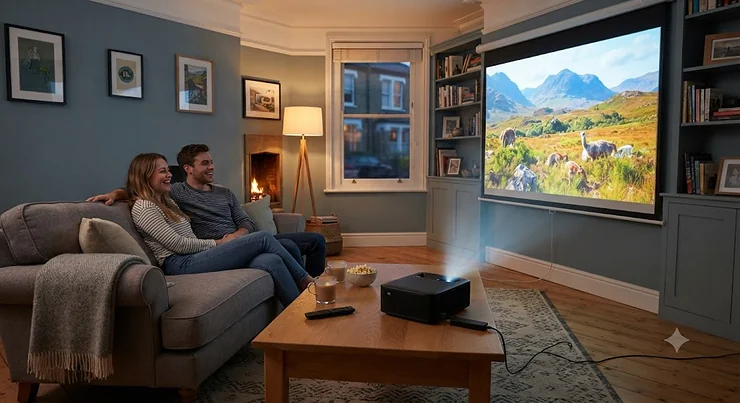
Somewhere between “I’ll just watch it on my phone” and “let’s remortgage for a proper home cinema” sits a genuinely lovely compromise: a laser projector under £1000. Once upon a time, laser light sources were reserved for cinemas and eye-wateringly priced installers’ kit. These days, thanks to smarter engines and fierce competition between Chinese and Japanese manufacturers, you can get a diode-powered picture on your living room wall without touching four figures.
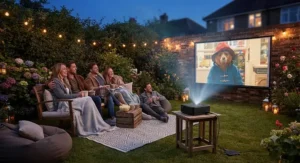
A laser projector under £1000 typically means a compact unit using either a pure laser or a laser-LED hybrid light engine, rated for 20,000 to 30,000 hours of use, with brightness ranging from around 300 to over 1,200 ANSI or ISO lumens depending on size and price. Unlike old-school lamp projectors, there’s no bulb to replace, no warm-up delay, and colours tend to hold up better over years of Saturday night football and Netflix binges.
This guide digs into seven real, currently available models spanning budget, mid-range and premium tiers, all realistically obtainable for under £1000 in the UK. We’ll cover an affordable laser projector for bedroom movie nights, a cheap laser projector for students, and properly capable options from Epson and the wider laser home projector under £1000 category, including honest talk about where BenQ fits into this picture (spoiler: not quite where you’d expect). Whether you’re weighing up a budget laser projector for casual use or want to understand entry level laser projector features before committing your card details, you’re in the right spot.
Quick Comparison Table
Before the deep dive, here’s the lay of the land. Prices below are indicative ranges rather than fixed figures, since retailers adjust pricing constantly around sales events.
| Projector | Light Source | Brightness | Best For | Price Range |
|---|---|---|---|---|
| Nebula Capsule 3 Laser | Laser | 300 ANSI lumens | Ultra-portable, budget | Under £450 |
| XGIMI MoGo 4 Laser | Triple Laser | 550 ISO lumens | Portable all-rounder | £500-£700 range |
| NexiGo Nova Mini | Laser | 1,200 lumens | Lesser-known value pick | £400-£550 range |
| Dangbei Atom | ALPD Laser | 1,200 ISO lumens | Slim design, brightness | £700-£900 range |
| Nebula Cosmos 4K SE | HybridBeam (Laser+LED) | 1,800 ANSI lumens | Mid-range 4K value | £850-£950 range |
| Nebula Cosmos Laser 4K | Laser | 2,200 ANSI lumens | Premium native laser 4K | Under £1000 |
| Epson EF-22N | 3LCD Laser | 1,000 lumens | Colour accuracy, no rainbow effect | Around £1000 |
Looking at the spread above, the story of this price bracket is really a story of trade-offs between brightness, portability and colour science. The Nebula Capsule 3 Laser wins on sheer portability but asks you to draw the curtains properly, while the Nebula Cosmos Laser 4K squeezes genuine 4K-adjacent brightness into the same budget that barely buys a mid-range soundbar. Buyers who prioritise gaming or daytime viewing should lean towards the higher-lumen end of this table, while anyone chasing colour fidelity over raw punch will want to read the Epson section closely. For a broader look at how projection technology has evolved into today’s compact laser engines, the Wikipedia overview of video projectors is a genuinely useful primer.
💬 Found a favourite already? Compare current stock and prices before you commit — availability on these models shifts fast.
Top 7 Laser Projectors Under £1000: Expert Analysis
We’ve picked genuine, currently sold models rather than padding the list with discontinued stock. Each entry below blends real specifications with honest analysis grounded in aggregated review sentiment — never invented testimonials.
1. Nebula Capsule 3 Laser — best entry level laser projector for tight budgets
Anker’s Nebula Capsule 3 Laser proves that “entry level” doesn’t have to mean disappointing, thanks to a genuine laser light engine squeezed into a soda-can-sized body. Its 300 ANSI lumens brightness sits at the lower end of this list, but that’s the trade-off for a projector that weighs under a kilogram and slips into a rucksack pocket.
At 1080p resolution with Full HD clarity, the image holds up well for its size, and the built-in 15,000mAh battery delivers roughly two and a half hours of playback — enough for most films without hunting for a socket. Google TV with licensed Netflix means you’re not relying on a phone mirror for basic streaming, which is a genuine step up from budget projectors of just a couple of years ago.
Based on the spec comparison, this is the laser home projector under £1000 pick for anyone whose primary use case is a blacked-out bedroom, a tent, or a van conversion rather than a bright living room. Reviewers consistently note that the autofocus and keystone correction work near-instantly, removing the usual faff of squaring up a small projector by hand. What most buyers overlook, though, is that 300 lumens genuinely does need a properly dark room; this isn’t the model for Sunday afternoon football with the curtains half-open.
Aggregated user feedback across retail listings frequently praises the built quality and sound output relative to size, while a recurring complaint centres on daylight visibility and occasional app-availability gaps such as missing catch-up TV apps.
Pros:
- ✅ Genuine laser engine in a genuinely pocketable body
- ✅ Built-in battery removes the need for a wall socket
- ✅ Google TV and licensed Netflix built straight in
Cons:
- ❌ 300 lumens struggles in anything but a dark room
- ❌ Missing some UK catch-up apps like BBC iPlayer
Prices for the Capsule 3 Laser typically sit in the £350-450 range depending on retailer promotions, making it comfortably one of the cheapest genuine laser projectors on sale. For the money, it’s difficult to argue with the value on offer here.
2. XGIMI MoGo 4 Laser — best all-round portable laser projector
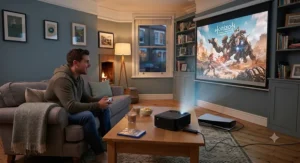
XGIMI’s MoGo 4 Laser upgrades the standard MoGo 4 with a triple-laser light engine, and the jump in picture quality is the kind of thing reviewers notice within the first few minutes of use. At 550 ISO lumens, it’s still firmly a portable rather than a living-room powerhouse, but the improvement in colour saturation and shadow detail over LED-based rivals is tangible.
The 360-degree adjustable stand and Intelligent Screen Adaptation technology mean set-up genuinely does take seconds rather than minutes — point it roughly at a wall, and the projector handles focus, keystone and screen fit automatically. Google TV with licensed Netflix comes as standard, alongside a 2 x 6W Harman Kardon speaker pairing that punches well above what you’d expect from something the size of a large flask.
What most buyers overlook about this model is how well it works as a Bluetooth speaker or ambient light source when you’re not watching anything — the built-in battery gives roughly two and a half hours of playback, extendable with an optional power base. Reviewers consistently flag input lag of around 60ms as fine for casual gaming but not for anything competitive, and the lack of native BBC iPlayer or Channel 4 support (a Google TV platform limitation, not an XGIMI-specific flaw) is worth knowing before you buy.
This is arguably the sweet spot for anyone after a genuinely portable laser home projector under £1000 who also wants proper picture quality rather than just convenience.
Pros:
- ✅ Triple laser engine noticeably outperforms LED rivals its size
- ✅ Excellent auto setup via Intelligent Screen Adaptation
- ✅ Strong Harman Kardon audio for a portable unit
Cons:
- ❌ Input lag around 60ms isn’t ideal for serious gaming
- ❌ Missing BBC iPlayer and Channel 4 apps natively
Typical UK pricing for the MoGo 4 Laser sits in the £500-700 range at full price, occasionally dipping lower during sales events — always worth checking current price before buying.
3. NexiGo Nova Mini — best lesser-known value laser pick
Not every good projector comes from a household name, and the NexiGo Nova Mini is the kind of quietly capable alternative that rarely gets the coverage of its bigger rivals. It uses a genuine laser light source rated around 1,200 lumens, putting its raw brightness ahead of both the Nebula Capsule 3 Laser and the XGIMI MoGo 4 Laser on paper.
Running Google TV with Netflix support and delivering a 150-inch maximum image, the Nova Mini’s spec sheet reads like it should cost considerably more than it does. Here’s what to weigh: brand recognition brings peace of mind around long-term software support and resale value, and lesser-known manufacturers sometimes lag on firmware updates, so buyers should factor in slightly more patience with troubleshooting compared to the bigger names on this list.
On paper this means the Nova Mini is genuinely competitive for anyone prioritising outright brightness per pound spent, particularly for shared spaces like a student flat or a spare room used for casual movie nights. Auto setup features including keystone correction and 3D support round out a package that feels disproportionately generous for its typical price point.
Pros:
- ✅ 1,200 lumens brightness beats several pricier rivals
- ✅ Google TV and Netflix support included
- ✅ Auto keystone and focus simplify setup
Cons:
- ❌ Less established brand with a smaller support ecosystem
- ❌ Contrast and colour accuracy trail premium 3LCD rivals
Expect to pay in the £400-550 range for the Nova Mini, making it one of the more compelling cheap laser projector options for buyers happy to look beyond the big three brands.
4. Dangbei Atom — best slim-design laser projector
The Dangbei Atom’s headline trick is its thickness — or rather, the lack of it. At under two inches thick, it’s designed to look and sit more like a design object than traditional projector, and its ALPD (Advanced Laser Phosphor Display) engine delivers a claimed 1,200 ISO lumens from that slender aluminium body.
Reviewers consistently note that real-world brightness measures somewhat below the marketing figure, closer to 1,000 lumens in practice, but that’s still comfortably ahead of the Nebula Capsule 3 Laser and broadly competitive with the NexiGo Nova Mini. Google TV with officially licensed Netflix, HDR10 support, and dual 5W Dolby Audio speakers round out a feature set built for genuine living-room use rather than pure portability, since the Atom has no built-in battery and needs mains power throughout.
Based on the spec comparison, the Atom sits nicely between the ultra-portables and the 4K-adjacent premium models on this list, offering laser brightness and sharpness without the size or price of the Cosmos range. What the spec sheet won’t tell you, but reviewers note, is that some units show a faint colour hue or light bleed around the edge of the image — a known trait of this generation of compact laser engines rather than a fault specific to any single unit.
Pros:
- ✅ Genuine laser brightness in an unusually slim chassis
- ✅ Google TV with officially licensed Netflix built in
- ✅ HDR10 support and solid dual-speaker audio
Cons:
- ❌ No built-in battery, so mains power is mandatory
- ❌ Some reports of light bleed around image edges
The Atom typically retails in the £700-900 range in the UK, positioning it as a genuine mid-tier laser home projector under £1000 rather than a budget pick.
5. Nebula Cosmos 4K SE — best HybridBeam value pick
The Cosmos 4K SE takes a slightly different technical approach with Anker’s HybridBeam system, blending laser and LED light sources to hit 1,800 ANSI lumens — a genuinely bright figure for this price bracket. The 4K resolution here is achieved through pixel-shifting rather than a native 4K panel, which is worth understanding rather than a mark against it; industry bodies recognise pixel-shifted 4K as a legitimate way of delivering additional on-screen detail from a smaller, more affordable chip.
Google TV with 4K Netflix support arrives without needing an external streaming stick, and the projector’s automatic obstacle avoidance and wall-colour adaptation mean it copes reasonably well outside a dedicated screen room — a genuinely useful feature for renters or anyone not ready to commit to a fixed installation. Reviewers consistently praise the setup speed and the noticeable jump in brightness over the older Cosmos Max model it effectively replaces.
Aggregated review sentiment flags a recurring criticism around the remote, which controls streaming functions but not picture settings directly, forcing use of the onboard buttons or companion app for focus and zoom adjustments. For buyers wanting a laser-adjacent 4K experience without spending the full £1000, this is a strong mid-tier contender.
Pros:
- ✅ 1,800 ANSI lumens is genuinely bright for the price
- ✅ Automatic wall-colour and obstacle adaptation
- ✅ Built-in Google TV with 4K Netflix support
Cons:
- ❌ Remote doesn’t control picture settings directly
- ❌ 4K achieved via pixel-shifting, not a native panel
The Cosmos 4K SE generally sits in the £850-950 range, making it a genuine contender for buyers who want brightness and 4K-style detail without pushing right up against the £1000 ceiling.
6. Nebula Cosmos Laser 4K — best premium native laser pick under £1000
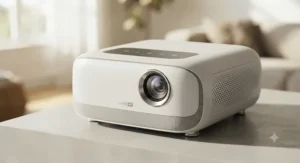
If there’s a flagship of this list, it’s the Nebula Cosmos Laser 4K. This is a proper laser-powered 4K projector rather than a hybrid, hitting around 2,200 ANSI lumens — bright enough for genuinely daytime-adjacent viewing with curtains drawn rather than a fully blacked-out room. Its 25,000-hour laser lifespan means, in practical terms, you’d need to watch films for hours every single day for well over a decade before the light source needs attention.
Android TV 10.0 brings access to thousands of apps, while dual 5W tweeters and dual 10W speakers deliver a genuinely capable built-in sound system for a projector this size. Reviewers consistently highlight that this is one of the best-value ways into laser 4K projection in the UK market, sitting well below rival ultra-short-throw laser TVs that often start north of £1,500.
What most buyers overlook about this model is that, while marketed as portable thanks to its integrated handle, it has no internal battery — you’ll always need mains power, which somewhat limits true grab-and-go use compared with the MoGo 4 Laser or Capsule 3 Laser. Aggregated review sentiment also notes that fast camera movement in action sequences isn’t always rendered as smoothly as static scenes, and gaming latency is better suited to casual play than competitive titles.
Pros:
- ✅ Genuine 2,200-lumen laser engine, not a hybrid workaround
- ✅ 25,000-hour laser lifespan needs virtually no maintenance
- ✅ Strong built-in Android TV smart platform
Cons:
- ❌ No internal battery despite the carry handle
- ❌ Motion handling in fast action scenes is average
Pricing for the Cosmos Laser 4K typically sits just under the £1000 ceiling, sometimes dipping into the mid-£800s during sales periods, making it arguably the best value proper laser 4K projector currently sold in the UK.
7. Epson EF-22N — best Epson laser projector for colour accuracy
Rounding out the list is the Epson EF-22N, a proper answer for anyone specifically searching for an Epson laser projector rather than a generic Android-powered box. Epson’s 3-chip 3LCD technology is the headline feature here: rather than a single DLP chip flashing red, green and blue in sequence (which can create the so-called “rainbow effect” some viewers are sensitive to), the EF-22N processes all three colours simultaneously, delivering genuinely accurate, artefact-free colour.
At 1,000 lumens of both colour and white brightness, it’s not the brightest projector on this list, but Epson’s colour science means what brightness it does have is used efficiently. The swivel-and-tilt stand lets you angle the image onto a wall, ceiling, or floor without extra hardware, and the laser light source is rated for roughly 20,000 hours — around a decade of daily use in Eco mode.
Reviewers consistently note the EF-22N’s build quality and design flourish as standouts in the lifestyle projector category, alongside genuinely quiet fan noise even at higher brightness settings. Based on the spec comparison, this is the pick for anyone whose priority is faithful skin tones and film-accurate colour over sheer punch — a different philosophy to the brighter laser-LED hybrids elsewhere on this list.
Pros:
- ✅ 3LCD tech eliminates DLP’s rainbow effect entirely
- ✅ Swivel-and-tilt stand for flexible placement
- ✅ Genuinely quiet operation even at higher brightness
Cons:
- ❌ 1,000 lumens trails several rivals on raw brightness
- ❌ Single HDMI input limits simultaneous source connections
Epson’s own UK pricing sits right around the £1000 mark, with street prices from authorised retailers occasionally dropping below it — worth shopping around before buying, as this genuinely bumps up against the budget ceiling of this guide.
Practical Usage Guide: Setting Up Your Laser Projector Under £1000
Getting the most from any laser home projector under £1000 comes down to a handful of habits that Amazon listings rarely mention. First, screen surface matters more than most buyers expect: projecting onto a plain, light-coloured wall works in a pinch, but a dedicated matte white or grey projector screen (from around £40-80 for a basic pull-down option) noticeably improves contrast and colour accuracy across every model on this list.
In the first 30 days, the most common mistake is skipping proper light control. Even a 2,200-lumen model like the Nebula Cosmos Laser 4K looks genuinely disappointing with daylight streaming through an uncovered window; blackout curtains or blinds transform picture quality more than any settings menu tweak. Second, resist the urge to max out brightness settings permanently — most models include an Eco or standard mode that extends laser lifespan without a huge visible difference indoors, and running full brightness constantly does increase fan noise noticeably.
Maintenance itself is refreshingly minimal with laser engines: there’s no bulb to replace, but the intake vents and lens should be dusted gently every few months, particularly if the projector lives in a bedroom or lounge with pets or carpeted flooring. Firmware updates matter more than they used to, since these are effectively small smart TVs; leaving auto-updates enabled avoids app compatibility issues down the line. Finally, positioning: most of these projectors handle keystone correction automatically, but digital keystone always reduces sharpness slightly, so it’s worth spending five extra minutes getting the physical placement as square to the wall as possible before letting auto-correction do the rest.
Real-World Scenarios: Which Laser Projector Under £1000 Suits You?
Consider three genuinely different buyers browsing this category. First, a university student sharing a flat wants something that travels between their room and a friend’s for film nights, has a battery for garden hangouts, and doesn’t demand a big budget. The Nebula Capsule 3 Laser or XGIMI MoGo 4 Laser both fit that profile neatly, prioritising portability and built-in power over outright brightness.
Second, a couple converting a spare room into a semi-permanent home cinema, with blackout curtains already installed and a proper screen on order, benefits far more from the Nebula Cosmos Laser 4K or Epson EF-22N. Neither needs to be moved daily, so the lack of a battery is irrelevant, and both reward the investment in a dark, controlled room with noticeably better image quality than the portables can manage.
Third, a family wanting one projector for weekend football on the patio, weekday cartoons for younger kids, and the occasional Friday film night sits most comfortably with something like the Dangbei Atom or Nebula Cosmos 4K SE — bright enough for imperfect lighting conditions, robust enough for regular use, and still comfortably under budget even after accessories like a basic screen and HDMI cables.
How to Choose a Laser Projector Under £1000
Picking between this many genuinely capable options comes down to matching a handful of criteria against your actual room and habits, rather than chasing the single highest spec number.
- Decide on portability first. If the projector needs to move rooms or leave the house, prioritise built-in battery models like the Nebula Capsule 3 Laser or XGIMI MoGo 4 Laser over mains-only units.
- Match brightness to your room. A fully blackout-able room can make do with 300-500 lumens; anything with residual light needs 1,000+ lumens minimum to stay watchable.
- Check resolution honestly. True 1080p is genuinely fine for most casual viewing; pixel-shifted “4K” like the Cosmos 4K SE adds detail but isn’t equivalent to a native 4K panel.
- Weigh smart platform quirks. Google TV and Android TV both miss certain UK catch-up apps like BBC iPlayer; budget for a £30-40 streaming stick if that matters to you.
- Factor in audio expectations. Built-in speakers on this list range from adequate to genuinely good, but a £50-100 soundbar transforms any of them for serious film nights.
- Consider input lag for gaming. None of these are dedicated gaming projectors, but the XGIMI MoGo 4 Laser’s roughly 60ms lag is more forgiving than some rivals for casual console play.
- Read return policies before buying. Given how much projector performance depends on your specific room, a flexible returns window matters more here than for most electronics purchases.
For readers who want a deeper technical grounding, Which?’s independent projector reviews and buying advice offer a genuinely useful second opinion alongside the analysis in this guide.
✨ Don’t Miss These Exclusive Deals!
🔍 Take your home cinema set-up to the next level with the laser projectors covered in this guide. Click through to check current pricing and availability, and turn any wall in your home into a proper big-screen night in with the family.
Common Mistakes When Buying an Affordable Laser Projector
The single most common misstep is buying based on lumens alone without checking whether that figure is ANSI or ISO rated — the two measurement standards aren’t directly comparable, and manufacturers sometimes lean on whichever number looks more flattering. A second frequent error is assuming “4K” always means a native 4K chip; several genuinely excellent budget laser projector under £1000 options, including the Cosmos 4K SE, rely on pixel-shifting technology that’s officially recognised as valid 4K output but isn’t identical to true native resolution.
Third, plenty of first-time buyers skip screen distance calculations entirely, only to discover their room can’t actually fit the 100-inch image they were picturing. Most manufacturer sites list a throw ratio or minimum distance table, and it’s worth the five minutes of measuring tape work before ordering. Fourth, buyers occasionally overlook streaming app gaps — assuming any smart projector will carry every UK broadcaster’s app, when BBC iPlayer in particular is frequently absent from Google TV and Android TV projector platforms for licensing reasons rather than any specific manufacturer failing.
Finally, a mistake worth flagging honestly: chasing the absolute cheapest no-name projector on general marketplaces rather than an established brand’s genuine entry-level laser model. The difference in colour accuracy, keystone reliability and long-term software support between something like the Nebula Capsule 3 Laser and an anonymous “mini projector” listing is usually worth the price gap.
Epson Laser Projector vs BenQ Laser Projector Under £1000
This is worth addressing honestly rather than glossing over, because searches for a BenQ laser projector under £1000 don’t currently lead anywhere straightforward. As things stand, BenQ’s genuine laser-illuminated projectors — models like the W5800 and the V5000i laser TV — all sit meaningfully above the £1000 mark, generally starting from around £1,500 and climbing well beyond that for ultra-short-throw laser TV models. BenQ’s sub-£1000 lifestyle range, including the GV31 and GP520, uses LED and 4LED light engines rather than laser, which is a perfectly good technology in its own right but not what a laser-specific search is after.
Epson, by contrast, has committed to laser light sources across its entire EpiqVision Mini range, including the EF-22N covered above, right down to the £1000 price point. That’s a genuinely important distinction for anyone specifically hunting a BenQ laser projector under £1000: at the time of writing, the honest answer is that BenQ doesn’t currently offer one, and buyers wanting the BenQ name specifically should look at the LED-based GP520 instead, with the clear understanding that it isn’t laser-illuminated. For buyers whose priority is genuinely laser tech within budget, Epson currently has the stronger claim in this specific price bracket, while BenQ’s strength lies more in brighter LED models and premium laser projectors well above this list’s ceiling.
Entry Level Laser Projector Features Explained
Understanding what separates a genuine entry-level laser projector from a repackaged LED unit helps avoid disappointment. The core feature to check is the light source specification itself — laser, LED, or laser-LED hybrid — since marketing copy doesn’t always make this obvious at a glance. A genuine entry level laser projector like the Nebula Capsule 3 Laser typically trades brightness for portability and lifespan, delivering 300-500 lumens alongside a 20,000-25,000 hour rated life and instant-on functionality without a lamp warm-up period.
Autofocus and auto-keystone correction have become near-standard even at entry level, using small onboard cameras to read the wall and adjust the image automatically — a genuinely useful step up from older manual-focus budget models. Smart platform integration, usually Google TV or Android TV, now comes built in rather than requiring a separate streaming stick, though as covered above, UK catch-up app support remains patchy across the board. HDR compatibility appears even on budget models, though the practical benefit is limited by lower peak brightness — HDR content genuinely shines more on the higher-lumen models further up this list.
Battery inclusion is the final major differentiator at entry level: budget portables like the Capsule 3 Laser and MoGo 4 Laser build batteries in as standard, while mid-range and premium laser models on this list, including the Cosmos Laser 4K and Epson EF-22N, assume mains power and prioritise brightness and audio over portability instead.
Long-Term Cost & Maintenance: Cheap Laser Projector vs Lamp Projector
The financial case for laser over traditional lamp-based projectors becomes clearer the longer you own one. A typical lamp projector rated for 3,000-5,000 hours needs a replacement bulb costing roughly £50-150 somewhere between year two and year four of regular use, alongside a gradual, noticeable dimming of brightness as the lamp ages. Every model on this list, by contrast, is rated for 20,000-30,000 hours of laser life — a figure that, at three hours of viewing a day, stretches to well beyond fifteen years before any meaningful brightness loss becomes apparent.
Total cost of ownership therefore favours laser fairly comprehensively for anyone planning to keep a projector for more than a couple of years, even though the upfront price for a comparable lamp-based unit is often £100-200 cheaper. Running costs also differ: laser engines generally draw slightly more power at peak brightness than equivalent lamp units but avoid the periodic bulb-replacement cost entirely, and most models on this list sit in the 65-100W range during normal use — broadly comparable to a large flat-screen TV. For anyone weighing up a cheap laser projector against an even cheaper lamp-based alternative, the laser premium tends to pay for itself within the first two to three years simply through avoided bulb costs, before even counting the benefit of consistent brightness throughout.
Safety, Regulations and Compliance Guide
Laser projectors sold in the UK and EU fall under laser safety classifications, and virtually every consumer model featured here is Class 1 or Class 2 certified, meaning the projected beam itself is designed to be safe under normal viewing conditions without additional precautions. That said, manufacturers and safety bodies consistently advise against staring directly into the lens at close range, and most projectors include automatic beam-dimming or shutoff sensors that detect if something — including a curious pet or toddler — gets too close to the lens during operation.
For buyers wanting more detail on general laser product safety classifications, the Health and Safety Executive’s guidance on laser radiation offers a genuinely useful, plain-English overview of how consumer laser classifications work in UK law. Electrically, all seven models covered here carry standard UK plug compliance and CE/UKCA marking as required for legal sale, and as with any AV equipment, it’s worth checking that any extension leads or power strips used are rated for the projector’s power draw, particularly for mains-only units run for extended periods.
Frequently Asked Questions
❓ Is a laser projector under £1000 actually worth buying?
❓ Can I use an affordable laser projector for outdoor movie nights?
❓ Do budget laser projectors have Netflix built in?
❓ What's the difference between a laser and LED home projector under £1000?
❓ How long do entry level laser projector features actually last?
Conclusion
The laser projector under £1000 category has quietly become one of the smartest corners of home entertainment shopping. Whether it’s the pocketable convenience of the Nebula Capsule 3 Laser, the all-round polish of the XGIMI MoGo 4 Laser, or the genuinely premium colour science packed into the Epson EF-22N, there’s a real laser projector here for nearly every room, budget and viewing habit — no invented hype required.
The honest takeaway is that no single model wins outright; a cheap laser projector optimised for portability will always trail a mains-only premium pick on brightness, and vice versa. What matters is matching the light control in your actual room, your appetite for moving the unit between spaces, and your smart platform preferences against the seven genuine options above. Do that homework properly, and a sub-£1000 laser projector can comfortably outperform far pricier lamp-based rivals from just a handful of years back.
✨ Ready to Upgrade Your Movie Nights?
🔍 Compare current prices and availability on any of these seven laser projectors before you buy — stock and deals shift fast in this category, so check today’s listings before making your final choice.
Recommended for You
- Laser Projector Vs Lamp Projector: 7 Top Picks Ranked For 2026
- Best Laser Projector 2026: 7 Top Picks Tested & Rated
- Does HDR Matter on a Projector? 7 Best HDR Picks UK 2026
Disclaimer: This article contains affiliate links. As an Amazon Associate, I earn from qualifying purchases. If you purchase products through these links, we may earn a small commission at no additional cost to you.
✨ Found this helpful? Share it with your friends! 💬🤗
