
In This Article
Here’s a scenario that plays out in living rooms across Britain every single week: someone’s bulb dies mid-film, the room goes black, and they’re left squinting at a “replacement lamp” listing that costs nearly as much as the telly they were trying to avoid buying. That’s usually the moment laser projector vs lamp projector stops being an abstract spec-sheet debate and becomes a genuinely urgent question.
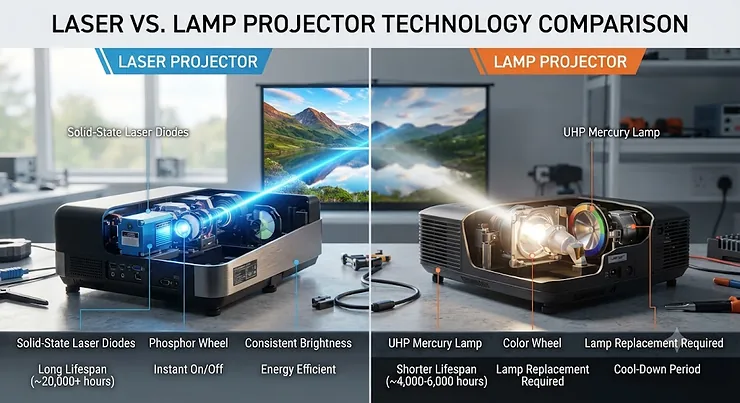
So, quick definition first. A laser projector vs lamp projector comparison is really a fight between two different light engines: one uses a conventional bulb (a UHP or UHE lamp) that dims and eventually burns out, while the other uses solid-state laser diodes that barely degrade and rarely fail outright. Laser designs generally reach far higher on-off contrast ratios than lamp-based DLP or LCD units, as Wikipedia’s overview of laser TV technology explains, which is one reason laser models have quietly taken over the upper end of the UK home cinema market.
We’ll get into full technical detail shortly, but the short version is this: lamp projectors are cheaper to buy and still perfectly capable for casual, occasional viewing, while laser projectors cost more upfront but pay that back over years of ownership through brightness that doesn’t fade and a light source you’ll likely never have to touch. Neither is universally “better” — it depends entirely on how many hours a week you’re actually watching, and what your patience for maintenance looks like.
Below, we’ve pulled together seven real, currently available projectors from across the budget-to-premium spectrum, tested the claims against manufacturer data and aggregated review sentiment, and built out genuine buying frameworks so you’re not left guessing. Let’s get into it.
Quick Comparison Table
Before the deep dive, here’s the shape of the market at a glance. All seven models below get the full treatment further down, but this table should narrow your shortlist to two or three candidates fast.
| Projector | Light Source | Brightness | Light Source Life | Price Range | Best For |
|---|---|---|---|---|---|
| Optoma HD146X | Lamp | 3,600 ANSI lumens | Up to 4,000–15,000 hrs | Under £500 | Tightest budget |
| Epson EH-TW6250 | Lamp | 2,800 ANSI lumens | 4,500–10,000 hrs | £700-£800 range | Balanced first upgrade |
| BenQ TK850i | Lamp | 3,000 ANSI lumens | 4,000–15,000 hrs | £900-£1,050 range | Bright living rooms |
| Anker Nebula Cosmos Laser 4K | Laser | 1,840 ANSI lumens | Up to 25,000 hrs | £1,000-£1,300 range | Portability + laser life |
| Epson EH-LS650 | Laser | 3,600 ANSI lumens | Up to 20,000 hrs | £1,600-£1,800 range | Space-saving UST setup |
| XGIMI Horizon 20 Pro | RGB Triple Laser | 4,100 ISO lumens | Up to 20,000–30,000 hrs | £1,800-£2,200 range | Colour-accurate gaming |
| Hisense PX3-PRO | TriChroma Laser | 3,000 ANSI lumens | Up to 25,000 hrs | £2,400-£2,600 range | Premium daylight viewing |
Looking at the spread, the pattern is obvious: laser light sources cluster at the top of the price ladder but deliver light-source lifespans that are somewhere between four and eight times longer than a typical lamp. What the table can’t show you is how that plays out day-to-day — a 15,000-hour “eco mode” lamp figure sounds competitive with laser on paper, but it usually comes with a meaningful brightness cut, whereas laser projectors hold close to peak output for most of their stated life. Budget shoppers shouldn’t panic, though; if you’re watching a couple of nights a week, even the cheapest lamp unit here will likely outlast your interest in that specific screen size.
💬 Just one click — help others make better buying decisions too!😊
Top 7 Laser and Lamp Projectors: Expert Analysis
We’ve deliberately mixed light sources and price tiers here so you can see exactly what extra money buys you as you move from lamp to laser, and from budget to premium.
1. Optoma HD146X — brightest lumens-per-pound at entry level
The HD146X earns its spot by being almost absurdly bright for its price bracket, and that number isn’t just marketing fluff. Optoma rates it with a genuinely ANSI-measured 3,600 lumens and a 25,000:1 contrast ratio, confirmed consistently across independent spec trackers rather than an inflated “peak lumens” claim. In practice, that brightness means you can watch football on a Saturday afternoon with curtains only half-drawn — something budget lamp projectors traditionally struggled with. The 1080p DLP panel, powered by a 240-watt lamp, won’t match native 4K detail, but from a normal sofa distance the difference is far less obvious than the spec sheet suggests.
Who should care: first-time buyers, students, or anyone setting up a spare-room cinema who wants big-screen impact without a big-screen invoice. Reviewers consistently note the HD146X punches well above its price for gaming, largely thanks to its low input lag mode. The trade-off, and it’s the whole point of this article, is a lamp lifespan of around 4,000 hours in bright mode, stretching to roughly 10,000-15,000 hours in eco or dynamic modes — so budget in a replacement bulb every few years if you’re a heavy user.
Pros:
- ✅ Exceptional brightness-to-price ratio for daytime viewing
- ✅ Low input lag makes it genuinely console-friendly
- ✅ Huge 301-inch maximum image size for the money
Cons:
- ❌ 1080p resolution, not native 4K
- ❌ Lamp needs periodic replacement and dims over time
Prices for the HD146X typically sit under £500, making it one of the cheapest routes into a genuinely watchable big screen — check current price and availability before buying, as retailer stock fluctuates.
2. Epson EH-TW6250 — best balanced step-up for first-time upgraders
If the HD146X is the entry ticket, the EH-TW6250 is the sensible next rung. Epson’s 3LCD engine delivers 2,800 lumens with a 35,000:1 contrast ratio, and because 3LCD splits light across three panels rather than a single spinning colour wheel, colours look noticeably more natural than on cheaper DLP rivals — no rainbow fringing on high-contrast scenes. Built-in Android TV means you’re not tethered to a streaming stick, and the pixel-shifting 4K enhancement technology, while not native 4K, does add a real bump in perceived detail over plain 1080p.
Based on the spec comparison with the HD146X above, what most buyers overlook is that this Epson trades some peak brightness for colour accuracy and a friendlier smart platform — a fair swap for anyone watching in the evening with the lights dimmed rather than fighting daylight. Lamp life is quoted at roughly 4,500 hours in standard mode and up to 7,500 hours in eco mode, and reviewers note replacement bulbs remain cheap and widely stocked, which softens the long-term running cost sting somewhat.
Pros:
- ✅ Natural, accurate colour thanks to 3LCD technology
- ✅ Built-in Android TV removes the need for a separate streaming stick
- ✅ Sub-20ms input lag suits casual gaming sessions
Cons:
- ❌ Lower peak brightness than DLP rivals at this price
- ❌ Manual lens controls make precise setup slightly fiddly
Expect to pay in the £700-£800 range at the time of research, positioning it as a genuine middle ground between the ultra-budget DLP crowd and pricier laser alternatives.
3. BenQ TK850i — best for lights-on sports and daytime viewing
BenQ built the TK850i specifically to fight ambient light, and it shows. With 3,000 ANSI lumens and a 30,000:1 contrast ratio, plus HDR-PRO processing, it’s genuinely one of the more usable projectors for Saturday afternoon football with the curtains open. The built-in Android TV dongle handles streaming duties, and BenQ’s colour tuning, covering close to 98% of the Rec. 709 standard, means sports and film content both look properly saturated rather than washed out.
What the spec sheet won’t tell you, but reviewers note repeatedly, is that the TK850i’s fan noise becomes noticeable in its brightest mode — worth factoring in for smaller rooms. The light source life runs from around 4,000 hours in normal mode up to roughly 15,000 hours in SmartEco mode, a familiar lamp-projector trade-off between brightness and longevity. For buyers who mainly watch sport or bright content and can tolerate periodic bulb changes, this is a strong pick; for dedicated movie-night darkness, the lower-lumen Epson above may actually produce a more filmic image.
Pros:
- ✅ Genuinely watchable with lights on or curtains open
- ✅ Strong colour accuracy for a lamp-based DLP model
- ✅ Android TV dongle included out of the box
Cons:
- ❌ Noticeable fan noise at full brightness
- ❌ Lamp costs add up if used in high-brightness mode daily
Current pricing tends to land around the £900-£1,050 range, making it a mid-tier lamp option for buyers who’ve decided laser isn’t yet worth the premium.
4. Anker Nebula Cosmos Laser 4K — best portable laser for multi-room use
This was Anker’s first real swing at a portable laser projector, and the headline number is a genuinely honest one: a 1,840 ANSI lumen rating that independent testing measured at around 1,702 lumens — a small but honest gap rather than the wild overclaiming some budget brands are guilty of. Crucially, it pairs a DLP chip using fast pixel-shifting to reach 3840×2160 resolution with a laser light source rated for around 25,000 hours, so you get laser longevity in a genuinely liftable, handle-equipped chassis rather than a fixed home-cinema install.
Here’s what most buyers overlook: portability and laser life sound like an odd combination, but this is exactly the use case where it makes sense — a projector that moves between the living room, the garden, and a friend’s house doesn’t get the luxury of “just swap the bulb when it dies,” because you’re relying on it working reliably wherever it lands. Aggregated buyer feedback highlights the built-in handle and reasonably punchy audio as standout features, though some reviewers flag the remote’s limited functionality and a slight blue tint across picture modes as rough edges.
Pros:
- ✅ Genuine laser light source rated for 25,000 hours
- ✅ True portability with a built-in carry handle
- ✅ Auto keystone, focus and screen-fit setup
Cons:
- ❌ Brightness trails fixed laser UST rivals
- ❌ Remote control functionality is limited
At around £1,000-£1,300 depending on retailer promotions, it sits at the entry point of “proper” laser ownership rather than the hybrid LED/laser budget tier.
5. Epson EH-LS650 — best ultra-short-throw laser for space-limited rooms
Ultra-short-throw (UST) laser projectors solve a very specific problem: no ceiling mount, no long cable run, just a unit sitting on a low cabinet inches from the wall producing a genuinely huge image. The EH-LS650 does this with a claimed brightness of 3,600 lumens and a laser light source rated for up to around 20,000 hours in eco mode, dropping to roughly 10,000 hours if you run it at full brightness constantly.
Reviewers consistently describe this as an effective all-rounder rather than a class leader in any single metric — the 3LCD design avoids the rainbow effect entirely, and the built-in Yamaha-tuned speakers are genuinely strong enough to skip a soundbar for casual viewing. What the spec sheet won’t tell you is that top-corner softness has been noted in independent testing, a minor optical compromise UST designs sometimes accept for their compact throw distance. For buyers replacing a large-screen TV in a flat or smaller lounge where a ceiling mount simply isn’t practical, this remains one of the most sensible laser UST options on the UK market.
Pros:
- ✅ Ultra-short-throw design needs no ceiling installation
- ✅ Yamaha-tuned built-in sound genuinely competes with entry soundbars
- ✅ 20,000-hour laser life removes bulb-replacement anxiety
Cons:
- ❌ Slight softness in top screen corners noted by reviewers
- ❌ Limited HDMI inputs for a projector at this price
UK pricing has ranged from around £1,600 up to £1,800 depending on retailer offers, positioning it as accessible-tier laser rather than flagship.
6. XGIMI Horizon 20 Pro — best for colour-accurate gaming and IMAX-style detail
XGIMI’s flagship-tier model swaps a phosphor-based laser for a genuine RGB triple laser engine, rated at 4,100 ISO lumens with a 20,000:1 contrast ratio, and the colour accuracy claims are unusually specific — XGIMI cites a Delta-E figure comfortably inside the “imperceptible to the human eye” range. For gamers specifically, an input lag around 1ms at 1080p paired with 240Hz smoothness puts this squarely ahead of most lamp-based rivals, which typically post input lag figures ten to eighty times higher.
Based on the spec comparison, what most buyers overlook is that RGB triple laser engines like this one don’t rely on a phosphor wheel at all, which is precisely why the colour gamut coverage and accuracy figures are so far ahead of single-laser-plus-phosphor designs — more on that distinction shortly. Google TV integration and physical lens shift (a rarity at this price) round out a genuinely premium feature set. The main honest caveat: at nearly £2,000, you’re paying a real premium purely for colour science and gaming responsiveness rather than raw brightness, which the cheaper LS650 above nearly matches.
Pros:
- ✅ RGB triple laser delivers exceptional colour accuracy
- ✅ Around 1ms input lag and 240Hz are genuinely gaming-grade
- ✅ Physical lens shift simplifies awkward room setups
Cons:
- ❌ Premium pricing versus similarly bright laser rivals
- ❌ Heavier and less portable than smaller laser models
Expect to pay somewhere in the £1,800-£2,200 range, which puts it in direct competition with the Hisense below on spec sheet alone, if not on UST convenience.
7. Hisense PX3-PRO — best premium UST laser for daylight home cinema
At the top of our list sits the PX3-PRO, Hisense’s flagship “Laser Cinema” model, independently measured delivering over 3,200 ANSI lumens against a 3,000 lumen manufacturer claim — genuinely rare honesty in a category not known for it. The TriChroma triple laser light source is rated for around 25,000 hours, and paired with an ultra-short 0.22 throw ratio it can project up to 150 inches from just inches away from the wall, making this the projector most capable of fully replacing a large flat-panel TV.
What most buyers overlook, per aggregated review sentiment, is just how much the built-in 50-watt Harman Kardon audio system and Dolby Vision plus HDR10+ support reduce the need for separate AV kit — several genuine owner reviews describe using it as their primary living room screen rather than an occasional cinema treat. Reviewers also flag that at close to £2,500 in the UK, it competes directly against its own less-featured PX3 sibling, so it’s worth double-checking current bundle pricing before committing. For buyers wanting the fullest laser-projector experience currently sold in Britain, this is about as close to “TV replacement” as projection technology gets.
Pros:
- ✅ Independently verified brightness exceeds manufacturer claims
- ✅ Genuine 4K UHD panel with Dolby Vision and HDR10+
- ✅ Built-in Harman Kardon audio reduces need for a soundbar
Cons:
- ❌ Highest price point in this list
- ❌ Requires a compatible ALR screen for best daylight results
Pricing sits in the £2,400-£2,600 range at the time of research, making this a considered investment rather than an impulse buy — but one that genuinely competes with large OLED TVs on total experience.
Practical Usage Guide: Getting the Most From Any Projector
Whichever light source you land on, the first 30 days genuinely shape how much you enjoy the purchase. Start by measuring your actual throw distance before unboxing anything — standard-throw lamp projectors like the Optoma or BenQ above need several metres of clearance, while UST laser models like the Epson LS650 or Hisense PX3-PRO need to sit within inches of the wall, so the wrong choice here means returns and wasted weekends.
On first use, resist the urge to max out brightness immediately. Running a lamp projector permanently in its brightest mode is the single fastest way to burn through its rated hours, and even laser units run cooler and quieter in eco or standard modes without a dramatic image quality hit. Common first-month mistakes include mounting too close to a white wall without a proper screen (which crushes contrast), skipping keystone correction and living with a wonky trapezoid image, and neglecting dust filters — a task many owners forget entirely until brightness noticeably drops.
For ongoing maintenance, build a simple habit: wipe the lens with a proper microfibre cloth monthly, clean or replace dust filters every three to six months depending on your room’s dust levels, and let the unit run its cooling fan cycle fully before unplugging after use. Lamp projector owners should also keep a spare bulb on hand once they’re past the halfway point of the rated lamp life, since bulbs occasionally fail abruptly rather than dimming gracefully. When any projector eventually reaches end of life, don’t bin it — UK law requires proper recycling of electrical goods rather than general waste disposal, as set out in the UK government’s WEEE regulations guidance, and most large retailers offer free take-back schemes for exactly this purpose.
Real-World Scenarios: Which Projector Actually Fits Your Life
The student in a shared house. Budget is tight, the room doubles as a bedroom, and the projector needs to pack away or tolerate abuse. The Optoma HD146X or the portable Anker Nebula Cosmos Laser 4K both fit here — the Optoma for pure value, the Anker if the extra spend on portability and laser reliability matters more than raw brightness.
The family replacing a living room TV. Frequent daily use, kids around, and zero appetite for maintenance faff. This is precisely the profile laser projectors were built for — the Epson EH-LS650 or Hisense PX3-PRO both eliminate the lamp-replacement chore entirely, and their UST design keeps cabling and mounting simple enough for non-technical households.
The occasional movie-night host. Watches perhaps once or twice a week, mostly after dark, doesn’t mind reasonably infrequent maintenance. Here, a lamp projector like the Epson EH-TW6250 or BenQ TK850i genuinely makes financial sense — at low weekly hours, you may never even reach the point of needing a replacement bulb before upgrading again anyway.
The competitive gamer. Input lag and colour accuracy matter more than raw brightness or price. The XGIMI Horizon 20 Pro’s near-instant lag and 240Hz support make it the standout here, worth the premium over its rivals specifically for this use case.
Buyer’s Decision Framework
If you watch fewer than five hours a week and money is tight, choose a lamp projector, because the running-cost gap versus laser genuinely won’t materialise before you upgrade anyway. If you watch daily or treat the projector as a TV replacement, choose laser, because the maintenance-free lifespan pays for the higher upfront cost within a few years. If your room has no ceiling access or you rent and can’t drill mounting points, prioritise ultra-short-throw laser models regardless of budget tier, since standard-throw units become genuinely impractical without proper mounting. If you’re gaming competitively, prioritise input lag and refresh rate figures over lumens or resolution claims, since a bright but laggy image will frustrate more than a slightly dimmer, responsive one. And if portability matters — house moves, garden movie nights, visiting friends — weight the decision toward laser-lit portable units, since their light source survives rough handling and repeated power cycling far better than a fragile lamp.
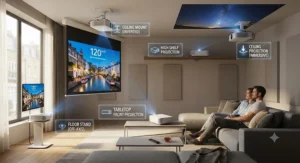
How to Choose Between a Laser Projector and a Lamp Projector
What is a laser projector vs lamp projector, in practical buying terms? It comes down to several weighted decisions, each explained below with the reasoning behind it.
- Weekly viewing hours. Calculate roughly how many hours a week you’ll actually use the projector — under five hours favours lamp, over ten hours strongly favours laser on total cost of ownership.
- Room lighting conditions. Bright rooms need higher lumens regardless of light source, with medium-sized screens under some ambient light generally needing a mid-range brightness rating and darker dedicated cinema rooms able to comfortably use less, according to general projector brightness guidance summarised on Wikipedia’s video projector overview.
- Available throw distance. Measure your room before shortlisting — standard throw needs metres of clearance, UST models need only inches, and this alone can eliminate half your options instantly.
- Maintenance appetite. Be honest about whether you’ll actually track lamp hours and budget for bulb replacement, or whether “buy once, forget about it” laser convenience is worth the premium.
- Total budget including running costs. Add estimated bulb replacement costs across a five-year ownership period to a lamp projector’s purchase price before comparing it directly against a laser model’s higher sticker price.
- Gaming or sports priorities. If input lag and motion handling matter, weight your decision toward specs like the XGIMI’s near-instant lag figure rather than brightness alone.
- Portability needs. Decide upfront whether the projector is a fixed home cinema fixture or something that travels, since this changes which category — UST laser, portable laser, or standard lamp — makes sense.
Laser Projector Vs Lamp Projector: The Real Differences
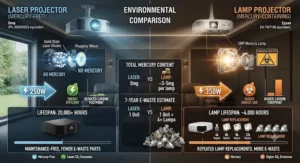
This is the heart of the matter, so let’s be precise rather than hand-wavy about it. A lamp projector uses a UHP (ultra-high-performance) or UHE bulb, essentially a specialised high-pressure mercury vapour lamp, to generate light that’s then shaped by either DLP mirrors or LCD panels. These bulbs are cheap to manufacture, which keeps entry prices low, but they degrade steadily from the moment they’re switched on and eventually fail outright, typically somewhere between 4,000 and 15,000 hours depending on brightness mode.
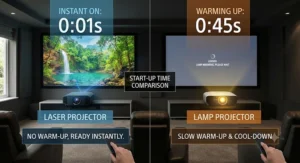
Laser projectors instead use solid-state laser diodes, which barely degrade over tens of thousands of hours and switch instantly to full brightness without the warm-up period lamps need. Laser projector advantages extend beyond just longevity, too: because laser light is inherently more directional and consistent, laser-lit projectors typically achieve dramatically higher contrast ratios and more consistent colour across the image than comparable lamp units. The trade-off is upfront cost — laser light engines simply cost more to manufacture, which is why even entry-level laser models like the Anker Nebula Cosmos Laser 4K sit above most lamp projectors on price.
Is a laser projector worth it, then? For anyone watching regularly, the maths genuinely favours laser once you account for replacement bulb costs and the convenience of never needing to track burn hours. For occasional or first-time buyers, a well-specified lamp projector like the Optoma HD146X remains a perfectly sensible, lower-risk entry point.
Common Mistakes When Buying a Projector
The most frequent error is chasing “lumens” numbers without checking whether they’re ANSI-rated. Cheap listings often quote inflated peak or LED lumens figures that bear little relation to real-world brightness, so confirming a brightness claim is genuinely ANSI-measured rather than an inflated marketing figure should be step one, not an afterthought. The second common mistake is buying a standard-throw projector for a room too small to accommodate it, only discovering the required distance after unboxing. Third, buyers frequently underestimate ambient light — a projector rated fine for “dark room” use will look genuinely washed out the moment curtains are opened, regardless of how good the reviews sounded. Fourth, many first-time buyers skip checking input lag entirely, only to find their console gaming feels sluggish weeks later. Finally, underestimating total cost of ownership — assuming zero maintenance cost for a lamp projector — routinely catches out buyers who then face a surprise bulb-replacement bill eighteen months in.
What to Expect: Real-World Performance
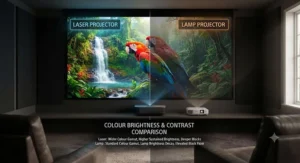
Spec sheets rarely translate cleanly into lived experience, so here’s the honest translation. A 2,800-3,000 lumen lamp projector, like the Epson EH-TW6250 or BenQ TK850i, genuinely needs a dimmed room to look its best; with curtains fully open on a bright afternoon, colours flatten and blacks turn grey. Push past 3,600 lumens, whether lamp or laser, and you start seeing genuinely watchable images with normal daytime light levels, which is precisely why brighter UST laser models market themselves as TV replacements. Contrast matters as much as brightness in practice — a projector with a huge lumen figure but mediocre contrast ratio will still look flat and washed out on dark scenes, which is where laser’s inherent contrast advantage over lamp becomes obvious the moment you watch anything shot at night.
Fan noise is another real-world factor spec sheets underplay. Higher-brightness lamp projectors like the TK850i run their cooling fans harder and it’s audible in a quiet room, while laser units generally run cooler and quieter at equivalent brightness, though UST models with tightly packed electronics can still generate noticeable fan noise at full output.
Long-Term Cost & Maintenance: Lamp Replacement Vs Laser Longevity
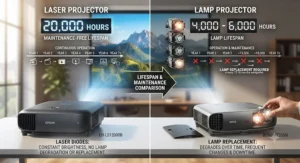
This is where the laser projector vs lamp projector decision really gets decided for most buyers, so let’s do the actual maths rather than gesture vaguely at “laser is cheaper long-term.” UK consumer testing has found that projector lamps commonly last somewhere between 700 and 3,000 hours on average, with a replacement bulb frequently costing more than £200, according to independent buying advice and test results from Which? — a genuinely significant lamp projector replacement bulb cost if you’re watching daily. Our researched models above suggest slightly longer real-world lamp life at 4,000-15,000 hours depending on mode, but the principle holds: heavy lamp projector users should expect at least one, likely two, bulb replacements across a five-year ownership window.
Run the numbers on the Optoma HD146X, for example: buy for around £450-£550, add one replacement bulb at roughly £150-£250 within three to four years of heavy use, and your effective five-year cost climbs meaningfully closer to entry-laser territory. Compare that against the Anker Nebula Cosmos Laser 4K’s laser projector long term value proposition — a higher purchase price around £1,000-£1,300, but a 25,000-hour light source that, at even four hours of daily viewing, would comfortably outlast a decade of ownership without a single replacement part. The crossover point, in our analysis, sits around three to four years of moderately heavy use (roughly two hours daily); below that, lamp remains the cheaper overall choice, and above it, laser’s total cost of ownership pulls ahead.
Beyond the light source itself, both categories carry similar running costs elsewhere — power consumption, occasional filter replacement, and eventual full-unit replacement once other components age out, regardless of light source type.
Features That Actually Matter (And Those That Don’t)
Genuinely worth prioritising: verified ANSI lumens, contrast ratio, input lag if you game, and light source lifespan relative to your actual viewing hours. Also worth real weight: keystone correction and lens shift, both of which solve genuine placement headaches that spec sheets under-emphasise but reviewers complain about constantly when absent.
Largely marketing noise for most home users: headline “peak lumens” figures that don’t specify ANSI measurement, exaggerated “million:1” dynamic contrast claims that rely on the lamp or laser dimming aggressively rather than genuine optical contrast, and 3D support, which vanishingly few buyers actually use post-purchase despite it being a common bullet point. Built-in smart platforms sit in the middle — genuinely useful day-to-day, but not worth paying a premium for over a projector with better core optics and a £30 streaming stick instead.
Safety, Regulations & Laser Phosphor Vs RGB Laser Explained
Laser light sources in consumer projectors are enclosed and classified for safe home use, but the underlying laser technology itself varies meaningfully between models, and this genuinely affects picture quality rather than being a marketing footnote. Most “laser” projectors, including budget and mid-range models, actually use a single blue laser diode shone onto a spinning phosphor wheel to generate the full colour spectrum — cheaper to manufacture, and still a substantial upgrade over lamp technology in terms of lifespan and consistency.
Premium models like the XGIMI Horizon 20 Pro instead use a genuine RGB triple laser engine — three separate laser diodes (red, green, blue) combined directly, with no phosphor wheel step at all. This laser phosphor vs RGB laser distinction is precisely why triple-laser models achieve such dramatically wider colour gamut coverage and lower Delta-E colour accuracy figures than phosphor-based laser units; you’re seeing pure laser primaries rather than colour derived from a phosphor conversion process. The Hisense PX3-PRO’s TriChroma system works on similar principles, which is why both it and the XGIMI post colour gamut figures that phosphor-laser and lamp projectors simply can’t match.
From a household safety standpoint, all consumer projectors sold in the UK must meet relevant laser safety classifications and general product safety standards before sale, and buyers shouldn’t need to research laser classes themselves — reputable retailers only stock compliant models. Where diligence genuinely matters is at end-of-life disposal, since projectors contain both electronics and, in lamp models, mercury-containing bulbs that require proper handling under UK waste regulations rather than general rubbish disposal.
Frequently Asked Questions
❓ Is a laser projector worth it over a lamp projector?
❓ What is the typical lamp replacement cost for a projector?
❓ How long do laser projectors actually last?
❓ What's the difference between laser phosphor and RGB laser projectors?
❓ Do laser projectors need any maintenance at all?
Conclusion
If there’s one honest takeaway from comparing these seven projectors, it’s that the laser projector vs lamp projector decision isn’t really about which technology is “better” in the abstract — it’s about matching light source to how you’ll genuinely use the thing. The Optoma HD146X and Epson EH-TW6250 remain entirely sensible choices for occasional viewers who’d rather not pay a laser premium for hours they won’t use; the BenQ TK850i splits the difference for bright-room sports fans still committed to lamp technology.
Once your viewing climbs toward daily habit territory, though, the laser models earn their keep. The Anker Nebula Cosmos Laser 4K brings laser reliability to a portable form factor, the Epson EH-LS650 solves the ceiling-mount problem entirely, and the XGIMI Horizon 20 Pro and Hisense PX3-PRO sit at the genuine premium end where colour accuracy, contrast, and TV-replacement brightness converge. Whichever you land on, weigh total cost of ownership rather than sticker price alone — that’s where this decision actually gets made.
✨ Don’t Miss These Exclusive Deals!
🔍 Take your home cinema setup to the next level with these carefully selected laser and lamp projectors. Click on any highlighted item to check current pricing and availability. These picks will help you create authentic big-screen movie nights your family will love!
Recommended for You
- Best Laser Projector 2026: 7 Top Picks Tested & Rated
- Does HDR Matter on a Projector? 7 Best HDR Picks UK 2026
- Best HDR Projector UK 2026: 7 Top Picks Tested & Reviewed
Disclaimer: This article contains affiliate links. As an Amazon Associate, I earn from qualifying purchases. If you purchase products through these links, we may earn a small commission at no additional cost to you.
✨ Found this helpful? Share it with your friends! 💬🤗
