
In This Article
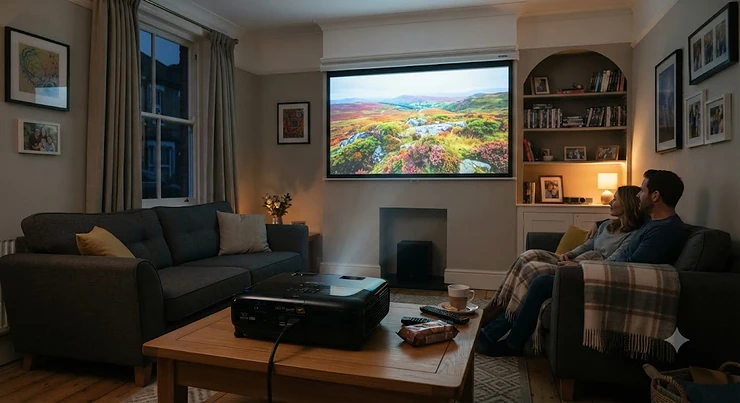
Somewhere between “I’ll just watch it on my phone” and “let’s build a home cinema,” there’s a middle ground most of us actually want: a proper big screen, without remortgaging the house. That’s the gap the best LCD projector fills, and it’s a bigger gap than most people realise until they’ve sat through their first 100-inch film night on a wall that cost less than a decent sofa. An LCD projector creates its picture by splitting light into red, green and blue beams, passing each through its own liquid crystal panel, then recombining them — a design that, done well, produces punchy colour without the shimmer some rival technologies suffer from. Most of the LCD projectors you’ll find on the UK high street and on Amazon actually use 3LCD, a specific three-panel version of the format pioneered and still dominated by Epson, which is why you’ll see that brand crop up again and again in this guide. If you’re wondering exactly how the tech behind that badge works, the 3LCD entry on Wikipedia has a genuinely clear breakdown of the optics involved.
This guide isn’t a rehash of a spec sheet. We’ve dug into real UK pricing, real professional reviews, and the aggregated sentiment from owners who’ve actually lived with these projectors, to work out which models earn their keep and which ones oversell themselves. You’ll get seven genuine products spanning budget to flagship, honest pros and cons for each, and enough context on 3LCD technology, colour gamut and the eternal 3LCD vs 1LCD debate that you’ll walk away knowing more than the sales assistant. Let’s get into it.
Quick Comparison: The Best LCD Projectors at a Glance
If you’re in a hurry, here’s the short version. Full details, honest analysis and pricing context for every model follow further down the page.
| Projector | Best For | Resolution | Brightness | Price Range |
|---|---|---|---|---|
| Epson EH-TW650 | Absolute beginners on a tight budget | Full HD | ~3,300 lumens | Under £600 |
| Epson EH-TW750 | Bright rooms, wireless casting | Full HD | 3,400 lumens | £600-£750 |
| Epson EH-TW6250 | First 4K HDR projector | 4K (pixel-shift) | 2,800 lumens | £750-£950 |
| Epson EH-LS650 | TV replacement, no ceiling mount | 4K (pixel-shift) | 3,600 lumens | £1,300-£1,800 |
| Epson EH-LS9000 | Dedicated cinema rooms | 4K (pixel-shift) | 2,600 lumens | £2,700-£2,900 |
| Epson EH-LS12000 | Enthusiast all-rounder | 4K (pixel-shift) | 2,700 lumens | £3,600-£3,900 |
| Epson EH-QB1000 | Gamers and HDR obsessives | 4K (pixel-shift) | 3,300 lumens | £4,700-£4,800 |
Look closely and a pattern emerges: brightness doesn’t simply climb with price, because home cinema projectors are tuned for darkened rooms while living-room-friendly models like the Epson EH-LS650 deliberately chase lumens over black-level finesse. The jump from Epson EH-TW6250 to Epson EH-LS650 roughly doubles the outlay for a laser light engine and ultra-short-throw convenience rather than a leap in raw image quality, so which one is “best” really depends on whether you’re fighting ambient light or watching in the dark. Budget buyers should also note that every model here uses pixel-shifting rather than native 4K panels — a distinction we’ll unpack properly later on.
💬 Found a model here you like the sound of? Bookmark this page and scroll down for the full breakdown before you buy.
Top 7 LCD Projectors: Expert Analysis
Below is the full spec, price and rating comparison for all seven models, followed by our take on what the numbers actually mean for you.
| # | Projector | Resolution | Brightness | Contrast | Price Range | Best For |
|---|---|---|---|---|---|---|
| 1 | Epson EH-TW650 | Full HD | ~3,300 lumens | Standard | Under £600 | First-time buyers |
| 2 | Epson EH-TW750 | Full HD | 3,400 lumens | Standard | £600-£750 | Bright rooms |
| 3 | Epson EH-TW6250 | 4K (pixel-shift) | 2,800 lumens | 35,000:1 | £750-£950 | Budget 4K HDR |
| 4 | Epson EH-LS650 | 4K (pixel-shift) | 3,600 lumens | High (laser) | £1,300-£1,800 | TV replacement |
| 5 | Epson EH-LS9000 | 4K (pixel-shift) | 2,600 lumens | High (laser) | £2,700-£2,900 | Cinema rooms |
| 6 | Epson EH-LS12000 | 4K (pixel-shift) | 2,700 lumens | 2,500,000:1 | £3,600-£3,900 | Enthusiasts |
| 7 | Epson EH-QB1000 | 4K (pixel-shift) | 3,300 lumens | 5,000,000:1 | £4,700-£4,800 | Gaming & HDR |
Reading this table left to right tells its own story: contrast ratio climbs steeply once you move into laser models, and that’s where the real cinematic payoff lives, not in the brightness figure alone. The Epson EH-TW6250 remains the best entry point if 4K HDR matters to you but a four-figure spend doesn’t, while the Epson EH-QB1000‘s eye-watering 5,000,000:1 dynamic contrast claim explains why reviewers keep pitting it against Sony and JVC’s native-4K flagships rather than against anything else wearing an Epson badge. None of these projectors use true 3840×2160 panels — all rely on pixel-shifting — so treat “4K” here as “4K-class detail,” not a literal pixel count.
✨ Ready to see prices for yourself? Check current availability on the models above before they’re snapped up.
1. Epson EH-TW650 — cheapest genuine 3LCD projector worth buying
The Epson EH-TW650 is the projector equivalent of a reliable hatchback: nothing flashy, but it starts every time and does the job it was built for. Its Full HD 3LCD panel setup means colour holds up surprisingly well for the price, avoiding the washed-out look that plagues some rock-bottom projectors. Lamp life is rated at around 4,500 hours, and independent testing measured audible noise at a genuinely unobtrusive 37dB, which matters more than people expect once you’re three films deep into a Sunday. Based on the spec comparison with pricier siblings, this is the model to buy if you’ve never owned a projector before and want to find out whether the format suits your life before committing serious money. Reviewers consistently describe it as offering big-screen thrills without big-screen complexity, making it a sensible pick for spare rooms, student flats, or as a “test the waters” purchase. Aggregated owner sentiment points to easy setup and dependable colour as the recurring positives, with the expected trade-off being a lack of 4K or smart features.
Pros:
- ✅ Genuinely affordable route into real 3LCD colour
- ✅ Quiet 37dB operation for lounge-friendly viewing
- ✅ Simple setup, ideal for total beginners
Cons:
- ❌ No 4K or HDR support at all
- ❌ Lamp-based, so bulbs need eventual replacing
At under £600, the Epson EH-TW650 represents strong value for anyone prioritising picture-per-pound over features, though buyers wanting future-proofing should look further down this list.

2. Epson EH-TW750 — sharpest budget pick with wireless casting
Where the Epson EH-TW650 plays it safe, the Epson EH-TW750 adds a genuinely useful trick: Miracast wireless casting, letting you throw content from a compatible phone or laptop without trailing an HDMI cable across the carpet. Its 3,400 ANSI lumen rating is a meaningful step up in practice, meaning it copes far better with curtains that don’t quite block out a summer evening than the cheapest models in this bracket. What most buyers overlook about this tier of projector is that brightness, not resolution, is usually the thing that ruins a viewing session in a real living room — and the TW750 addresses exactly that. It still uses three individual LCD panels rather than a single chip, so you get the accurate, natural colour rendering 3LCD is known for, without the rainbow artefacts some single-chip rivals can show during high-contrast scenes. Aggregated review sentiment frames it as a “no-nonsense” upgrade pick for anyone who found their first budget projector too dim for anything but pitch-black rooms.
Pros:
- ✅ Genuinely brighter, copes with ambient light better
- ✅ Wireless Miracast casting, no cables required
- ✅ Consistent 3LCD colour accuracy for the price
Cons:
- ❌ Still Full HD only, no 4K upscaling
- ❌ Built-in speaker is a backup at best, not a solution
Typically found in the £600-£750 range, the Epson EH-TW750 is the projector to choose if brightness and wireless convenience matter more to you than resolution.
3. Epson EH-TW6250 — best value 4K HDR with built-in Android TV
The Epson EH-TW6250 was the model that dragged genuinely affordable 4K HDR projection into the mainstream, and reading through owner reviews, that reputation has largely held up. Its pixel-shifting engine combines two overlapping Full HD layers to simulate 4K detail, backed by 2,800 lumens and support for HDR10 and HLG. Built-in Android TV means you can stream Netflix or iPlayer without a separate stick cluttering the socket. Here’s what the spec sheet won’t tell you outright: reviewers have flagged that it only offers a single HDMI input, which is a genuine inconvenience if you’re juggling a games console and a set-top box, and its HDR handling — while a real step up from Full HD models — doesn’t support the more advanced HDR10+ format found further up Epson’s range. Based on the spec comparison with the LS650 above it, the TW6250 is best suited to buyers who want their first taste of HDR projection without doubling their budget, and who can live with a single input or a cheap HDMI switch.
Pros:
- ✅ Genuine 4K HDR at a genuinely accessible price
- ✅ Built-in Android TV removes the need for a streaming stick
- ✅ Low input lag, respectable for casual console gaming
Cons:
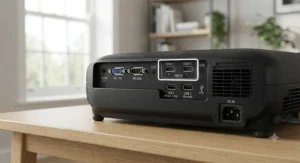
- ❌ Only one HDMI input on the unit
- ❌ No HDR10+ or Dolby Vision support
Originally launched around £1,150, the Epson EH-TW6250 is now typically found in the £750-£950 range, making it arguably the best-value 4K entry point on this list.
4. Epson EH-LS650 — best ultra-short-throw all-rounder
Placing the Epson EH-LS650 just centimetres from your wall and getting a genuine 100-inch image back is the kind of thing that still feels like a magic trick, even once you understand the throw ratio behind it. Its 0.25-0.62:1 ultra-short-throw optics mean you avoid a bulky ceiling mount and trailing cables entirely, while a 3,600-lumen laser engine — brighter than most models on this list — lets it hold its own against a well-lit living room in a way lamp-based projectors simply can’t. On paper this means it functions less like a traditional projector and more like a giant, slightly awkward television, complete with a built-in 20W Yamaha 2.1 speaker system that genuinely reduces the need for a soundbar. What most buyers overlook is that this convenience comes with trade-offs: aggregated reviewer sentiment consistently notes that software polish lags slightly behind the hardware, with occasional app hiccups on the built-in Android TV interface, and picture purists point out its black levels can’t match a dedicated dark-room projector like the LS9000 below. Reviewers also note that, while superb for casual family viewing and sport, it’s not quite pitched at serious film enthusiasts chasing reference-level accuracy.
Pros:
- ✅ True TV-replacement brightness and ease of placement
- ✅ Excellent built-in Yamaha sound system
- ✅ 20,000-hour laser life, no lamp replacements
Cons:
- ❌ Occasional software/interface niggles reported by owners
- ❌ Not native 4K, and blacks trail dedicated cinema models
Prices for the Epson EH-LS650 typically sit between £1,300 and £1,800 depending on retailer and colour finish, positioning it as a genuine TV alternative rather than a cinema-room purist’s choice.
5. Epson EH-LS9000 — best mid-premium laser for dark rooms
Step up to the Epson EH-LS9000 and you’re firmly in dedicated-cinema territory, a projector built for rooms where the curtains are drawn and the popcorn is real. Its laser light engine brings genuine longevity alongside HDR10+ support, a rarity at this price point that gives content mastered with dynamic metadata noticeably more punch than static HDR10 alone. Reviewers testing it in dark-room conditions describe a picture with real solidity and depth, particularly at the 100-inch-plus scale this class of projector is designed for. Based on the spec comparison with the step-up LS12000, the LS9000 gets you the vast majority of the premium Epson experience — laser brightness, HDR10+, dual HDMI 2.1 inputs supporting 4K/120Hz for next-gen consoles — while trimming the price by well over a thousand pounds. What most buyers overlook is that black-level performance, while very good, isn’t quite reference-class; several reviews note they’d like to see slightly deeper shadow detail in the darkest scenes, and there’s no built-in speaker, so budget for separate audio.
Pros:
- ✅ HDR10+ support at a genuinely reachable price
- ✅ Dual HDMI 2.1 ports, 4K/120Hz for gaming
- ✅ Laser light source rated for years of near-maintenance-free use
Cons:
- ❌ Black depth falls just short of true reference level
- ❌ No built-in speakers, external audio required
Launched at £2,999 and now typically available around £2,700-£2,900, the Epson EH-LS9000 offers what reviewers widely regard as the best value entry into serious home cinema laser projection currently on the market.
6. Epson EH-LS12000 — best all-round enthusiast laser projector
The Epson EH-LS12000 earned a reputation as one of the most complete home cinema projectors under five figures, and having replaced several older Epson flagships, it remains the benchmark this whole category gets measured against. A claimed 2,700 lumens of laser brightness sits alongside a dynamic contrast rating of 2,500,000:1, numbers that — while inflated by the usual “dynamic” caveats — translate into genuinely convincing HDR when paired with quality source material. Motorised lens shift, zoom and focus make installation dramatically easier than fully manual rivals, a detail that matters enormously the first time you’re trying to align a 120-inch image without a ladder. Here’s what the spec sheet won’t tell you: reviewers comparing it directly against the newer QB1000 consistently conclude that the LS12000 delivers the vast majority of that flagship’s picture quality for a substantially lower outlay, which is precisely why it remains a five-star pick even as newer models arrive above it. The trade-off, as with every projector here, is that its LCD panels aren’t native 4K, relying instead on pixel-shifting for perceived detail.
Pros:
- ✅ Motorised lens controls make setup far less fiddly
- ✅ HDR10, HLG and HDR10+ all supported
- ✅ Strong value against its own newer flagship sibling
Cons:
- ❌ Not native 4K resolution
- ❌ Large, heavy chassis needs a permanent home
Having launched at £4,500, the Epson EH-LS12000 has since settled into a more accessible £3,600-£3,900 bracket, and remains, by most expert accounts, the smartest all-round enthusiast buy in Epson’s current line-up.
7. Epson EH-QB1000 — brightest flagship for gaming and HDR
At the top of this list sits the Epson EH-QB1000, a projector that reviewers keep comparing not to other Epsons, but to native-4K rivals from Sony and JVC costing considerably more. Its 3,300-lumen laser output is class-leading for a home cinema projector, and combined with dynamic tone mapping, it wrings noticeably more shadow and highlight detail out of HDR10+ content than the LS12000 below it. For gamers, the appeal is concrete rather than theoretical: a measured input lag of around 19 milliseconds alongside HDMI 2.1 ports supporting 4K at 120Hz makes it a legitimate console and PC gaming display, not just a movie machine that tolerates games. Based on the spec comparison against the Sony VPL-XW5000ES — its most obvious rival — reviewers note the Epson lacks native 4K resolution but compensates with motorised lens memories, HDR10+ support and a meaningfully lower price. Reviewers consistently flag the same honest caveat as with every LCD projector on this list: the light path isn’t fully sealed, so long-term dust ingress is a known (if manageable) risk factor worth budgeting a service for eventually.
Pros:
- ✅ Class-leading brightness for a home cinema laser projector
- ✅ Genuinely excellent for both film and console/PC gaming
- ✅ Undercuts native-4K rivals significantly on price
Cons:
- ❌ Still pixel-shifted, not native 4K like some rivals
- ❌ Unsealed light path means eventual dust sensitivity
Currently retailing around £4,700-£4,800, the Epson EH-QB1000 is the projector to choose if you want the best HDR and gaming performance Epson’s 3LCD line-up currently offers, and you’re prepared to pay flagship money for it.
Setting Up Your LCD Projector: A Practical Usage Guide
Buying the right projector is half the job; getting it working properly in your actual room is the other half, and it’s the part Amazon’s product page never quite covers. Start with placement: even ultra-short-throw models like the Epson EH-LS650 need a level, flat surface at a precise distance from the wall, so measure twice before you commit to a shelf. For longer-throw models such as the Epson EH-LS12000 or Epson EH-QB1000, ceiling mounting keeps cables tidy but makes future lens adjustments more fiddly, so many enthusiasts recommend living with a temporary floor or shelf placement for a week or two before drilling anything.
Once positioned, resist the urge to skip calibration. Every model here ships with a “vivid” or “dynamic” picture mode that looks punchy in a bright showroom but is usually oversaturated and blue-tinted for actual film watching; switching to Cinema or Natural mode and nudging colour temperature down slightly makes a bigger difference than most owners expect. A common first-30-days mistake is leaving frame interpolation switched on for films, which can introduce the unnatural “soap opera effect” — fine for sport, distracting for cinema. Finally, budget for a proper screen rather than a painted wall if you can; even a modest fixed-frame screen noticeably improves contrast and colour uniformity across every projector on this list, from the entry-level Epson EH-TW650 right up to the Epson EH-QB1000.
Buyer’s Decision Framework: Which LCD Projector Should You Actually Buy?
Cutting through seven options is easier with a simple framework rather than a spec-by-spec slog. If you’ve never owned a projector and want to try the format without serious financial risk, choose the Epson EH-TW650 or Epson EH-TW750, because the low buy-in means a change of heart costs you little. If your living room has decent ambient light and you want something that behaves like a giant TV rather than a cinema installation, the Epson EH-LS650 is built precisely for that job. If 4K HDR matters but your budget caps out around £900, the Epson EH-TW6250 remains the most sensible gateway.
For anyone converting a spare room into a genuine dark-room cinema, the calculation shifts: the Epson EH-LS9000 delivers most of the premium experience for meaningfully less outlay than the flagship, while the Epson EH-LS12000 is the safer, more complete all-rounder if your budget stretches that far. Serious gamers chasing the lowest input lag and brightest HDR, meanwhile, should look straight at the Epson EH-QB1000, since its 19ms response and 4K/120Hz support are specifically engineered for that crowd. As a simple rule of thumb: buy for your room’s ambient light first, your content type second, and resolution last — because every model here uses pixel-shifting rather than true native 4K, so the resolution gap between them is smaller than the price gap suggests.
How to Choose the Best LCD Projector
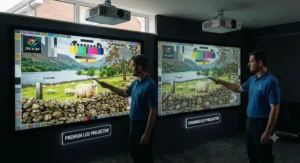
Picking the right model comes down to a handful of genuinely decisive factors, rather than the dozens of specs marketing pages love to list. Here’s the shortlist that actually matters, in the order we’d weigh them.
- Room lighting first. A projector that’s stunning in a blacked-out cinema room can look washed out in a bright lounge, so match lumens to your actual environment rather than the biggest number on the box.
- Light source: lamp versus laser. Lamp-based models like the Epson EH-TW650 are cheaper upfront but need bulb replacements every few thousand hours; laser models like the Epson EH-LS9000 cost more initially but run for 20,000+ hours with minimal upkeep.
- Throw distance and placement. Ultra-short-throw designs such as the Epson EH-LS650 suit rooms where ceiling mounting isn’t practical; traditional throw projectors need more distance but offer more installation flexibility.
- HDR format support. Not all HDR is equal — models supporting HDR10+ (like the Epson EH-LS9000 and above) handle scene-by-scene brightness far better than those limited to static HDR10.
- Gaming requirements. If low input lag and 4K/120Hz matter to you, prioritise models like the Epson EH-QB1000 that explicitly advertise sub-20ms response times.
- Genuine connectivity. Check HDMI port count honestly; some genuinely excellent budget models, including the Epson EH-TW6250, only offer a single input.
- Total cost, not just sticker price. Factor in eventual lamp replacement costs for non-laser models, plus a screen if you don’t already have one, before comparing headline prices.
As the What Hi-Fi? best projectors guide notes from extensive hands-on testing, picture performance in a genuinely dark room can differ enormously from how the same projector behaves once ambient light enters the equation — which is exactly why step one on this list matters more than any spec sheet number.
3LCD vs 1LCD Projector: What’s the Real Difference?
The term “LCD projector” gets used loosely, and it’s worth untangling before you buy. A 1LCD projector uses a single liquid crystal panel and a spinning colour wheel to sequentially display red, green and blue information, similar in principle to how single-chip DLP projectors work, just with LCD rather than micromirror technology. A 3LCD projector — the format every model in this guide uses — instead splits white light into three separate beams via dichroic mirrors, sends each through its own dedicated LCD panel, then recombines them optically before the lens. The practical upshot is that 3LCD projectors display all three colours simultaneously rather than sequentially, which largely eliminates the fleeting “rainbow effect” some viewers notice with sequential-colour systems, particularly on fast-moving or high-contrast content.
| Feature | 3LCD | 1LCD (sequential colour) |
|---|---|---|
| Colour display method | Simultaneous, via 3 panels | Sequential, single panel |
| Rainbow artefacts | Effectively eliminated | Can be noticeable to sensitive viewers |
| Colour brightness | Typically matches white brightness | Often lower than white brightness |
| Common use case | Home cinema, education, business | Rare in modern consumer projectors |
| Market prevalence | Dominant format among LCD projectors | Largely superseded |
In practice, 1LCD projectors are now genuinely rare in the consumer space; almost every LCD projector you’ll encounter shopping on Amazon today, including all seven featured in this guide, is a 3LCD design. The comparison matters more as background knowledge than as an active buying decision — but it explains why Epson leans so heavily on the “3LCD” badge in its marketing, and why that badge is a reasonable proxy for colour accuracy when you’re comparing against single-chip DLP alternatives instead.
LCD Projector Colour Gamut Explained
Colour gamut refers to the total range of colours a display can reproduce, and it’s one of the areas where 3LCD projectors have built their reputation. Because each of the three panels handles one primary colour continuously rather than in rotation, 3LCD models tend to maintain their full colour brightness even as image content becomes more colour-intensive, rather than dimming noticeably during saturated scenes — a limitation some single-chip designs can show. This is why Epson markets its “Color Light Output” figure alongside standard white brightness: on genuine 3LCD projectors, the two numbers are usually very close, which is a meaningful practical indicator of consistent, natural-looking colour.
Higher-end models in this guide push gamut coverage further still. The Epson EH-LS9000, Epson EH-LS12000 and Epson EH-QB1000 all support 10-bit colour processing and HDR formats that expand the effective colour and brightness range well beyond the entry-level Epson EH-TW650 or Epson EH-TW750. What most buyers overlook is that a wider colour gamut on paper doesn’t automatically mean better colour in your specific room; ambient light, screen material and even wall colour all interact with a projector’s gamut in ways a spec sheet simply can’t capture. If colour accuracy for film-grade viewing is a genuine priority, budgeting for a proper calibration — even a basic self-calibration using test patterns — will do more for perceived gamut performance than chasing an extra few hundred lumens.
Epson 3LCD Technology Review: An Honest Look
Epson didn’t just adopt 3LCD technology, it invented it, launching the format commercially back in 1989 and continuing to license it to a small consortium of other manufacturers ever since. That history matters practically: because Epson controls the core technology, its own Epson LCD projector range tends to represent the format at its most refined, from the entry-level Epson EH-TW650 through to the flagship Epson EH-QB1000. The consistent throughline across every model in this guide, regardless of price, is that Epson’s dichroic mirror and prism assembly is manufactured to genuinely tight tolerances, which is why even budget Epson projectors rarely show the dark banding or double-imaging that poorly aligned 3-panel systems can suffer from.
Where honesty demands nuance is on the trade-offs. 3LCD’s light path isn’t fully sealed on most models, meaning dust can occasionally settle on internal optics over years of use — a known and openly documented characteristic of the format, flagged by reviewers even on flagship units like the Epson EH-QB1000. None of the projectors in this guide use genuinely native 4K panels either; every “4K” model here relies on pixel-shifting, a legitimate and effective technique, but not the same as a true 3840×2160 chip. Reviewers and aggregated owner feedback are broadly consistent on the upside, though: real-world colour accuracy, minimal rainbow artefacting, and dependable brightness retention are the genuine, repeatedly verified strengths of Epson’s implementation, and they’re the reasons this guide leans so heavily on the brand rather than any deliberate favouritism. Independent testing from outlets such as Trusted Reviews backs this up at the flagship end too, consistently praising Epson’s colour accuracy and HDR handling even while flagging the same native-resolution caveat we’ve been upfront about throughout this guide.
Common Mistakes When Buying an LCD Projector
Even careful buyers trip over the same handful of pitfalls repeatedly, so it’s worth naming them plainly. The first is buying on lumens alone: a 3,600-lumen Epson EH-LS650 and a 2,700-lumen Epson EH-LS12000 serve genuinely different purposes, and the higher number doesn’t automatically mean the better projector for a dark, dedicated room. The second is underestimating screen size versus throw distance; buyers regularly discover after delivery that their chosen room can’t achieve the 100-inch-plus image they pictured, simply because they didn’t check the throw ratio beforehand.
A third common error is ignoring HDMI port count, an oversight that catches out Epson EH-TW6250 buyers more than most, given its single input. A fourth is assuming all “4K” projectors carry equal detail; as covered above, none of these seven use native 4K panels, so comparing pixel-shifted models against genuinely native 4K rivals on resolution alone is misleading. Finally, plenty of buyers skip budgeting for a proper screen, then wonder why their picture looks flatter and less contrasty than the glowing reviews suggested — a plain white wall is a compromise, not a solution, on any projector from the Epson EH-TW650 to the Epson EH-QB1000.
Best LCD Home Cinema Projector by Room and Use Case
Different rooms genuinely call for different projectors, so here are three realistic scenarios worth recognising yourself in. Picture a student in a shared house, wanting occasional film nights in a bedroom that gets decent blackout curtains but no budget for a screen: the Epson EH-TW650 or Epson EH-TW750 covers this comfortably, delivering solid picture quality without demanding a serious financial commitment or permanent installation.
Now picture a family wanting to replace their living room TV entirely, in a room with big windows and no appetite for ceiling drilling: the Epson EH-LS650‘s ultra-short-throw design and genuinely bright laser output are built precisely for this brief, sitting on a low unit rather than dangling from above. Finally, picture a couple converting a spare room into a dedicated evening cinema, prioritising picture quality above all else and willing to invest properly in blackout and a fixed screen: here the Epson EH-LS9000 or Epson EH-LS12000 earns its higher price tag, delivering laser brightness, HDR10+ and motorised lens controls that a casual living-room projector simply doesn’t need. Matching the projector to the room, rather than to the biggest spec sheet, consistently produces happier buyers according to aggregated owner feedback across every price tier covered here.
Long-Term Cost & Maintenance
The sticker price is only part of the ownership story. Lamp-based models like the Epson EH-TW650 and Epson EH-TW750 will eventually need a replacement bulb, typically every 4,000-7,500 hours depending on brightness mode, and while genuine Epson lamps aren’t cheap, moderate weekly viewing habits mean most owners won’t face that cost for several years. Laser models, including the Epson EH-LS650, Epson EH-LS9000, Epson EH-LS12000 and Epson EH-QB1000, sidestep this entirely, with light sources rated around 20,000 hours — enough for well over a decade of typical evening use — which meaningfully improves their total cost of ownership despite the steeper upfront price.
Filters, where fitted, benefit from occasional cleaning to maintain brightness and airflow, and it’s worth checking your specific model’s maintenance schedule rather than assuming a “laser and forget it” approach across the board. When a projector genuinely reaches the end of its life, UK households have a legal right to responsible disposal rather than binning it with general waste; the UK Government’s WEEE regulations guidance sets out how electrical items like projectors should be collected and recycled, and most larger electronics retailers are required to accept old units for free when you buy a replacement. Factoring lamp replacement or eventual recycling into your budget from day one avoids an unwelcome surprise a few years down the line.
Frequently Asked Questions
❓ Is an LCD projector better than a DLP projector?
❓ How long do LCD projector lamps actually last?
❓ Can I use an LCD projector in a bright room?
❓ Do LCD projectors really support 4K resolution?
❓ What's the difference between 3LCD and Epson's own projectors?
Conclusion
Choosing the best LCD projector for 2026 really comes down to matching your room, your budget and your patience for setup to the right model, rather than chasing whichever spec sheet looks most impressive. The Epson EH-TW650 and Epson EH-TW750 remain sensible, low-risk entry points for anyone new to projection, while the Epson EH-TW6250 is still arguably the smartest way into genuine 4K HDR without a four-figure spend. For living rooms fighting daylight, the Epson EH-LS650 does a genuinely convincing impression of an oversized television, and for anyone serious about a dedicated cinema experience, the Epson EH-LS9000, Epson EH-LS12000 and Epson EH-QB1000 each represent a meaningfully different rung on the same well-built ladder.
What ties all seven together is Epson’s 3LCD heritage: consistent colour, minimal rainbow artefacting, and — as this guide has tried to be honest about throughout — genuine trade-offs around native resolution and light-path sealing that no amount of marketing gloss should paper over. Whichever model fits your room and budget, you’re buying into a genuinely mature, well-understood technology rather than a gamble, and that alone counts for a great deal when you’re spending real money on movie nights to come.
✨ Found the right projector for your room? Check today’s price before you commit, and enjoy the big screen! 🍿
Recommended for You
- DLP vs LCD Projector: 7 Top Picks & the 2026 Verdict
- Best DLP Projector 2026: 7 Sharp Picks Worth Your Money
- Laser Projector Under £1000: 7 Brilliant Picks for 2026
Disclaimer: This article contains affiliate links. As an Amazon Associate, I earn from qualifying purchases. If you purchase products through these links, we may earn a small commission at no additional cost to you.
✨ Found this helpful? Share it with your friends! 💬🤗
