
In This Article
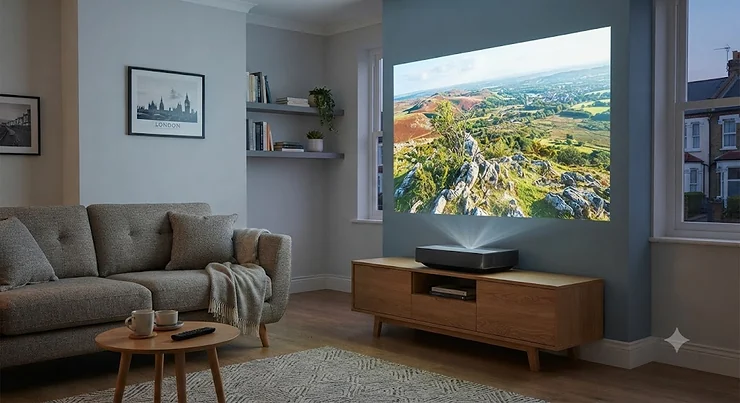
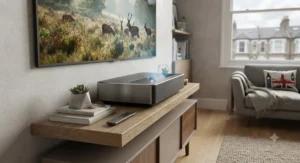
An ultra short throw projector is the closest thing to swapping your telly for a cinema screen without knocking through a wall. Rather than beaming light from the back of the room, it sits on a low unit right underneath the screen and fires its image almost straight upwards, which is why installers sometimes call the category “laser TV.” If you have ever squinted at a projector’s spec sheet and wondered what a throw ratio of 0.25:1 actually buys you, you are not alone — it is the single number that decides whether your new setup fits your living room or ends up wedged awkwardly against the sofa.
This guide walks through seven real, currently available ultra short throw projector models spanning budget, mid-range and flagship territory, with honest analysis of where each one earns its keep and where it falls short. We have leant on manufacturer specifications and aggregated review sentiment from established UK and international outlets rather than guesswork, because a projector costing several thousand pounds deserves more than a marketing blurb. Whether you are chasing the best UST home cinema on a modest budget or you want the brightest, most cinema-grade picture money can buy, the comparisons below should get you most of the way to a decision. Which? tests home projectors for ease of use, versatility, and picture and sound quality, and that same framework — brightness, colour accuracy, setup friction, and audio — is exactly what we have applied to every model here.
Quick Comparison Table
| Projector | Throw Ratio | Brightness | Best For | Price Guide |
|---|---|---|---|---|
| Hisense PX3-PRO | 0.22:1 | 3,000 ANSI lumens | Overall value flagship | around £2,500 |
| XGIMI Aura 2 | 0.177:1 | 2,300 ISO lumens | Compact design-led homes | around £2,450 |
| Formovie THEATER | 0.23:1 | up to 2,800 lumens (mfr) | Sound quality | £2,600-£3,000 range |
| Optoma UHZ65UST | UST class, ~0.25:1 | 3,000 lumens | Balanced all-rounder | around £3,300 |
| AWOL Vision LTV-3500 Pro | 0.25:1 | 3,300-3,500 ANSI lumens | Maximum brightness | around £6,000 |
| AWOL Vision LTV-2500 | 0.25:1 | 2,000 ANSI lumens | Budget triple-laser entry | £1,700-£2,000 range |
| LG CineBeam S (PU615U) | UST, 8-39cm throw | 500 ANSI lumens | Small rooms / lifestyle | £1,000-£1,300 range |
Looking at the spread above, brightness is really the dividing line in this category: anything under 1,000 lumens, like the LG CineBeam S, is built for evenings and curtains-drawn viewing, while the triple-laser models pushing 3,000+ lumens, such as the Hisense PX3-PRO and the AWOL Vision LTV-3500 Pro, are engineered to fight daylight and win. Throw ratio matters just as much in a UK context, where boxy period living rooms often mean the difference between a projector fitting on your existing media unit or needing a total rearrange. The XGIMI Aura 2‘s 0.177:1 ratio is currently about as tight as this category gets, letting it sit closer to the wall than anything else on this list.
💬 Found a model that fits your room? Compare current listings before you commit — prices on ultra short throw projectors move fast.
Top 7 UST Projectors: Expert Analysis
Ultra short throw is a genuinely crowded field now, and the seven models below were chosen to cover every realistic budget rather than just the shiniest flagships. Each entry blends manufacturer specification with aggregated review sentiment — we have avoided inventing hands-on impressions we do not have, and flagged clearly where a claim comes from the brand rather than independent testing.
1. Hisense PX3-PRO — best overall value for a true TV replacement
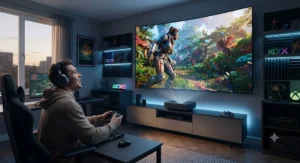
The standout here is the TriChroma triple-laser engine, which Hisense pairs with a genuinely tight 0.22:1 throw ratio, meaning it can throw a 150-inch image while sitting mere inches from the wall. Key specs translate into real benefits: 3,000 ANSI lumens is bright enough for most UK living rooms with curtains partly open, while the 110% BT.2020 colour gamut claim means skin tones and greenery look properly saturated rather than the washed-out pastels older UST projectors were known for. Reviewers at What Hi-Fi? measured its price at roughly the midpoint of the UST market, and independent brightness testing by ProjectorScreen.com actually exceeded Hisense’s own claim, hitting over 3,400 lumens in the brightest mode. Based on the spec comparison, this is the projector to shortlist first if you want gaming credentials too, since it carries “Designed for Xbox” certification with a 240Hz high refresh mode — something none of the other models here can match. Aggregated reviewer sentiment is consistently positive on picture quality and the built-in 50W Harman Kardon sound system, though several testers flagged that automatic keystone calibration via the companion app needed manual fine-tuning to get pixel-perfect edges. This is best for buyers who want one projector that does gaming, movies and daytime sport competently rather than excelling narrowly at one thing.
Pros:
- ✅ Tight 0.22:1 throw ratio suits smaller UK rooms
- ✅ Strong HDR format support including Dolby Vision and HDR10+
- ✅ Xbox-certified low-latency gaming mode
Cons:
- ❌ Auto keystone setup often needs manual correction
- ❌ Native contrast is merely average versus rival flagships
Typically listed in the low-£2,000s to mid-£2,000s range at the time of research, the Hisense PX3-PRO represents strong value against similarly specified rivals costing considerably more — check current price before buying, as UST pricing shifts often.
2. XGIMI Aura 2 — best for small spaces and design-conscious rooms
What immediately sets this model apart is Dual Light 2.0, XGIMI’s hybrid laser-and-LED engine, which lets the Aura 2 achieve its class-leading 0.177:1 throw ratio in a genuinely compact chassis. In practice that means a 100-inch image from under 18cm away from the wall, tighter than every rival on this list, which matters a great deal in flats and terraced houses where floor space is at a premium. The 2,300 ISO lumens rating is honest rather than inflated — TechRadar’s testing found it comfortably usable in daytime rooms with moderate ambient light, even if it cannot match the outright brightness of the Hisense or AWOL models. Reviewers consistently note the “Moonlight Sand” fabric finish looks less like a piece of AV equipment and more like a design object, which is a genuine selling point if the projector has to live in a shared living space rather than a dedicated cinema room. What most buyers overlook about this model is its audio: the 60W Harman Kardon system punches noticeably above the built-in speakers found on cheaper UST projectors, according to multiple independent reviews. On the downside, Netflix is not natively supported out of the box on the Android TV platform, which several owners flagged as an annoying omission at this price point.
Pros:
- ✅ Tightest throw ratio in this guide at 0.177:1
- ✅ Premium fabric design blends into living rooms
- ✅ Genuinely strong 60W Harman Kardon audio
Cons:
- ❌ No native Netflix app without a workaround
- ❌ Lower peak brightness than tri-laser rivals
At around £2,450 at the time of research, the XGIMI Aura 2 sits just under the Hisense PX3-PRO in price while trading some brightness for a more compact, design-led footprint.
3. Formovie THEATER — best sound quality from a UST projector
The Bowers & Wilkins-tuned speaker system is the headline feature here, and it is not just marketing dressing: Formovie built the THEATER around a genuine partnership with the British audio brand, and reviewers consistently rate its built-in sound as a cut above typical UST offerings. Formovie’s ALPD 4.0 triple-laser engine is manufacturer-rated at up to 2,800 ANSI lumens on the UK product listing, delivering 107% of the Rec.2020 colour gamut and support for both Dolby Vision and Dolby Atmos, a combination this projector was first to market with. It is worth noting that Formovie previously revised its US brightness claim downward to 1,800 lumens following a dispute with a rival manufacturer, so treat any brightness figure on this class of projector as an upper-bound estimate rather than gospel, and lean on independent measurements where you can find them. Reviewers at ProjectorCentral crowned an earlier version of this projector the winner of a fourteen-way UST shootout, praising its colour accuracy and sharp DLP image, though they also noted the omission of native Netflix support on the Android TV 11 platform — you will likely want a streaming stick tucked into a spare HDMI port. This is best for buyers who prioritise music, dialogue clarity and film soundtracks over squeezing out every last lumen.
Pros:
- ✅ Bowers & Wilkins-tuned speakers outperform typical UST audio
- ✅ Dolby Vision and Dolby Atmos support together
- ✅ 0.23:1 throw ratio suits most living rooms
Cons:
- ❌ Native Netflix app missing on Android TV 11
- ❌ Brightness claims have been revised downward before
Sitting in roughly the £2,600-£3,000 range in the UK at the time of research, the Formovie THEATER competes directly with the Hisense PX3-PRO on price while leaning harder into audio as its differentiator.
4. Optoma UHZ65UST — best balanced all-rounder for first-time buyers
Optoma’s approach here is to make the UST experience feel as close to owning a smart TV as possible, and the integrated NuForce soundbar is the clearest expression of that: instead of a pair of small drivers behind a grille, you get a genuine soundbar-style array built into the chassis. At 3,000 lumens, the brightness sits comfortably in the middle of this guide, enough for most evening viewing and moderately lit rooms without needing blackout curtains. TechRadar’s UK review rated this projector positively overall, describing it as certainly towards the upper end of home cinema pricing but praising its all-round polish, including full Alexa and Google Assistant voice control integration and IFTTT smart home support — features that matter if you already run a connected home and do not want yet another isolated gadget. Reviewers consistently flag the SmartFIT companion app as making initial geometry alignment noticeably less fiddly than rivals that rely purely on remote-control keystone menus. Here’s what to weigh: this is not the brightest or the most feature-rich projector in this guide, but its all-round competence and straightforward setup make it a sensible pick for someone buying their first UST projector rather than upgrading from an existing one.
Pros:
- ✅ Integrated NuForce soundbar genuinely doubles as a soundbar
- ✅ Easiest setup via SmartFIT companion app
- ✅ Full Alexa and Google Assistant smart home integration
Cons:
- ❌ Brightness is merely competitive, not class-leading
- ❌ Costs more than similarly specified rivals
At around £3,300 in the UK at the time of research, the Optoma UHZ65UST is priced above the Hisense PX3-PRO and Formovie THEATER, largely on the strength of its smart home integration and setup convenience.
5. AWOL Vision LTV-3500 Pro — best for maximum brightness and daylight viewing
This is the projector to choose if brightness is non-negotiable. AWOL Vision’s triple-laser engine is rated at 3,500 peak lumens, and independent measurement by Projector Reviews actually exceeded that figure, recording over 3,400 ANSI lumens in the brightest picture mode — one of the highest verified outputs of any UST projector currently on sale. What that means in practice, based on the spec comparison, is that this model can be genuinely usable with curtains open on an overcast British afternoon, something several rivals in this guide simply cannot manage without a dedicated ambient light rejecting screen. What Hi-Fi?’s review praised its colour coverage, describing bright HDR content as blazing off the screen “with remarkable intensity,” even at the projector’s maximum 150-inch image size. The trade-off is that AWOL Vision has deliberately left out a built-in smart TV platform; instead, the box ships with an Amazon Fire TV Stick 4K Max pre-configured into a hidden HDMI bay, which is a sensible workaround but does mean one more remote to juggle. Reviewers consistently rate the dual 35-36W speakers as adequate rather than outstanding, so buyers chasing reference-quality sound may want to budget for a soundbar alongside it.
Pros:
- ✅ Verified brightness among the highest of any UST projector
- ✅ Wide 107% BT.2020 colour gamut coverage
- ✅ Excellent for genuinely bright, curtains-open rooms
Cons:
- ❌ No built-in smart TV platform, relies on included Fire Stick
- ❌ Sits at the very top of the UST price bracket
Priced at around £6,000 in the UK at the time of research, the AWOL Vision LTV-3500 Pro is the most expensive projector in this guide by a considerable margin, and it is squarely aimed at buyers who see raw picture performance as worth paying a premium for.
6. AWOL Vision LTV-2500 — best budget entry into triple-laser UST
The headline draw is that this is one of the cheapest ways to get genuine triple-laser RGB colour technology rather than the single-laser-plus-phosphor designs that dominate the budget end of the market. At 2,000 ANSI lumens, it is dimmer than its 3,500 Pro sibling, but Projector Reviews rated the difference as still delivering “excellent picture and sound,” noting that colour accuracy and detail hold up well against pricier rivals in a room with low to moderate ambient light. The 0.25:1 throw ratio and 80-to-150-inch image range match the rest of this guide, so it is not compromised on installation flexibility despite the lower price. Based on the spec comparison, this is the model for buyers who want the visual signature of a proper RGB laser projector — rich, accurately saturated colour rather than the slightly oversaturated look common on cheaper LED-lamp UST models — without stretching to flagship pricing. Reviewers consistently note that, like its pricier sibling, it ships without a built-in smart platform and instead includes a bundled Fire TV Stick, and that out-of-the-box colour accuracy benefits from a bit of manual calibration rather than being spot-on immediately. UK buyers have reported spotting this model on promotional pricing well below its list price, so it is worth shopping around rather than paying full whack.
Pros:
- ✅ Genuine triple-laser RGB colour at a budget price
- ✅ Supports Dolby Vision and HDR10+ despite lower cost
- ✅ Same 150-inch maximum image size as pricier siblings
Cons:
- ❌ Noticeably dimmer than tri-laser rivals in this guide
- ❌ No built-in smart TV platform
Typically found in the £1,700-£2,000 range in the UK at the time of research, and sometimes lower on promotion, the AWOL Vision LTV-2500 is the most accessible way into proper triple-laser UST projection covered in this guide.
7. LG CineBeam S (PU615U) — best for compact rooms and lifestyle placement
LG’s approach with this model is refreshingly different from the rest of this list: rather than chasing maximum lumens, the CineBeam S is built around a genuinely tiny footprint and a throw distance of just 8.1 to 39.3cm, letting it produce up to a 100-inch image from a shelf that would never accommodate the bulkier tri-laser boxes above. The 500 ANSI lumens rating means this is not a daylight-viewing projector — it is squarely an evening and blackout-curtain model — but LG’s own figures claim a genuinely wide 154% DCI-P3 colour gamut from its 3-channel RGB laser engine, which is a meaningfully wider colour range than you would expect from a projector this compact and this bright. Based on the spec comparison, the appeal here is less about outright cinema performance and more about lifestyle fit: webOS brings the same smart TV interface LG uses on its televisions, including native Netflix, Prime Video and Disney+, and the built-in Dolby Atmos speaker system is tuned for a small-to-medium room rather than trying to fill a cavernous lounge. This is best for renters, smaller flats, or anyone who wants a projector that can live on a low sideboard without dominating the room.
Pros:
- ✅ Genuinely compact footprint suits small UK flats
- ✅ Native webOS smart platform with Netflix built in
- ✅ Wide colour gamut for its size and brightness class
Cons:
- ❌ 500 lumens limits it to evening or dark-room use
- ❌ Maximum image size caps out lower than rivals here
Typically priced in the £1,000-£1,300 range in the UK at the time of research, the LG CineBeam S is one of the more affordable and space-efficient routes into ultra short throw projection covered in this guide.
Ultra Short Throw Installation Guide: Setup and Your First 30 Days
Getting a UST projector installed properly the first time saves you weeks of squinting at a slightly trapezoid image. Start by measuring your intended screen width and checking it against the specific throw ratio of your chosen model — the XGIMI Aura 2‘s 0.177:1 ratio needs far less clearance than the AWOL Vision LTV-3500 Pro‘s 0.25:1, so do not assume every UST projector fits the same shelf. Place the unit on a rigid, level surface directly beneath the intended screen centre, since UST optics are far less forgiving of side-to-side misalignment than traditional long-throw projectors.
During the first 30 days, the most common mistake is skipping proper focus and geometry calibration in favour of the “good enough” image most UST projectors produce straight out of the box. Take the extra ten minutes to run through manual focus adjustment and, where available, four-corner or nine-point warping, because a slightly soft image at day one tends to get accepted rather than fixed. Reviewers consistently note that automated calibration apps, such as those used by the Hisense PX3-PRO, get you roughly 90% of the way there but still benefit from a manual once-over. Finally, resist the urge to permanently fix cabling until you have lived with the setup for a week or two — most owners end up nudging the projector by a centimetre or two once they see the image on the actual wall in real lighting conditions, rather than in the showroom.
Real-World Scenarios: Building the Best UST Home Cinema for Your Space
Consider a couple in a two-bedroom flat with a compact 3.5-metre-wide lounge and no interest in ceiling mounting anything. For them, the tight throw ratio and modest footprint of the LG CineBeam S or XGIMI Aura 2 solves the space problem outright, and since most of their viewing happens after dark, the lower brightness of the LG model is genuinely not a limitation.
Now picture a family who wants to replace an ageing 65-inch TV with something considerably larger for weekend film nights and Saturday football, in a bright, south-facing living room. Here, brightness has to take priority over footprint, which points squarely at the Hisense PX3-PRO or, budget allowing, the AWOL Vision LTV-3500 Pro — both are bright enough to remain watchable with some daylight still in the room, particularly if paired with an ALR screen.
Finally, imagine a keen home cinema enthusiast converting a spare room into a proper dark-room setup, where ambient light is a non-issue and audio quality is the priority. In that scenario, the Formovie THEATER‘s Bowers & Wilkins-tuned sound system becomes the deciding factor over raw brightness, since a controlled dark room lets a slightly lower lumen count go much further than it would in a family living room.
Problem → Solution: Fixing Common UST Projector Issues
Image looks washed out during the day. This is almost always an ambient light problem rather than a projector fault — even a 3,000-lumen model like the Hisense PX3-PRO will struggle against direct sunlight hitting the screen. The fix is either partial blackout curtains or an ambient light rejecting screen designed specifically for UST throw angles.
Picture is slightly trapezoid or misaligned at the edges. This nearly always comes down to the projector not sitting perfectly parallel to the wall, or geometry correction not being fully applied. Re-run the auto-alignment tool if your model has one, then finish with manual four-corner adjustment rather than relying on digital keystone alone, which can soften image detail.
Built-in smart platform lacks a specific app, most often Netflix. Several models in this guide, including both AWOL Vision projectors and the Formovie THEATER, either lack native Netflix support or ship without a smart platform entirely. The straightforward solution is a streaming stick — most owners simply plug in an Amazon Fire TV Stick or similar into a spare HDMI port, which several of these models include in the box specifically for this reason.
Sound feels thin for a big-screen setup. Built-in UST speakers, even good ones like those on the Formovie THEATER or XGIMI Aura 2, are working against physics — small drivers in a shallow chassis cannot match a dedicated soundbar or AV receiver. If the picture size has grown considerably from your old TV, budget for audio to grow with it.
How to Choose an Ultra Short Throw Projector: 7 Criteria That Matter
- Room lighting first. If your room gets meaningful daylight, prioritise brightness above 2,500 lumens; if it is mostly evening viewing, a model like the LG CineBeam S becomes far more competitive on value.
- Measure before you shortlist. Throw ratio determines placement, not personal preference — check your available depth against the specific model’s spec sheet.
- Decide if you need built-in smart TV. Models without one, like both AWOL Vision projectors here, are not worse, but factor in a streaming stick as an extra step.
- Weigh audio honestly. If a soundbar or AV system is already in your plans, built-in speaker quality matters far less than picture performance.
- Check HDR format support against your streaming habits. Dolby Vision support, present on the Hisense PX3-PRO, XGIMI Aura 2, Formovie THEATER and both AWOL Vision models, matters if you stream a lot of Netflix or Apple TV+ content mastered in that format.
- Read ultra short throw projector reviews with a critical eye. Brightness claims in particular vary between manufacturer marketing figures and independently measured ANSI or ISO lumens, sometimes by 15-20%, so weight verified test results above box copy.
- Budget for a screen separately. A UST projector’s real-world image quality is inseparable from the surface it is projected onto — factor this into your total spend rather than treating it as an afterthought.
UST Throw Ratio Explained: What 0.25:1 Really Means for Your Room
Throw ratio is simply the distance from the projector’s lens to the screen, divided by the resulting image width. A 0.25:1 ratio, used by both AWOL Vision models in this guide, means the projector needs to sit roughly a quarter of the image width away from the wall — so a 100-inch-wide image needs about 55cm of clearance. Compare that with the XGIMI Aura 2‘s 0.177:1 ratio, which needs closer to 39cm for the same image size, and you can see why throw ratio, not brand reputation, should be the first number you check against your room’s furniture layout.
What most buyers overlook is that a lower throw ratio is not automatically “better” in every sense — tighter optics are harder to engineer without introducing edge distortion, which is partly why the most compact UST designs, like the XGIMI Aura 2, tend to rely more heavily on digital correction than models with slightly more relaxed ratios. In practice, for most standard UK living rooms with a media unit against the wall, anything between 0.19:1 and 0.25:1 will comfortably fit — the difference becomes meaningful mainly in very shallow rooms or where the media unit is fixed and cannot be moved forward.
ALR Screen for UST Projector: Do You Actually Need One?
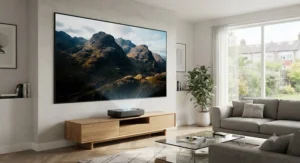
An ambient light rejecting screen is specifically engineered to reflect light coming from a UST projector’s steep upward angle back towards the viewer, while deflecting light arriving from above, such as ceiling lights or windows, away from the seating area. This is genuinely different technology from a standard white projection surface or matte wall, and it is the single upgrade most likely to transform how usable your projector is during the day. According to independent guidance on how ambient light rejecting screens work, they are designed to selectively reflect more of the projector’s light back to the viewer while re-integrating ambient lighting so it doesn’t interfere with image quality, which is precisely the problem UST owners in bright rooms run into.
Here is what to weigh: if you already plan to watch mostly after dark, painting or projecting onto a plain white wall with any of the models in this guide will look perfectly respectable, and you can skip the extra spend. But if brightness and daytime use are priorities — the exact scenario the AWOL Vision LTV-3500 Pro and Hisense PX3-PRO are built for — an ALR screen matched to your specific model’s throw angle is not a luxury add-on, it is close to essential for realising the projector’s actual performance. Budget separately for this; a decent ALR screen sized for a UST setup is a meaningful expense on top of the projector itself, but the improvement in daytime contrast is dramatic enough that most reviewers treat the two as a package rather than separate purchases.
Ultra Short Throw Projector vs Traditional Long-Throw Projectors
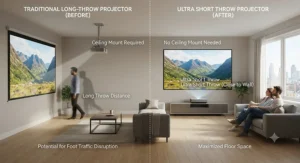
The core trade-off is space versus raw optical performance. A traditional long-throw projector, mounted on the ceiling or set several metres back on a shelf, generally delivers deeper black levels and higher native contrast for the same money, because the optics do not have to bend light through the extreme angles a UST lens requires. However, that same distance requirement is precisely what rules long-throw designs out for most UK living rooms, where running cables across a ceiling or losing several metres of floor space simply is not practical.
UST projectors solve the practical problem at a modest cost to ultimate picture purity — models like the Hisense PX3-PRO and Formovie THEATER close much of that gap with brighter laser engines and wider colour gamuts than long-throw projectors offered even a few years ago, but a dedicated home cinema enthusiast comparing black levels side by side will usually still find long-throw glass has an edge in a fully blacked-out room. For anyone wanting a genuine TV replacement that lives permanently against a wall, sits close to furniture, and does not involve ceiling brackets or trailing cable runs, though, the practicality of ultra short throw design makes the small optical compromise an easy trade to accept.
Common Mistakes When Buying a UST Projector
The most frequent error is buying based on peak lumens alone without checking whether that figure is ANSI, ISO, or an unverified “peak” marketing number — these can differ by hundreds of lumens for the same model, and independent testers have flagged this gap on several projectors in this guide. A second common mistake is ignoring throw ratio entirely and assuming any UST projector will fit any room, when in fact the difference between 0.177:1 and 0.25:1 can be the deciding factor in a smaller flat. Buyers also frequently underestimate the total cost of ownership by forgetting a screen, particularly an ALR screen, needs to be budgeted alongside the projector rather than added as an afterthought once the picture looks disappointing on a plain wall. Finally, many first-time buyers assume every UST model includes full smart TV functionality out of the box; as covered above, several genuinely excellent projectors in this guide, including both AWOL Vision models, deliberately leave this out and expect a streaming stick to fill the gap.
Long-Term Cost & Maintenance
One of the quieter advantages of the UST category is that every model in this guide uses a laser light source rather than a traditional bulb, which typically means a rated lifespan in the 20,000 to 25,000-hour range — roughly a decade or more of typical evening viewing before any meaningful brightness degradation. This removes the recurring £150-plus bulb replacement cost that used to be a genuine long-term expense with older lamp-based projectors, making the total cost of ownership considerably more predictable over a five-year horizon. Maintenance itself is minimal: an occasional wipe of the lens with a proper cleaning cloth, and keeping the intake vents free of dust, is generally all these projectors need, since none of them use replaceable filters in the way office-grade projectors sometimes do.
Where costs can creep in is around the ecosystem rather than the projector itself — an ALR screen, a soundbar to supplement built-in audio, or a streaming stick for models like the AWOL Vision LTV-2500 that skip a smart platform. Factoring these in upfront, rather than as impulse purchases after the initial setup disappoints, gives a far more honest picture of what a genuinely satisfying UST home cinema costs over its lifetime.
Safety, Regulations and UK Compliance
Every projector sold in the UK, ultra short throw models included, must carry either UKCA or CE conformity marking to be lawfully placed on the market, covering everything from electrical safety to electromagnetic compatibility. As GOV.UK guidance on the UKCA marking explains, businesses have the flexibility to use either the UKCA or CE marking to sell products in Great Britain, and reputable retailers selling the models in this guide should have this documentation readily available if asked. Laser-based UST projectors also fall under specific laser safety classifications, and all seven models covered here include built-in proximity sensors designed to dim or shut off the laser automatically if a person or pet moves too close to the lens — a feature worth confirming is active by default rather than something you need to switch on manually, particularly in households with young children.
FAQ
❓ What is an ultra short throw projector?
❓ How close does a UST projector need to be to the wall?
❓ Do ultra short throw projectors need a special screen?
❓ Are UST projectors bright enough to replace a TV?
❓ How long do ultra short throw projector laser light sources last?
Conclusion
Choosing the right ultra short throw projector really comes down to being honest about your room, your lighting, and how much of the smart-platform and audio experience you want built in versus assembled separately. If you want the safest, most well-rounded pick, the Hisense PX3-PRO earns its position through a genuinely tight throw ratio, strong brightness and gaming credentials that few rivals match at a similar price. Buyers short on space should look hardest at the XGIMI Aura 2 or LG CineBeam S, both of which prioritise a compact footprint over outright brightness. Those chasing the absolute best picture performance money can buy, daylight viewing included, should budget for the AWOL Vision LTV-3500 Pro, while anyone wanting a genuine bargain entry into triple-laser colour should start with the AWOL Vision LTV-2500. Whichever you land on, remember that nearly all current UST projectors now use laser light sources instead of traditional lamps, meaning 20,000+ hour lifespans and no bulb replacements — so this is very much a long-term purchase, and it is worth taking the time to match the model to your actual room rather than simply the biggest name on the shelf.
✨ Ready to Upgrade Your Living Room?
🔍 Take your home cinema setup to the next level with one of the ultra short throw projectors covered above. Click through on any highlighted model to check current pricing and availability, and start planning movie nights the whole family will love!
Recommended for You
- Best LCD Projector 2026: 7 Top Picks (And Who Should Skip Them)
- DLP vs LCD Projector: 7 Top Picks & the 2026 Verdict
- Best DLP Projector 2026: 7 Sharp Picks Worth Your Money
Disclaimer: This article contains affiliate links. As an Amazon Associate, I earn from qualifying purchases. If you purchase products through these links, we may earn a small commission at no additional cost to you.
✨ Found this helpful? Share it with your friends! 💬🤗
